Certis Oncology Solutions' 17-slide deck, exported on 6 July 2018 under the internal title 'Certis Oncologist Slideshare 7-2-18', pitches patient-derived orthotopic xenografts - growing a patient's tumour in mice and testing several drugs on it in parallel - to practising oncologists. The science is real, one published case shows a PDOX result supporting a compassionate-use IND from the FDA, and the board includes a venture chairman, the former CEO of Cancer Treatment Centers of America and two UCLA oncologists. But there is no ask, no financials, no market size and no price: the only pricing…
Key takeaways
- Certis Oncology's 17-slide July 2018 deck is a physician-facing credentials deck, not a fundraising deck - the internal file title is 'Certis Oncologist Slideshare 7-2-18', yet the cover reads 'Privileged & Confidential, do not distribute'.
- The footers prove it is a cut of a longer deck: pages run 2-6, then 9, 10, 9, 10, 11, 12, 13, then jump to 22 before returning to 15 and 16, with two slides numbered 9 and two numbered 10.
- There is no funding ask, no valuation, no financials, no market size and no price anywhere in the file - the only pricing language is 'pricing is more reasonable than competitors', with no competitor named and no figure given.
- The slide tabbed 'Revenue Model' contains no revenue: it lists eleven available PDOX cancer types and twelve drugs evaluated, and is the page numbered 22.
- The strongest evidence - a published case where PDOX results supported a compassionate-use IND from the FDA and the patient responded (Murakami et al, Oncotarget 2016) - is a single patient and appears as slide 8 of 17.
- 'Hundreds of patient tumor samples into thousands of mice' is the deck's largest quantity; the establishment success rate and the completed concordance correlation are both described in adjectives and never printed as numbers.
- The callout 'what happens in mice happens in patients' is a categorical predictive-validity claim aimed at the one audience - practising oncologists - trained to reject it.
- The testimonial on slide 4 comes from Dr Fritz Eilber, who appears eleven slides later as a Certis director, and the relationship is not disclosed where the quote runs; the 'Our Team' slide is a board slide with no CSO, surgical lead or lab director on it.
What this deck actually is
Seventeen slides, built in PowerPoint on a Mac and exported to PDF on 6 July 2018. The internal document title is the most useful fact in the file: Certis Oncologist Slideshare 7-2-18 . This is not a fundraising deck. It is a physician-facing credentials deck — a document built to persuade practising oncologists to send Certis Oncology Solutions their patients' tumour tissue — and it was posted to a public slide-sharing site.
That matters, because the cover of the same file reads "Privileged & Confidential — Do not distribute without permission." A deck whose own filename contains the word "Slideshare" cannot also be confidential. That contradiction is the first tell that this document was assembled quickly out of an existing set of slides rather than written for the audience it names.
The second tell is the footers. Slides 1 through 6 are numbered 2, 3, 4, 5, 6 in sequence. Then the numbering goes 9, 10, 9, 10, 11, 12, 13 — two pages numbered 9 and two numbered 10 — and then jumps to 22 before returning to 15 and 16. This deck is a cut of a longer deck, and nobody re-paginated it. If a version of the parent document with a slide 22 exists, it almost certainly contains the pricing, financials and ask that are missing here.
What Certis does is genuinely interesting. The company implants a slice of a patient's own tumour into the corresponding organ of an immunodeficient mouse — a patient-derived orthotopic xenograft, or PDOX — grows it, and tests several drugs against it in parallel so the treating oncologist can choose therapy on evidence from the patient's own tissue rather than on population statistics. The science is real, the clinical need is real, and the board is unusually strong. The deck built around it never once tells you what any of it costs, how often it works, or what happens next.
Slide-by-slide walkthrough
Slide 1 — Cover
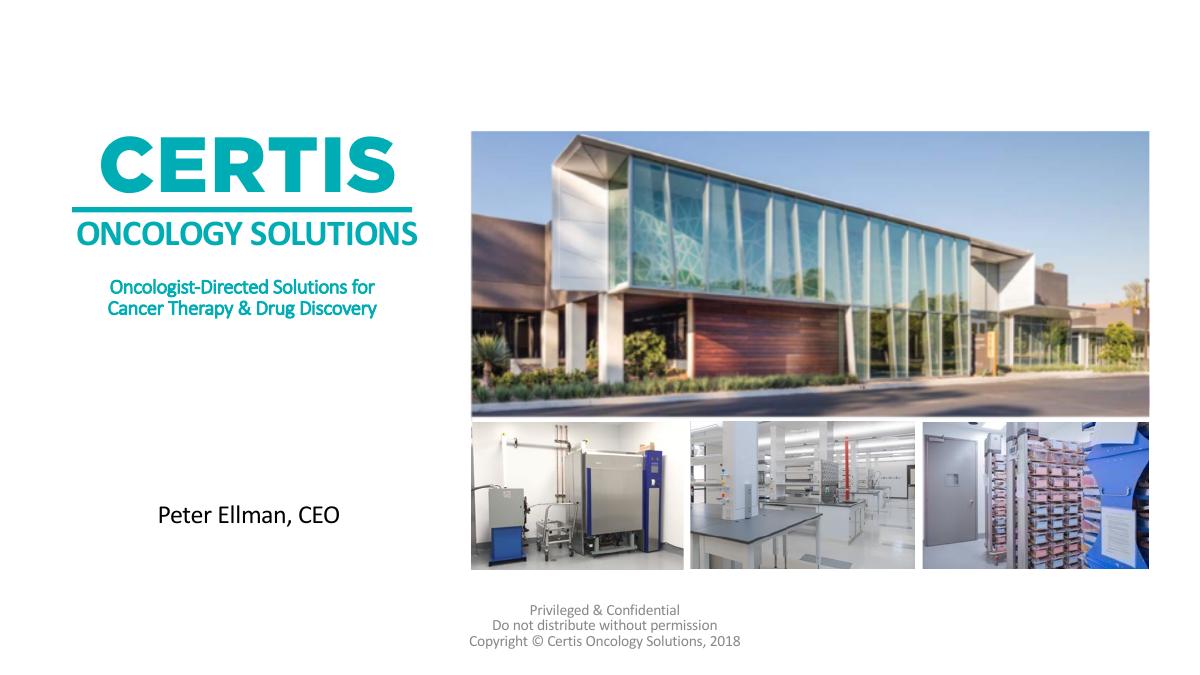
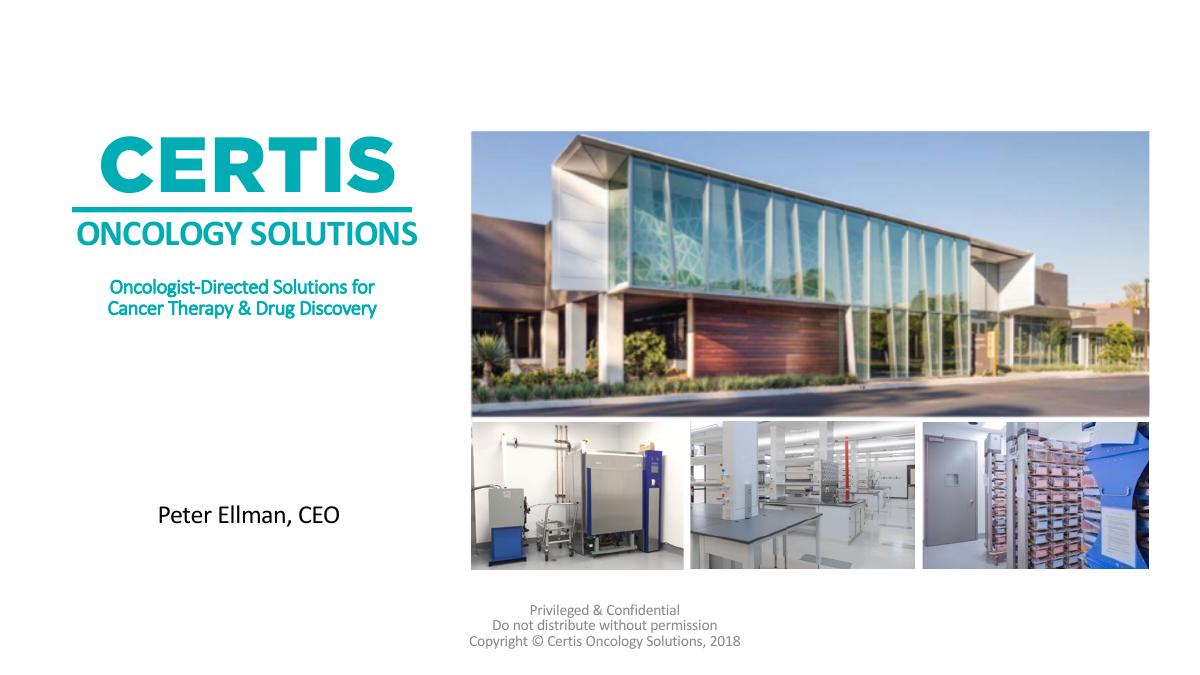
The Certis Oncology Solutions wordmark over a full-bleed photograph, the line "Oncologist-Directed Solutions for Cancer Therapy & Drug Discovery", and "Peter Ellman, CEO". Bottom right: the confidentiality notice and a 2018 copyright line.
"Oncologist-Directed Solutions for Cancer Therapy & Drug Discovery" is two businesses joined by an ampersand. Serving treating physicians who need a therapy answer for one patient in weeks, and serving pharmaceutical companies who need preclinical models for a drug programme over years, are different customers, different sales cycles, different pricing and different regulatory postures. The cover promises both, and the deck never chooses.
The word the cover most needs is the one it omits: mouse . An oncologist reading a subject line about "precision solutions" has seen a hundred of them. "We grow your patient's tumour in mice and test six drugs on it before you have to choose one" is a sentence nobody forgets.
Slide 2 — The Challenge: the paradigm needs to be changed
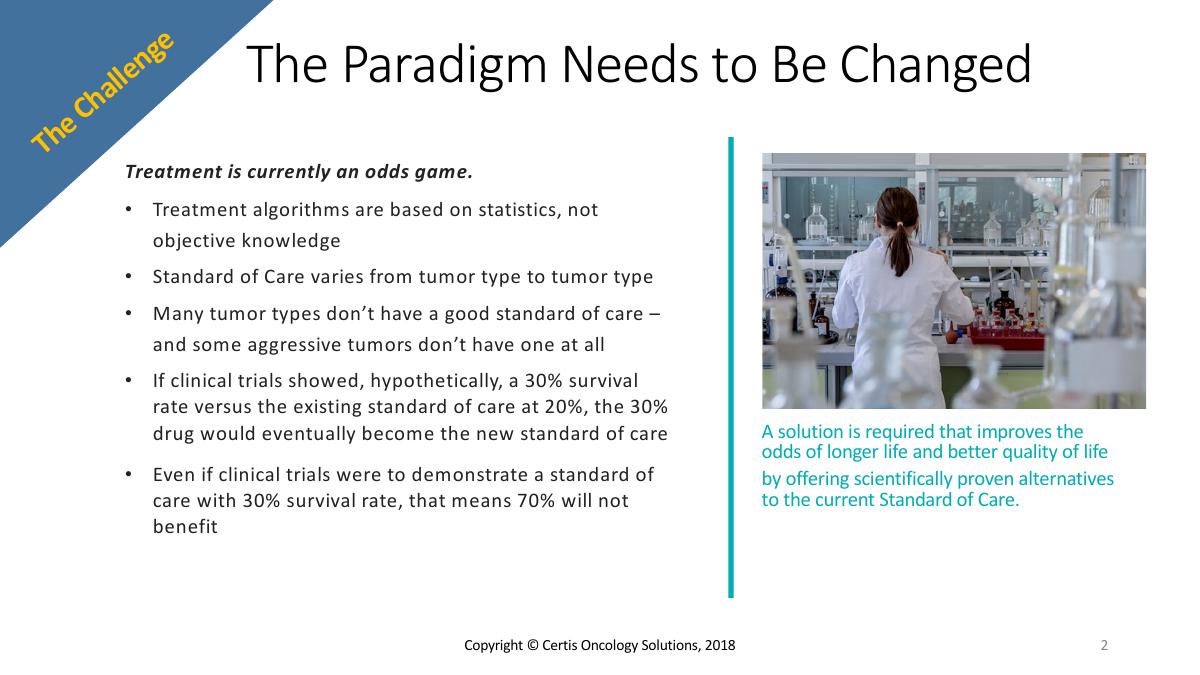
Five bullets arguing that treatment is "an odds game": algorithms based on statistics rather than objective knowledge, standard of care varying by tumour type, some aggressive tumours having no good standard of care at all, and the observation that a hypothetical drug improving survival from 20% to 30% becomes the new standard of care — which still means 70% of patients do not benefit.
That last bullet is the best argument in the deck. It reframes the entire category in one move: the standard of care is a population average, and the individual patient in front of you is not an average. Every oncologist reading it recognises the problem immediately.
The weakness is that both numbers are explicitly hypothetical. The slide says "if clinical trials showed, hypothetically, a 30% survival rate versus the existing standard of care at 20%". Real five-year survival figures for the tumour types Certis actually models — pancreatic, ovarian, sarcoma, melanoma — are published, sourced and in several cases far more alarming than the invented ones. Using a made-up example when the true numbers are stronger is a self-inflicted wound.
Slide 3 — The Challenge: a new approach to discovery is required
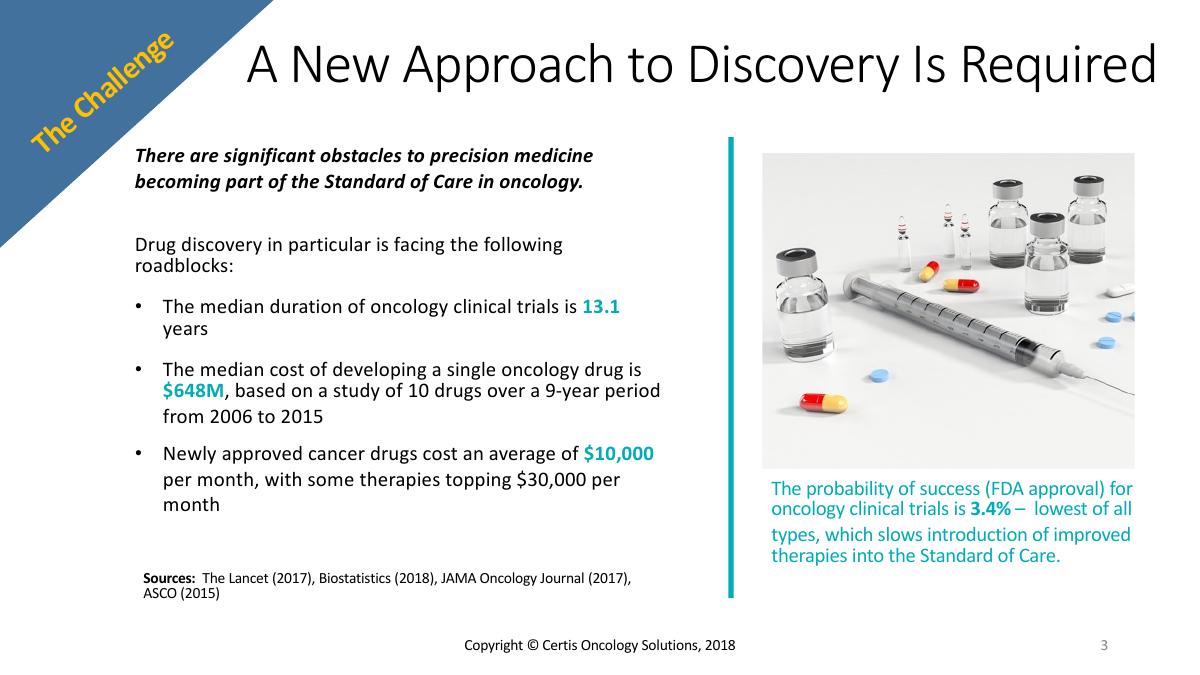
The strongest evidence slide in the file. Four sourced claims: median oncology clinical-trial duration of 13.1 years; median cost to develop a single oncology drug of $648M across ten drugs from 2006 to 2015; newly approved cancer drugs averaging $10,000 a month and topping $30,000; and, in the callout, a 3.4% probability of FDA approval for oncology trials — the lowest of any therapeutic area. Sources are listed in small type: The Lancet (2017), Biostatistics (2018), JAMA Oncology Journal (2017), ASCO (2015).
Citing sources at all puts this deck ahead of most. But the citations are journal names and years, not papers — a reader who wants to check the 3.4% figure has to go and find it. The $648M number is from a widely discussed 2017 analysis of ten companies with a single approved cancer drug; the deck attributes it to the wrong journal in that family. On a slide whose entire job is credibility with physicians who read these journals, that is the one error you cannot afford.
The bigger problem is that the slide never lands. Four devastating facts about the cost and failure rate of oncology drug development are presented, and the deck does not then say what Certis's model does to any of them. Does a PDOX programme shorten a preclinical cycle? By how much? Does it raise the 3.4%? By what mechanism? The whole point of a problem slide is that the solution slide answers it in the same units.
Slide 4 — The Solution: precision drug discovery
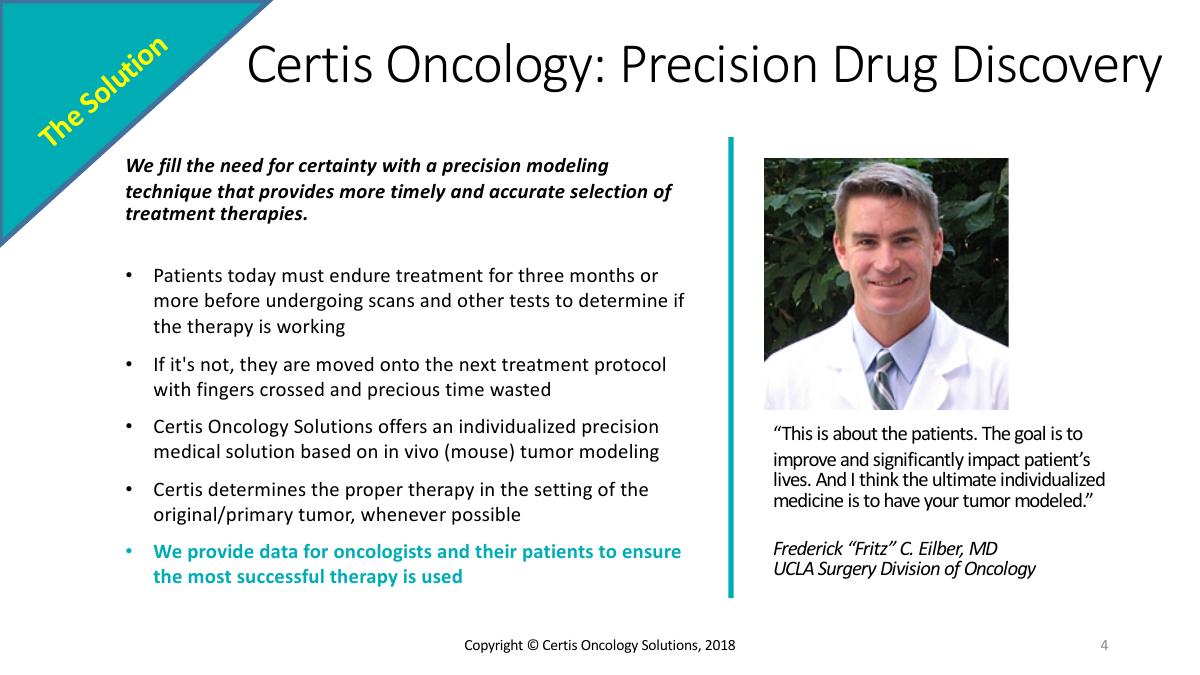
The core narrative. Patients endure three months or more of a therapy before scans reveal whether it is working; if it is not, they move to the next protocol "with fingers crossed and precious time wasted". Certis offers an individualised solution based on in vivo mouse tumour modelling, determines therapy in the setting of the original tumour where possible, and provides data to oncologists and patients. Alongside sits a quotation from Frederick "Fritz" C. Eilber, MD, UCLA Surgery Division of Oncology: "This is about the patients… the ultimate individualized medicine is to have your tumor modeled."
"Three months of scans and fingers crossed" is the sharpest customer-pain sentence in the deck, and it is the one an oncologist will physically nod at.
The quotation is a problem, though — not because of what it says, but because of what the deck does not say. Eleven slides later, Dr Eilber appears again on the board of directors. Quoting your own director as though he were independent third-party validation, without disclosing the relationship on the slide where the quote appears, is exactly the sort of thing a diligent reader catches and cannot un-see. Disclose it in six words — "Dr Eilber is a Certis director" — and it becomes a strength: a leading sarcoma surgeon believed in this enough to join the board.
Slide 5 — Certis PDOX: the most clinically relevant
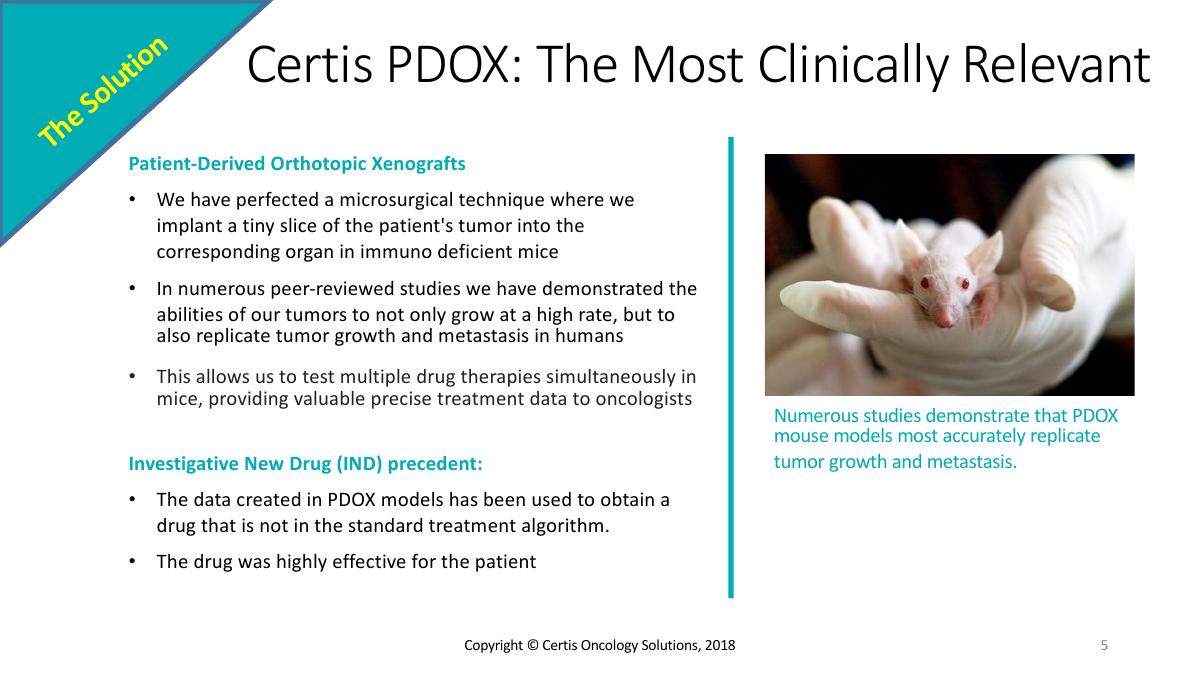
The technique. A microsurgical implantation of a tiny slice of the patient's tumour into the corresponding organ in immunodeficient mice; peer-reviewed studies said to demonstrate high growth rates and replication of human tumour growth and metastasis; the ability to test multiple therapies simultaneously. Below that, an IND precedent: data created in PDOX models was used to obtain a drug outside the standard treatment algorithm, and the drug "was highly effective for the patient".
Note the singular. "The patient." This is the deck's marquee clinical proof, and it is a single case — the same case detailed two slides later. The slide says "numerous peer-reviewed studies" and names none of them, on a page selling to physicians whose entire professional training is to ask which studies.
"We have perfected a microsurgical technique" is also a claim that would land better with a number attached. Perfected as measured how — establishment rate, passage success, time to first readout?
Slide 6 — The 3-step Certis PDOX process
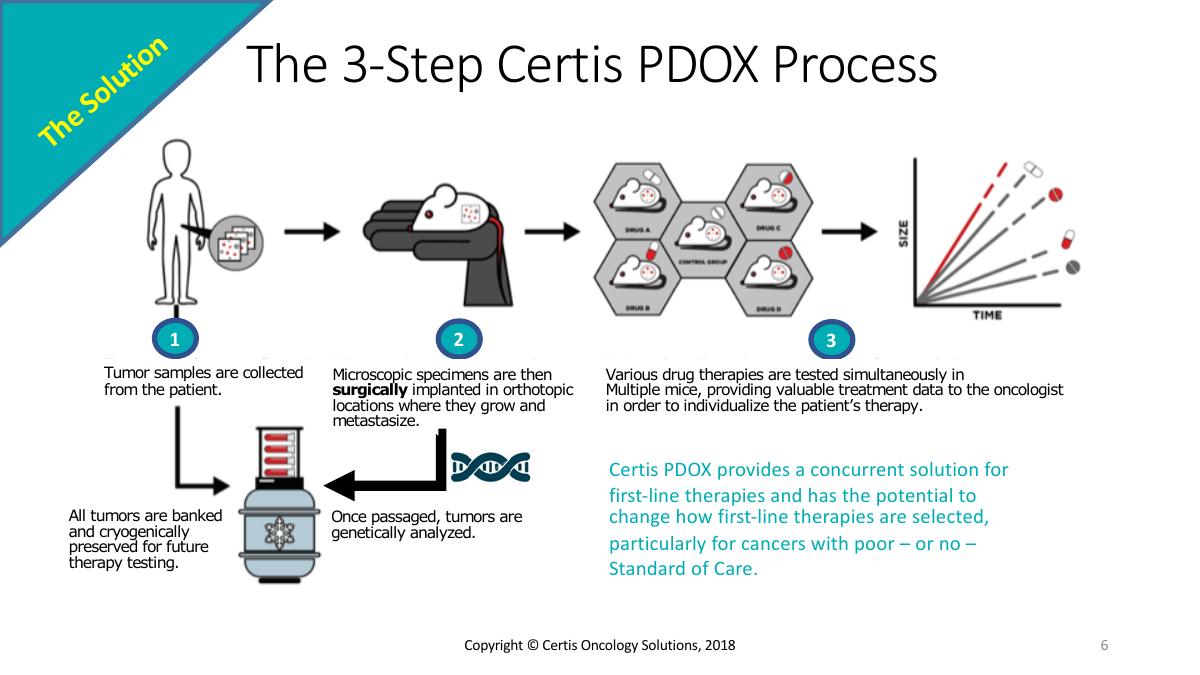
Three numbered steps with illustrations: tumour samples collected from the patient; specimens surgically implanted in orthotopic locations where they grow and metastasise; multiple drug therapies tested simultaneously in multiple mice. Two footnotes add that all tumours are banked and cryogenically preserved, and that once passaged they are genetically analysed.
This is the best-constructed slide in the deck. It is visual, it is linear, and it converts an unfamiliar technique into something a busy clinician understands in ten seconds. It is what the whole deck should look like.
What is missing is the axis every clinical customer cares about: time. Three steps with no elapsed days between them. Slide 7 will eventually reveal a 3–4 month median interval to treatment recommendation, but it is buried in a comparison table rather than drawn on the process the physician is being asked to adopt.
Slide 7 — PDOX vs PDX
A two-column comparison. PDOX: surgical orthotopic implantation, technology proven with innovation continuing, reliably metastasises, high tumour establishment success rate, 3–4 months median to establishment and treatment recommendation. PDX: subcutaneous, "commercializing patient treatment using technology unchanged in decades", rarely metastasises, lower success rate, 6–9 months to recommendation.
The differentiation is real and well chosen — orthotopic placement genuinely produces metastasis in a way flank implantation usually does not, and that is the scientific heart of the company.
But the table is a competitive slide with no competitor on it. "PDX" is not a company; Champions Oncology, Crown Bioscience and The Jackson Laboratory were the actual named alternatives an oncologist or a pharma buyer would have been considering in 2018, and none of them appears. And of the five rows, only one carries a number. "High success rate" versus "lower success rate" is an assertion; "72% versus 41%" is a competitive advantage. The company says elsewhere in the deck that it has implanted hundreds of tumours into thousands of mice, which means it knows the real rate and chose not to print it.
Slide 8 — PDOX concordance: translational application
The case study. Histology images of the primary tumour and the PDOX tumour at 50 µm, showing retained histological features. The narrative: standard of care failed, the PDOX identified an IGF-R inhibitor as active, the patient received that drug under a compassionate-use IND obtained from the FDA on the basis of the PDOX result, and responded well — with life extended and quality of life improved. Cited: Murakami et al, Oncotarget 2016.
This is the most valuable slide in the deck and it is the ninth thing the reader sees. A published, FDA-touching, single-patient story in which the model changed the therapy and the therapy worked is the entire proposition made concrete. It should be slide 2 or 3, told at full length, with the patient's timeline drawn out.
What it must also do — and does not — is state its own limits. One case is a proof of mechanism, not a proof of efficacy. A physician audience respects a slide that says "n=1, published, here is what it does and does not tell you" far more than one that lets the reader do the deflating themselves.
Slide 9 — Concordance validation
Five bullets: hundreds of patient tumour samples implanted into thousands of mice; disease progression and metastasis mimicking clinical progression in humans; increased accuracy and reduced time to treat aggressive tumours; a "significant, sustainable competitive advantage" over existing mouse models; and close simulation of tumour response to each treatment option. The callout reads: "With Certis PDOX tumor sensitivity, what happens in mice happens in patients."
"Hundreds… into thousands" is the largest quantity in the entire deck and it is the vaguest possible form of it. Three hundred or nine hundred; two thousand mice or eight thousand. The company counts these — it must, for animal-facility compliance alone — so the imprecision is a choice.
The callout is the single most dangerous sentence in the file. "What happens in mice happens in patients" is a categorical claim of predictive validity that no xenograft platform in 2018 could support, and it is aimed at the one audience trained to reject it. The defensible version — "in our concordance series, model response matched patient response in X of Y evaluable cases" — is more persuasive precisely because it is bounded.
Slide 10 — Outcome studies
Two studies. Concordance: "correlation data exceeded our expectations", CLIA certified for high-complexity testing, "will be a key marketing tool to develop revenue stream", data collection complete and being readied for publication. Core needle biopsy study: described as a game changer, in progress, non-disruptive to standard procedure, allowing tumour collection well before surgical biopsy and establishment from the time of diagnosis.
The core-needle-biopsy work is strategically the most important thing on the page: if establishment can start at diagnosis rather than at surgery, the 3–4 month clock starts months earlier, which is the difference between a useful answer and a late one. It gets four bullets and no data.
"Correlation data exceeded our expectations" is a feeling, not a finding. The study is complete — the deck says so — so the number exists and is simply withheld. And "will be a key marketing tool to develop revenue stream" is internal commercial language that has no business on a slide shown to physicians; it invites the reader to see the study as marketing rather than evidence.
The CLIA certification is buried as a sub-bullet under a study heading. It is a regulatory qualification for high-complexity clinical testing and it deserves its own line on its own slide.
Slide 11 — The value of the Certis PDOX model
Five bullets on why the model matters: the ability to test drugs against metastasis, which often responds differently to the primary tumour; avoidance of false positives and negatives from ectopic growth; help identifying the ideal patient population for a drug; "despite the complexity of SOI, pricing is more reasonable than competitors"; and the parenthetical "(We will charge if we have success establishing xenografts, enabling us to proceed to testing)". A sidebar lists the five recognised pillars of therapy selection: surgery, radiation, targeted molecular therapy, chemotherapy, immunotherapy.
The pricing bullet is the closest this deck comes to commercial terms, and it contains no price. "More reasonable than competitors" with no competitor named and no figure quoted is not a pricing claim; it is a hope. The parenthetical hiding beside it is the actual business model — Certis only charges when establishment succeeds — and it is genuinely good. Success-contingent pricing removes the buyer's largest risk and quietly signals confidence in the establishment rate. It should be a headline, not a parenthesis.
The bullet about identifying the ideal patient population is also aimed at a different customer entirely. That is a pharmaceutical-development benefit, sitting on a slide read by a treating clinician.
Slide 12 — The Certis offer for oncologists
The actual ask of the reader, in five numbered steps: obtain the tumour and surgically implant it; passage it multiple times to ensure future growth; cryopreserve it for later use if standard of care fails; free establishment and cryopreservation included; drug testing separate and paid. A benefits column repeats the clinical-relevance and speed claims. A requirements box lists patient consent and applicable forms, and "compliance with HIPPA privacy and confidentiality regulations".
Structurally this is the right slide: a concrete, low-friction offer with the free part clearly separated from the paid part. Free establishment and banking is a smart wedge — it costs the oncologist nothing, creates a preserved asset for the patient, and puts Certis in the workflow before any purchasing decision.
Then it misspells HIPAA. On the compliance line. In a deck asking physicians to hand over patient tissue. It is a typographical slip and it is also the exact word a risk-averse clinician is scanning for, and the misspelling appears in the requirement box that a hospital's own privacy officer will read.
The offer is also incomplete in the way that matters most to the buyer: what does the paid part cost? No price, no range, no "typical programme". An oncologist who wants to act on this slide cannot, because they do not know what to tell the patient or the department.
Slide 13 — Cryopreservation of immortalised tumours
Five steps of tumour banking, ending with indefinite storage at −180°C in liquid nitrogen and the note that immortalised tumours can be used indefinitely for future drug-discovery studies and patient testing.
This is the most commercially interesting asset in the company and the deck treats it as a process diagram. A growing, validated, cryopreserved bank of orthotopically established human tumours across a dozen cancer types is a durable proprietary asset with real value to pharma. The slide never says how many models are in the bank, never says who owns them, and never says whether the patient's consent covers subsequent commercial drug-discovery use — a question that follows directly from the previous slide's consent requirement and is left hanging.
Slide 14 — Revenue model: tumour models
The section tab reads "Revenue Model". The slide lists eleven PDOX cancer types currently available — cervical, colon, oesophageal, extraskeletal myxoid chondrosarcoma, liver metastasis, melanoma, ovarian, pancreatic, sarcoma — and twelve novel drugs evaluated in PDOX, from cobimetinib and dactolisib through trastuzumab and Yondelis. A small graphic is labelled "Oncology Drug Development".
A slide tabbed "Revenue Model" that contains no revenue, no price, no unit, no customer count and no forecast is the clearest evidence that this file was cut from a longer deck. This is the page numbered 22 in a document whose other pages run 2 to 16.
The content itself is good raw material: eleven tumour types and twelve named compounds is a credible catalogue, and the first drug is misspelled ("Cobmetinib" for cobimetinib), which is once again the kind of error that a pharmacologist reading the list will notice first. Turn the two columns into a price sheet — model establishment, per-arm drug study, banking — and this becomes the slide that closes business.
Slide 15 — Certis Oncology board
Seven people with photographs: James H. Berglund, chairman, Enterprise Partners Venture Capital; Stephen Bonner, former CEO and director of Cancer Treatment Centers of America; Gail Bryan, Latitude Link; Frederick "Fritz" C. Eilber, MD, UCLA surgical oncology; Peter Ellman, CEO, with a career line reading Nextec, Stratagene, ParagonDx, Thermoscan; Mark Grosvenor, Grosvenor Industries; and Arun S. Singh, MD, UCLA hematology-oncology.
This is a serious board — a venture chairman, the former chief executive of a national cancer-care network, and two UCLA oncologists. Most seed-stage decks would put it far earlier.
But it is a board slide labelled "Our Team", and there is no team on it. The company's proposition rests on a demanding microsurgical technique performed at scale in a licensed animal facility, and the deck names no chief scientific officer, no surgical lead, no laboratory director and no head of the CLIA-certified testing operation. The one operator named is the CEO, and his four listed companies come with no roles and no outcomes. For a physician deciding whether to entrust patient tissue, "who actually does the surgery, and what are their credentials" is the question, and this slide answers it with a list of directors.
Slide 16 — Scientific advisory board
Three names in plain text: Dr Nicholas M. Bernthal of UCLA, pediatric orthopedic surgery and complex general surgical oncology; Dr William Tap of Memorial Sloan Kettering, chief of the sarcoma medical oncology service; Dr James Tomlinson of UCLA, complex general surgical oncology.
The chief of sarcoma medical oncology at Memorial Sloan Kettering advising your company is a genuinely strong signal, and it is delivered as the third bullet of a text list with no photographs, while the board slide two pages earlier gets a full portrait layout. The formatting inversion tells the reader which slide the company thought mattered, and it chose wrong.
All three advisers are surgeons and oncologists; there is no pharma-development, regulatory or commercial voice among them, which is a visible gap for a company that says it wants to sell into drug discovery.
Slide 17 — Thank you
"Thank you!", an email address and a phone number. Nothing else.
A physician-directed deck should close with the referral pathway: how tissue is requested, what consent form to use, what the turnaround is, who to call in theatre. An investor deck should close with the ask. This slide does neither, and after sixteen slides the reader's only available next action is to compose an email from scratch.
What this deck does better than most startup pitch decks
It cites sources. Slide 3 lists four journals behind its four claims. Attribution is imperfect, but most decks in any sector cite nothing at all. · The problem is framed in one unanswerable sentence. A standard of care that helps 30% of patients still fails 70% of them — that reframes the category without attacking anyone. · The process slide is genuinely clear. Three steps, three illustrations, and an unfamiliar surgical technique becomes legible in ten seconds. · It has a published clinical case with an FDA fingerprint. A compassionate-use IND obtained on the strength of a PDOX result, published in Oncotarget, is real evidence — rare at this stage. · The pricing model is buyer-friendly and quietly confident. Charging only when establishment succeeds removes the customer's biggest risk. · The free wedge is well designed. Free establishment and cryopreservation, paid drug testing, gets Certis into the clinical workflow before any budget conversation. · The differentiation is scientific, not rhetorical. Orthotopic versus subcutaneous implantation is a defensible technical distinction, not a marketing adjective. · The board and advisers are real and checkable. Named people at named institutions, all verifiable in a minute.
Where this deck would fail in an investor meeting
There is no ask. No amount, no instrument, no valuation, no round name, anywhere in seventeen slides. · There are no financials. No revenue, no burn, no runway, no forecast, no break-even. · There is no price. The only pricing language in the file is "more reasonable than competitors". · There is no market size. No TAM, no addressable patient population, no pharma-services market figure. · There is no traction in numbers. "Hundreds of tumours, thousands of mice" is the entire quantitative record — no customers, no oncologists onboarded, no studies sold. · The establishment success rate is never stated, despite being the metric the whole offer is priced on. · The concordance rate is never stated either, despite the deck saying data collection is complete. · No competitor is named. The comparison is against a technique, not against the funded companies selling that technique. · "What happens in mice happens in patients" is an overclaim the target audience is trained to reject. · The testimonial on slide 4 comes from a board member, and the relationship is not disclosed on that slide. · The team slide is a board slide. No CSO, no surgical lead, no lab director, no operating team. · Pagination proves the deck is a cut of a larger file — 9, 10, 9, 10, then 22 — and the missing pages are almost certainly the commercial ones. · The cover says "Privileged & Confidential" on a file whose own title contains the word "Slideshare". · HIPAA is misspelled in the compliance requirement box; cobimetinib is misspelled in the drug list. · The two customers — treating oncologists and pharma drug discovery — are interleaved throughout, so neither gets a complete story. · The strongest asset, the published IND case, is slide 8 of 17. · No timeline anywhere: no milestones, no roadmap, no next twelve months. · The closing slide offers an email address and no next step for either audience.
Credentials deck vs investor deck
Primary audience Treating oncologists (per the filename) One audience, named on the cover
Proof One published patient case, n=1 Case plus concordance rate across a stated series
Traction "Hundreds of tumours, thousands of mice" Models established, customers, revenue, repeat rate
Pricing "More reasonable than competitors" Price per model, per drug arm, per banking year
Competition PDOX vs PDX, no company named Named vendors, on price, speed and success rate
Team Board of directors and three advisers Operators: CSO, surgical lead, lab director
Market Absent Addressable patients and pharma preclinical spend
Ask Absent Amount, instrument, use of funds, milestones bought
How you would rebuild this deck
Choose one audience per file. Build the oncologist deck and the pharma-services deck separately. They share the science slide and nothing else. · Open on the case. Standard of care failed, the model named an IGF-R inhibitor, the FDA granted compassionate use on that evidence, the patient responded — published in Oncotarget. That is slide 2. · Put the establishment rate and the concordance rate on one slide. Both numbers exist. Print them with denominators and a date, and state what they do not prove. · Draw the clock. Biopsy → establishment → passage → readout, in days, with the 3–4 month median on the arrow and the core-needle study shown as the plan to shorten it. · Publish a price sheet. Establishment, per-arm testing, annual banking, and the success-contingent term as the headline rather than a parenthesis. · Name the competition. Champions, Crown, JAX — on speed, establishment rate, metastasis and cost. A comparison table with no competitor in it reads as evasion. · Replace the board slide with a team slide, then keep the board slide. The people doing the surgery and running the CLIA operation come first; the directors and advisers come after. · Disclose the relationship under the testimonial and let its weight come from the credential rather than from implied independence. · Cut the categorical claim. Replace "what happens in mice happens in patients" with the measured concordance figure. · Add the four missing slides: market, financials, twelve-month milestones, and the ask — amount, instrument, and exactly which experiments the money buys. · Fix HIPAA, fix cobimetinib, re-paginate. Fifteen minutes of work that removes the impression of a document assembled in a hurry.
The transferable lesson
Certis Oncology's deck fails in the most common way a strong company's deck fails: everything the reader needs is somewhere in the business, and none of it is in the file. The establishment rate exists — the company implanted hundreds of tumours to learn it. The concordance figure exists — slide 10 says the data collection is complete. The price exists, because slide 12 sells a paid service. The team exists, because someone performs the microsurgery. Every one of those is absent from the seventeen slides, and what fills the space instead is adjectives: "high success rate", "more reasonable", "exceeded our expectations", "what happens in mice happens in patients".
An audience of oncologists is the least adjective-tolerant audience a founder will ever face, and this deck was built for them. The lesson generalises: whenever your deck reaches for a comparative word — better, faster, cheaper, higher — you are standing on top of a number you already own and have chosen not to print. Readers assume the number is unflattering. Usually it isn't; it is simply un-retrieved, and the founder decided a smooth sentence was safer than a specific one.
Go back through your own deck and highlight every comparative adjective. For each one, either replace it with the figure and its denominator, or delete the claim. Then check the last slide: if the reader finishes and cannot name the single action you want them to take, the deck has no ending — only a stop.
Frequently asked questions
- What is Certis Oncology Solutions?
- Certis Oncology Solutions is a San Diego precision-oncology company that grows a patient's own tumour tissue inside immunodeficient mice using patient-derived orthotopic xenografts (PDOX), then tests several drug therapies against those models in parallel so the treating oncologist can select therapy from the patient's own tissue rather than population statistics. The company also banks and cryopreserves established tumours indefinitely for later testing and drug-discovery work.
- Is the Certis Oncology deck a pitch deck for investors?
- No. The PDF's internal title is 'Certis Oncologist Slideshare 7-2-18', and the content is a credentials and referral pitch aimed at practising oncologists - it asks physicians to send patient tumour tissue, and separates a free establishment-and-banking offer from paid drug testing. It contains no funding ask, no valuation, no financials and no market size, which is why it reads as incomplete when judged as an investor deck.
- What is the difference between PDOX and PDX?
- A PDX model implants patient tumour tissue subcutaneously, usually in the flank, which is simpler but rarely produces metastasis. A PDOX model surgically implants the tissue into the corresponding organ - the orthotopic site - so the tumour grows in its native microenvironment and metastasises more reliably. Certis's deck claims a higher establishment rate and a 3-4 month median to a treatment recommendation for PDOX against 6-9 months for PDX, though it gives no success-rate percentages for either.
- What is the biggest problem with the Certis Oncology deck?
- Every number the company clearly owns is missing. It states it has implanted hundreds of tumours into thousands of mice, so it knows its establishment rate; it says the concordance data collection is complete, so it knows the correlation; it sells a paid drug-testing service, so it has a price. None of those figures appear. In their place are comparative adjectives - 'high success rate', 'more reasonable than competitors', 'exceeded our expectations' - which a physician or investor audience reads as evasion.
- Which slides should founders copy from this deck?
- Three. The three-step process slide, which turns an unfamiliar microsurgical technique into something a busy clinician understands in ten seconds. The problem framing on slide 2 - a standard of care that helps 30% of patients still fails 70% of them - which reframes a category without attacking a competitor. And the offer structure on slide 12, which puts free establishment and cryopreservation up front and prices only the paid step, with charges contingent on successful establishment.
- What would make this deck fundable?
- Four additions and one reorder. Add a market slide sizing both the patient population and pharma preclinical spend; add financials with revenue, burn and runway; add twelve-month milestones; and add an ask with an amount, an instrument and the specific experiments it buys. Then move the published compassionate-use IND case to slide 2, print the establishment and concordance rates with denominators, publish a price sheet, and replace the board-only 'team' slide with the operators who actually perform the surgery.