Chalkable’s pitch deck centers on the 'App Store for School' concept, addressing the fragmented landscape of educational software. The company identifies two primary pain points for schools: discovery and payment. By acting as a centralized platform, Chalkable aims to streamline how schools find, purchase, and integrate third-party apps like ClassDojo and Khan Academy. The business model relies on a per-student fee ($10) and a 30% revenue share on third-party app sales. While the deck provides a clear vision of the product interface and a specific $1.1 million fundraising target, it lacks cri…
Key takeaways
- The company defines itself as the 'App Store for School' on slide 1, using a high-level analogy to explain its core value proposition.
- Slide 3 identifies 'Discovery' and 'Payment' as the two primary friction points preventing schools from adopting new software.
- The product interface, shown on slide 4, features a centralized dashboard with integrated apps like Desmos Calc, Khan Math, and YouTube.
- Slide 5 highlights partnerships or integrations with established edtech players like BioDigital and ClassDojo.
- The platform includes a grading and assignment management layer, as evidenced by the 'Biology10 Homework 2' interface on slide 6.
- The revenue model is explicitly stated on slide 7 as a '$10 Student' fee with a '$5 App Budget Built-In' and a '30% Rev Share on Apps'.
- Chalkable is seeking $1.1 million in funding, with 30% of the round already committed at the time of the deck's creation (slide 8).
- The founders have significant skin in the game, having 'Bootstrapped $150k' prior to raising an additional '$200k' (slide 8).
Chalkable Pitch Deck Analysis
Chalkable presents a vision for the 'App Store for School,' a concept that was particularly resonant during the early-to-mid 2010s edtech boom. The deck is characterized by a minimalist aesthetic, using large typography and high-fidelity product mockups to convey a sense of simplicity in a traditionally complex market. The following teardown examines the eight slides provided, analyzing the narrative flow from problem identification to the financial ask.
Slide 1: The Hook
The title slide is direct. It features the company logo and the tagline 'App Store for School.' Below the text is a graphic of two pieces of chalk forming a 'V' or checkmark. This slide establishes the 'X for Y' analogy immediately. By calling themselves an 'App Store,' Chalkable bypasses the need for a long explanation of their business model; investors instantly understand that this is a platform play involving discovery, distribution, and a percentage-based take rate.
Slide 2 and 3: The Problem Statement
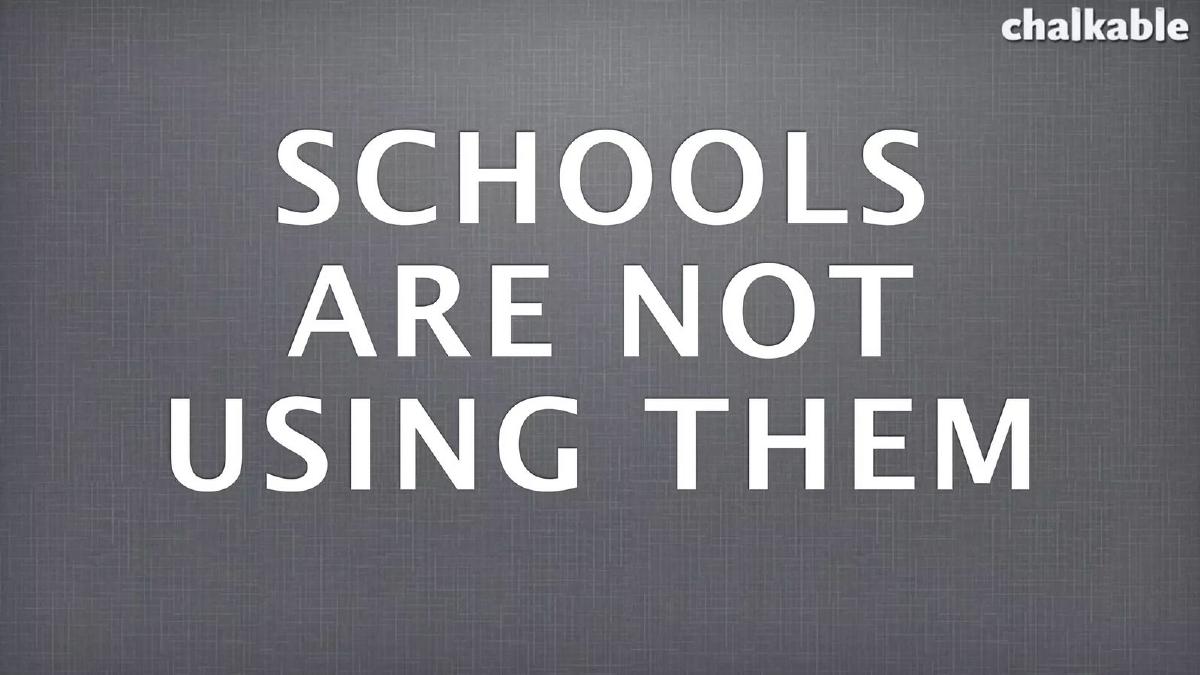
Slide 2 uses a bold, full-screen statement: 'SCHOOLS ARE NOT USING THEM.' This refers to the educational apps and digital tools that were becoming abundant at the time. Slide 3 narrows down the 'why' behind this lack of adoption, listing two words: 'DISCOVERY' and 'PAYMENT.' This is a classic 'two-sided pain point' strategy. Schools can't find the right tools because the market is fragmented, and even if they do find them, the procurement and payment process in K-12 is notoriously difficult. Chalkable positions itself as the bridge over these two hurdles.
Slide 4: The Solution (Product Interface)
This slide provides the first look at the Chalkable dashboard. The UI is designed to look like a physical notebook or binder, a common skeuomorphic design choice of the era. The 'App Store' tab is active, showing a featured banner for 'HUMAN' (BioDigital) and a grid of other apps. Notable inclusions are Khan Math and YouTube. The interface suggests a single sign-on (SSO) environment where a student or teacher (in this case, 'Sebastianog') can access all their tools from one place. The presence of a '$83' balance in the top left corner hints at the 'App Budget' mentioned later in the deck.
Slide 5: Partner Ecosystem
Slide 5 reinforces the platform's credibility by showcasing high-quality content from partners. It features large images for BioDigital (3D anatomy) and ClassDojo. By highlighting these specific brands, Chalkable is signaling to investors that they aren't just building a shell; they are already attracting the 'best-in-class' apps that schools actually want to use. This is a crucial 'chicken-and-egg' slide for any marketplace business.
Slide 6: Workflow Integration
One of the biggest challenges for educational marketplaces is moving beyond a simple directory to become a daily utility. Slide 6 shows a 'Biology10 Homework 2' screen. It demonstrates how a third-party app (XVIVO Cell Visualizer) is embedded directly into a teacher's grading workflow. We see a list of students (Daniel Washington, Ashley Levitt, etc.) with grades (A-, B, A-) being assigned. This slide tells the investor that Chalkable is also a Learning Management System (LMS) or at least a 'Gradebook' layer, which increases user stickiness.
Slide 7: The Business Model
This is the most data-dense slide in the set. It outlines a clear monetization strategy: $10 per Student . The slide breaks this down further, noting a $5 App Budget Built-In . This is a clever tactical move; by including a budget for apps within the platform fee, Chalkable ensures that transaction volume occurs immediately upon adoption. The final piece of the puzzle is the 30% Rev Share on Apps , which is the standard 'App Store' tax. The pie chart, though simple, visually represents the split between the platform fee and the app budget.
Slide 8: The Ask
The final slide in this set covers the fundraising details. Chalkable is Raising $1.1 million and notes that 30% is Committed . This creates a sense of momentum for new investors. The slide also highlights the founders' commitment, stating they have Bootstrapped $150k and previously Raised $200k . This total of $350,000 in prior capital suggests the product shown in the mockups is likely functional and has undergone some level of initial development or pilot testing.
What Works in This Deck
The Analogy: 'App Store for School' is a powerful, self-explanatory hook that sets the stage for the rest of the presentation. · Visual Clarity: The deck avoids cluttered slides. By using large text and clear product shots, the founders ensure the audience stays focused on the core message. · Integrated Workflow: Showing the gradebook (Slide 6) is vital. It proves the platform isn't just a store you visit once, but a tool teachers use to manage their daily tasks. · Transparent Economics: Slide 7 provides a specific dollar-amount business model. Many early-stage decks be vague about pricing; Chalkable is explicit.
What Is Missing
The Team: There is no mention of who is building this. In seed-stage investing, the team is often more important than the idea. The lack of founder bios or relevant experience is a significant omission. · Market Size: While the $10-per-student model is clear, the deck doesn't calculate the Total Addressable Market (TAM). Investors need to see how many students are in the target demographic to understand if this can become a billion-dollar business. · Sales Strategy: Selling to schools is notoriously slow and difficult. The deck does not explain how they plan to acquire districts or overcome the 'Discovery' and 'Payment' barriers they identified earlier. · Competition: There is no mention of existing LMS players (like Blackboard or Canvas) or other emerging marketplaces (like Clever).
Founder Takeaways
Use a 'North Star' Analogy: If your business model follows a proven pattern in another industry (like the App Store), use that language. It reduces the cognitive load on the investor and lets you spend more time on your specific execution.
Show, Don't Just Tell: Instead of saying 'we integrate with apps,' Chalkable showed exactly how an app like BioDigital looks inside their interface. This makes the product feel real and tangible.
Skin in the Game: Mentioning the $150k in bootstrapped funds is a strong signal of founder conviction. If you have invested your own money or significant time without pay, make sure that is reflected in your 'Ask' slide to build trust with potential backers.
Define the Unit Economics Early: Even if your pricing changes later, having a 'Version 1.0' of your revenue model (like the $10/student fee) shows that you are thinking like a business owner, not just a product builder.
Frequently asked questions
- What is Chalkable's primary business model?
- Chalkable operates as a marketplace and platform for educational apps. According to slide 7, they charge $10 per student. This fee includes a $5 built-in budget for apps, and the company takes a 30% revenue share on all third-party app sales made through their platform. This mimics the successful economic models of consumer app stores like Apple or Google Play.
- How does the product solve the 'Discovery' problem for schools?
- As shown on slide 4, Chalkable provides a curated 'App Store' interface where teachers and administrators can browse software by category (Newest, Highest Rated, Popular, Free, Subject). By centralizing these tools in one dashboard, it eliminates the need for schools to vet and manage dozens of individual vendor relationships and logins.
- Which third-party applications are integrated into the platform?
- The deck showcases several high-profile integrations. Slide 4 displays Desmos Calc, Guttenberg, Khan Math, Polling, Cell Command, and YouTube. Slide 5 further emphasizes partnerships with BioDigital (3D human anatomy) and ClassDojo (behavioral management), suggesting a broad range of pedagogical and administrative tools.
- What are the fundraising specifics mentioned in the deck?
- On slide 8, Chalkable states they are raising $1.1 million. They note that 30% of this round is already committed. The slide also reveals the company's financial history, including $150,000 in bootstrapped funds and $200,000 previously raised, indicating a total of $350,000 in capital invested prior to this round.
- What critical information is missing from this pitch deck?
- This version of the deck is missing a team slide, which is vital for assessing execution capability. It also lacks a market size analysis (TAM/SAM/SOM), a formal competitive landscape, and a roadmap for school district acquisition. Without these, it is difficult to judge the scalability of the $10-per-student model against the cost of long K-12 sales cycles.