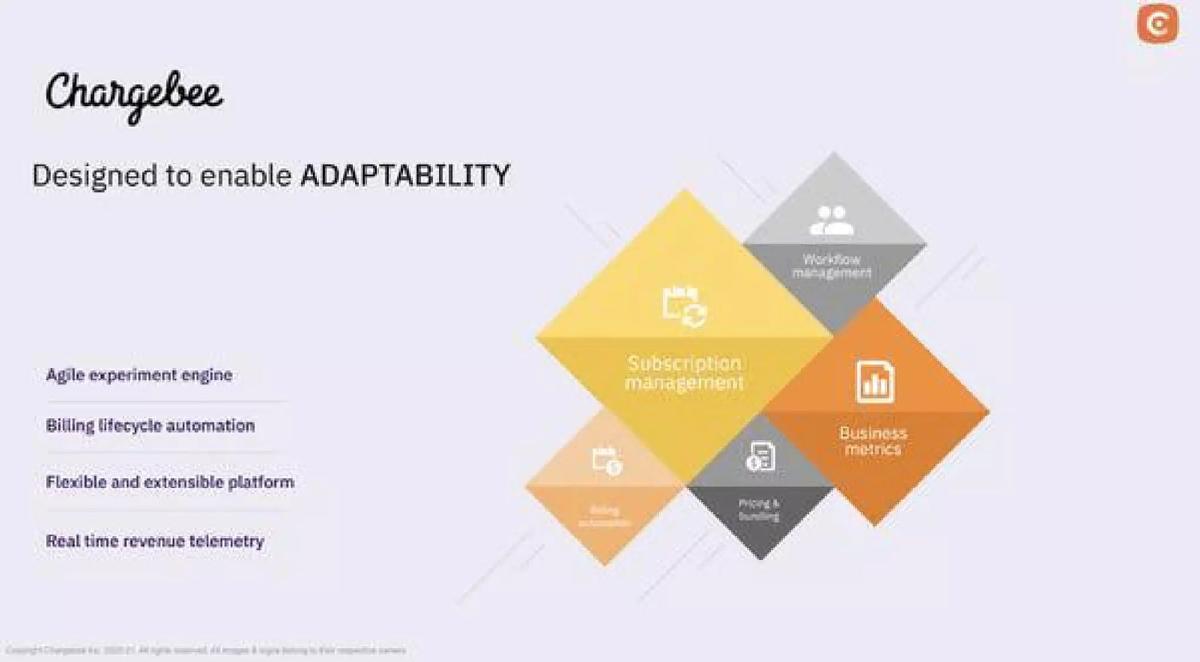
Chargebee’s 10-slide deck is a masterclass in narrative-driven selling for a later-stage SaaS company. Rather than leading with API documentation or feature lists, the deck establishes a macro-trend: the 'Exponential Change' that threatens half of the S&P 500. It positions Chargebee as the 'Agile experiment engine' necessary to survive this shift. The deck leans heavily on social proof, citing 20,000+ customers and $3 billion in ARR enabled through new business models. While it lacks traditional fundraising slides like a team overview, financial projections, or a specific 'ask,' it serves as…
Key takeaways
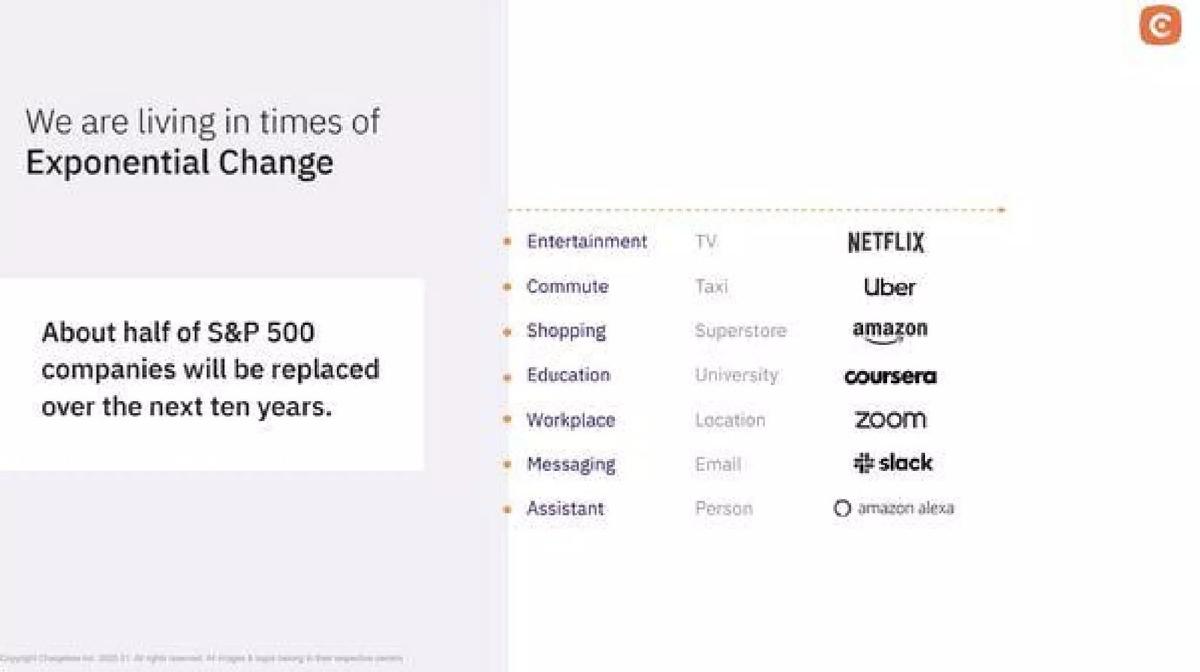
- The deck uses a macro-economic hook, claiming half of S&P 500 companies will be replaced in ten years (Slide 2).
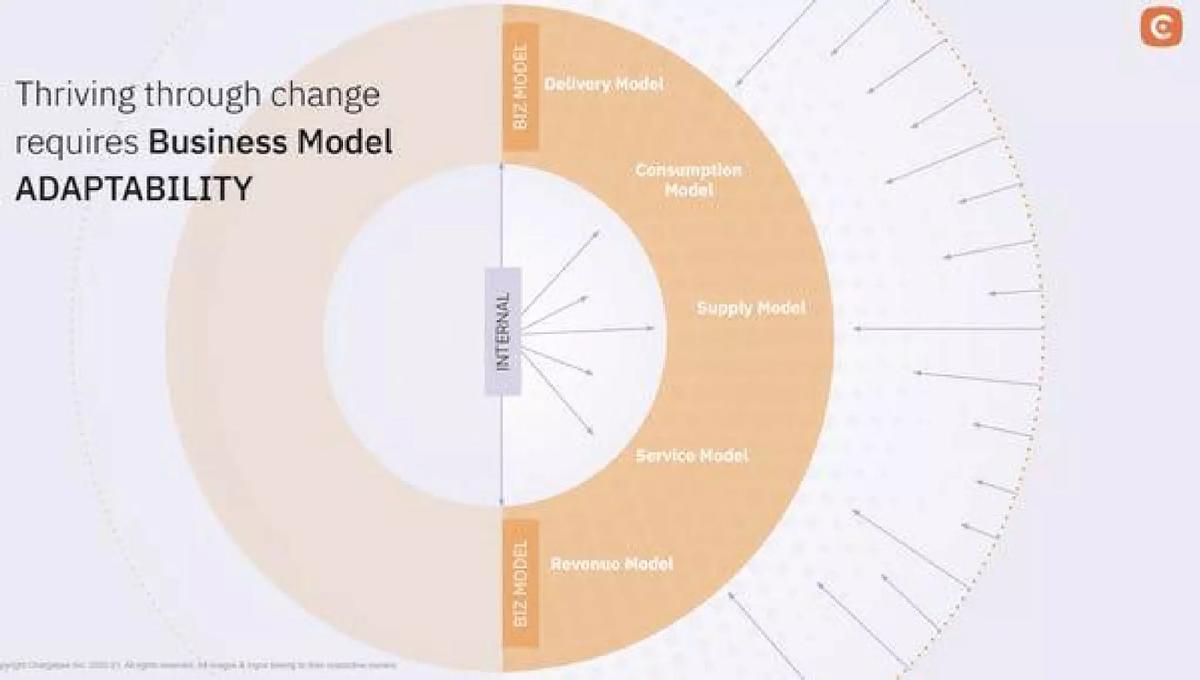
- It frames billing not as a utility, but as a 'Business Model Adaptability' tool (Slide 3).
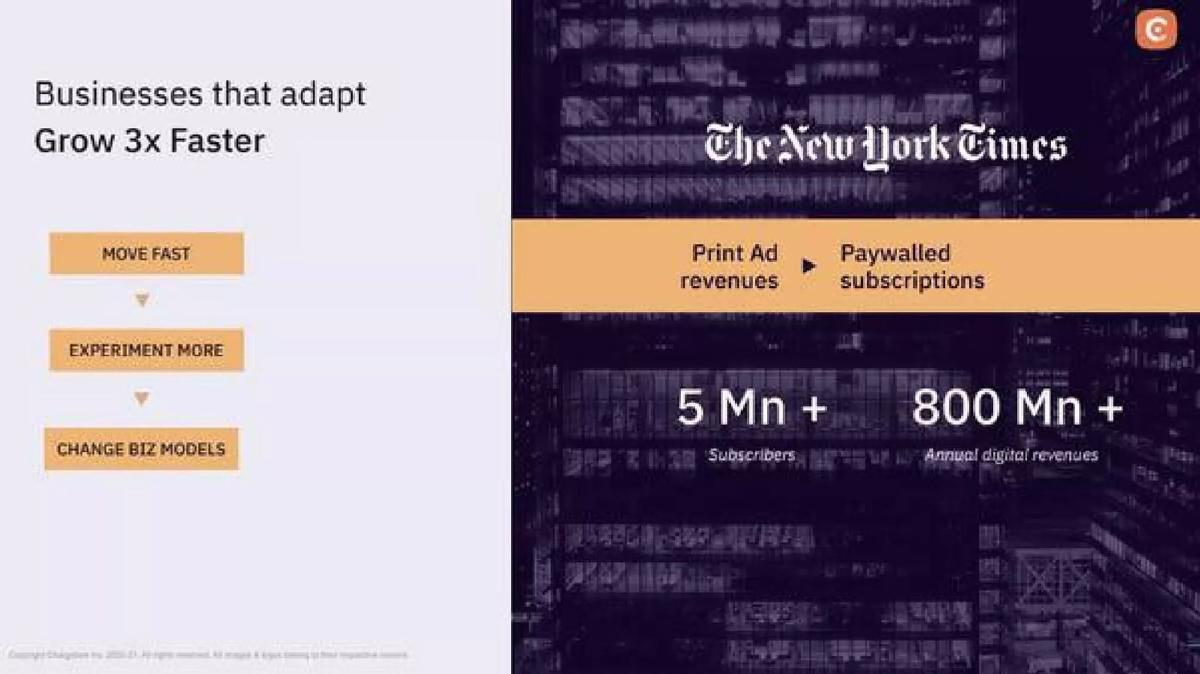
- Chargebee claims businesses that adapt their models grow 3x faster than those that do not (Slide 5).
- The New York Times is used as a primary case study for shifting from print ad revenue to $800M+ in annual digital revenue (Slide 5).
- The platform is described through four pillars: experiment engine, lifecycle automation, extensible platform, and revenue telemetry (Slide 6).
- Traction is quantified at 20,000+ high growth businesses and $3Bn+ ARR enabled via new models (Slide 7).
- Specific customer success stories for MakeSpace and Yousign highlight speed to market and 2x customer growth (Slides 8-9).
- The deck completely omits a team slide, financial ask, competition analysis, and product screenshots.
The Narrative Shift: From Billing to Adaptability
Chargebee’s 10-slide deck is a fascinating example of how a company at a 'Later' stage (having raised over $468 million according to catalogue facts) moves away from the 'how-to' of its product and focuses entirely on the 'why' of its existence. In the early days of SaaS, billing was a back-office headache. Today, Chargebee argues it is the front-line of competitive survival. This teardown examines how the company uses a high-level narrative to justify its massive market presence.
Slides 1-2: The Macro Hook
Slide 1 sets a dramatic tone with a split-screen image of a cityscape and a modern glass facade. The text 'Yesterday was NOTHING like today' and 'So how can businesses be READY FOR TOMORROW?' establishes a sense of urgency. It doesn't mention billing or software; it mentions survival.
Slide 2 doubles down on this by citing a specific, high-stakes statistic: 'About half of S&P 500 companies will be replaced over the next ten years.' To illustrate this 'Exponential Change,' Chargebee lists several industry shifts: Entertainment (TV to Netflix), Commute (Taxi to Uber), and Workplace (Location to Zoom). By placing themselves in the context of these giants, Chargebee implicitly suggests that they are the infrastructure behind the next wave of industry leaders.
Slides 3-5: Defining the Solution as a Strategy
Slide 3 introduces the concept of 'Business Model ADAPTABILITY.' It uses a concentric circle diagram to show how an 'Internal' core must radiate through supply, consumption, delivery, and revenue models. This is a sophisticated way of saying that a company's billing system needs to touch every part of the business.
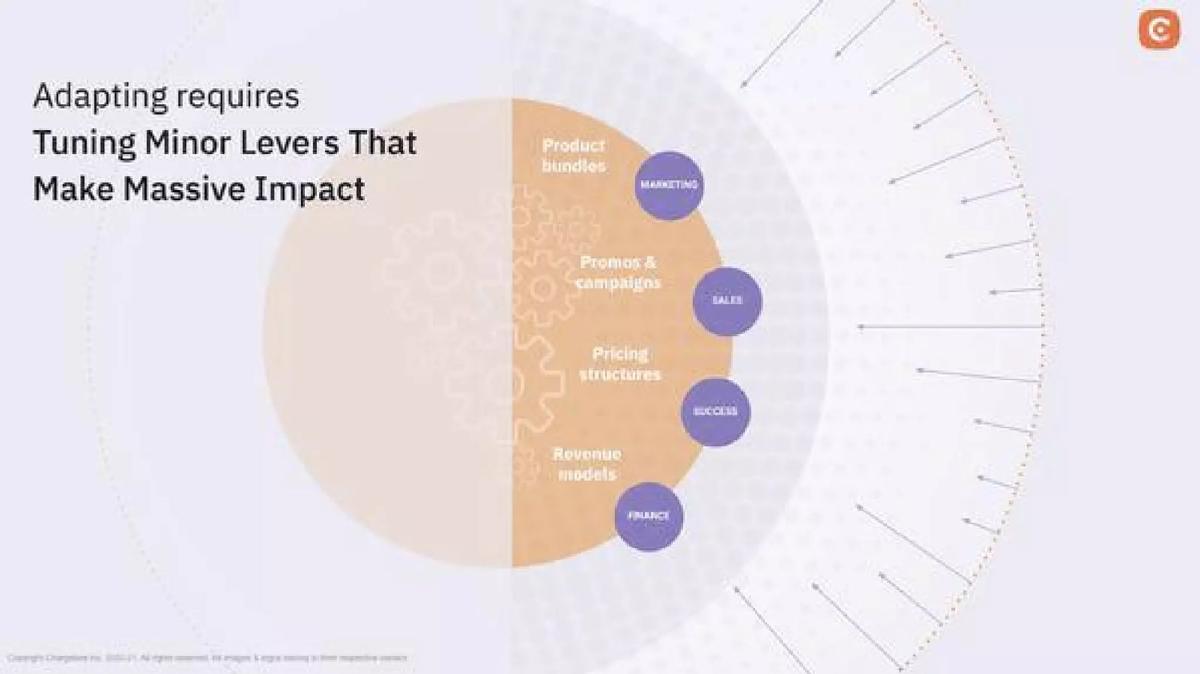
Slide 4 gets more granular about what 'adaptability' actually means in practice. It lists 'Minor Levers' that have 'Massive Impact,' such as product bundles, promos, pricing structures, and revenue models. This slide is crucial because it speaks directly to the pain points of a Chief Revenue Officer (CRO) or a Product Manager who wants to run an experiment but is blocked by a rigid, legacy billing system.
Slide 5 provides the 'Proof of Concept' for this strategy. It claims that 'Businesses that adapt Grow 3x Faster.' It uses The New York Times as the primary example, showing their transition from print ad revenues to a paywalled subscription model that boasts 5 Mn+ subscribers and $800 Mn+ in annual digital revenues. This slide bridges the gap between a theoretical 'adaptability' and cold, hard cash.
Slide 6: The Product Architecture
Slide 6 is the only slide that describes the actual platform. It avoids screenshots, opting instead for a diamond-shaped infographic. It identifies four key pillars: Agile experiment engine , Billing lifecycle automation , Flexible and extensible platform , and Real time revenue telemetry . By using words like 'engine' and 'telemetry,' Chargebee positions itself as a high-performance piece of machinery rather than just a database of invoices.
Slides 7-10: Social Proof and Case Studies
Slide 7 is the 'Traction' slide. It lists three massive figures: 20,000+ high growth businesses, 410+ business model iterations, and $3 Bn+ ARR enabled via new models. The inclusion of 'business model iterations' as a metric is a clever way to reinforce the 'adaptability' theme established in the first half of the deck. The slide is crowded with recognizable logos, including Calendly , Freshworks , Okta , and Sendinblue .
Slides 8 and 9 are dedicated case studies. Slide 8 focuses on MakeSpace , highlighting how they scaled into 31 new markets in one year. It includes a quote emphasizing that building complex billing in-house is a mistake. Slide 9 focuses on Yousign , which grew its customer base by 2x in 6 months. These slides follow a 'Who/Why/Unexpected Development/Impact' format that makes the ROI of using Chargebee very clear.
Slide 10 concludes the deck by summarizing the four main strategies Chargebee enables: Freemium as an acquisition strategy, Localization for global expansion, Self-service empowerment, and Enterprise-grade finance automation. It lists logos like Study.com and A Cloud Guru to anchor these strategies in reality.
What Works in the Chargebee Deck
The 'Adaptability' Narrative: By framing billing as a tool for growth and experimentation rather than a cost center, Chargebee elevates its product to a strategic necessity. · Quantified Social Proof: The deck doesn't just say they have customers; it says they have enabled $3 billion in revenue through new models. This is a much more powerful metric than total processed volume because it implies Chargebee is responsible for the growth, not just the collection. · The New York Times Example: Using a 170-year-old institution to prove the necessity of digital transformation makes the 'Exponential Change' argument feel universal, not just limited to tech startups. · Clean Visual Design: The deck uses a consistent color palette (orange and purple) and avoids cluttered text, making it easy to digest in a high-pressure meeting.
What is Missing from the Chargebee Deck
No Team Slide: For a company that raised $468 million, the team is a huge asset. Their absence here suggests this deck is intended for a stage where the company's brand and metrics speak louder than the founders' resumes. · No Unit Economics: There is no mention of LTV, CAC, churn, or net revenue retention (NRR). While the $3Bn ARR figure is impressive, investors usually want to see the efficiency of the business itself. · No Competitive Landscape: Chargebee operates in a crowded market (competing with Stripe, Recurly, and Zuora). This deck makes no attempt to differentiate Chargebee from these competitors on a technical or pricing level. · No Financial Ask: There is no slide detailing how much money is being raised or how the funds will be used. This confirms the deck is likely a 'vision' or 'sales' deck rather than a formal Series A/B pitch. · No Product Screenshots: The deck is entirely conceptual. A potential user or investor never sees what the dashboard actually looks like.
What a Founder Should Copy
The Macro-to-Micro Flow: Start with a massive problem that affects everyone (Slide 2), then show why the current way of doing things is failing (Slide 3), and finally present your product as the only way to navigate that change (Slide 6). · The 'Why Now' Factor: Chargebee creates a sense of 'adapt or die' by citing the S&P 500 replacement rate. Founders should look for similar macro trends that make their solution inevitable. · Strategic Metrics: Don't just report standard KPIs. Find a metric that reinforces your unique value proposition. For Chargebee, 'Business model iterations' (Slide 7) is a genius metric because it proves their customers are actually using the 'adaptability' they sell. · Case Study Structure: The format on Slides 8 and 9—identifying an 'Unexpected Development' and then the 'Impact'—is a great way to tell a story of resilience and partnership rather than just a list of features.
Frequently asked questions
- What is the primary value proposition of Chargebee according to this deck?
- Chargebee positions itself as an 'adaptability' engine rather than just a billing tool. The deck argues that in a world of exponential change, the ability to rapidly iterate on business models, pricing structures, and product bundles is the key to 3x faster growth. It moves the conversation from 'collecting payments' to 'enabling strategic business shifts.'
- Does this deck include financial projections or a fundraising ask?
- No. This 10-slide deck contains no financial projections, no mention of the amount being raised, and no 'ask' slide. It functions more as a high-level strategic overview or a sales deck designed to align stakeholders on the company's vision and market position rather than a granular seed-stage investment pitch.
- How does Chargebee use social proof to build credibility?
- The deck uses a multi-layered approach to social proof. It starts with a massive legacy brand (The New York Times) to prove the category, then lists 15+ modern SaaS logos like Okta, Calendly, and Freshworks. Finally, it provides deep-dive case studies for MakeSpace and Yousign to demonstrate specific ROI metrics like scaling to 31 markets in one year.
- What market trends does the deck highlight?
- The deck highlights the shift from traditional ownership to subscription-based consumption. It cites the replacement of 'Taxi' by 'Uber' and 'Superstore' by 'Amazon' as evidence of 'Exponential Change.' It specifically points to the risk facing S&P 500 companies that fail to adapt their delivery and revenue models to this new reality.
- Who is the intended audience for this specific slide deck?
- Given the lack of team and 'ask' slides, this appears to be a 'vision deck' used for later-stage investor conversations or enterprise sales. It is designed for an audience that already understands what billing is but needs to be convinced that Chargebee is a strategic partner for global scale and complex experimentation.