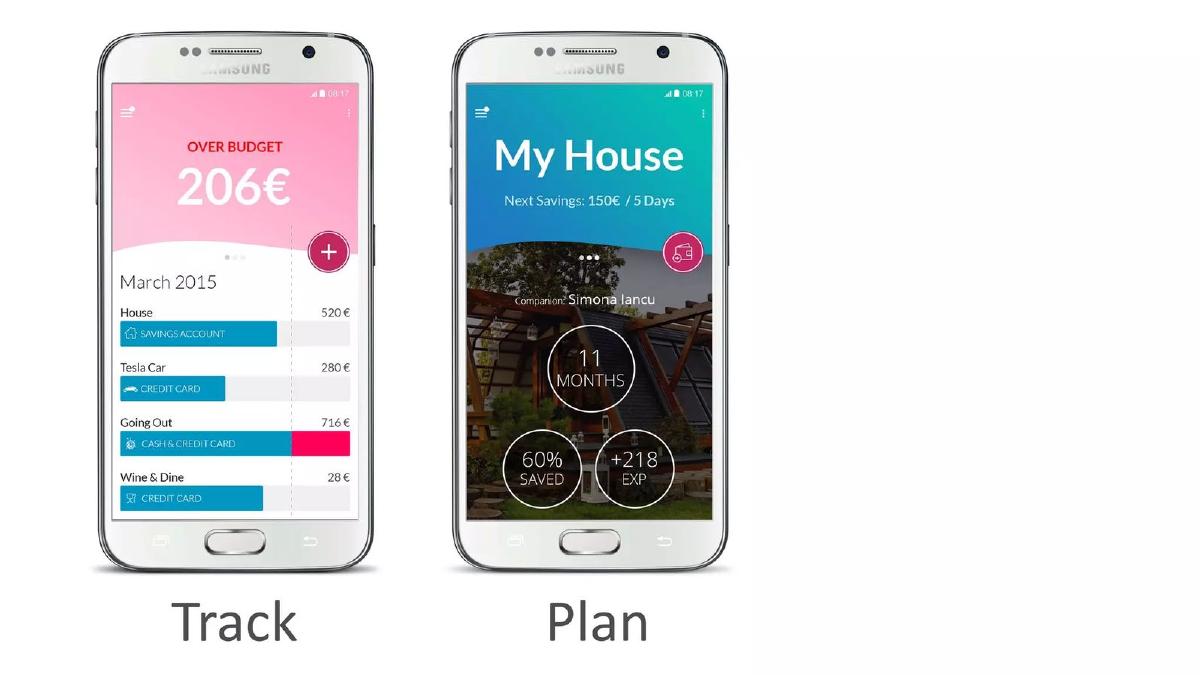
Challenge xp is a personal finance application that utilizes gamification elements like 'badges' and 'experience points' to encourage saving. The pitch deck is heavily design-centric, showcasing a clean mobile interface that tracks spending and sets long-term goals. However, as a fundraising document, it is critically incomplete. It fails to define a target market, explain how the company intends to generate revenue, or provide any traction data. The 'Partnerships' slide suggests a B2B2C play with banks, but provides no details on existing relationships or integration strategy. The team consi…
Key takeaways
- The company tagline is 'Plan & save for things that matter,' established on Slide 1.
- The problem slide (Slide 2) uses visual consumerism cues but lacks any quantitative data regarding debt or savings gaps.
- The product includes a tracking feature that displays a '206€' over-budget status for March 2015 on Slide 3.
- Gamification is a core pillar, featuring 'Story Badges,' 'Alpha Challenges,' and 'EXP' points as shown on Slide 4.
- The business model is vaguely hinted at through 'Partnerships' with banks on Slide 5, but no commercial terms are provided.
- The team is limited to two individuals: Vlad Balan (CEO/Designer) and Adi Pop (CTO/Architect) on Slide 6.
- There is no mention of a funding ask, valuation, or use of proceeds in the provided slides.
- The deck omits a competition slide, market sizing (TAM/SAM/SOM), and any form of financial projections.
Slide-by-Slide Analysis
Slide 1: Title Slide
The deck opens with the company name, ChallengeXP , and the tagline "PLAN & SAVE FOR THINGS THAT MATTER." The design is minimalist, using a white background with a subtle diagonal grey gradient. The branding uses a magenta/pink color palette. This slide establishes the company as a personal finance or budgeting tool, but it does not specify the platform (mobile vs. web) or the target demographic.
Slide 2: The Problem
Slide 2 attempts to illustrate the problem of consumerism without using any text other than the question "Do we really need all this stuff?" The background is a dense collage of corporate logos, including Coca-Cola, McDonald's, Sony, and Starbucks. While visually striking, this slide fails to define a specific, venture-scale problem. It hints at overspending but lacks data on consumer debt levels, low savings rates, or the psychological barriers to financial planning that the app intends to solve.
Slide 3: Product - Track
This slide introduces the first phase of the user journey: "Track." It shows a mobile interface on a Samsung smartphone. The UI displays an "OVER BUDGET 206€" alert for "March 2015." Below this, it lists categories such as "House (520 €)," "Tesla Car (280 €)," "Going Out (716 €)," and "Wine & Dine (28 €)." The slide demonstrates that the app can categorize spending by account type (Savings Account, Credit Card, Cash). The use of the Euro symbol suggests a primary focus on the European market.
Slide 4: Product - Plan and Focus
Slide 4 expands on the product features by adding "Plan" and "Focus" to the "Track" pillar. The "Plan" screen shows a goal for "My House" with a progress indicator of "60% SAVED" and a timeline of "11 MONTHS." It also introduces a social or collaborative element with the text "Companion: Simona Iancu." The "Focus" screen highlights the gamification engine, showing a user named "Jack" who is "Level 10" with "1830pts." It lists achievements like "Story BADGE," "Alpha CHALLENGE," and "Quick SAVE." This slide is the strongest in the deck as it clearly defines the unique selling proposition: gamified savings goals.
Slide 5: Business Model / Strategy
Slide 5 is titled "But where to put all this money?" It features an image of a glass jar filled with Euro banknotes (5, 10, 20, and 50 Euro notes) with a blue arrow labeled "Partnerships" pointing toward a large building labeled "BANK." This is a highly simplified representation of a business model. It suggests that ChallengeXP acts as a top-of-funnel aggregator that moves user capital into traditional banking institutions. However, it omits critical details: Is there a referral fee? Does the app take a percentage of the interest? Are there any signed Letters of Intent (LOIs) with banks?
Slide 6: The Team
The team slide features two members: Vlad Balan (CEO / UI&UX Designer) and Adi Pop (CTO / Software Architect). Both are shown in stylized, black-and-white circular headshots with a magenta checkmark icon. While the slide identifies the founders, it provides no professional context. There are no mentions of past companies, technical achievements, or specific skills that qualify them to handle sensitive financial data or navigate banking regulations.
Slide 7: Contact / Closing
The final slide repeats the logo and tagline from Slide 1 and provides a contact email: SAVE@CHALLENGEXP.COM . There is no call to action, no mention of the investment round, and no summary of why now is the right time for this product.
What Challenge xp Does Well
The deck excels in UI/UX presentation . The mobile mockups on Slides 3 and 4 are clean, modern, and intuitive. They successfully communicate how the gamification elements (levels, points, and badges) integrate with standard budgeting features. By focusing on "things that matter" (like a house or a car), the founders tap into a goal-oriented emotional trigger that differentiates them from purely analytical budgeting apps. The three-step framework of Track, Plan, and Focus is a simple, effective way to explain the product's core functionality to a non-technical audience.
What is Missing from the Deck
This deck is missing several components essential for a professional fundraise:
Market Size (TAM/SAM/SOM): There is no indication of how many people struggle with savings or the total addressable market for personal finance apps in Europe or globally. · Revenue Model: Aside from a vague arrow pointing to a bank, there is no explanation of how the company generates income. · Competition: The deck ignores the existence of established players like Mint, YNAB, or Revolut, which already offer similar tracking and goal-setting features. · Traction: There are no metrics regarding user acquisition costs, monthly active users (MAU), or the amount of money currently being tracked or saved through the platform. · The Ask: The deck does not state how much money the founders are looking to raise, what the valuation is, or what milestones they intend to reach with the capital. · Roadmap: There is no timeline for future feature releases, geographic expansion, or partnership growth.
Founder Takeaways
Design is not a business model. While the ChallengeXP deck looks professional, it functions more like a design portfolio than a business plan. Founders should ensure that for every slide showing a feature, there is a corresponding slide showing the business logic behind it. Quantify the problem. Instead of asking a rhetorical question about "stuff," use data to show the percentage of the population with less than $1,000 in savings. Be specific about partnerships. If your business relies on banks, you must explain the integration (e.g., Plaid, Open Banking APIs) and the commercial incentives for those banks to work with you. Finally, include a clear funding ask. An investor should never finish a deck wondering what the founder actually wants from them.
Frequently asked questions
- What is the primary value proposition of Challenge xp?
- Based on Slide 1 and Slide 4, the value proposition is helping users save for significant life goals (like a house or car) by gamifying the budgeting process. It uses a 'Track, Plan, Focus' framework to turn mundane financial management into a series of 'challenges' and 'badges' to maintain user engagement.
- How does the company plan to make money?
- The deck is largely silent on monetization. Slide 5 shows an arrow labeled 'Partnerships' pointing from a jar of cash to a bank building. This implies a lead-generation or referral model where the app directs user savings into partner bank accounts, but no specific revenue splits or fee structures are mentioned.
- What stage of development is the product in?
- The product appears to be in the high-fidelity prototype or early beta stage. Slide 3 and Slide 4 show detailed UI mockups on a Samsung device with specific dates (March 2015) and currency (Euros). However, there is no mention of user counts, app store downloads, or retention metrics to prove it is live.
- Who are the founders and what is their expertise?
- Slide 6 lists Vlad Balan as CEO and UI/UX Designer, and Adi Pop as CTO and Software Architect. The deck emphasizes their technical and design roles but provides no information regarding their previous industry experience, education, or ability to scale a fintech company.
- What are the biggest risks for an investor in this deck?
- The primary risks are the lack of market validation and the absence of a clear path to profitability. Without a slide on competition (like Mint or YNAB) or a slide on unit economics (CAC vs. LTV), it is impossible to determine if the business is viable or how it will survive in a crowded fintech space.