CAMP4 Therapeutics' Series B deck is a highly technical, data-driven presentation that successfully secured $100M in 2022. Rather than relying on market size tropes, the company focuses on the scientific validation of its RNA Actuating Platform (RAP). By showcasing in vivo Proof of Concept (PoC) data across multiple indications—specifically Dravet Syndrome and Urea Cycle Disorders—CAMP4 demonstrates that its approach to upregulating gene expression via regulatory RNAs (regRNAs) is both programmable and scalable. The deck leans heavily on biological evidence, including non-human primate data a…
Key takeaways
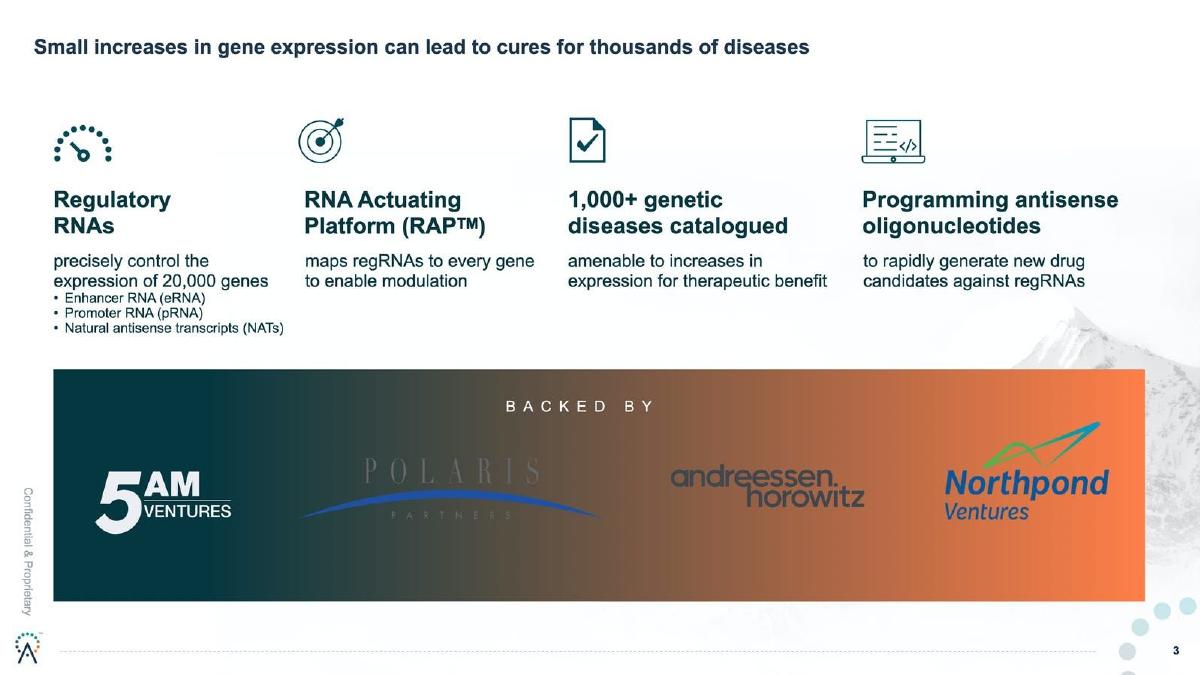
- The deck identifies a catalog of 1,000+ genetic diseases amenable to gene expression increases as the core market opportunity (Slide 3).
- CAMP4 leverages a proprietary RNA Actuating Platform (RAP) to map regRNAs to 20,000 genes (Slide 3).
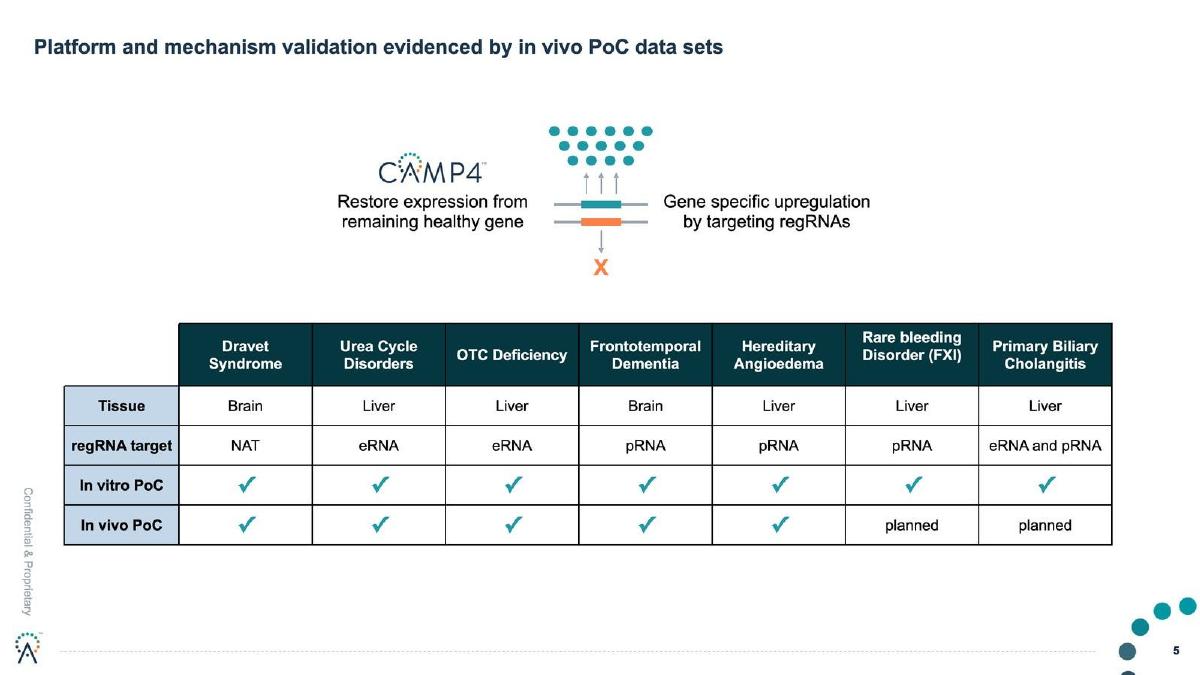
- Validation is presented through a matrix showing in vitro and in vivo PoC across seven distinct therapeutic areas (Slide 5).
- The platform workflow is broken down into three clear steps: mapping regRNAs, generating ASO drug leads, and programming new medicines (Slide 9).
- Lead candidate CMP-SCN-001 shows dose-dependent upregulation of SCN1A mRNA in human cell lines (Slide 13).
- Non-human primate data confirms protein upregulation across multiple brain regions, including the temporal cortex and thalamus (Slide 15).
- Safety is highlighted by the absence of adverse clinical or histological findings at doses up to 5 mg (Slide 15).
- The company is backed by a high-tier syndicate including Andreessen Horowitz and Northpond Ventures (Slide 3).
Executive Summary: The Science of Scalable Upregulation
CAMP4 Therapeutics operates in the highly specialized field of programmable medicines. Their Series B deck, which supported a $100M raise in 2022, is a clinical and technical deep dive into the power of regulatory RNA (regRNA). Unlike many startups that focus on a single drug, CAMP4 pitches a platform—the RNA Actuating Platform (RAP)—capable of addressing over 1,000 genetic diseases. The deck is structured to move the investor from the broad potential of the platform to the specific, granular data of their lead programs in the central nervous system (CNS) and liver.
Slide 1-2: Title and Branding
The opening slides establish the brand identity with the tagline "Solving Problems is in our RNA." The imagery of a mountain peak (Camp 4 is a famous high-altitude camp on Everest) reinforces the company's name and the scale of the challenge they are tackling. These slides are minimalist, serving only to set the tone for a high-stakes biotech presentation.
Slide 3: The Value Proposition and Syndicate
Slide 3 is the most important 'business' slide in the deck. It summarizes the company's four pillars: Regulatory RNAs (controlling 20,000 genes), the RAP Platform , a catalog of 1,000+ genetic diseases , and the use of antisense oligonucleotides (ASOs) . By stating that small increases in gene expression can lead to cures for thousands of diseases, CAMP4 defines its Total Addressable Market (TAM) not in dollars, but in biological opportunity. The bottom of the slide features a heavy-hitting investor block: 5AM Ventures, Polaris Partners, Andreessen Horowitz, and Northpond Ventures . In biotech, the quality of the syndicate is often a primary signal of the platform's technical viability.
Slide 5: Platform and Mechanism Validation
This slide addresses the 'platform vs. product' risk. CAMP4 presents a matrix of seven indications, including Dravet Syndrome, Urea Cycle Disorders, and Frontotemporal Dementia . The table shows that they have achieved in vitro Proof of Concept (PoC) for all seven and in vivo PoC for five of them. This is a critical slide for a Series B; it proves that the RAP platform isn't a one-hit-wonder but can generate viable candidates across different tissues (Brain and Liver) and different regRNA targets (NAT, eRNA, and pRNA).
Slide 7: Agenda - Transitioning to Science
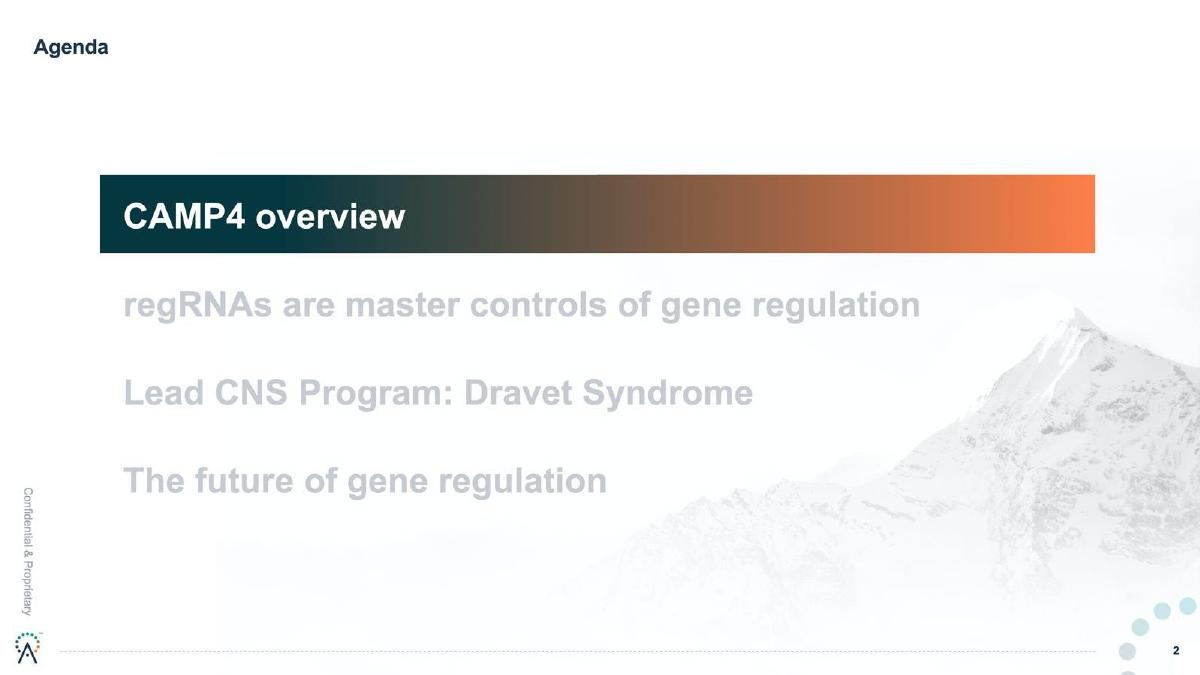
The deck uses a clear agenda to signal a shift into the technical mechanics of gene regulation. This helps keep the narrative focused, ensuring the investor understands the transition from the 'what' (the company) to the 'how' (the science).
Slide 9: The RNA Actuating Platform (RAP) Workflow
Slide 9 visualizes the 'factory' aspect of the company. The process is broken into three steps: 1. Map regRNAs (using machine learning), 2. Generate ASO drug leads (screening for upregulation), and 3. Program new medicines (designing for safe delivery). This slide is designed to convince investors that CAMP4 has a repeatable, industrialized process for drug discovery, which justifies a higher valuation than a traditional single-asset biotech company.
Slide 11: Lead CNS Program - Dravet Syndrome
The agenda returns to highlight the lead program. For a platform company, the lead program is the 'proof of the pudding.' If the lead program fails, the platform's value is questioned. CAMP4 chooses Dravet Syndrome, a severe form of epilepsy, as its primary battleground.
Slide 13: Lead Candidate Data (CMP-SCN-001)
This slide provides the biological evidence required for a Series B. It shows how their lead candidate, CMP-SCN-001 , inhibits the NAT regulating the SCN1A gene . A bar chart demonstrates dose-dependent upregulation of SCN1A mRNA in human cell lines and patient fibroblasts. The data is clear: as the dose (nM) increases from 0.150 to 80.000, the relative SCN1A levels rise significantly compared to the Non-Targeting Control (NTC). This is the 'smoking gun' data that proves the drug does exactly what the platform promised.
Slide 15: Non-Human Primate (NHP) Data
To further de-risk the program, Slide 15 moves from cell lines to primates. The chart shows SCN1A protein upregulation across multiple brain regions, including the Temporal Cortex, Thalamus, and Spinal Cord . The slide also notes "No adverse clinical or histological findings up to 5 mg," which supports a >25X therapeutic margin . For investors, this slide addresses the two biggest risks in biotech: efficacy (does it work in a complex organism?) and safety (is it toxic?).
Slide 17-18: The Future of Gene Regulation
The deck concludes by looking forward. While the specific details of the 'future' slides are kept brief in this version, the intent is to leave the investor with the impression that Dravet Syndrome is just the first of many applications for the RAP platform.
What CAMP4 Therapeutics Does Exceptionally Well
The strength of this deck lies in its scientific transparency . In the biotech world, investors are often wary of 'black box' platforms that claim to use AI or machine learning without showing the biological output. CAMP4 avoids this trap by providing specific, labeled data charts (Slides 13 and 15) that cite external research (Hsiao et al, eBiomedicine, 2016) and show clear dose-response curves.
Furthermore, the tissue diversity shown on Slide 5 is a masterstroke. By proving they can hit targets in both the brain (notoriously difficult to reach) and the liver, they effectively double the perceived value of their platform. They aren't just a 'CNS company' or a 'Liver company'; they are a 'Gene Regulation company.'
What is Missing from the Deck
While this deck is excellent for scientific due diligence, it omits several standard 'pitch' elements that a founder in a different industry might find essential:
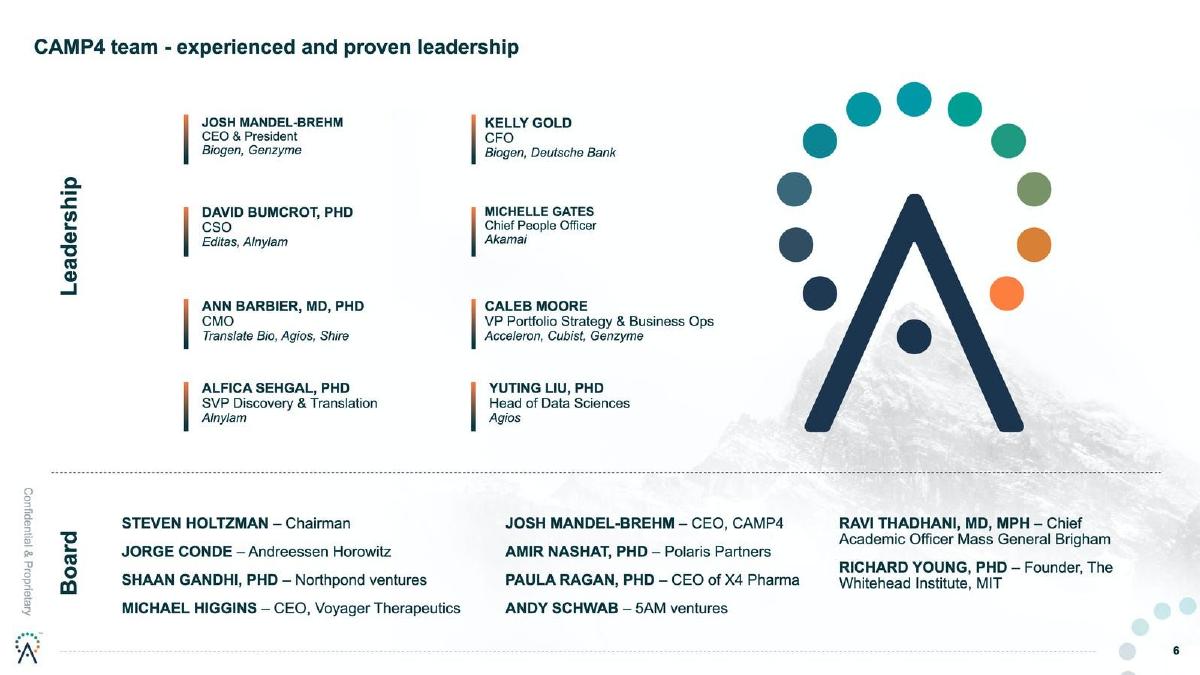
Team Slide: There is no mention of the founders, the CEO, or the scientific advisory board. In biotech, the pedigree of the scientists is usually a major selling point. · Competitive Landscape: The deck does not mention other companies working on ASOs or gene therapy for Dravet Syndrome (such as Stoke Therapeutics). Investors would certainly ask how CAMP4’s approach differs from existing clinical-stage competitors. · Financial Ask: There is no slide detailing how the $100M will be spent. Usually, a Series B deck would outline milestones, such as 'IND filing' or 'Phase 1 readout,' that the funding will enable. · Unit Economics/Commercialization: There is no discussion of how these drugs will be priced or the specific patient populations (prevalence) for the 1,000+ diseases mentioned.
Lessons for Founders
Founders building platform-based companies should take two major lessons from CAMP4:
1. Use a Validation Matrix: If you claim to have a platform, you must show it working in multiple, distinct environments. Slide 5’s checkmark table is a simple but highly effective way to communicate that your technology is versatile and repeatable.
2. Lead with Data, Not Hype: CAMP4 doesn't use flashy adjectives. They use terms like "dose-dependent upregulation" and "therapeutic margin." For sophisticated investors, the data is the hype. If your technology has passed in vivo testing, that should be the centerpiece of your deck, not your market size projections.
3. The Power of the Syndicate: If you have high-tier investors from a previous round, put them on the first or second slide. In highly technical fields, VCs often look for 'social proof' from other firms that have already performed deep technical due diligence. CAMP4 places their backers on Slide 3, immediately establishing credibility before diving into the complex biology of regRNAs.
Conclusion
The CAMP4 Therapeutics deck is a specialized tool for a specialized audience. It succeeds because it treats the investor as a peer scientist, providing the exact data points (mRNA levels, protein expression, NHP safety) required to validate a $100M investment. While it lacks the narrative 'fluff' of a consumer tech deck, its clinical rigor makes it a gold standard for biotech fundraising.
Frequently asked questions
- What is the primary therapeutic mechanism CAMP4 is developing?
- CAMP4 targets regulatory RNAs (regRNAs), such as Enhancer RNA (eRNA), Promoter RNA (pRNA), and Natural antisense transcripts (NATs). By targeting these regRNAs with antisense oligonucleotides (ASOs), the company can precisely upregulate the expression of specific genes to treat diseases caused by haploinsufficiency or low protein production.
- How does CAMP4 validate its platform across different tissues?
- Slide 5 provides a validation matrix showing Proof of Concept (PoC) in both brain and liver tissues. They demonstrate in vivo PoC for Dravet Syndrome and Frontotemporal Dementia (brain) as well as Urea Cycle Disorders and OTC Deficiency (liver), proving the platform's versatility across different organ systems.
- What specific data is provided for their lead program?
- For their lead CNS program (Dravet Syndrome), CAMP4 presents data on CMP-SCN-001. Slide 13 shows dose-dependent mRNA upregulation in patient fibroblasts, and Slide 15 shows SCN1A protein upregulation in non-human primates across eight brain regions, supporting a >25X therapeutic margin.
- Who are the key investors mentioned in the deck?
- The deck explicitly lists four major backers on Slide 3: 5AM Ventures, Polaris Partners, Andreessen Horowitz (a16z), and Northpond Ventures. This syndicate provided the foundation for the $100M Series B round reported by Business Insider.
- What is missing from this version of the pitch deck?
- This version of the deck omits a dedicated team slide, detailed financial projections, a specific breakdown of the $100M use of funds, and a competitive landscape analysis. It functions primarily as a scientific and platform validation document rather than a full business plan.