Now (formerly NowAccount) utilized a brief 7-slide deck to secure $29M in Series A funding in 2021. The company addresses a massive $10 trillion gap in B2B accounts receivable by providing an 'innovative payment acceleration platform' that functions like a credit card for B2B transactions. Unlike traditional factoring, Now uses a unique bond securitization structure, including an authorized municipal bond structure, to fund its operations. By the time of this raise, the company had already processed over $700 million in invoices for 1,000 clients selling to 10,000 obligors. The deck is notabl…
Key takeaways
- The company identifies a $10 trillion market in accounts receivable generated by U.S. small-to-middle market B2B companies (Slide 6).
- Now positions itself as a 'payment acceleration platform' rather than a lender or factor to avoid the stigma and balance sheet impact of debt (Slide 4).
- The platform has processed over $700 million in invoices and serves 1,000 clients (Slide 7).
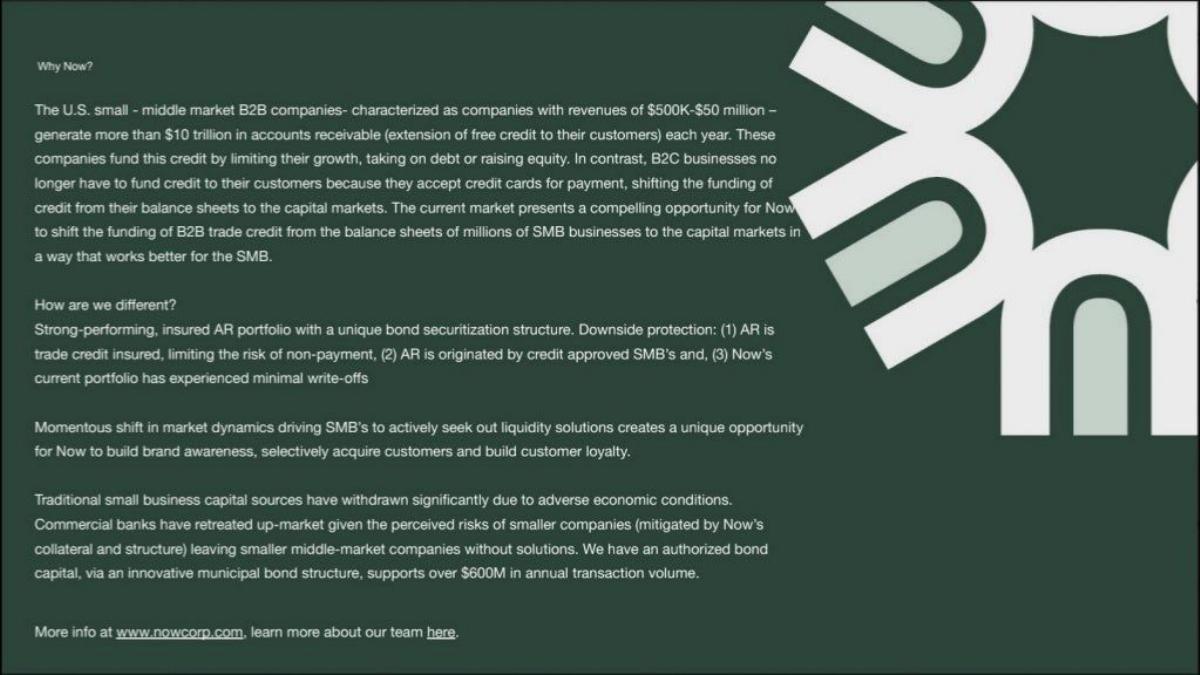
- A core differentiator is the use of an authorized municipal bond structure to support over $600 million in annual transaction volume (Slide 6).
- The product allows SMBs to get paid within 1 day of choosing to accelerate an invoice (Slide 5).
- The portfolio maintains a Days Sales Outstanding (DSO) of less than 60 days (Slide 7).
- Approximately 40% of the company's transaction volume involves Fortune 500 obligors, including Coca-Cola, GE, and AT&T (Slide 7).
- The deck omits a dedicated team slide, instead providing a hyperlink to a website for team information (Slide 6).
The 7-Slide Series A: Now’s Lean Approach to Fundraising
The pitch deck for Now (operating as NowAccount) is a masterclass in brevity. At just seven slides, it managed to secure a $29 million Series A in 2021. The deck focuses heavily on the structural innovation of the product—specifically how it uses capital markets to solve a liquidity problem for small businesses—rather than the typical SaaS metrics of CAC, LTV, and churn. This teardown examines how they leveraged massive transaction volume and a unique financial engine to convince VCs of their scalability.
Slide 1: Title and Branding
The cover slide is minimalist, featuring the 'Now' logo and a geometric pattern. There is no tagline or mission statement on the first slide, which is a bold choice that relies on the brand name to carry the initial weight. The dark green color palette suggests stability and growth, fitting for a FinTech company.
Slide 2: Our Mission
Slide 2 states: "Now’s mission is to enable businesses to grow fearlessly." This is a high-level emotional hook. It frames the company not as a financial tool, but as an empowerment engine. The background image shows a diverse office environment, reinforcing the B2B focus mentioned in the catalogue facts.
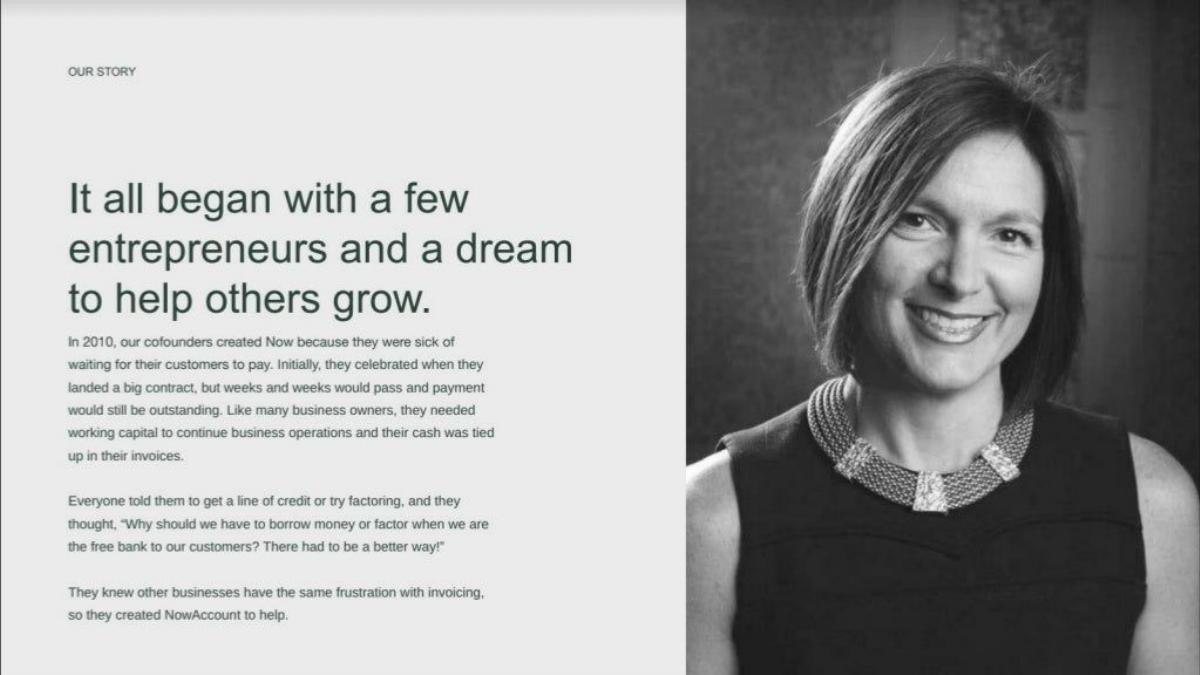
Slide 3: Our Story
The 'Our Story' slide provides the origin of the company. It notes that in 2010, the co-founders created Now because they were "sick of waiting for their customers to pay." This slide humanizes the problem by describing the frustration of landing a big contract only to have cash tied up in outstanding invoices for weeks. It explicitly mentions that the founders rejected traditional lines of credit or factoring, asking, "Why should we have to borrow money or factor when we are the free bank to our customers?" This sets the stage for a non-debt solution.
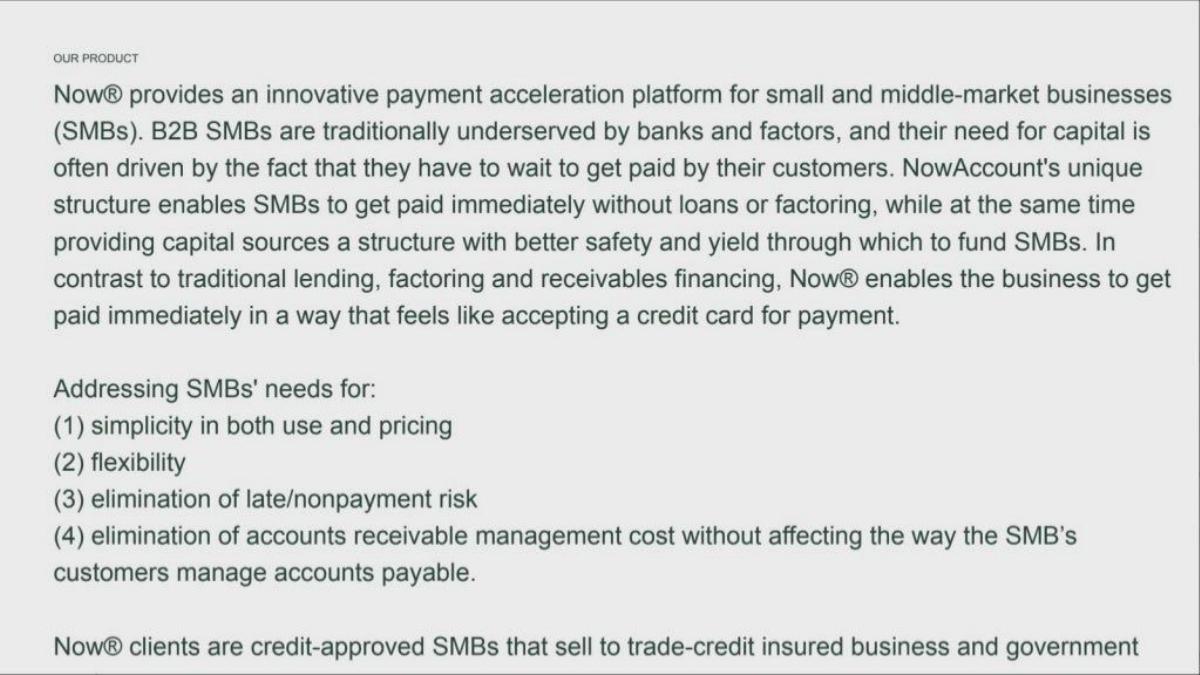
Slide 4: Our Product (The Value Proposition)
This slide defines Now as an "innovative payment acceleration platform for small and middle-market businesses (SMBs)." It highlights four specific needs the product addresses: (1) simplicity in both use and pricing, (2) flexibility, (3) elimination of late/nonpayment risk, and (4) elimination of accounts receivable management cost. The most critical distinction made here is that the platform enables SMBs to get paid immediately "without loans or factoring." This positioning is vital for B2B companies that want to avoid the appearance of financial distress often associated with factoring.
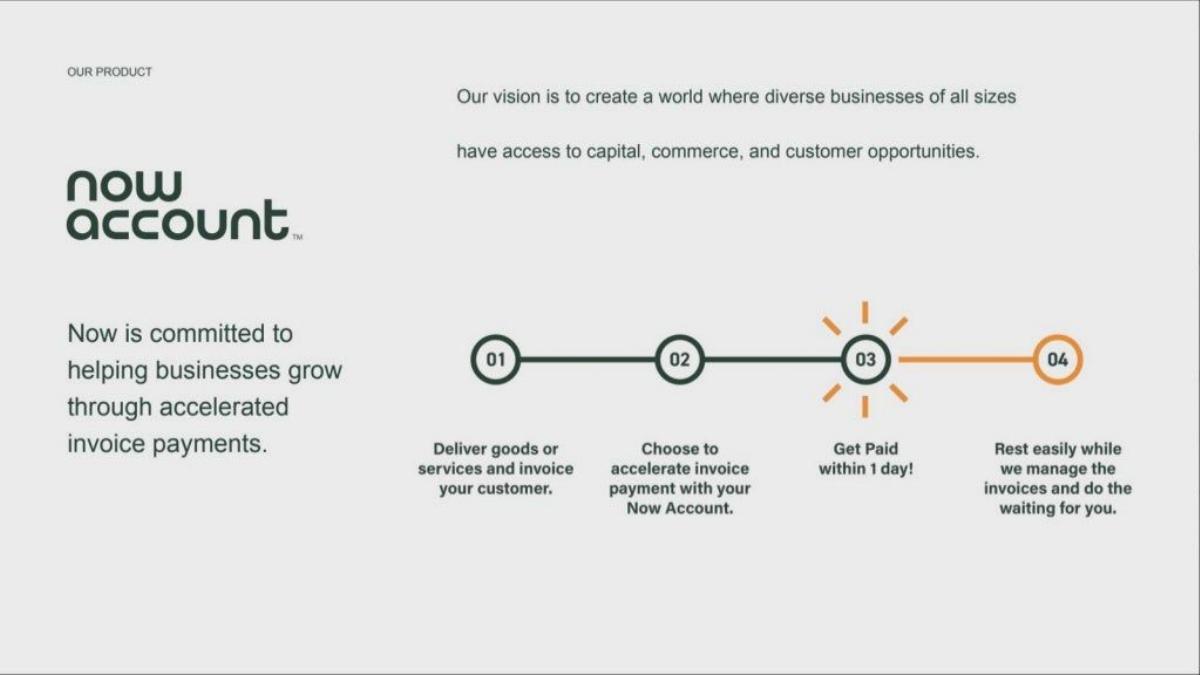
Slide 5: Our Product (The Process)
Slide 5 provides a visual four-step process for how the service works: (1) Deliver goods or services and invoice your customer, (2) Choose to accelerate invoice payment with your Now Account, (3) Get Paid within 1 day!, and (4) Rest easily while we manage the invoices and do the waiting for you. This clarifies the user experience and emphasizes the speed of liquidity ('within 1 day'). It also introduces the 'Now Account' branding, which suggests a banking-like relationship rather than a transactional one-off service.
Slide 6: Why Now? (The Market and Differentiator)
This is the most data-dense slide in the deck. It identifies a "$10 trillion in accounts receivable" market generated by U.S. SMBs with revenues between "$500K-$50 million." It argues that while B2C businesses have shifted credit risk to capital markets via credit cards, B2B businesses are still stuck funding their own credit. The 'How are we different?' section reveals the company's secret sauce: a "unique bond securitization structure." It mentions an "authorized bond capital, via an innovative municipal bond structure," which supports over "$600M in annual transaction volume." This is a sophisticated financial play that moves the conversation from a simple SaaS tool to a deep-tech FinTech infrastructure. Notably, this slide lacks a team section, instead providing a URL: "learn more about our team here."
Slide 7: Portfolio Summary and Platform Highlights
The final slide serves as the 'Traction' slide. It lists impressive figures: 1,000 clients selling to 10,000 obligors , with over $700M invoices processed . It also shows a DSO of less than 60 days . A row of logos for 'Quality Obligors' includes Coca-Cola, CDC, Lowe’s, Bank of America, GE, and AT&T , proving that Now’s clients are selling to creditworthy, blue-chip entities. The 'Platform Highlights' reiterate that the structure uses SPVs (Special Purpose Vehicles) funded directly from capital markets. It claims the debt capital in the SPV "turns more than 6x per year," which is a key metric for capital efficiency in FinTech. The slide concludes by mentioning the company is uniquely positioned for the "COVID-related economic crisis," dating the deck to the 2020-2021 era.
What Now’s Deck Does Well
The deck excels at differentiation through structure . Most FinTech companies in the invoice space struggle to explain why they aren't just another factoring firm. Now uses Slide 4 and Slide 6 to clearly articulate that they are a payment platform backed by a municipal bond structure, which is a significantly more scalable and lower-cost capital source than traditional warehouse lines used by competitors.
The social proof on Slide 7 is also exceptionally strong. By listing Fortune 500 companies as the 'obligors' (the ones actually paying the invoices), Now de-risks the investment. Investors aren't just betting on Now; they are betting on the ability of Coca-Cola and GE to pay their bills, which is a very safe bet.
What is Missing from the Now Pitch Deck
Despite the successful raise, the deck has several glaring omissions that would typically be required for a Series A:
Team Slide: There is no slide dedicated to the founders' backgrounds. While a link is provided, a Series A investor usually wants to see the 'Why us?' directly in the presentation. · The Ask: There is no mention of how much money is being raised or what the specific milestones for the next 18-24 months are. We know from catalogue facts it was $29M, but the deck itself is silent on this. · Competition: There is no competitive matrix. The deck assumes the investor agrees that factoring and bank loans are the only alternatives, ignoring other modern FinTech competitors like C2FO or Fundbox. · Financial Projections: There are no charts showing revenue growth, margin expansion, or future volume targets. The deck relies entirely on historical transaction volume ($700M+).
What Founders Should Copy
Founders should emulate Now’s clarity of the 'Job to be Done.' Slide 5 makes it incredibly easy to understand how a customer interacts with the product. If your product is complex (like a bond-securitized payment platform), your process explanation must be simple.
Additionally, the market sizing on Slide 6 is effective because it doesn't just use a generic 'TAM' circle. It explains why the market exists (B2B companies acting as free banks) and quantifies the specific behavior ($10 trillion in AR). This provides a logical foundation for why a solution is necessary now.
Finally, the use of efficiency metrics like 'capital turns' (Slide 7) is a great way for FinTech founders to show they understand the mechanics of their business beyond just top-line growth. Showing that capital turns 6x per year tells an investor that the company can generate significant volume without needing a 1:1 ratio of equity to debt.
Frequently asked questions
- How does Now differ from traditional factoring?
- According to Slide 4 and Slide 7, Now positions itself as a payment platform rather than a financing product. It enables businesses to get paid immediately in a way that 'feels like accepting a credit card.' Unlike factoring, which often involves high costs and debt on the balance sheet, Now uses a non-recourse structure funded by capital markets via Special Purpose Vehicles (SPVs) and municipal bonds.
- What is the target market for Now?
- Slide 6 defines the target as U.S. small-to-middle market B2B companies with revenues between $500,000 and $50 million. These companies are described as traditionally underserved by banks and forced to act as 'free banks' to their customers by waiting weeks or months for invoice payments.
- What are the key performance metrics shared in the deck?
- Slide 7 lists several major milestones: 1,000 clients, 10,000 obligors, over $700 million in total invoices processed, and a DSO (Days Sales Outstanding) of under 60 days. It also notes that debt capital in their SPV turns more than six times per year.
- How does Now mitigate the risk of non-payment?
- Slide 6 explains that the accounts receivable (AR) portfolio is trade-credit insured, which limits the risk of non-payment. Additionally, the AR is originated by credit-approved SMBs, and the current portfolio has experienced 'minimal write-offs.' Slide 7 also highlights that 40% of their volume comes from Fortune 500 companies.
- What is missing from this pitch deck?
- The deck is missing several standard components: a dedicated team slide with bios (only a link is provided), a detailed 'Ask' slide, a competitive landscape analysis, and specific forward-looking financial projections. It also lacks a clear breakdown of how the Series A capital will be allocated across departments like sales, marketing, or engineering.