Nscale’s 9-slide deck is a highly technical, asset-heavy presentation that successfully secured $155M in Series A funding in 2024. The company positions itself as a 'full-stack AI hyperscaler,' differentiating from software-only players by owning the entire value chain—from greenfield data center sites in Norway to the GPU orchestration layer. The deck leans heavily on the pedigree of its leadership team and the sheer scale of its infrastructure pipeline, which includes a 1.3 GW pipeline of sites across Europe and North America. While it lacks traditional startup metrics like current revenue…
Key takeaways
- The company claims a 1.3 GW pipeline of greenfield sites across Europe and North America to support AI growth (Slide 2).
- Nscale projects an investment of $20-30 billion over the next three years to develop 500MW of full-stack AI cloud capacity (Slide 2).
- The leadership team features deep infrastructure experience, including a CEO who raised $131 million for data centers and a CPO who delivered over 1 GW of capacity (Slide 2).
- Nscale claims its modular data center approach reduces development costs by 30% compared to conventional builds (Slide 2).
- The company highlights a speed-to-market advantage, commissioning data centers in 14 months versus the industry standard of 24-36 months (Slide 2).
- The flagship Glomfjord facility in Norway offers 30MW of capacity, expandable to 60MW, powered by 100% renewable hydro energy (Slide 8).
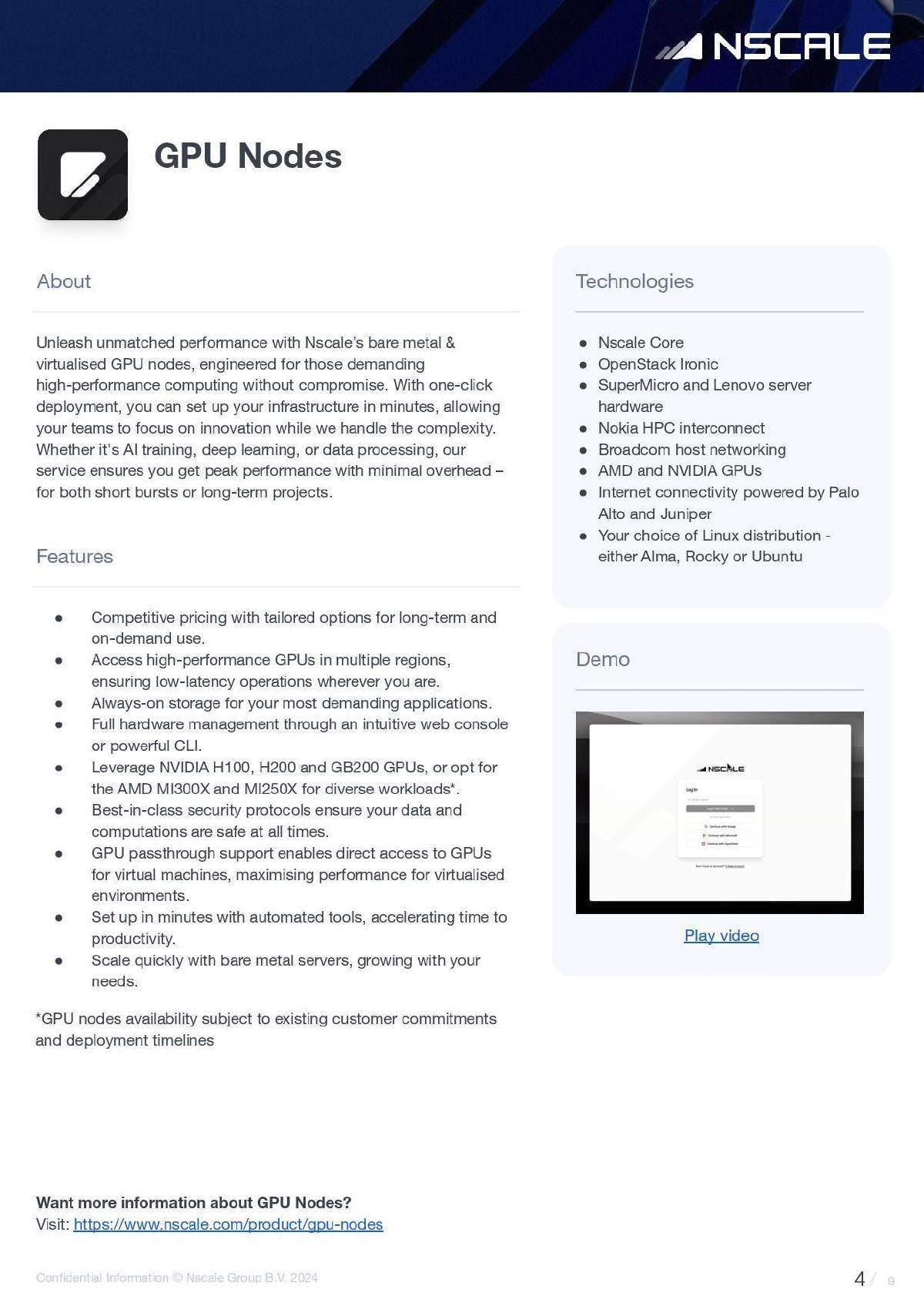
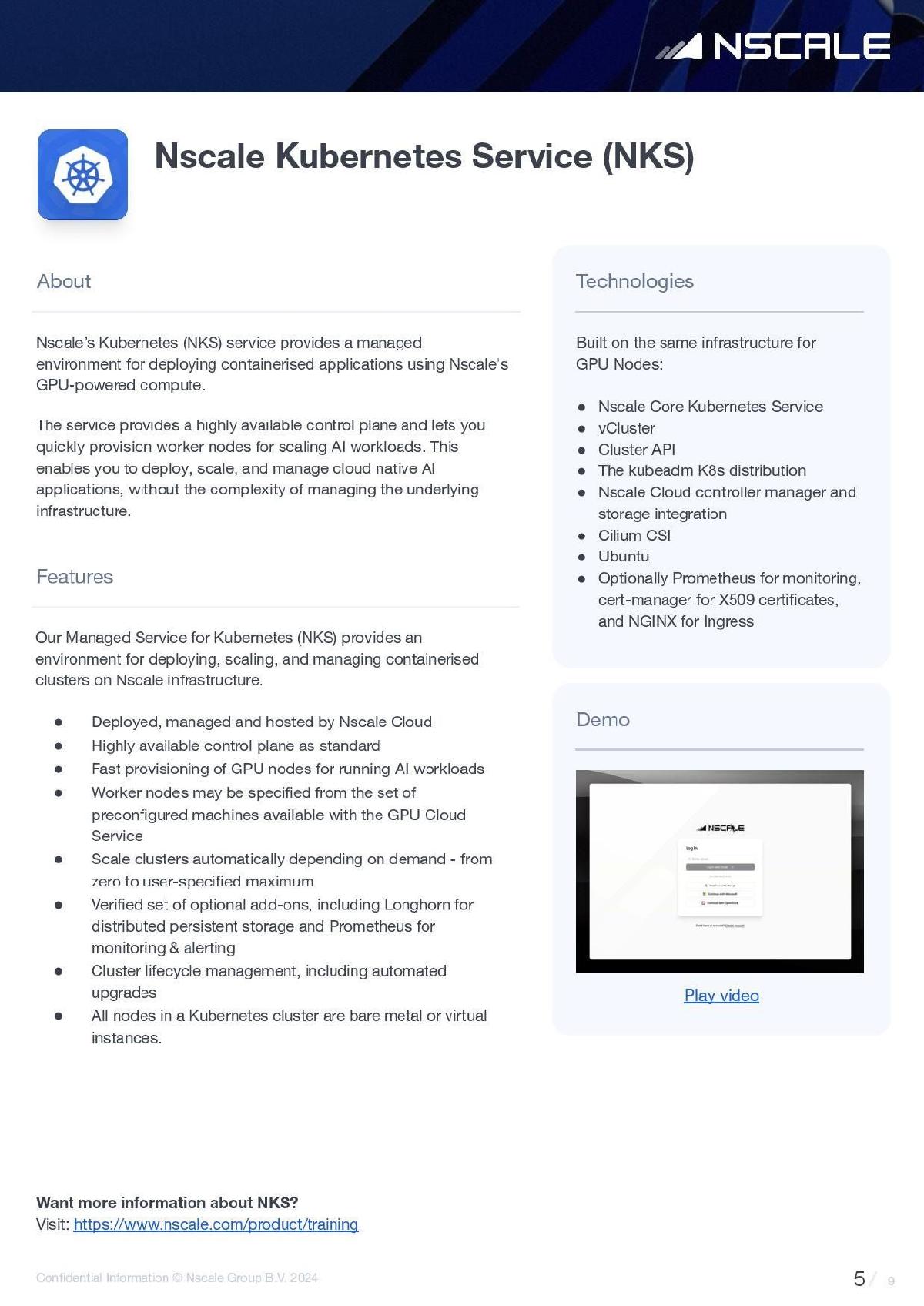
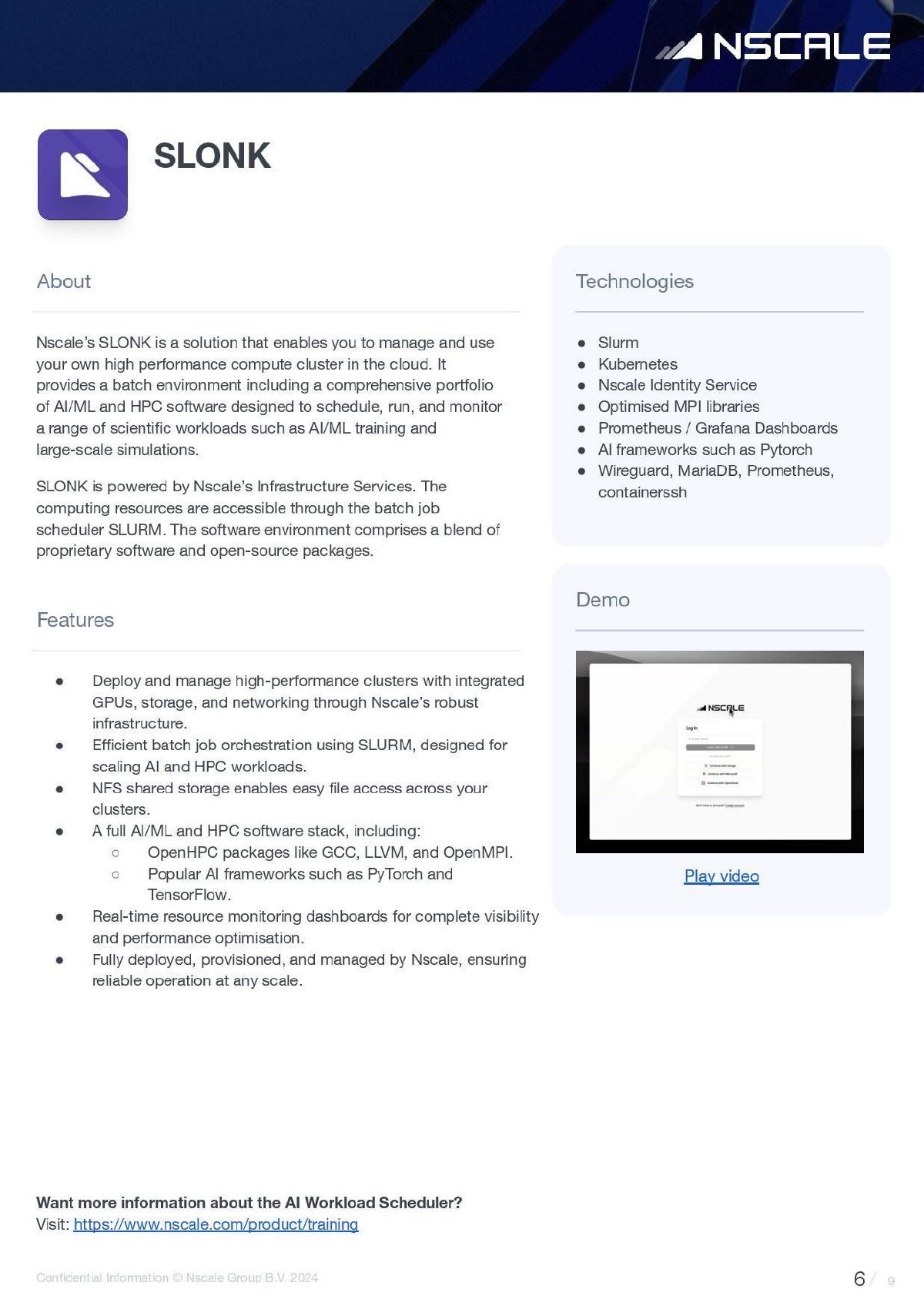
- The technical stack is built on industry standards including Kubernetes (NKS), SLURM for scheduling, and support for NVIDIA H100/H200 and AMD MI300X GPUs (Slide 4, 5, 6).
- The deck omits all financial performance data, current burn rates, and specific customer traction or case studies.
The Infrastructure Play: Nscale's $155M Series A Teardown
Nscale’s pitch deck is a departure from the typical SaaS presentation. In an era where most AI startups are building wrappers or niche applications, Nscale is building the 'foundry.' The deck, which supported a $155M Series A in 2024, focuses almost entirely on the physical and technical foundations required to power the next decade of AI development. It is a high-conviction, asset-heavy pitch that prioritizes engineering pedigree and infrastructure scale over traditional software metrics.
Slide 1: Title Slide
The deck opens with a minimalist title slide. The tagline, "Nscale is the hyperscaler engineered for AI," immediately sets the ambition level. They are not a 'cloud provider' or a 'GPU host'; they are positioning themselves alongside giants like AWS, Google Cloud, and Azure, but with a specific optimization for artificial intelligence. The sub-headline emphasizes 'cost-effective, high-performance infrastructure,' signaling the two primary pain points they intend to solve for AI developers.
Slide 2: Executive Summary, Competitive Advantage, and Leadership
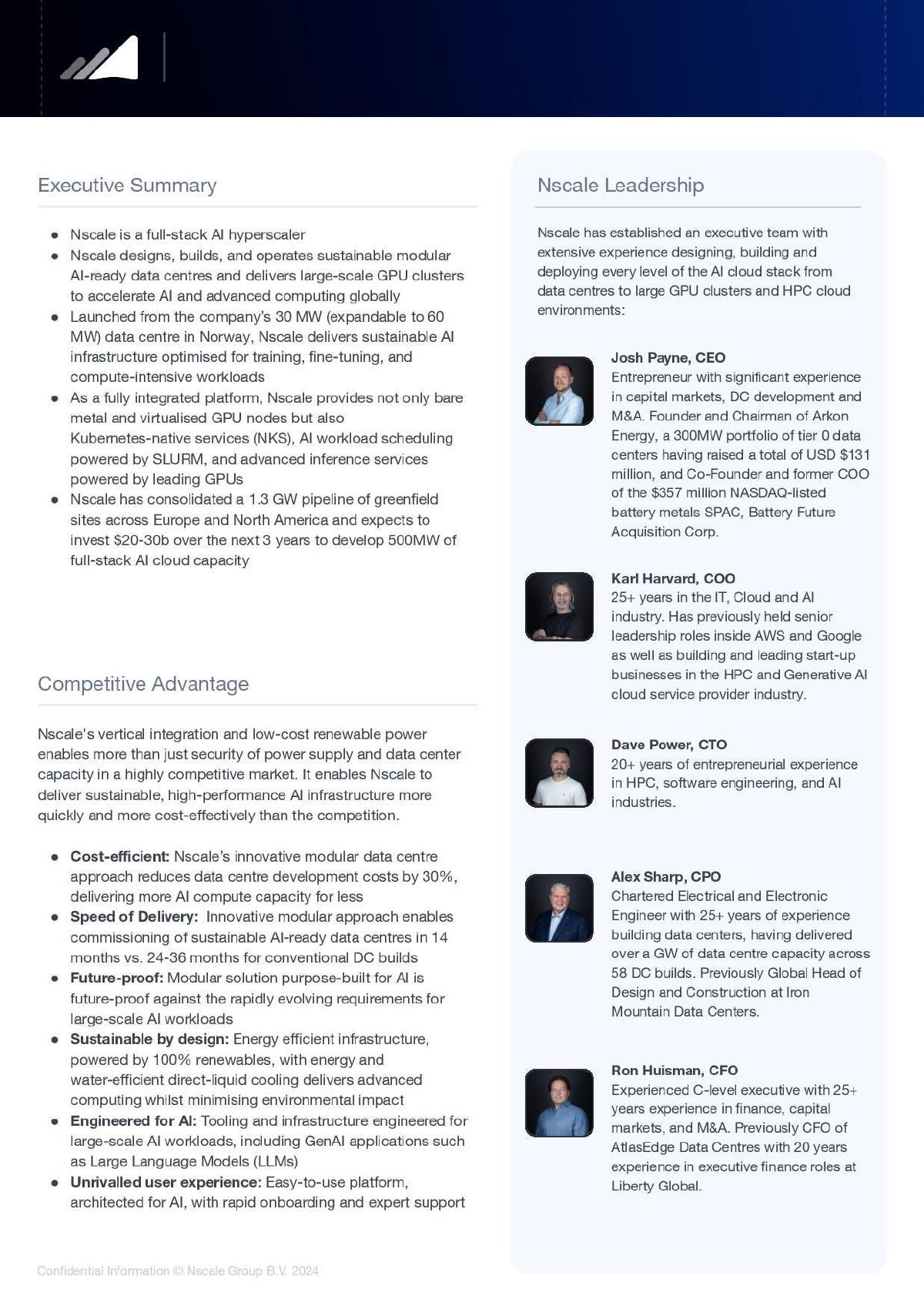
This is the most information-dense slide in the deck, functioning as a 'one-pager' for the entire business. It breaks down the company into three pillars: what they do, why they win, and who is doing it.
Executive Summary: Nscale describes itself as a 'full-stack AI hyperscaler.' Key data points include a 30 MW data center in Norway (expandable to 60 MW) and a staggering 1.3 GW pipeline of greenfield sites. The most ambitious claim is the expectation to invest $20-30b over the next 3 years to develop 500MW of capacity. This scale of capital expenditure is rarely seen in a Series A deck, indicating that Nscale is playing a different game than typical venture-backed startups.
Competitive Advantage: They claim four main edges: cost-efficiency (30% lower DC development costs), speed of delivery (14 months vs. 24-36 months), sustainability (100% renewables), and vertical integration. The speed metric is particularly compelling for investors, as the current AI boom is constrained by how fast compute can be brought online.
Leadership: The team bios are tailored to prove they can handle billions in infrastructure. CEO Josh Payne is noted for raising $131 million for data centers previously, and CPO Alex Sharp is credited with delivering over 1 GW of capacity across 58 builds. This slide effectively de-risks the 'can they actually build this?' question that plagues asset-heavy startups.
Slide 3: The Hyperscaler Ecosystem
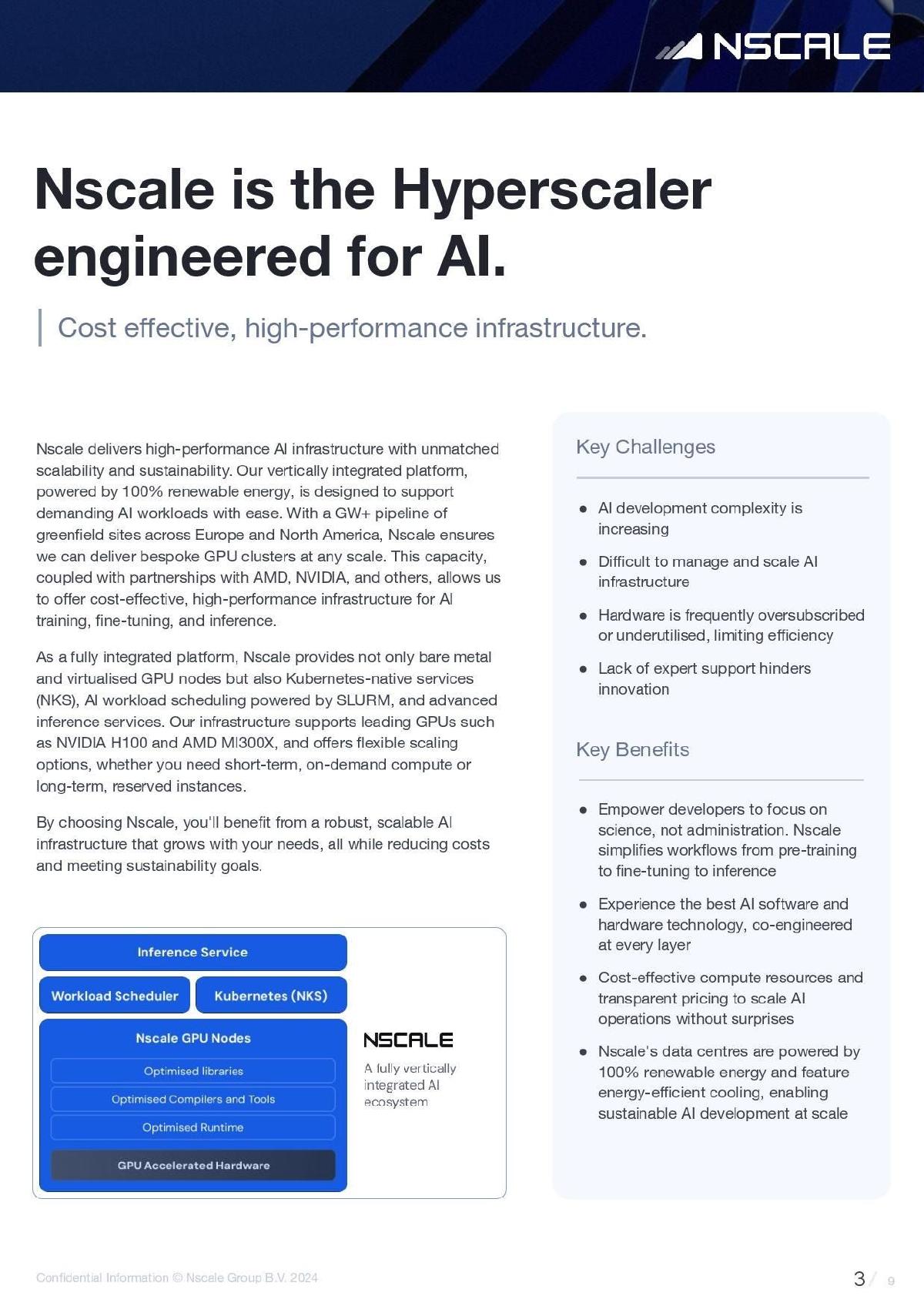
Slide 3 visualizes the 'full-stack' claim. It shows a vertical diagram starting from GPU Accelerated Hardware at the bottom, moving through Optimised Runtime/Compilers , up to Nscale GPU Nodes , and finally the service layer (Kubernetes, Workload Scheduler, and Inference Service). By showing this stack, Nscale argues that they aren't just renting out hardware; they are providing a software-defined environment that makes that hardware useful. The 'Key Challenges' listed—such as hardware being oversubscribed or underutilised—position Nscale as the solution to the inefficiencies of current cloud providers.
Slide 4: GPU Nodes
This slide gets into the technical weeds of the hardware offering. It lists specific, high-demand hardware: NVIDIA H100, H200, and GB200 , alongside AMD MI300X and MI250X . For a Series A investor in 2024, seeing GB200 and MI300X on the roadmap was a signal of Nscale's top-tier hardware partnerships. The 'Technologies' sidebar mentions SuperMicro, Lenovo, Nokia, Broadcom, and Palo Alto , further anchoring the startup in a network of established enterprise vendors. A small 'Demo' box with a link to a video suggests the platform is live and functional, not just a concept.
Slide 5: Nscale Kubernetes Service (NKS)
Slide 5 focuses on the developer experience. By offering a managed Kubernetes environment, Nscale is targeting modern engineering teams who want to deploy containerized AI applications without managing the underlying bare metal. The slide lists technical features like vCluster, Cluster API, and Cilium CSI . This is a 'table stakes' slide for a cloud provider, but it is necessary to prove they have the software maturity to compete with established hyperscalers.
Slide 6: SLONK (Workload Scheduler)
Nscale introduces 'SLONK,' their AI workload scheduler. Powered by SLURM (a standard in high-performance computing), SLONK is designed for batch processing, large-scale simulations, and LLM training. This slide targets the 'heavy lifters' of the AI world—researchers and labs who need to orchestrate thousands of GPUs for weeks at a time. The inclusion of PyTorch and TensorFlow support reinforces their readiness for standard AI workflows.
Slide 7: Inference Service
While slides 4-6 focused on training and orchestration, Slide 7 addresses the 'production' side of AI: inference. They highlight support for Hugging Face models and the Open Inference Protocol V2 . The ability to 'scale from zero to thousands of endpoints' is a direct challenge to serverless inference providers. This slide rounds out the 'full-stack' promise, showing that Nscale supports the entire AI lifecycle from training to deployment.
Slide 8: Glomfjord Data Centre
This slide provides the physical proof of the company's progress. It features photos of the Glomfjord facility in Northern Norway . The location is strategic: the Arctic Circle provides natural cooling, and the facility is powered by 100% renewable hydro power . This isn't just a sustainability play; it's a cost play. Low-cost power is the single biggest operational expense for AI compute, and Nscale is claiming some of the 'lowest cost AI training hubs on earth.' The mention of 30MW expandable to 60MW gives a concrete sense of their current 'Flagship' scale.
Slide 9: DC Landscape and Pipeline
The final slide is the 'vision' slide. It maps out their 1.3 GW pipeline. Beyond the flagship in Norway, they list massive future sites: 400MW in Texas, 333MW in Ohio, and 200MW more in Norway . By mapping these out globally, Nscale shows they are not just a regional European player but a global contender. This slide is designed to justify the large valuation and round size by showing the sheer volume of land and power they have already secured or are targeting.
What Works in the Nscale Deck
The Scale of Ambition: Most startups are afraid to talk about billions of dollars in investment. Nscale leans into it, positioning the $155M round as just the beginning of a $20B+ infrastructure build-out. · Vertical Integration Narrative: The deck clearly explains why owning the data center matters. It’s not just about 'having chips'; it’s about power costs, cooling efficiency, and deployment speed. · Technical Specificity: Listing specific GPU models (GB200) and software protocols (SLURM, Kubernetes) speaks directly to the technical due diligence teams at major VC firms. · De-risking through Pedigree: The leadership slide is exceptionally strong for an infrastructure play. They aren't just 'tech guys'; they are 'data center guys' who have built at gigawatt scale before.
What is Missing from the Nscale Deck
Traction and Revenue: There is no mention of how much revenue the 30MW Glomfjord site is currently generating. Are they at 10% utilization or 100%? Who are the anchor tenants? · Unit Economics: While they claim a 30% cost reduction, the deck lacks a breakdown of the margin profile. Investors would want to see the spread between power/hardware costs and rental revenue. · The Competition: The deck ignores the elephant in the room: CoreWeave, Lambda Labs, and the hyperscalers themselves. There is no 'Competitive Landscape' slide showing where Nscale sits relative to other AI-specific clouds. · The Ask: The deck ends abruptly with a map. It does not state how much they are raising (though we know it was $155M) or how that specific capital will be allocated across the pipeline.
Founder Takeaways: What to Copy
Use 'Hard' Proof: If you have physical assets, show them. The photos of the Norway data center on Slide 8 do more to build trust than a dozen charts could. · Quantify the Pipeline: Nscale doesn't just say they are growing; they list specific megawatts and locations. If your business relies on a pipeline (sales or infrastructure), list the 'Flagship' vs. 'Pipeline' clearly. · Address the Bottleneck: In 2024, the bottleneck for AI was GPUs and Power. Nscale’s deck is built entirely around solving those two specific bottlenecks. Align your deck with the current 'macro' pain point of your industry. · Focus on 'Speed to Market': The claim of 14-month delivery vs. 36-month industry standard is a powerful hook. If you have a process innovation that saves time, make it a central pillar of your competitive advantage.
Frequently asked questions
- How does Nscale justify its massive $155M Series A round?
- The justification lies in the capital-intensive nature of physical infrastructure. Nscale isn't just building software; they are building data centers. Slide 2 notes they expect to invest $20-30 billion in the next three years. A $155M round is essentially 'seed' capital for the massive land, power, and hardware acquisitions required to compete with AWS or Azure in the AI space.
- What is Nscale's primary competitive advantage according to the deck?
- Vertical integration. By designing the modular data centers, securing low-cost renewable power (like the hydro power in Norway mentioned on Slide 8), and building their own software orchestration layer (SLONK), they claim to reduce costs by 30% and deployment time by over 50% compared to traditional data center builds.
- Does the deck mention specific GPU availability?
- Yes. Slide 4 explicitly lists support for NVIDIA H100, H200, and GB200 GPUs, as well as AMD MI300X and MI250X. This is a critical detail for AI startups, as GPU supply was a major bottleneck during the 2023-2024 AI boom.
- Who is the target customer for Nscale?
- While not explicitly named, the technical focus on SLURM, Kubernetes, and Large Language Model (LLM) optimization (Slide 2 and 3) suggests they are targeting AI labs, enterprise GenAI developers, and high-performance computing (HPC) researchers who require massive, sustained compute power.
- What is missing from this pitch deck?
- The deck is entirely devoid of traction metrics. There are no revenue figures, no user growth charts, and no logos of existing customers. It also lacks a 'The Ask' slide detailing exactly how the $155M will be spent, though the infrastructure pipeline on Slide 9 implies the destination of the funds.