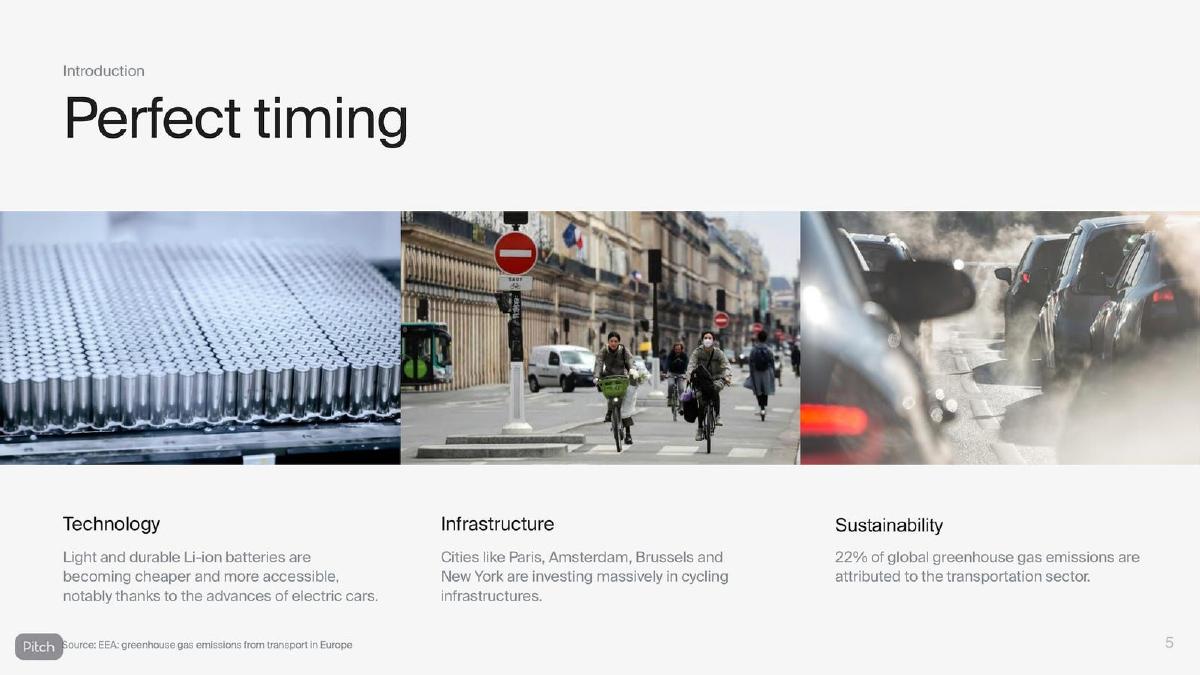
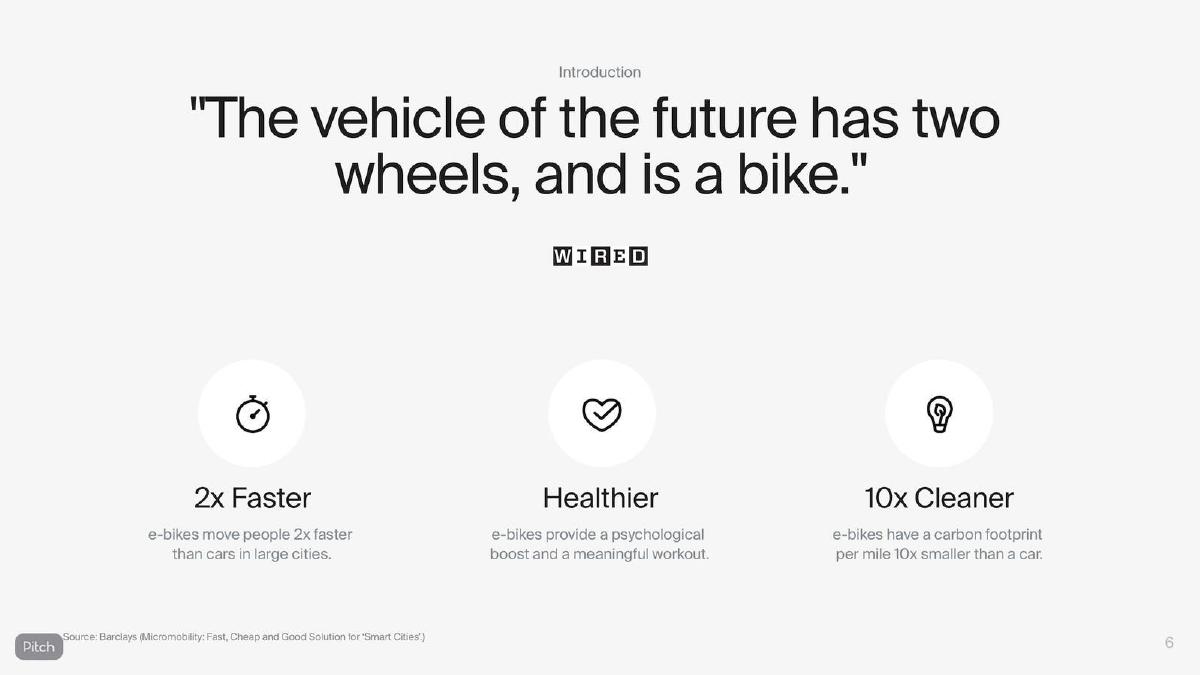
Cowboy’s 30-slide Series C deck is a study in premium brand positioning. Rather than focusing solely on technical specifications, the deck emphasizes the 'connected' nature of the product, blending hardware, software, and services into a unified ecosystem. By highlighting a 70+ NPS (Slide 7) and a 'cult-like community' (Slide 25), Cowboy shifts the narrative from a commodity bicycle to a high-margin technology platform. The deck successfully leverages social proof through prestigious design awards and top-tier venture backing, including Index Ventures and Tiger Global. While it lacks granular…
Key takeaways
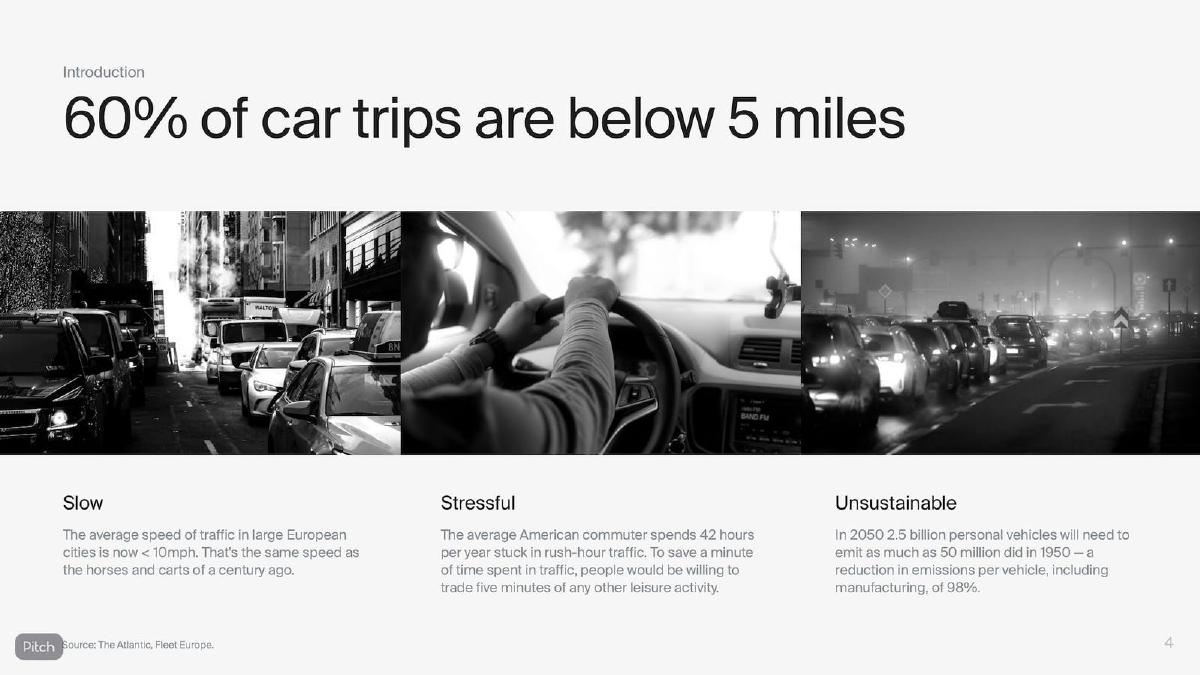
- The deck identifies a massive market inefficiency: 60% of car trips are under 5 miles, yet urban traffic speeds have dropped below 10mph (Slide 4).
- Cowboy positions itself through four pillars: Hardware, Software, Services, and Direct-to-Consumer (Slide 10).
- The company emphasizes design excellence, citing Red Dot 'Best of the Best' awards in 2019 and 2021 (Slide 7).
- Software is a primary differentiator, with features like crash detection and shared position tracking highlighted to improve rider safety (Slide 19).
- The business model includes recurring revenue streams through theft insurance and maintenance subscriptions (Slide 10).
- Customer loyalty is quantified with a 70+ Net Promoter Score (NPS) across both test rides and after-sales experience (Slide 10).
- The deck showcases a global footprint, operating in 12 countries across Europe and the US (Slide 7).
- Investor pedigree is a central trust signal, listing previous rounds led by Hardware Club, Index Ventures, Tiger Global, and Exor (Slide 28).
Cowboy: The $80M Series C Pitch Deck Analysis
Cowboy’s Series C deck is a masterclass in aesthetic storytelling. In an industry often bogged down by gear ratios and battery watt-hours, Cowboy chooses to sell a lifestyle and a solution to urban decay. The deck, which supported an $80 million raise in 2022, focuses on the 'connected' experience, bridging the gap between a physical product and a digital service.
Slides 1-3: Brand Immersion
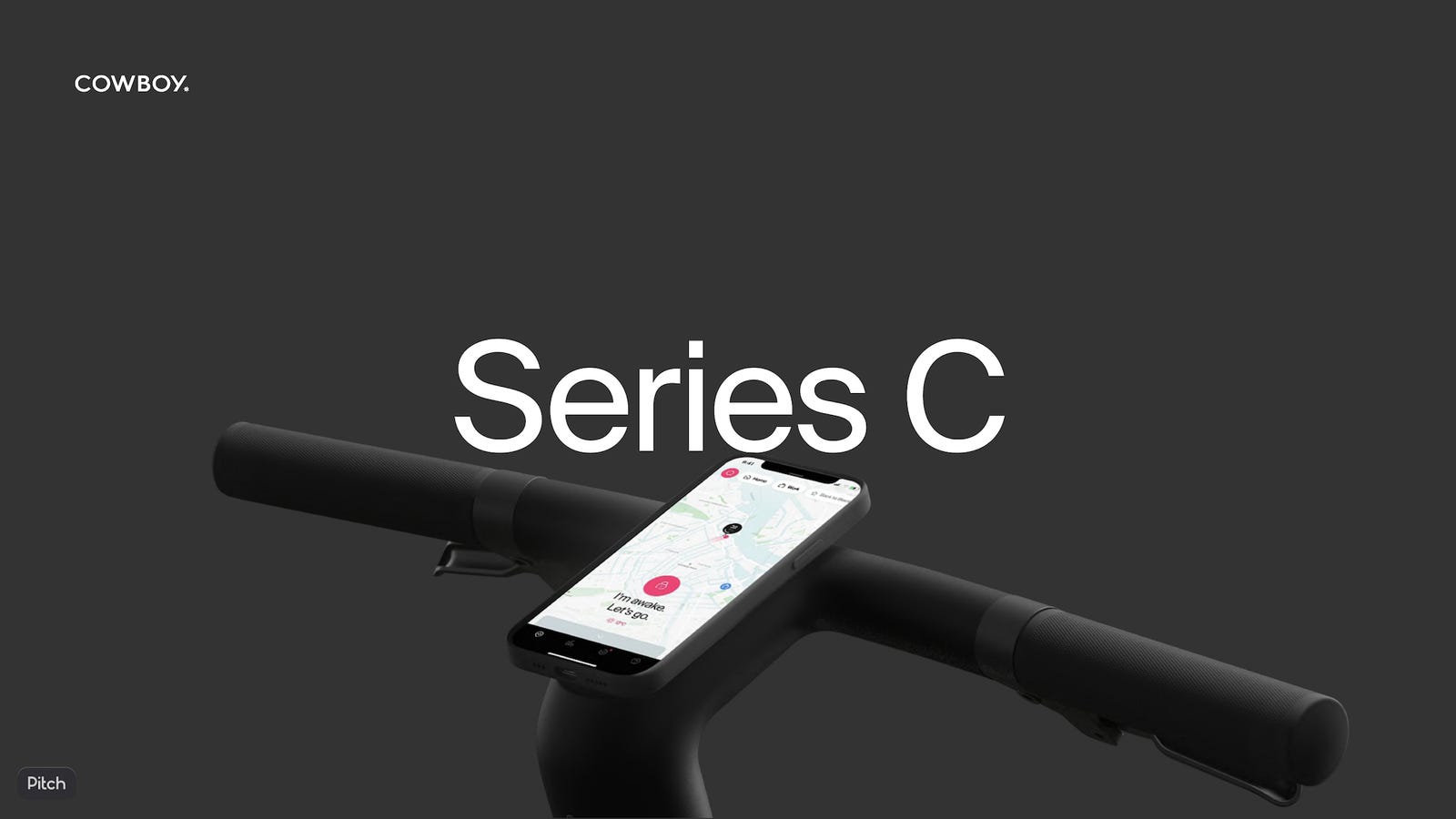
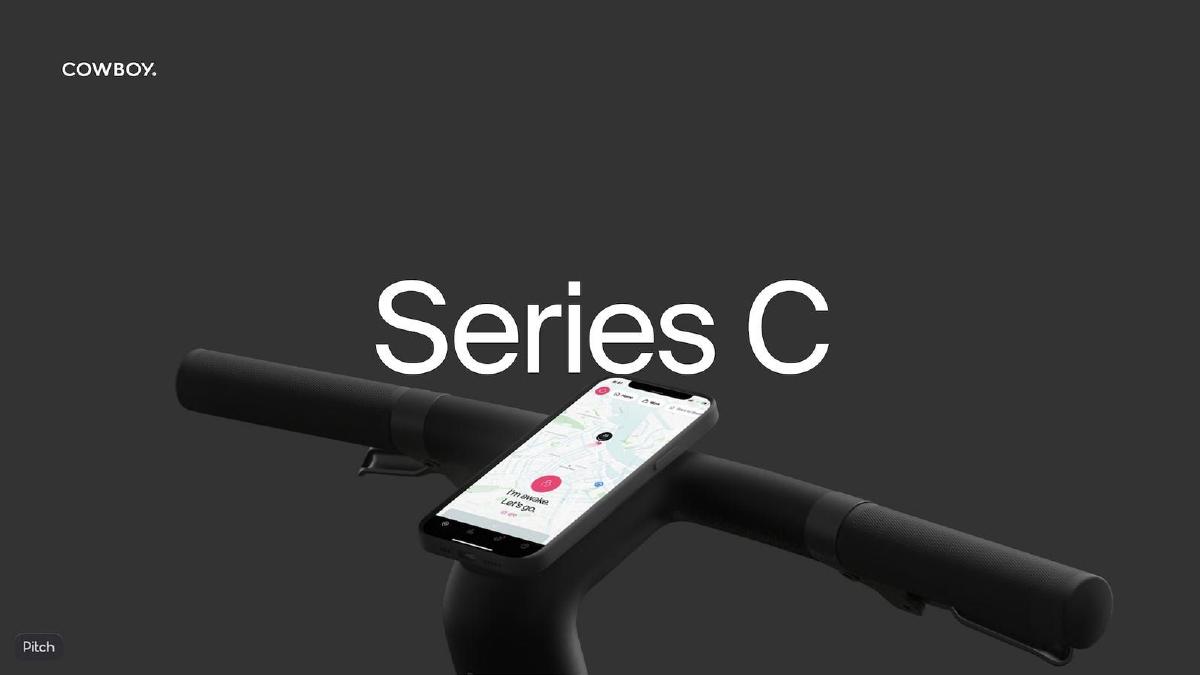
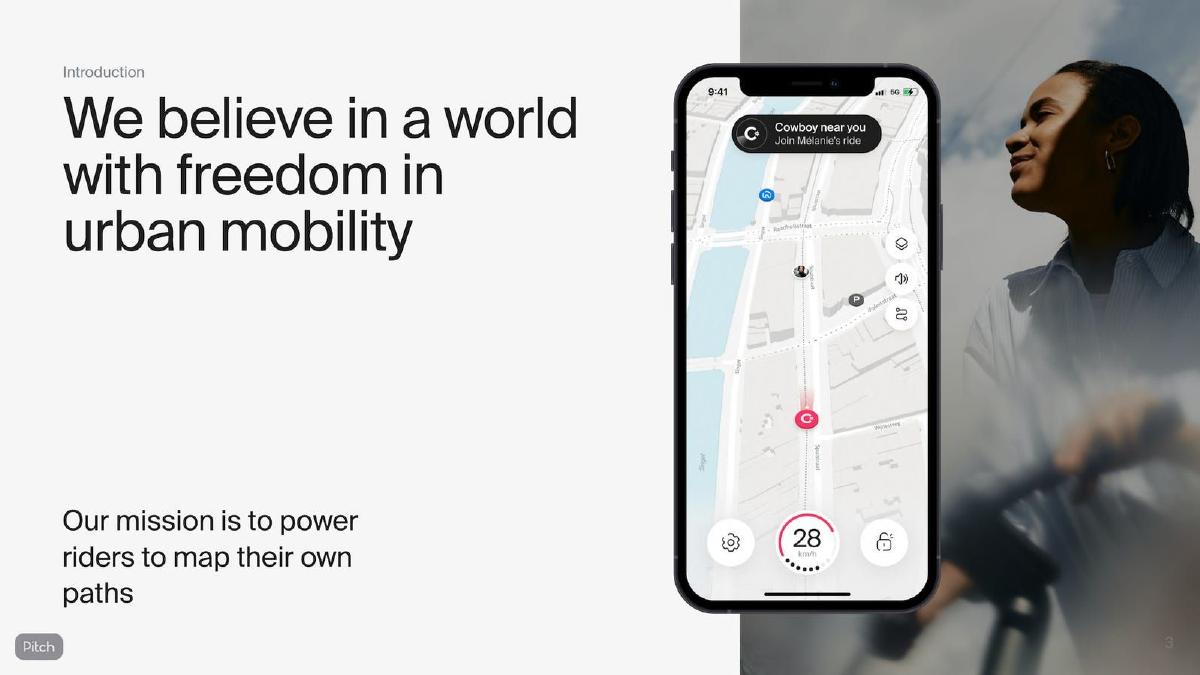
The opening of the deck is minimalist. Slides 1 through 3 contain only the company name 'Cowboy.' This is a bold choice for a Series C deck, signaling a brand that believes its visual identity and reputation precede it. It forces the viewer to focus on the high-fidelity product photography—specifically the integrated cockpit where a smartphone acts as the bike's dashboard. This immediately establishes the 'Software-Enabled Hardware' thesis.
Slide 4: The Problem Statement
Slide 4 provides the macro-economic justification for the business. It leads with a powerful statistic: '60% of car trips are below 5 miles.' The slide categorizes the current state of urban transport into three buckets: Slow (average speeds in European cities are < 10mph), Stressful (42 hours per year stuck in traffic), and Unsustainable (the need for a 98% reduction in emissions per vehicle by 2050). By framing the car as an obsolete tool for short distances, Cowboy positions the e-bike not as a toy, but as a necessary infrastructure upgrade.
Slide 7: Cowboy at a Glance
This is the 'traction' slide, and it is densely packed with social proof. Key figures include:
100,000 Riders: A target set for 2023. · $80m Series C: Explicitly stating the round size and backing by Index Ventures and Tiger Global. · Multiple Revenue Streams: Mentioning bike sales, accessories, and subscription services. · 12 Countries: Showing geographic diversification across Europe and the US. · 70+ NPS: A critical metric for a D2C brand, indicating high customer satisfaction. · Red Dot Best of the Best: Highlighting design awards from 2019 and 2021.
Slide 10: The Four Pillars
Cowboy defines its competitive advantage through four distinct areas: Hardware (award-winning design), Software (industry-leading integrated app), Services (recurring revenue via theft insurance and maintenance), and Direct-to-Consumer (high NPS and controlled customer experience). This slide is crucial because it explains how they will achieve the margins necessary to justify a Series C valuation in a hardware-heavy sector.
Slides 13 & 16: Hardware Excellence
Slide 13 focuses on the 'Automatic transmission,' removing the complexity of traditional cycling. Slide 16 uses a quote from Wallpaper magazine: 'Cutting edge of modern commuting. Simplicity is the watchword.' By using a lifestyle and design publication rather than a cycling magazine, Cowboy reinforces its position as a premium consumer tech brand rather than a sports equipment company.
Slides 19 & 22: Software as a Safety Feature
Slide 19 introduces the safety features powered by the app, including crash detection, brake lights, and shared position tracking. The visual shows a smartphone interface asking 'What happened?' with options to alert emergency contacts. Slide 22 follows up with a quote from TechRadar , calling it 'The most well developed e-bike app we've tested to date.' This section is designed to prove that the software isn't just a gimmick—it's a core part of the utility and safety of the vehicle.
Slide 25: Community and Culture
Slide 25 is a collage of user-generated content titled 'Cult-like community of riders.' It reiterates the 70 NPS for the after-sales experience. In the world of D2C, community is a moat. If users are proud to be seen with the product, the cost of customer acquisition (CAC) decreases over time through organic word-of-mouth. The images show a diverse range of urban professionals, further defining the target demographic.
Slide 28: The Investor Pedigree
The final significant slide lists the lead investors from every round, from Pre-Seed to Series C. This 'wall of fame' includes:
Alexis Houssou (Hardware Club): $0.8m Pre-Seed. · Martin Mignot (Index Ventures): $2.8m Seed. · Lee Fixel (Tiger Global): $11m Series A. · Noam Ohana (Exor Seeds): $26m Series B. · Sita Chantramonklasri (Siam Capital): $80m Series C.
This slide serves as the ultimate validation. For a new investor, seeing Tiger Global and Index Ventures doubling down through the stages reduces the perceived risk of the hardware business model.
What Cowboy's Deck Does Well
Visual Consistency: The deck uses a dark, premium color palette and high-quality photography that matches the product's physical design. This creates a cohesive brand experience for the investor.
Focus on 'Connectedness': By emphasizing the app and recurring services, Cowboy addresses the primary concern with hardware startups: the lack of recurring revenue. They successfully frame the bike as a platform rather than just a product.
Social Proof: The deck is relentless with awards (Red Dot) and press quotes (Wallpaper, TechRadar). This external validation is vital for a high-end consumer play.
What is Missing from the Deck
Unit Economics: While the deck mentions 'multiple revenue streams,' it does not provide data on the Contribution Margin per bike or the Customer Acquisition Cost (CAC) vs. Lifetime Value (LTV). For a Series C, these are usually the most scrutinized numbers.
Competitive Landscape: There is no mention of competitors like VanMoof or Specialized. Investors at this stage want to know how Cowboy wins against both other 'smart' bikes and established legacy manufacturers.
Financial Projections: The deck is light on forward-looking financial data, focusing instead on the '100,000 riders' milestone. While the full data room likely contained these details, their absence from the pitch narrative is notable.
Lessons for Founders
Sell the Problem, Not the Specs: Cowboy doesn't start with battery life; they start with the fact that cars are too slow for cities. Founders should always lead with the 'Why' before the 'What.'
Quantify Love: If you are a consumer brand, NPS is your most important metric. Cowboy's repeated use of their 70+ NPS score proves that their growth is sustainable and driven by happy customers.
Build a Narrative Arc: The transition from the problem (traffic) to the solution (hardware) to the ecosystem (software/services) to the validation (investors/awards) is a perfect logical flow for a growth-stage pitch.
Frequently asked questions
- What is Cowboy's primary value proposition?
- Cowboy positions itself as a premium, connected urban mobility solution. It differentiates through a seamless integration of high-end hardware (automatic transmission), proprietary software (navigation and safety features), and a direct-to-consumer service model that includes recurring revenue from insurance and maintenance.
- How does Cowboy address the 'hardware is hard' investor bias?
- They counter this by emphasizing their software ecosystem and recurring revenue streams. By highlighting their 'Integrated App' and services like 'Cowboy Care,' they demonstrate that the hardware is a gateway to a long-term, high-margin relationship with the customer, rather than a one-time transaction.
- What metrics does Cowboy use to prove product-market fit?
- The deck relies heavily on Net Promoter Score (NPS), reporting a score of 70+ for both the initial test ride and the post-purchase experience. They also cite a target of 100,000 riders by 2023 and their presence in 12 international markets as evidence of scalability.
- Who are the key investors mentioned in the deck?
- The deck lists a prestigious roster of backers: Alexis Houssou (Hardware Club) for Pre-Seed, Martin Mignot (Index Ventures) for Seed, Lee Fixel (Tiger Global) for Series A, Noam Ohana (Exor Seeds) for Series B, and Sita Chantramonklasri (Siam Capital) for the $80M Series C.
- What specific hardware features are highlighted?
- Cowboy focuses on simplicity and technology, specifically highlighting their automatic transmission system and a design that won the Red Dot 'Best of the Best' award. The visual language of the deck emphasizes a minimalist, 'cutting edge' aesthetic.