Crash’s 2018 pre-seed deck is a study in minimalist storytelling. With only nine slides, the company secured $1.3 million by focusing almost exclusively on the emotional and statistical frustration of the modern job hunt. The deck identifies a specific inefficiency—the 150 applications required to get one offer—and proposes a 'Reverse Jobs Board' as the solution. While it lacks standard venture components like a competitive matrix, detailed business model, or financial projections, it leverages strong social proof through user testimonials and a team slide featuring notable backers like Steve…
Key takeaways
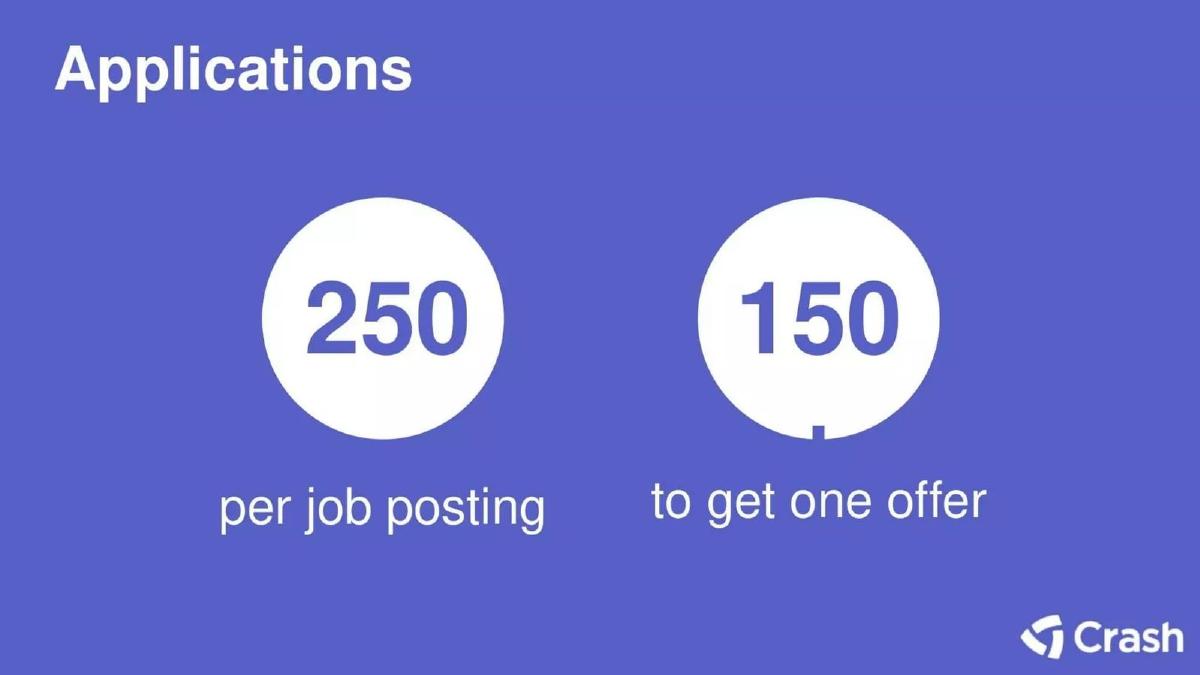
- The deck identifies a high friction point in the labor market, noting on slide 4 that it takes 150 applications to get one job offer.
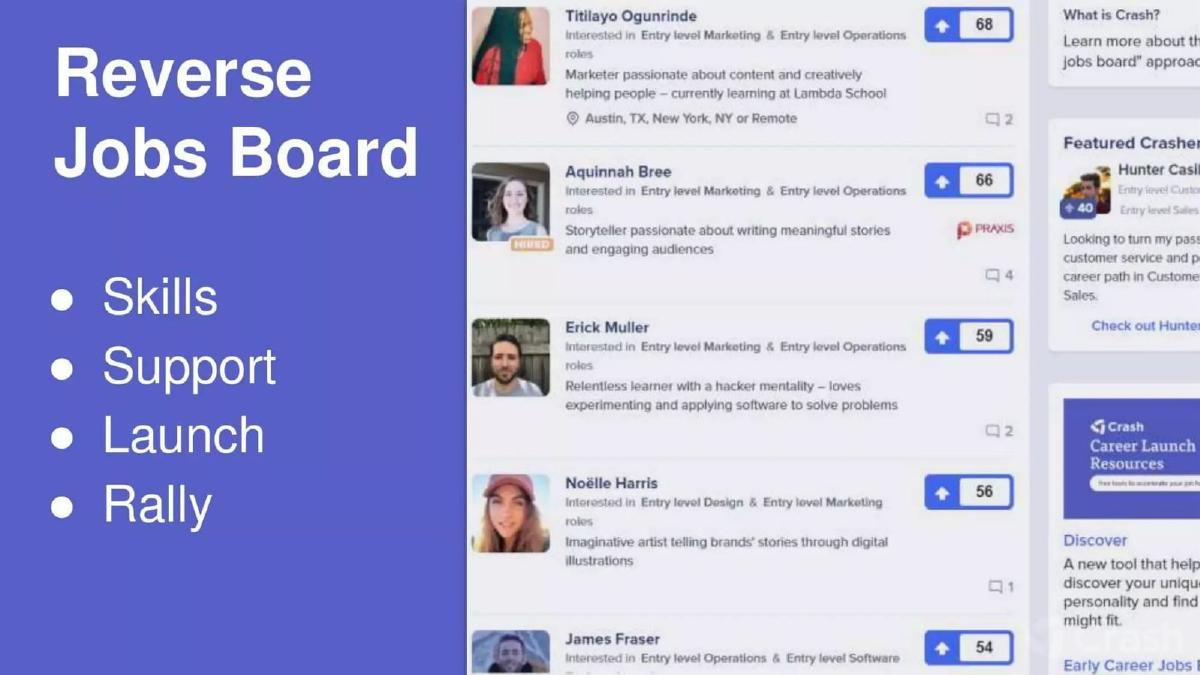
- Crash positions its product as a 'Reverse Jobs Board' on slide 5, focusing on skills, support, launch, and rally.
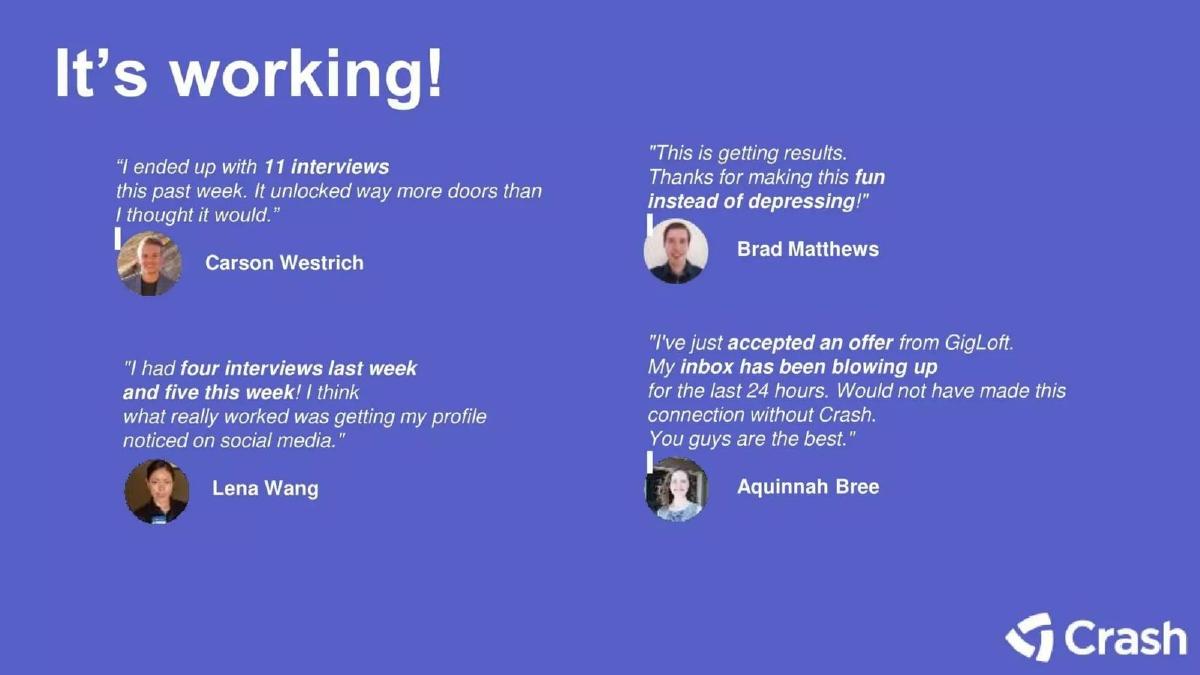
- The presentation relies heavily on qualitative social proof, dedicating slide 6 entirely to four user testimonials.
- The team slide (slide 7) highlights a five-person core team and lists high-profile advisors and investors including Steve Blank and Floodgate.
- The deck contains zero mentions of revenue, pricing models, or unit economics.
- There is no competitive analysis or market sizing (TAM/SAM/SOM) included in the nine slides.
- The company sets a specific long-term impact goal on slide 8: launching 10 million careers by 2024.
- The visual style is extremely minimalist, using large typography and high-contrast colors to maintain focus on single ideas per slide.
The Minimalist Approach to Pre-Seed Fundraising
The Crash pitch deck from 2018 is a notable example of narrative-led fundraising. Consisting of only nine slides, the deck helped the company secure $1.3 million in funding. It does not follow the traditional Sequoia-style template that mandates a slide for every business function. Instead, it focuses on the emotional and systemic failure of the current job market, positioning Crash as the necessary disruptor. This teardown examines how a lean deck can still be effective by leaning heavily on team credibility and user validation.
Slides 1-3: The Emotional Hook and Problem Identification
Slide 1 is a simple title slide featuring the Crash logo against a white background with confetti-like accents. It establishes the brand identity but offers no tagline or mission statement, forcing the viewer to move quickly to the next slide to understand the value proposition.
Slide 2 uses a full-bleed image of a barista with the text "Waiting for more" overlaid on a blue translucent block. This is a classic 'emotional hook' slide. It represents the underemployed or the aspiring professional stuck in a service role, visually defining the target demographic without using a single statistic. It sets the stage for a 'hero's journey' narrative where the candidate is the protagonist.
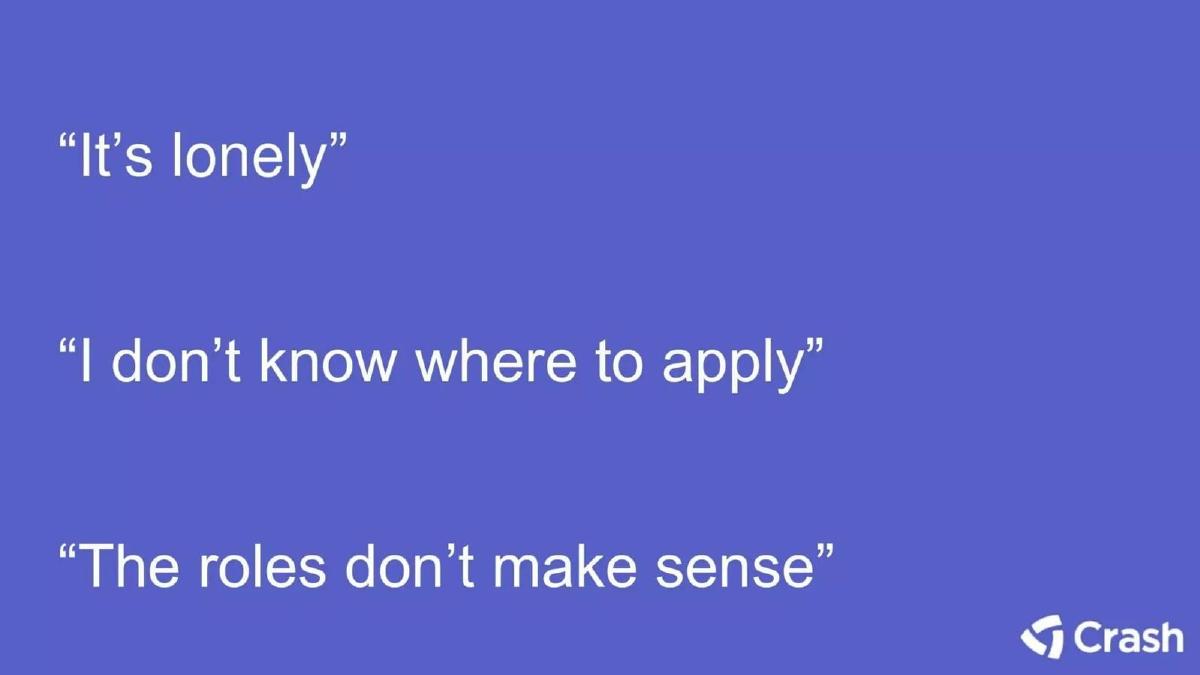
Slide 3 deepens the problem statement by using direct quotes: "It’s lonely," "I don’t know where to apply," and "The roles don’t make sense." By presenting the problem through the voice of the user, Crash avoids sounding like a detached corporate entity. This slide identifies the psychological friction of the job search, which is often overlooked in favor of purely technical problems in EdTech decks.
Slide 4: The Statistical Reality
Slide 4 provides the quantitative weight to the emotional arguments made previously. It presents two stark figures: "250 per job posting" and "150 to get one offer." These numbers define the inefficiency of the current market. By highlighting that a candidate must apply 150 times to receive a single offer, Crash justifies the need for a radical new approach. This is the only slide in the first half of the deck that uses data, and it chooses the most impactful metric possible to illustrate a 'broken' system.
Slide 5: The Solution - The Reverse Jobs Board
Slide 5 introduces the core product concept: the "Reverse Jobs Board." The slide features a screenshot of the platform's interface, showing candidate profiles with upvotes and skill tags. To the left, four bullet points outline the platform's pillars: Skills, Support, Launch, and Rally. This slide is crucial because it explains the 'how.' Instead of a traditional job board where candidates hunt for roles, the 'Reverse' model suggests a marketplace where candidates are showcased to employers. The UI shown includes profiles for individuals like Titilayo Ogunrinde and Aquinnah Bree, emphasizing that the product is already live and populated with talent.
Slide 6: Proof of Concept
Slide 6 , titled "It’s working!" , is the deck's traction slide. Rather than showing a 'hockey stick' growth chart, Crash uses four testimonials. Carson Westrich mentions ending up with "11 interviews this past week," while Lena Wang notes having "four interviews last week and five this week." Aquinnah Bree explicitly states she "just accepted an offer from GigLoft." These quotes serve as social proof that the 'Reverse Jobs Board' model effectively bypasses the 150-application hurdle mentioned on Slide 4. For a pre-seed deck, this qualitative evidence is often more persuasive than early-stage, volatile traffic data.
Slide 7: The Team and Backers
Slide 7 is arguably the strongest slide in the deck for a pre-seed round. Titled "Scrappy, startup veterans," it introduces the five-person team: Isaac Morehouse (Founder/CEO), Mitchell Earl (Director of Marketing), Ilya Radchenko (Sr. Engineer), Chuck Grimmett (Product Manager), and Dave Wasmer (Lead Engineer). The inclusion of specific roles suggests a balanced team capable of both product development and market entry.
However, the bottom half of the slide is what likely secured the $1.3 million. It features logos for Praxis, Floodgate, Moment Ventures, Alerion Ventures, and 500 Startups. Most notably, it includes a photo of Steve Blank , the father of the Lean Startup movement. This level of institutional and advisory backing at the pre-seed stage signals to investors that the founders are already vetted by some of the most respected names in venture capital.
Slides 8-9: Vision and Call to Action
Slide 8 presents the company's long-term ambition: "We’re launching 10 million careers by 2024." This serves as a proxy for a market size slide. By stating a goal of 10 million successful outcomes, the founders are implying a massive scale without getting bogged down in the methodology of a TAM/SAM/SOM calculation. It is a bold, time-bound commitment that appeals to the 'impact' side of venture investing.
Slide 9 is the closing slide, featuring a man looking at a wall of sketches and notes with the text "Launch your career" and the founder's email address: isaac@crash.co. It is a clean, professional finish that maintains the minimalist aesthetic of the entire presentation.
What Works in This Deck
The primary strength of the Crash deck is its narrative clarity. It identifies a specific, painful inefficiency (150 applications per offer) and offers a specific, structural solution (Reverse Jobs Board). By the time an investor reaches the team slide, the 'why' and 'what' have been clearly established, leaving only the 'who' to be validated. The use of social proof via testimonials on Slide 6 is also highly effective, as it transforms the product from a theoretical concept into a proven tool that gets people hired. Finally, the investor logos on Slide 7 provide immediate 'FOMO' (fear of missing out) and credibility, which is essential for closing a $1.3 million round at such an early stage.
What Is Missing from This Deck
Despite its success, the deck omits several standard components that many investors require:
Business Model: There is no mention of how Crash makes money. Do they charge candidates, employers, or both? Is it a subscription model or a placement fee? · Competitive Landscape: The deck does not address how Crash differs from LinkedIn, Indeed, or Hired.com. It assumes the investor agrees the current market is broken but doesn't explain why Crash will win over existing giants. · Financial Projections: There are no burn rate figures, revenue targets, or unit economics. · The Ask: The deck does not state how much money is being raised or how the funds will be allocated. While the catalogue facts state $1.3 million was raised, that information is not on the slides. · Market Sizing: While Slide 8 mentions 10 million careers, it doesn't translate this into a dollar-value market opportunity.
What a Founder Should Copy
Founders should emulate the visual consistency and brevity of this deck. Each slide focuses on one single idea, which prevents 'cognitive overload' during a pitch. The problem-first approach on Slides 2-4 is a masterclass in building empathy before introducing technology. Additionally, if a founder has high-profile advisors or early investors, they should follow Crash’s lead on Slide 7 by giving those logos and names prominent placement. This deck proves that at the pre-seed stage, you don't need a 30-page document; you need a compelling story, evidence that the product works, and a team that investors can trust.
Frequently asked questions
- How did Crash raise $1.3M without a business model slide?
- At the pre-seed stage, investors often prioritize the founder's vision, the team's pedigree, and the clarity of the problem being solved. Crash's deck focuses on the 'broken' state of hiring, using slide 4 to show the inefficiency of 250 applications per posting. By demonstrating early user traction through testimonials on slide 6 and showcasing a team backed by Floodgate and 500 Startups on slide 7, they built enough credibility to defer detailed monetization discussions to the live pitch.
- What is a 'Reverse Jobs Board' as described in the deck?
- Slide 5 introduces the 'Reverse Jobs Board' concept. Instead of companies posting roles and candidates applying, the UI suggests a platform where candidates are featured based on their skills and personality. The slide lists four pillars: Skills, Support, Launch, and Rally. This flips the traditional power dynamic of hiring, placing the candidate's profile at the center of the discovery process for employers.
- Why is the team slide so effective in this deck?
- Slide 7 is effective because it balances internal execution capability with external validation. It lists a Founder/CEO, two engineers, a product manager, and a marketing director, showing a complete 'build and sell' unit. Below the team, it displays logos for Praxis, Floodgate, Moment Ventures, and 500 Startups, alongside a photo of Lean Startup pioneer Steve Blank. This immediately signals to new investors that the company has already passed the due diligence of respected industry veterans.
- Is the lack of market sizing a mistake for a pre-seed deck?
- While most decks include a TAM (Total Addressable Market) slide, Crash opts for a mission statement instead. Slide 8 claims they will launch '10 million careers by 2024.' This implies a massive market without using the traditional 'billions of dollars' charts. For a pre-seed round, showing a path to millions of users is often a proxy for market size, though more conservative investors might find the omission of financial data a red flag.
- What role do the testimonials play in the fundraising narrative?
- Slide 6, titled 'It's working!', serves as the primary evidence of product-market fit. By quoting specific users like Carson Westrich and Lena Wang, the deck proves that the 'Reverse Jobs Board' isn't just a concept—it is generating interviews and job offers. In the absence of a growth chart or revenue figures, these qualitative wins provide the 'traction' necessary to justify a $1.3 million investment.