Creddinv Technologies is a fintech platform designed to bridge the gap between Indian investors and early-stage startups. The deck outlines a three-pronged business model: a 'Premium Series' for private rounds, an Alternative Investment Fund (AIF) for Pre-Series A companies, and a venture debt product offering 12-18% coupon rates. While the deck provides clear revenue take-rates (ranging from 1% to 4% depending on the product), it is a pre-revenue presentation. The roadmap indicates platform development began in January 2024 with a target launch in mid-May. The deck lacks critical data such a…
Key takeaways
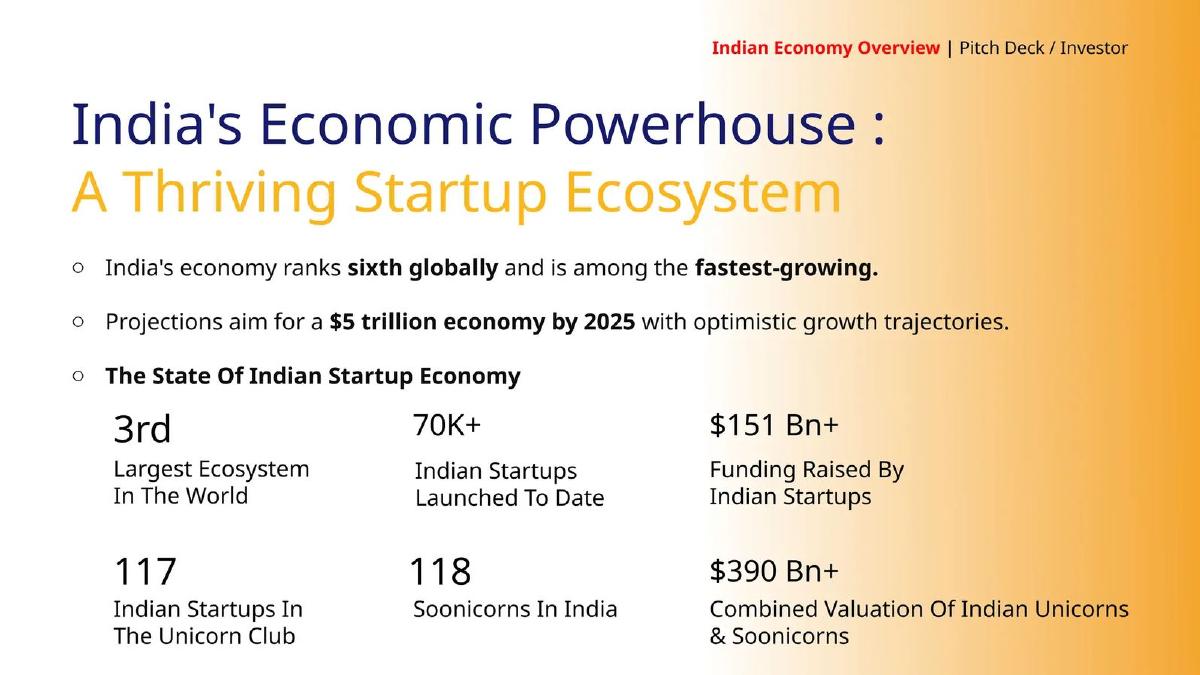
- The platform targets the Indian startup ecosystem, which the deck notes has over 70,000 startups and 117 unicorns (Slide 2).
- Creddinv operates three distinct product lines: Private Rounds, AIF (CAT-1), and Venture Debt (Slide 8).
- The AIF product generates revenue at a rate of 2-4% of total investment raised for Pre-Series A companies (Slide 10).
- Venture debt instruments offer investors a coupon rate of 12-18% with durations of 12-36 months (Slide 11).
- Platform development was initiated in January 2024, with a launch goal of mid-May 2024 (Slide 12).
- The founders, Anil Kar and Nandakishor L, both cite backgrounds at QI Ventures and various Indian banks (Slides 4-5).
- The company plans to seek a formal valuation in Q3 to coincide with the onset of revenue generation (Slide 12).
- The stated exit strategy involves reaching a valuation of 150 crores to attract VCs and family offices (Slide 13).
Executive Summary and Market Context
Slide 1: Title Slide
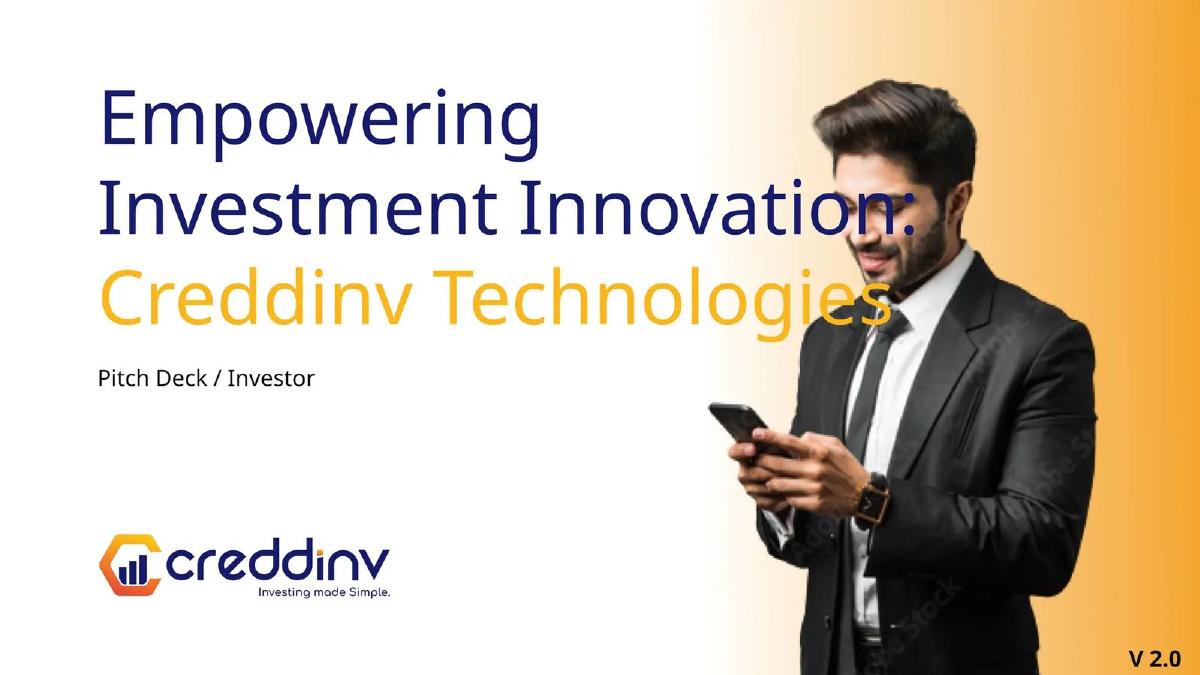
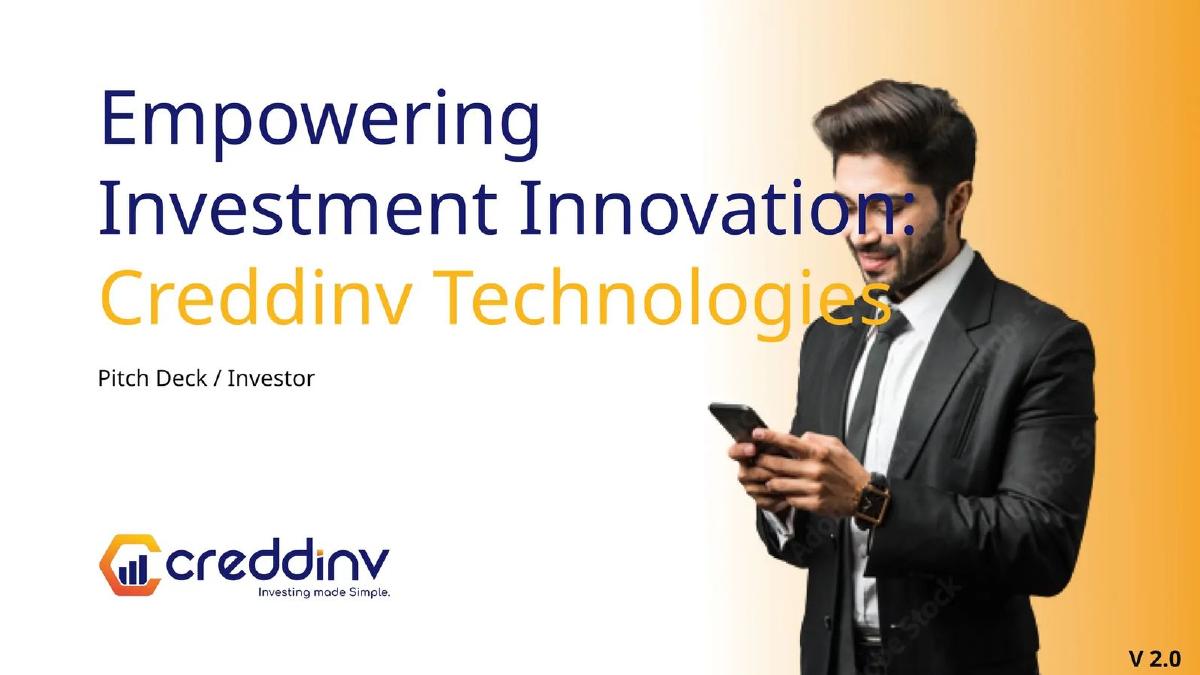
The deck opens with the title 'Empowering Investment Innovation: Creddinv Technologies.' The subtitle 'Investing made Simple' serves as the brand promise. The visual features a professional using a smartphone, reinforcing the mobile-first nature of the platform. A version tag 'V 2.0' is visible in the bottom right corner, suggesting an iterative approach to the pitch.
Slide 2: Indian Economy Overview
This slide establishes the 'Why Now' by highlighting the scale of the Indian startup ecosystem. It cites that India is the 3rd largest ecosystem globally with over 70,000 startups launched. Key metrics include $151 Bn+ in funding raised by Indian startups and a combined valuation of $390 Bn+ for the country's 117 unicorns and 118 'soonicorns.' This slide serves to validate the total addressable market (TAM) without naming it explicitly.
Company Mission and Leadership
Slide 3: Introduction
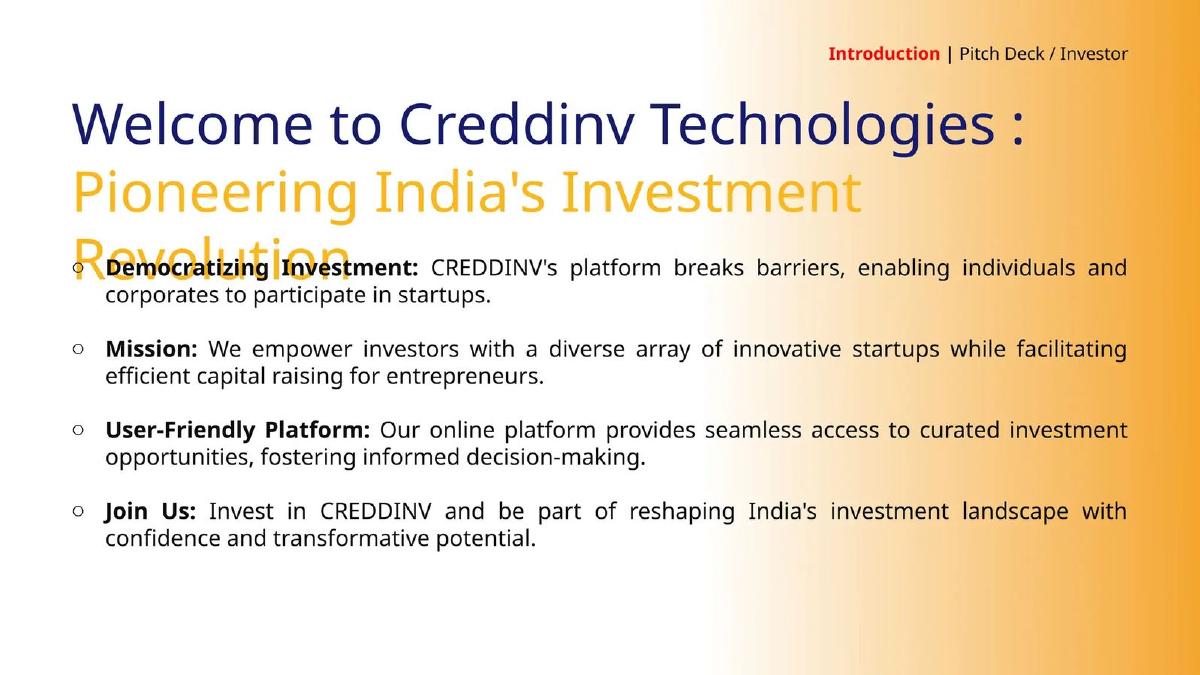
Creddinv defines its mission as democratizing investment by breaking barriers for individuals and corporates. The slide emphasizes a 'User-Friendly Platform' and 'curated investment opportunities.' The language is high-level, focusing on 'informed decision-making' and 'transformative potential' rather than technical specifications.
Slide 4: Visionaries - Anil Kar
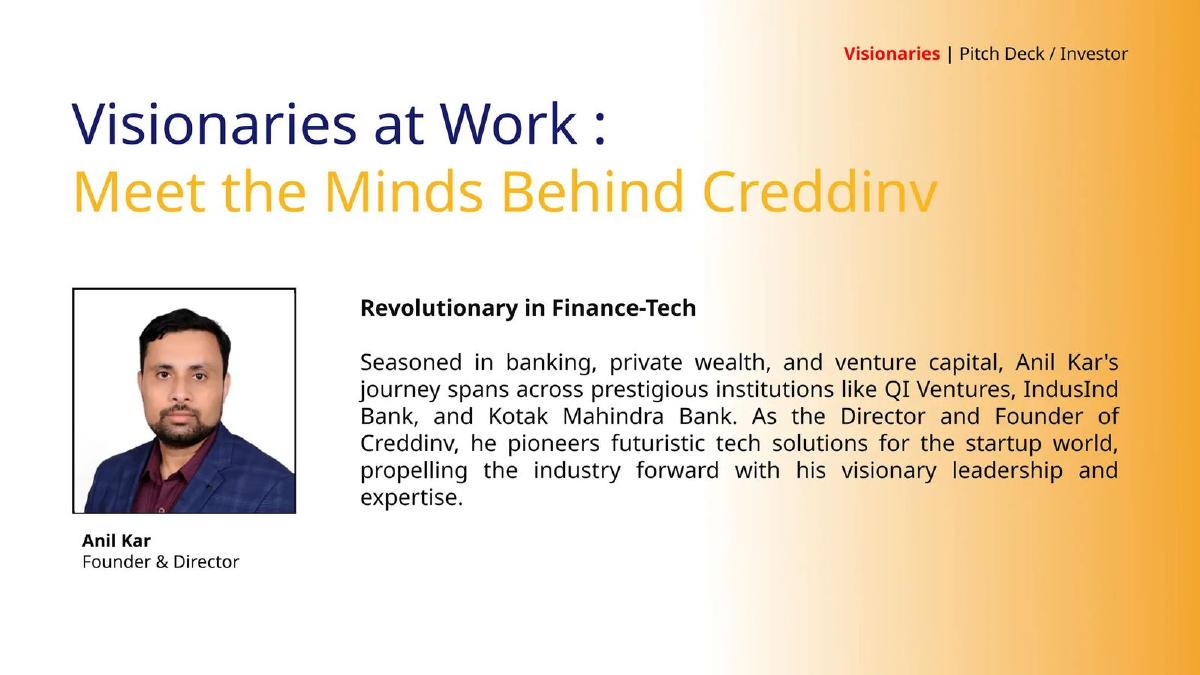
The first of two team slides introduces Anil Kar, Founder & Director. His background is described as 'seasoned in banking, private wealth, and venture capital.' Specific institutions mentioned include QI Ventures, IndusInd Bank, and Kotak Mahindra Bank. The text positions him as the pioneer of the platform's 'futuristic tech solutions.'
Slide 5: Visionaries - Nandakishor L
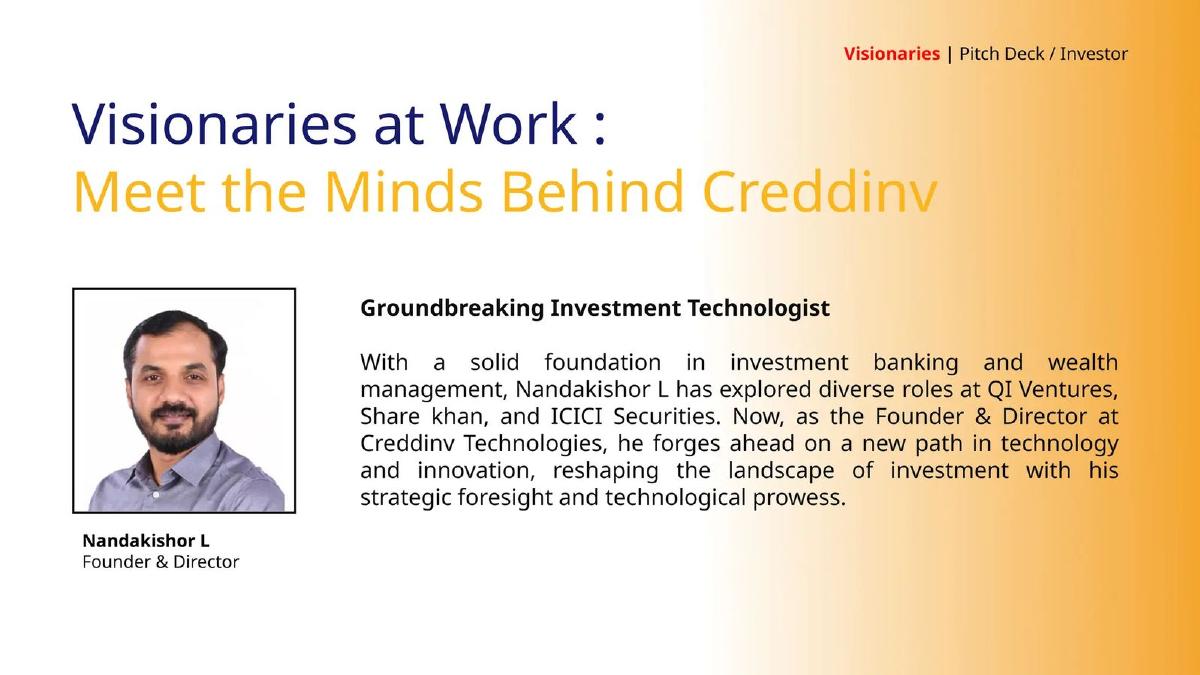
The second Founder & Director, Nandakishor L, is introduced as a 'Groundbreaking Investment Technologist.' His career path mirrors Kar's, with experience at QI Ventures, plus ICICI Securities and Sharekhan. The dual-founder structure suggests a heavy emphasis on traditional finance (TradFi) expertise being applied to a new fintech solution.
Problem, Solution, and Business Model
Slide 6: Problem & Solution
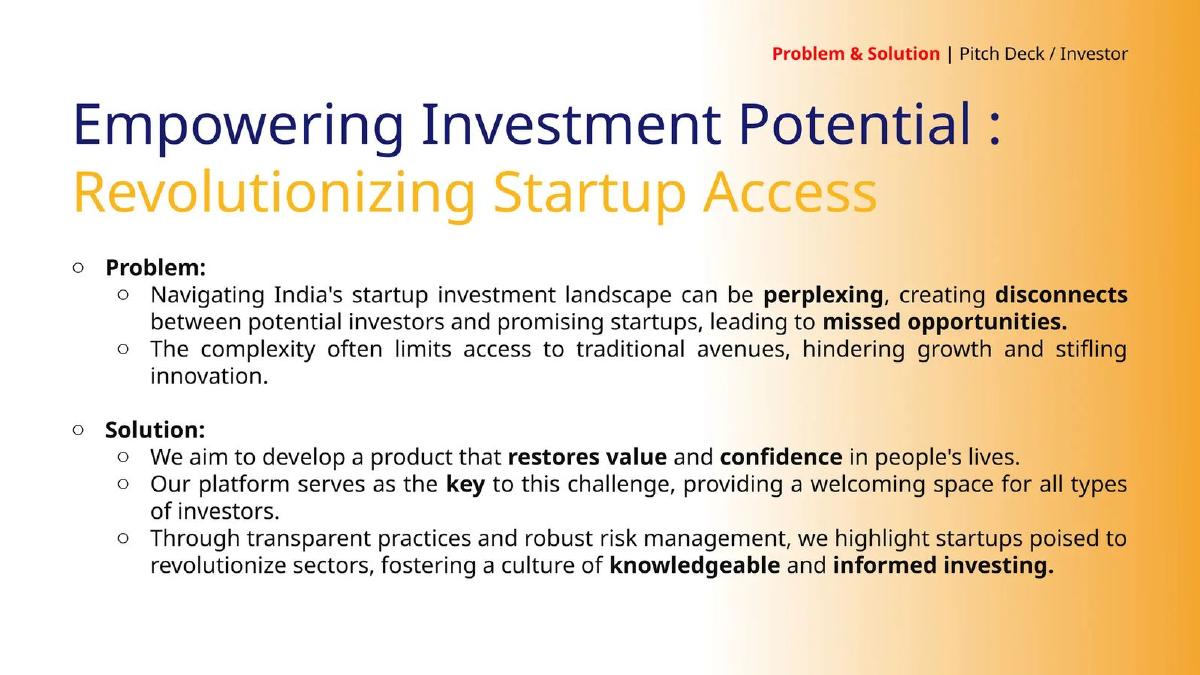
The problem is defined as a 'perplexing' landscape with 'disconnects' between investors and startups. The solution is presented as a platform that 'restores value and confidence' through transparent practices and risk management. While the slide identifies the pain point, it lacks specific examples of current barriers (e.g., high ticket sizes, regulatory hurdles, or lack of discovery tools).
Slide 7: Business Model Overview
This slide introduces the 'nexus' concept, where the platform connects investors with startups. It reiterates the mission to empower investors while streamlining capital raising. It sets the stage for the specific product lines detailed in the subsequent slides.
Slide 8: Product Portfolio
Creddinv breaks its offering into three primary lines: 1) Private Round – Creddinv’s Premium Series, 2) AIF (Alternative Investment Fund - CAT-1), and 3) Venture Debt. This diversification suggests the company aims to capture value across different risk profiles and stages of the startup lifecycle.
Slide 9: Premium Series Details
The 'Premium Series' is the entry-level product for HNI and UHNI clients. It facilitates capital raises above 1 Crore for startups. For the investor, the minimum ticket size is stated as ranging from 5 lakhs to 25 lakhs. This slide clearly defines the target customer and the entry price point.
Slide 10: Alternative Investment Fund (AIF)
The AIF (Category 1) product targets startups seeking funding between 2cr and 5cr, specifically at the Pre-Series A stage. Crucially, this slide provides a hard metric for revenue: the platform generates 2-4% of the total investment raised through this channel. This is the first mention of specific unit economics in the deck.
Slide 11: Venture Debt
The third product line is venture debt, offering startups an alternative to equity dilution. For investors, it promises a coupon rate of 12-18% with a duration of 12-36 months. Creddinv takes a 1-1.5% fee on the total investment raised. This slide is effective because it provides clear terms for both the supply (startups) and demand (investors) sides of the marketplace.
Roadmap and Exit Strategy
Slide 12: Strategic Roadmap
The roadmap provides a timeline for 2024. Platform development began in January, with a launch targeted for mid-May. Revenue generation and a subsequent formal valuation are slated for Q3. The mention of engaging a 'reputable valuator' suggests the founders are preparing for a future equity round based on early performance data.
Slide 13: Exit Planning
The exit strategy is unusually explicit for an early-stage deck. It mentions converting 'debt into equity' (though it is unclear if this refers to the company's own funding or a product feature) and targeting a valuation of 150 crores. The goal is to attract Venture Capital firms and family offices once this milestone is reached. This slide signals to current investors that the founders are already thinking about liquidity events.
Slide 14: Thank You
The final slide provides the company website and a registration link for the investor portal. It ends with the call to action: 'Start today and watch your portfolio thrive!'
What Works in the Creddinv Deck
The deck excels at defining its revenue model. By stating the 2-4% take-rate for AIF and 1-1.5% for venture debt, the founders remove ambiguity regarding how the business actually makes money. The division of the product into three distinct categories (Private, AIF, Debt) also shows a sophisticated understanding of investor appetite, offering both high-risk equity and yield-bearing debt instruments. Furthermore, the team slides provide strong 'founder-market fit' by listing recognizable Indian financial institutions like Kotak Mahindra and ICICI Securities.
What is Missing from the Creddinv Deck
The most glaring omission is the 'Ask.' There is no slide indicating how much capital the company is currently seeking, the valuation at which they are raising, or how the funds will be allocated (e.g., 50% engineering, 30% marketing). Additionally, the deck lacks a competitive analysis. The Indian investment platform space is crowded with players like AngelList India, Let’s Venture, and Tyke. Without addressing how Creddinv differs from these incumbents, investors may struggle to see the unique value proposition. Finally, there is no mention of regulatory compliance. Operating an AIF and a venture debt platform in India requires specific SEBI licenses; mentioning the status of these licenses would significantly de-risk the investment for a potential backer.
Founder Recommendations
Founders building similar investment marketplaces should take note of Slide 11. Providing clear coupon rates and durations for debt products makes the 'value' tangible for investors. However, to improve this deck, a founder should add a 'Traction' slide even if the product is not yet live. This could include a waitlist of investors, a pipeline of startups ready to raise, or letters of intent. The 'Exit Planning' slide (Slide 13) is a bold choice that can be polarizing; while it shows the founders are aligned with investor returns, setting a specific valuation target (150 crores) can sometimes be seen as arbitrary or limiting. A better approach is to focus on the scale of the business (e.g., 'reaching $XM in AUM') rather than a specific exit valuation.
Frequently asked questions
- What is the primary problem Creddinv aims to solve?
- According to slide 6, the company identifies a 'perplexing' startup investment landscape in India that creates disconnects between potential investors and promising startups. They argue that complexity limits access to traditional avenues, leading to missed opportunities for investors and stifled innovation for entrepreneurs.
- How does Creddinv generate revenue?
- Revenue is generated through transaction fees on capital raised. Slide 10 specifies a 2-4% fee for their Alternative Investment Fund (AIF) channel, while slide 11 notes a 1-1.5% fee for venture debt raises. The deck does not explicitly state the fee for the 'Premium Series' private rounds.
- Who are the target investors for the platform?
- Slide 9 indicates the platform specifically targets High Net Worth Individuals (HNI) and Ultra-High Net Worth Individuals (UHNI). The 'Premium Series' offers investment opportunities ranging from 5 lakhs to 25 lakhs for startups raising above 1 crore.
- What is the current stage of the product?
- The company is in the development phase. Slide 12 states that platform development began in January 2024, with a targeted launch in mid-May. As of the deck's creation, it appears to be pre-revenue, with revenue generation expected to begin by Q3.
- What is missing from the Creddinv pitch deck?
- The deck lacks a specific financial 'ask' (how much money they are raising), a breakdown of how funds will be used, a competitive landscape analysis, and any mention of existing partnerships or user waitlists to prove early traction.