Crema’s 11-slide deck is a masterclass in visual storytelling for a consumer brand. It identifies a clear market gap: while gourmet coffee consumption is rising, the physical retail market remains dominated by five conglomerates controlling 80% of the $14bn US CPG coffee market. Crema positions itself as the digital bridge, using a 'Brew Log' to learn taste preferences and match users with independent roasters. While the deck excels at establishing market size ($5bn for at-home specialty coffee) and founder-market fit, it is entirely devoid of financial projections, unit economics, or a speci…
Key takeaways
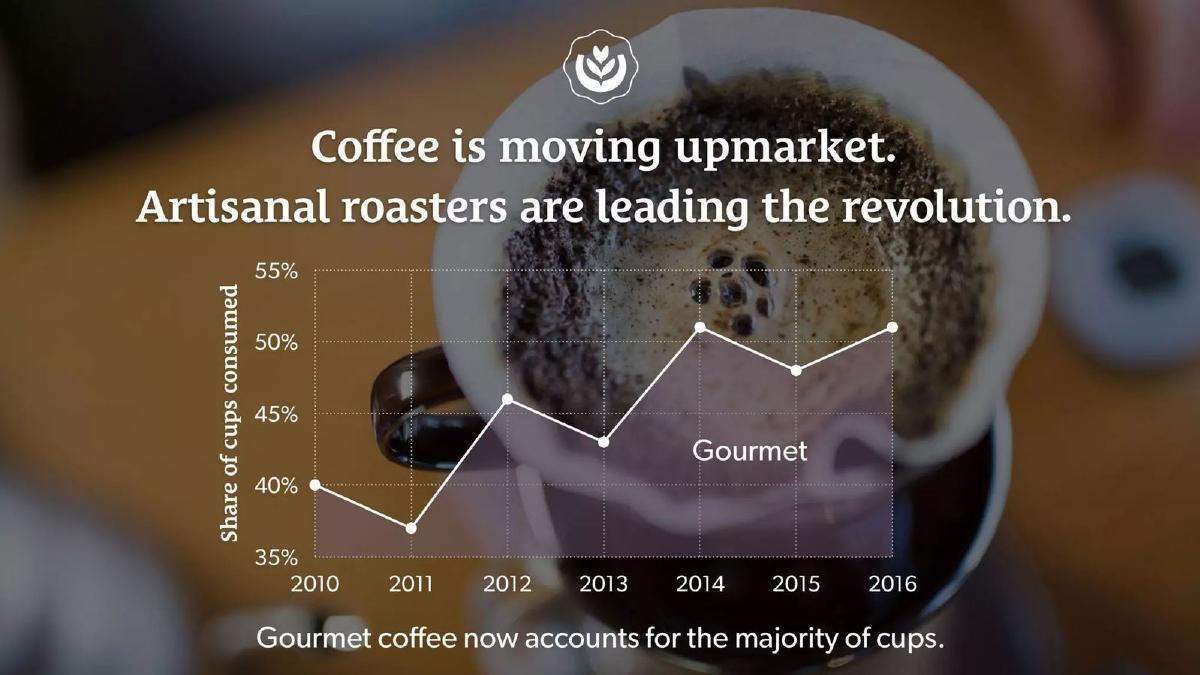
- Gourmet coffee has moved from a niche to the majority of cups consumed as of 2016 (Slide 2).
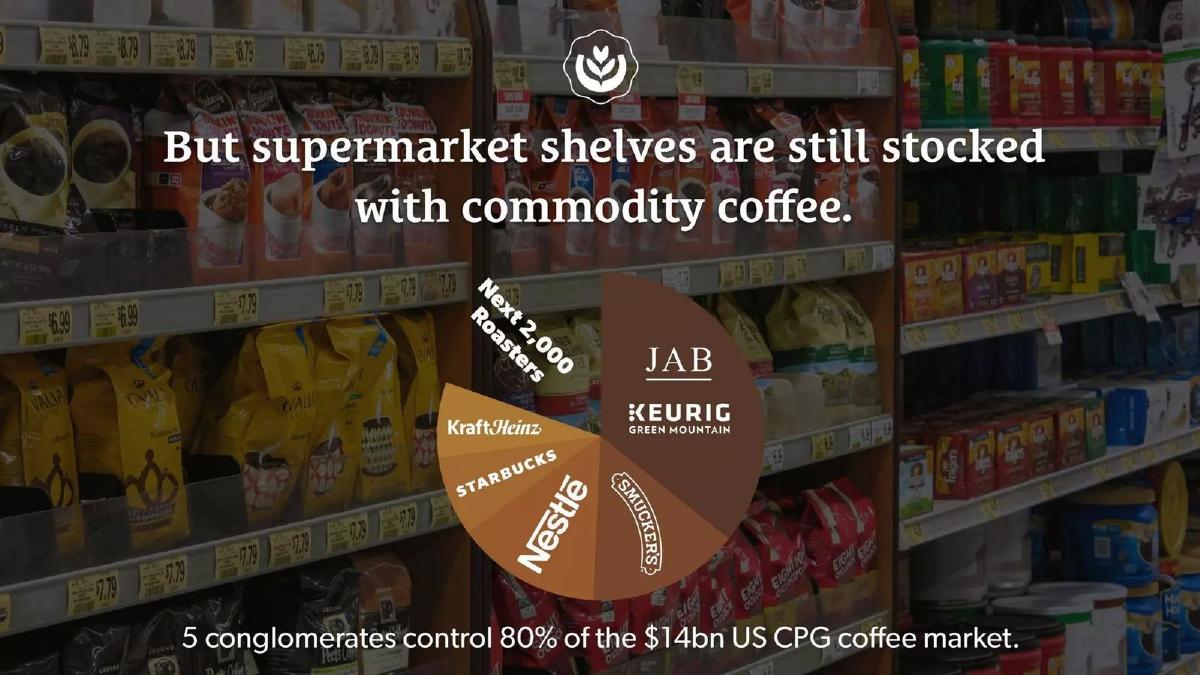
- Five conglomerates currently control 80% of the $14bn US CPG coffee market, leaving little room for craft roasters on shelves (Slide 3).
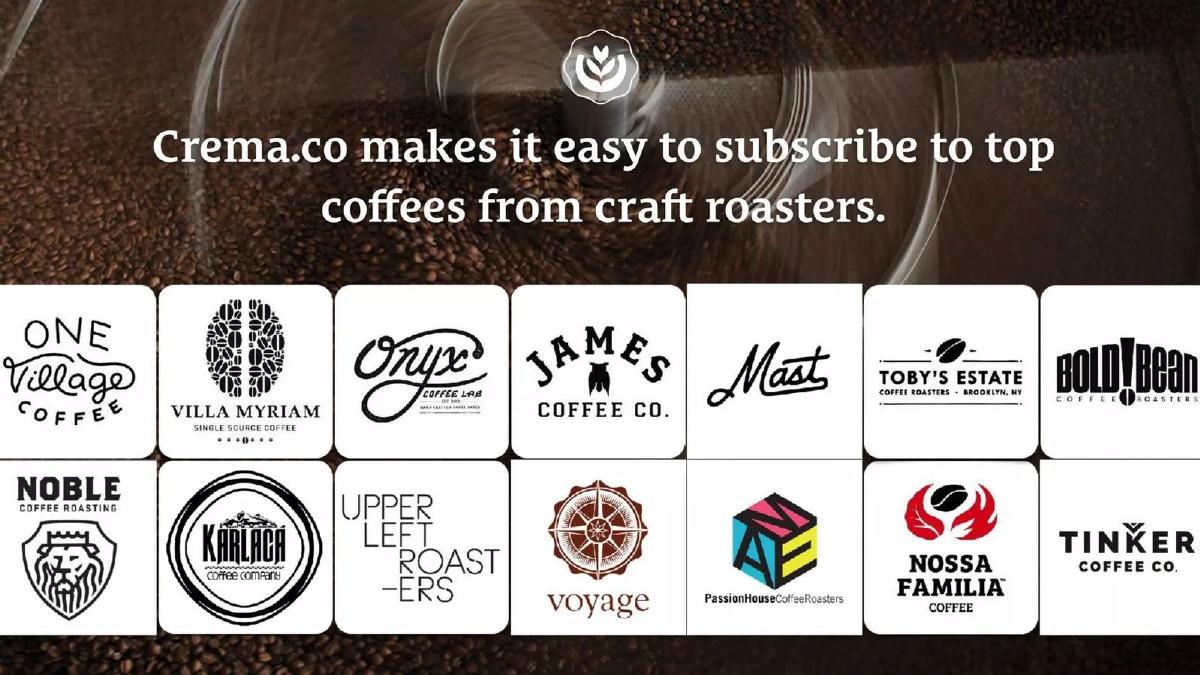
- The platform has already onboarded at least 14 craft roasters, including notable names like Onyx Coffee Lab and Toby's Estate (Slide 4).
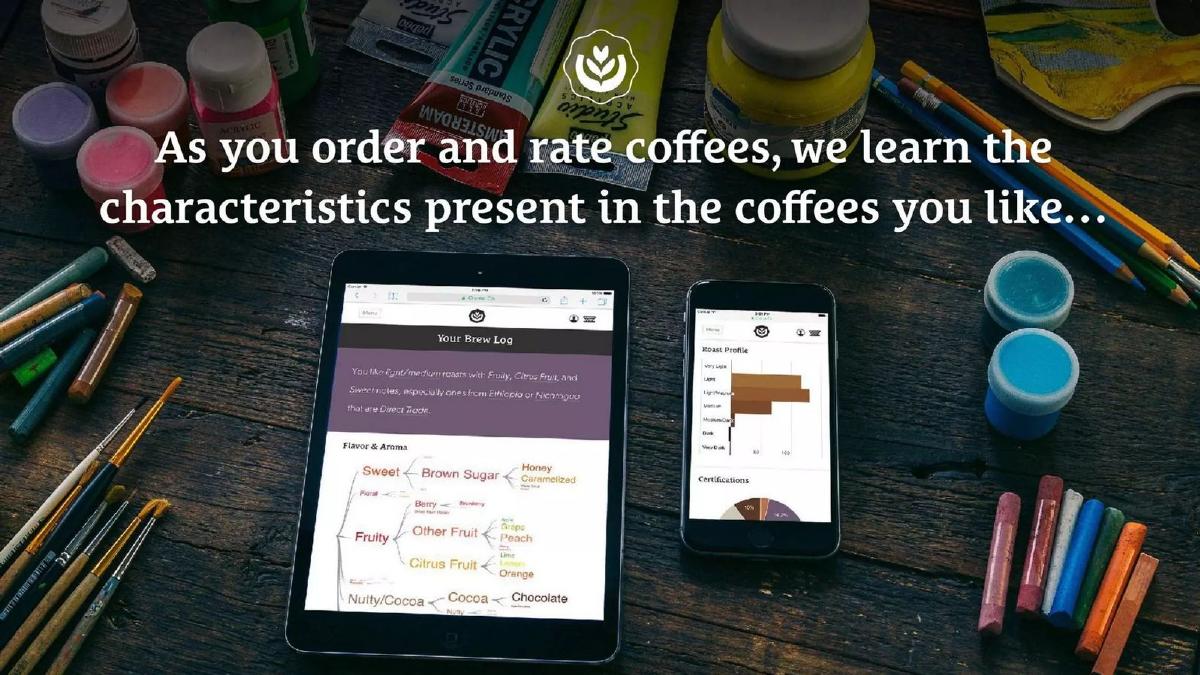
- Product differentiation relies on a data-driven 'Brew Log' that tracks flavor profiles like 'Fruity,' 'Nutty/Cocoa,' and 'Sweet' (Slide 5).
- The addressable market for at-home specialty coffee consumption in the US is valued at $5bn (Slide 8).
- The target demographic (ages 25-39) saw a 200% growth in specialty coffee penetration between 2008 and 2016 (Slide 9).
- The founding team balances industry expertise (Catalyst Coffee Consulting) with technical leadership (Twigkit and Nutshell) (Slide 10).
- The deck lacks any mention of traction metrics, revenue, churn, or the specific amount of capital being raised.
The Vision: Democratizing Specialty Coffee
Crema’s pitch deck is a visually driven narrative that focuses on the transition of coffee from a commodity to a craft experience. In 2014, the 'Third Wave' coffee movement was hitting its stride, and this deck seeks to capture that momentum by positioning Crema as the essential infrastructure for discovery. The deck uses high-quality photography and minimalist text to create a premium feel, mirroring the product it intends to sell.
Slides 1-3: The Market Problem and the 'Why Now'
The deck opens with a strong title slide (Slide 1) featuring logos from major publications like TechCrunch, Eater, and Food & Wine, immediately establishing third-party credibility. Slide 2 presents a compelling 'Why Now' argument: a line graph showing that 'Gourmet' coffee consumption has climbed from roughly 40% in 2010 to over 50% by 2016. The takeaway is clear: the market has already shifted.
Slide 3 identifies the friction point. Despite the consumer shift toward gourmet, 5 conglomerates control 80% of the $14bn US CPG coffee market . The slide features a pie chart dominated by JAB, Nestlé, and Kraft Heinz, set against a background of cluttered supermarket shelves. This visual contrast highlights the difficulty craft roasters face in reaching the 'upmarket' consumer through traditional retail channels.
Slides 4-7: The Solution and Product Experience
Slide 4 introduces the solution: a subscription service for top coffees from craft roasters. It displays 14 logos of partner roasters, including James Coffee Co., Onyx, and Nossa Familia. This serves as a 'traction-lite' slide, proving that the supply side of the marketplace is already engaged.
Slides 5 and 6 delve into the product's technical edge. Crema isn't just a delivery service; it’s a recommendation engine. Slide 5 shows a 'Brew Log' on a tablet, which maps flavor profiles like 'Honey Caramelized,' 'Berry,' and 'Citrus Fruit.' The copy states, 'As you order and rate coffees, we learn the characteristics present in the coffees you like.' Slide 6 shows the output: a 'Top Picks for You' screen that filters by roast and certification, suggesting a personalized user experience designed to reduce churn.
Slide 7 rounds out the product section by focusing on the 'story behind the beans.' By featuring a profile of a farmer (Ruben Ramirez), Crema appeals to the ethical and origin-conscious consumer, a hallmark of the specialty coffee demographic.
Slides 8-9: Market Size and Demographics
The deck moves back to the macro view in Slide 8, sizing the at-home specialty coffee consumption market at $5bn in the US . This is a subset of the larger $14bn CPG coffee market, providing a realistic but large enough TAM (Total Addressable Market) for a seed-stage startup.
Slide 9 provides the 'growth' hook. It shows a bar chart of 'Past-day Penetration' for specialty coffee among the 25-39 age group. The penetration grew from under 20% in 2008 to over 40% in 2016. This 200% growth in a high-spending demographic is the strongest indicator of future scalability in the deck.
Slide 10: The Team
The team slide (Slide 10) is a standard but effective two-column layout. Emily McIntyre provides the 'Coffee' expertise, citing her work as a journalist and consultant. Tyler Tate provides the 'Tech' expertise, with a background in enterprise software and design. This balance is crucial for a marketplace that relies on both industry relationships and a high-quality digital interface.
What Works in the Crema Deck
Visual Cohesion: The deck uses professional photography that makes the product feel 'premium.' For a consumer brand in the luxury/gourmet space, the aesthetic of the deck is part of the pitch. It looks like the brand it wants to be.
Clear Market Gap: The juxtaposition of Slide 2 (consumer demand for gourmet) and Slide 3 (conglomerate control of retail) creates a logical 'vacuum' that Crema fills. It’s an easy-to-understand 'Arbitrage of Attention' play.
Data-Driven Personalization: By showing the 'Brew Log' and flavor mapping, the founders move away from being a 'box-of-the-month' club and toward being a data company. This is a much more venture-scalable narrative.
What is Missing from the Crema Deck
The Ask: There is no slide indicating how much money the company is raising, what the terms are, or what the milestones will be for the next 18 months. This is a significant omission for a fundraising document.
Traction Metrics: While the deck shows roaster logos, it says nothing about the number of active subscribers, monthly recurring revenue (MRR), or growth rates. Without these, it’s impossible to tell if the product has found market fit.
Unit Economics: In a subscription business, CAC (Customer Acquisition Cost) and LTV (Lifetime Value) are the most important metrics. The deck doesn't explain how they acquire customers or how long those customers stay subscribed.
Competition: The deck ignores other coffee subscription services (like Trade Coffee or Mistletoe) that were emerging or active around the same time. Investors want to know why Crema’s algorithm or brand is defensible against direct competitors.
What a Founder Should Copy
The 'Why Now' Slide: Slide 9 is a perfect example of how to use demographic shifts to create urgency. If you can show that your target audience's behavior has changed by 200% in a few years, you don't need to work as hard to prove the market exists.
The Problem Visualization: Using a pie chart of conglomerates over a photo of a messy supermarket shelf (Slide 3) is a great way to visualize a 'boring' market stat. It makes the problem feel visceral rather than academic.
Simplified Product Walkthrough: Instead of a 10-minute demo, Slides 5 and 6 explain the entire value proposition—learning, matching, and discovering—in two images. It respects the investor's time while proving the product's sophistication.
Frequently asked questions
- What is Crema's core business model?
- Based on the deck, Crema operates as a subscription marketplace for specialty coffee. It connects consumers with a variety of craft roasters (Slide 4) and uses a recommendation engine (Slide 5 and 6) to personalize the selection based on user ratings and taste preferences. It essentially acts as a digital storefront and discovery layer for roasters who lack national retail distribution.
- How does Crema differentiate itself from other coffee subscriptions?
- The differentiation is centered on data and storytelling. Slide 5 highlights a 'Brew Log' that learns specific characteristics (roast profile, origin, and flavor notes), while Slide 7 emphasizes 'the story of the people behind the beans.' This suggests a focus on transparency and education that goes beyond simple delivery.
- What market trends is Crema capitalizing on?
- The deck identifies two primary trends: the 'upmarket' shift where gourmet coffee became the majority of consumption by 2014-2016 (Slide 2), and the massive growth in the millennial demographic (25-39), which saw a 200% increase in specialty coffee penetration over eight years (Slide 9).
- Who are the founders and what is their background?
- The team consists of Emily McIntyre (Coffee Director), who has a background in coffee journalism and consulting for brands like Eater and Sprudge, and Tyler Tate (CEO), who has experience in enterprise software and SaaS CRM design at companies like Twigkit and Nutshell (Slide 10).
- What is missing from this pitch deck?
- The deck is missing several critical components for a seed round: there is no 'Ask' slide (valuation or amount), no financial projections, no mention of current revenue or subscriber counts (traction), and no breakdown of unit economics (CAC/LTV). It is a vision-heavy deck rather than a performance-heavy one.