Credit Stacks (presenting as Lightning) delivered a punchy, visual-heavy deck for their 500 Startups Demo Day. The deck identifies a specific market failure: 3 million people with high earning potential but no U.S. credit history are being systematically declined by traditional banks. By targeting this 'prime credit' segment through B2B2C channels, the company claims a customer acquisition cost (CAC) of $10 or less, a significant reduction from the industry standard of hundreds of dollars. The deck emphasizes operational readiness, noting that 100% of the necessary infrastructure—including an…
Key takeaways
- The company identifies a $15 billion missed opportunity in the credit market on slide 4.
- The target demographic is 3 million people who currently have no access to credit despite high potential, as shown on slide 3.
- Credit Stacks offers a $5,000 unsecured credit line with rewards and a mobile-first experience on slide 6.
- The deck claims a customer acquisition cost of $10 or less via B2B2C marketing channels on slide 8.
- Operational readiness is highlighted on slide 7, stating that 100% of the issuing bank, credit line, and regulatory requirements are secured.
- The team includes members with experience at PayPal, Chase, American Express, Wonga, LG, and the FDIC, according to slide 9.
- The deck omits a specific funding ask, financial projections, and a competitive landscape analysis.
- The product is branded as 'Lightning by CreditStacks' on the final slide 10.
Executive Summary
Credit Stacks (branded in this deck as Lightning) presented at the 500 Startups Demo Day for Batch 20. The deck is a masterclass in Demo Day efficiency: it uses high-impact visuals, minimal text, and focuses on a single, massive market inefficiency. The company targets the 'new to country' professional segment—individuals who are creditworthy by every metric except for their lack of a U.S. Social Security history. By securing the entire backend stack before pitching, the founders demonstrate significant de-risking in a sector known for high barriers to entry.
Slide 1: Title Slide
The deck opens with the company name 'CREDITSTACKS' and the product name 'LIGHTNING CREDIT CARD.' The tagline 'CREDIT THAT EMPOWERS' establishes the mission-driven nature of the product. The contact email for Elnor Rozenrot is provided immediately, which is standard for investor-facing materials.
Slide 2: The Personal Hook
Slide 2 features a photo of CEO Elnor Rozenrot with a large red 'DECLINED' stamp over his face. The text describes him as a 'Successful entrepreneur, MBA, full of hope and dreams.' This slide humanizes the problem, illustrating that even highly qualified individuals face systemic rejection from the U.S. credit system due to a lack of local history.
Slide 3: The Target Demographic
This slide quantifies the problem. It features a split image of young professionals and a revolving door, with the text '3 MILLION PEOPLE' and 'NO ACCESS TO CREDIT.' This defines the initial beachhead market: the millions of professionals who move to the U.S. annually for work but are locked out of the financial system.
Slide 4: The Market Opportunity
Slide 4 puts a dollar value on the problem: '$15B MISSED OPPORTUNITY.' By framing the lack of credit access not just as a social issue but as a massive lost revenue stream for the banking industry, Credit Stacks positions itself as a bridge to a lucrative, underserved segment.
Slide 5: The Philosophy
Featuring an image of a man running up stairs, the text reads 'ALWAYS FORWARDS NOT BACKWARDS.' This slide serves as a transition from the problem to the solution, suggesting that the company’s underwriting looks at a customer's future potential and current professional standing rather than just their past U.S. credit history.
Slide 6: The Product Solution
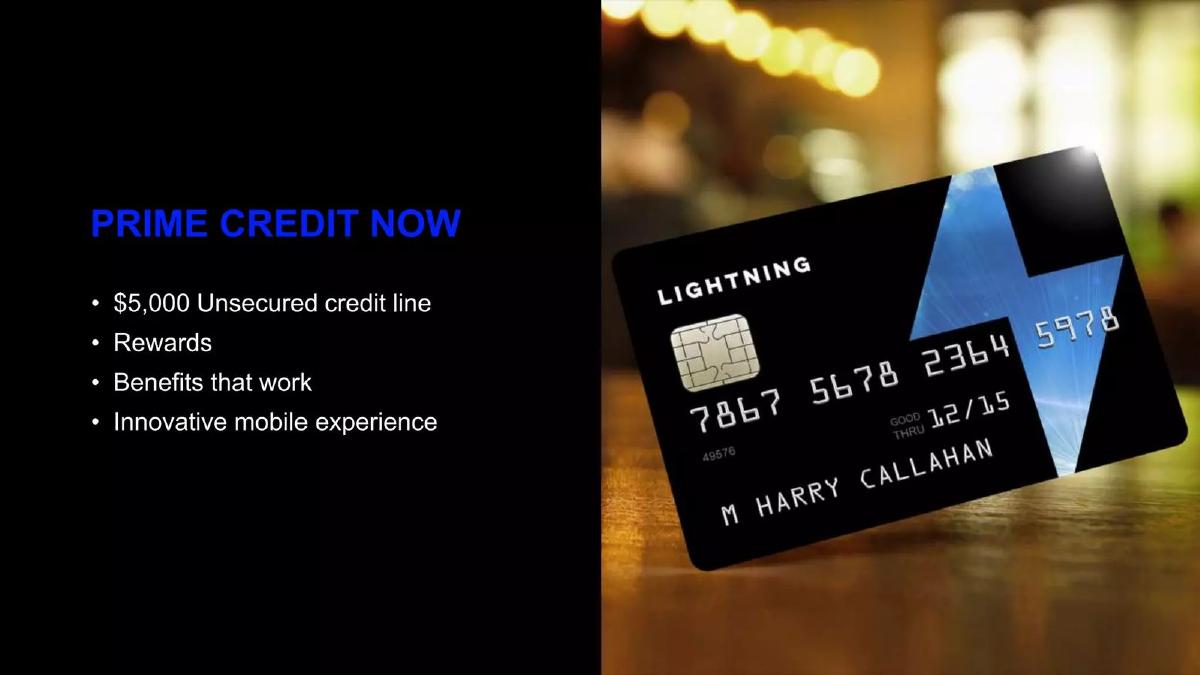
Slide 6 introduces 'PRIME CREDIT NOW.' It lists four key features: a '$5,000 Unsecured credit line,' 'Rewards,' 'Benefits that work,' and an 'Innovative mobile experience.' The visual shows a sleek, black 'Lightning' branded card. The mention of an 'unsecured' line is critical, as it differentiates the product from the 'secured' cards typically offered to those without credit history.
Slide 7: De-Risking the Infrastructure
This is arguably the most important slide for a fintech startup. Under the heading 'WE OVERCAME BARRIERS,' the company lists five components: Issuing bank, Credit line, Processor + servicer, Regulation, and Mastercard. Each is marked as '100%.' This tells investors that the company isn't just an idea; they have already secured the difficult partnerships and regulatory approvals required to actually issue cards and lend money.
Slide 8: The Unit Economics
Slide 8 focuses on the '$10 ACQUISITION COST.' The text explains that by 'Using b2b2c marketing channels we reduce the customer acquisition cost from hundreds of dollars to $10 or less.' In the credit card industry, where CAC often exceeds $200-$300, this 20x-30x efficiency is a significant competitive advantage and a key driver for venture-scale returns.
Slide 9: The Team
The team slide features five members, highlighting their roles in Regulation, Marketing, Risk, Technology, and the CEO. Below the photos are logos for PayPal, Chase, American Express, Wonga, LG, and the FDIC. This demonstrates deep domain expertise in every facet of the business, particularly in the critical areas of risk management and regulatory compliance.
Slide 10: The Closing
The final slide invites investors to 'JOIN US TO HELP EMPOWERING PEOPLE.' It features the 'LIGHTNING BY CREDITSTACKS' logo, the website URL, and the CEO's email address once again. It is a standard closing that reinforces the brand and the mission.
What Works Well
Infrastructure Validation: Slide 7 is a powerful way to show progress. In fintech, the 'idea' is easy, but the 'plumbing' (bank partners, processors, licenses) is incredibly hard. Showing that these are 100% complete removes a major layer of risk for seed-stage investors. · Extreme CAC Efficiency: The claim of a $10 CAC on slide 8 is the 'wow' metric of the deck. By identifying a B2B2C loophole (likely partnering with companies hiring these immigrants), they show a path to profitability that traditional banks cannot match. · Clear Market Gap: The deck does an excellent job of showing that their target audience is 'Prime' in every way except for a specific technicality (lack of SSN history). This makes the investment feel like an arbitrage opportunity rather than a high-risk subprime play.
What Is Missing
Business Model Details: While we know it's a credit card, the deck doesn't specify the revenue mix. Is it primarily interchange fees, interest, or annual fees? · Competitive Landscape: There is no mention of other 'new to country' fintechs or how they plan to defend their B2B2C channels once incumbents catch on. · The Ask: The deck does not state how much money they are raising or what the specific milestones for the next 18 months will be. · Financial Projections: There are no charts showing projected card growth, loan book size, or expected default rates, which are crucial for a lending business.
Founder Takeaways
Lead with De-Risking: If you are in a regulated industry, show that you have already done the hard work of securing licenses or partnerships. Don't just say you 'will' get them; show that you 'have' them. · Focus on One Metric: Credit Stacks focused on CAC. If you have one metric that is significantly better than the industry average, make it a full-page highlight. · Use the 'Personal to Global' Narrative: Starting with the CEO's personal struggle (Slide 2) and scaling it to a $15B market (Slide 4) is a classic, effective storytelling technique that keeps investors engaged.
Frequently asked questions
- What is the primary problem Credit Stacks is solving?
- Credit Stacks addresses the 'credit invisible' problem for high-earning immigrants. Slide 3 and 4 highlight that 3 million people are being declined for credit, representing a $15 billion missed opportunity. These individuals often have the income and professional background for prime credit but lack the domestic history required by traditional U.S. banking algorithms.
- How does Credit Stacks acquire customers so cheaply?
- Slide 8 states the company achieves a CAC of $10 or less by using B2B2C marketing channels. While the deck doesn't explicitly name the partners, this typically involves partnering with employers or relocation services that interact with high-value immigrants before they even arrive in the U.S., bypassing expensive direct-to-consumer advertising.
- What are the core features of the Lightning credit card?
- According to slide 6, the card offers a $5,000 unsecured credit line, a rewards program, 'benefits that work,' and an innovative mobile experience. The 'unsecured' nature is a key differentiator, as most immigrants are forced into 'secured' cards that require a cash deposit equal to the credit limit.
- Is the company's infrastructure ready for launch?
- Slide 7 suggests full operational readiness. It lists five critical barriers—Issuing bank, Credit line, Processor + servicer, Regulation, and Mastercard—and marks each as '100%' complete. This indicates the startup has already navigated the complex legal and technical hurdles of the fintech space.
- What information is missing from this pitch deck?
- As a Demo Day deck, it is intentionally brief. It lacks a detailed business model (how they make money beyond interest/interchange), a slide on the competitive landscape, multi-year financial projections, and a specific dollar amount for the 'ask' or how the funds will be allocated.