Ingoude Company, led by Henrietta Mitchell and Matt Zhang, aims to bridge the gap in technology access for creative professionals. The deck, dated September 13, 2023, outlines a multi-product strategy focused on affordability and 'creative finance.' While the presentation relies heavily on placeholder text for product descriptions and market analysis, it provides concrete traction metrics, including 180,000 subscribers and 54,000 Monthly Active Users (MAU) after one year of operation. The company reports having raised $3 million to date and maintains a team of eight employees. The deck follow…
Key takeaways
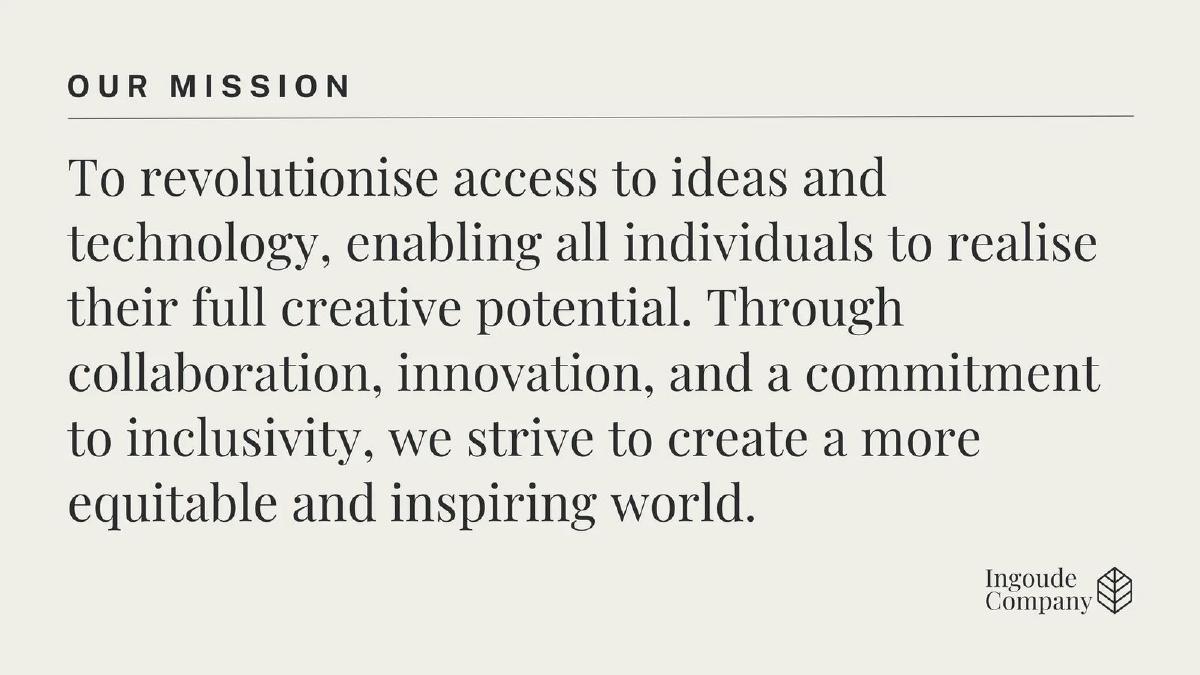
- The company identifies its mission as revolutionizing access to ideas and technology for all individuals on slide 4.
- Founder Henrietta Mitchell brings nearly 15 years of experience in brand transformation and product development as stated on slide 5.
- The product strategy is split into two main pillars, with Product #1 described as an AI-powered, cloud-based, and scalable solution on slide 8.
- Market size is estimated with a TAM of 1.3B, a SAM of 488M, and a SOM of 228M on slide 12.
- Traction metrics on slide 14 include 180k subscribers, 54k MAU, and 10.8k DAU after one year in operation.
- The company reports a 7% churn rate and a 44% Net Promoter Score (NPS) on slide 14.
- Revenue projections on slide 15 suggest a tripling of revenue from year one to year two, though specific currency values are omitted from the chart.
- The 'Path to Integration' timeline on slide 16 spans five quarters, from Adaptation in Q1 to Iteration in the following year's Q1.
Executive Summary and Title
The Ingoude Company pitch deck, dated September 13, 2023, opens with a minimalist aesthetic, establishing a brand identity centered on 'New Business Opportunity.' The title slide (Slide 1) introduces the two primary founders: Henrietta Mitchell (CEO) and Matt Zhang (CTO). The visual language is clean, utilizing a cream and charcoal palette that suggests a focus on design-led industries.
Mission and Vision
Slide 2 and Slide 4 define the company's purpose. The overarching goal is to 'bridge the gap in technology access and opportunity.' The mission statement on slide 4 is broad, aiming to 'revolutionise access to ideas and technology' with a commitment to inclusivity and equity. While the sentiment is high-level, it sets the stage for a social-impact or accessibility-focused tech play within the creative sector.
The Team
Slide 5 introduces the core team and advisors. Henrietta Mitchell is credited with 15 years of experience working with brands to bring products to market. Matt Zhang is positioned as a leader in innovative technologies and finance. The inclusion of a Chief Counsel (Claudia Alves) and a seasoned business advisor (Rufus Stewart) suggests a focus on regulatory compliance and strategic scaling, which is often a requirement for companies operating in the 'Creative Finance' space mentioned later in the deck.
Product and Service Strategy
Service Pillars
Slide 7 outlines four key areas of operation: Servicing Creative Industries, Simplifying Technology, Solving Affordability, and Innovating Creative Finance. This slide is critical as it defines the company's value proposition as a multi-faceted solution rather than a single-feature tool. However, the descriptions under these headings are currently placeholder text, leaving the specific execution methods to the reader's imagination.
Product Breakdown
Slides 8 and 9 provide a 'Product #1' and 'Product #2' breakdown. Product #1 is described as 'AI-powered' and 'Cloud-based,' while Product #2 is 'Data-driven' and 'Secure.' These are standard tech industry descriptors. The use of placeholder 'Lorem Ipsum' text on these slides is a significant omission for a live pitch, as it fails to explain what the software actually does for the user. The visuals show users in creative environments (writing, using laptops), reinforcing the target demographic.
Market Analysis and Competition
Competitive Landscape
Slide 10 and 11 address the competition. The deck acknowledges a 'step back' to survey the industry. Slide 11 lists three specific competitors: Wardiere Inc., Hanover and Tyke, and Salford & Co. The metrics provided for these competitors (ranging from 12M to 100M MAU) suggest that Ingoude is entering a mature market with high-traffic incumbents. The deck notes that Hanover and Tyke has 2.9 million podcast titles, indicating that audio content may be a key segment of the market Ingoude is targeting.
Market Size
Slide 12 utilizes the standard TAM/SAM/SOM framework. The Total Addressable Market (TAM) is cited at 1.3B, the Serviceable Addressable Market (SAM) at 488M, and the Serviceable Obtainable Market (SOM) at 228M. The units (users vs. dollars) are not specified, which is a common ambiguity in early-stage decks. The large scale of these numbers suggests a global ambition.
Traction and Financials
Key Performance Indicators
Slides 13 and 14 provide the most concrete data in the deck. After one year in operation, the company reports 180,000 subscribers. The engagement metrics show a 30% conversion from subscriber to MAU (54,000) and a 20% stickiness from MAU to DAU (10,800). A 7% churn rate is respectable for a new platform, and a 44% NPS indicates strong user satisfaction. The mention of $3 million already raised provides a baseline for the company's current valuation and runway.
Revenue Projections
Slide 15 shows a line graph of revenue projections. The text states that revenue is expected to triple from year one to year two. The graph shows a dip in Q3 before a recovery in Q4, which might suggest seasonality in the creative industries or a planned product transition. However, the Y-axis lacks currency denominations, making it difficult to assess the actual scale of the projected growth.
Roadmap
Slide 16, titled 'Path to Integration,' provides a five-quarter timeline. The phases are Adapt (Q1), Evaluate (Q2), Launch (Q3), Monitor (Q4), and Iterate (Q1). This suggests the company is currently in a heavy development or pilot phase, with a major launch event planned for the third quarter of their cycle.
What Works and What is Missing
Strengths of the Deck
Clean Design: The minimalist aesthetic is professional and fits the 'creative industry' target market. · Strong Traction Metrics: Slide 14 provides clear, quantifiable data that proves the concept has initial market fit. · Experienced Team: The 15-year tenure of the CEO and the inclusion of legal counsel early on suggests a mature approach to business building.
Critical Omissions
Product Specificity: The heavy use of placeholder text on slides 6, 7, 8, and 9 is a major weakness. A founder cannot raise capital without explaining the actual mechanics of their 'AI-powered' or 'Creative Finance' solution. · The Ask: The deck concludes on slide 18 without a specific funding request. Investors need to know how much capital is being sought and what the primary use of funds will be. · Unit Economics: While churn and NPS are mentioned, there is no data on Customer Acquisition Cost (CAC) or Lifetime Value (LTV), which are essential for evaluating the scalability of the $3 million already raised.
Founder Recommendations
Founders should copy the clear layout of the traction slide (Slide 14), as it presents complex KPIs in an easily digestible format. However, they must avoid the pitfall of using placeholder text in a final version. Every slide must serve a purpose; if a slide contains 'Lorem Ipsum,' it effectively tells the investor that the founder does not yet have a clear plan for that specific area of the business. Finally, always include a clear 'Ask' slide that details the funding goal and the milestones that capital will unlock.
Frequently asked questions
- What is the primary industry focus of Ingoude Company?
- Based on slide 7, the company focuses on 'Servicing Creative Industries.' The deck emphasizes bridging the gap in technology access and opportunity within this sector, specifically mentioning 'Innovating Creative Finance' as one of its core service pillars. The mission statement on slide 4 reinforces this by aiming to enable individuals to realize their full creative potential through inclusive technology.
- Who are the key members of the leadership team?
- As shown on slide 5, the team is led by Henrietta Mitchell (Founder & CEO), who has 15 years of experience in brand transformation, and Matt Zhang (Founder & CTO), who has a background in innovative technologies and finance. They are supported by Rufus Stewart as a business advisor and Claudia Alves as Chief Counsel, who specializes in legal landscapes for creative industries.
- What are the core features of Ingoude's products?
- The deck describes two products using high-level descriptors. Product #1 (slide 8) is characterized as analytics-driven, user-friendly, cloud-based, AI-powered, and scalable. Product #2 (slide 9) is described as data-driven, dynamic, secure, and connected. However, the specific functional utility of these products is obscured by placeholder text throughout the product section.
- How does the company measure its current traction?
- Traction is detailed on slides 13 and 14. The company has been in operation for one year, has 8 employees, and has raised $3 million. User metrics include 180,000 subscribers, 54,000 Monthly Active Users (MAU), and 10,800 Daily Active Users (DAU). They also report a 44% Net Promoter Score (NPS) and a 7% churn rate.
- What does the competitive landscape look like for Ingoude?
- Slide 11 identifies three competitors: Wardiere Inc. (12M MAU, desktop platform), Hanover and Tyke (100M MAU, podcast focus), and Salford & Co. (12M MAU, female content focus). Ingoude positions itself against these established players by focusing on technology simplification and affordability within the creative sector, though the specific 'moat' is not explicitly detailed.