Kinnu’s 14-slide Seed deck is a lean, metric-focused presentation that successfully secured $6.5M in 2024. The narrative centers on the 'Why Now' of Large Language Models (LLMs) and the failure of traditional online courses, which see only a 2% completion rate according to slide 3. By positioning themselves as a 'brain-optimised' alternative to social media doom-scrolling, Kinnu highlights a product that has already achieved over 100,000 installs and a 4.8-star rating within 10 months of launch (slide 5). The deck is particularly strong in its use of social proof, listing five high-valuation…
Key takeaways
- The deck identifies a massive market gap by citing that only 2% of learners complete traditional online courses (Slide 3).
- Kinnu leverages the 'Why Now' of LLMs to explain how they can massively decrease content creation costs while providing adaptive learning (Slide 3).
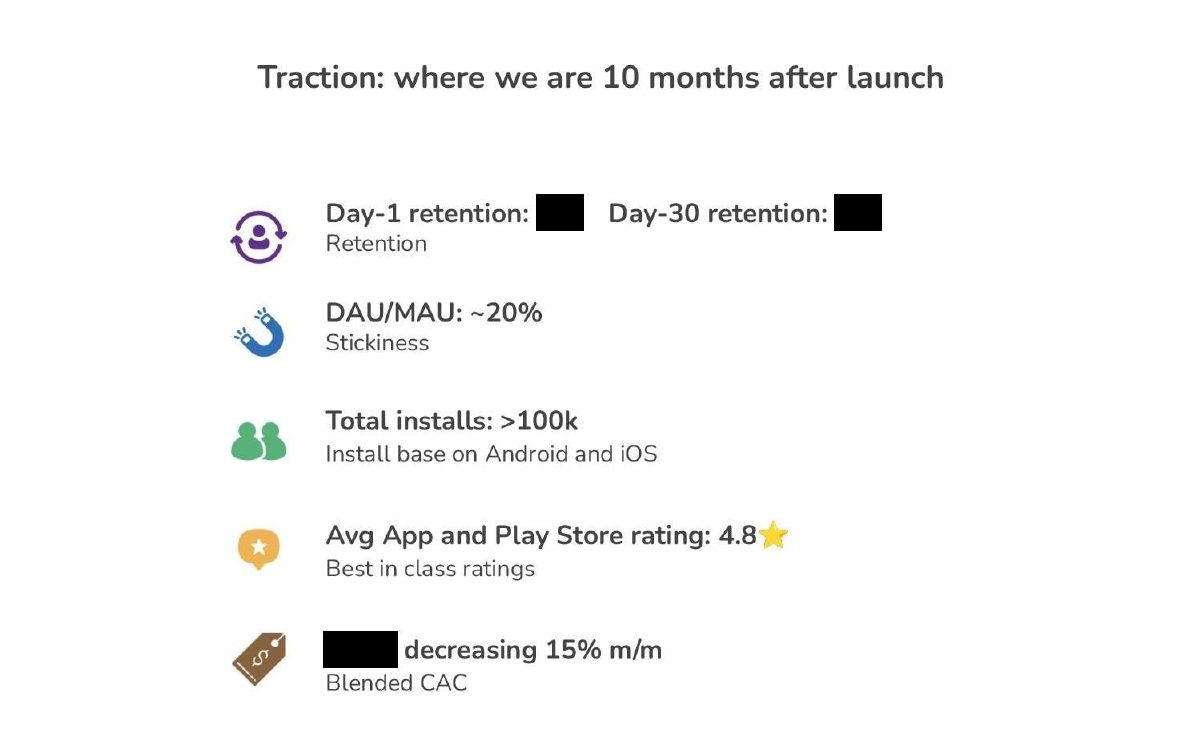
- Product-market fit is signaled through a 4.8-star rating and over 100,000 installs achieved in just 10 months (Slide 5).
- The startup reports a DAU/MAU 'stickiness' ratio of approximately 20%, a key metric for consumer apps (Slide 5).
- Efficiency is demonstrated by a blended CAC that is decreasing at a rate of 15% month-over-month (Slide 5).
- The GTM strategy includes a clear transition from community-led growth to B2B corporate learning and L&D (Slide 6).
- Social proof is a primary driver, featuring angels from companies with valuations ranging from $1b to $8b (Slide 7).
- The deck explicitly states a $6.5m USD fundraising target to reach specific (though redacted) benchmarks (Slide 7).
Slide-by-Slide Teardown
Slide 1: Title Slide
The deck opens with a clean, minimalist title slide. It features the Kinnu logo and the tagline: "The power to learn anything you want to." Below this, a sub-headline describes the product as a "brain-optimised learning app designed around how humans actually learn." The use of a red 'hand-written' strike-through on the word 'should' (replaced by 'actually') immediately signals a challenge to the educational status quo.
Slide 2: The Vision
This is a purely emotional/visionary slide featuring a still from The Matrix with the quote "I know kung fu." — Neo from the Matrix . It serves to anchor the product's goal: rapid, effortless, and effective knowledge acquisition. It sets a high bar for the technology's promise without using technical jargon.
Slide 3: Why Now
This slide provides the logical foundation for the investment. It lists four macro trends: the ability of LLMs to decrease content costs , the increase in demand for casual learning , the social media guilt factor, and the growth in microcontent . Crucially, it includes two data points: a grid showing that "Only 2% of learners complete online courses" and a chart showing the digital learning market growing at a 16.3% CAGR post-COVID , projected to reach $404b within a total education market of $7.8T.
Slide 4: The Product
Kinnu uses four mobile mockups to demonstrate the UI. Key features highlighted include "Map-based, geospatial content discovery," "Dynamic bite-sized content," "Smart reviews" with dynamic spacing, and a "Forgetting Simulator" that tracks knowledge in real-time. The slide uses the phrase "non plus ultra learning experience" to position the app as the pinnacle of its category.
Slide 5: Traction
Ten months post-launch, the company presents strong engagement data. While specific retention percentages for Day-1 and Day-30 are redacted in this version, they report a DAU/MAU of ~20% . The scale is established with ">100k total installs" and a "4.8 star" average rating. A vital efficiency metric is also included: blended CAC is decreasing 15% m/m .
Slide 6: Go-To-Market (GTM)
The GTM slide is split into 'Now' and 'Later.' Current growth is driven by content- and community-led growth and Word of Mouth (WOM) , citing Duolingo and Anki as case studies. They also mention SEO for own content is "Growing 20% w/w." The future ('Later') strategy is a pivot to B2B corporate learning , modeled after Coursera and Google.
Slide 7: Fundraising
The final slide reveals the company previously raised ~$2.5m from Spark and Jigsaw . It leans heavily on angel social proof, listing five individuals associated with billion-dollar exits or valuations (Motorway, Moonbug, Google Ventures, Upgrade, and Snyk). The current ask is clearly stated: "Currently raising $6.5m USD." The specific benchmarks and allocation for this round are redacted.
What Kinnu Does Well
Metric Transparency: Even in a Seed round, Kinnu isn't just selling a dream. By including DAU/MAU, total installs, and CAC trends, they prove that the product has 'legs.' The 20% stickiness ratio is a respectable benchmark for a consumer education app, suggesting that users aren't just downloading the app but are actually returning to it.
Market Antagonism: The deck identifies a clear 'villain'—the 98% failure rate of traditional online courses. By highlighting this, they make their 'brain-optimised' approach feel like a necessary evolution rather than just another app. This is a classic 'Problem/Solution' framing that works well for VCs looking for disruptive potential.
High-Velocity Social Proof: The fundraising slide is exceptionally strong. Listing angels from Snyk ($8b val) and Moonbug ($1b exit) tells a new investor that sophisticated, successful operators have already vetted this team and the tech. It reduces the perceived risk of the Seed round significantly.
What is Missing from the Kinnu Deck
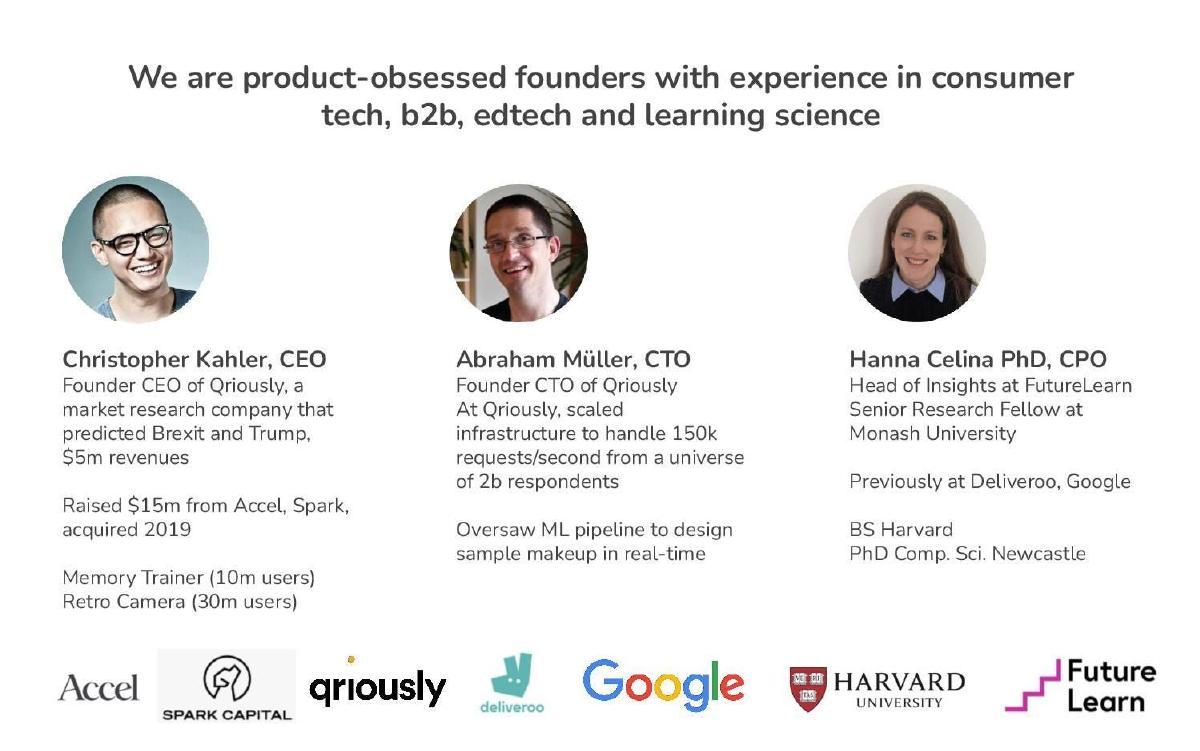
The Team Slide: While the angel investors are impressive, the actual founders are not detailed in the provided slides. In a Seed round, the pedigree of the founders (their technical background in AI or their experience in EdTech) is usually the most important factor. Without this, the 'how' of the LLM implementation remains a black box.
Unit Economics: While CAC is mentioned as decreasing, there is no mention of LTV (Lifetime Value) or monetization strategy. Is this a subscription model? Ad-supported? Freemium? Investors need to know how the $6.5M will eventually turn into a profitable enterprise, especially if they plan to move into B2B.
Competitive Landscape: The deck mentions Duolingo and Anki as 'case studies' for growth, but it doesn't explicitly state how Kinnu wins against them. Duolingo is a massive incumbent in gamified learning; a slide showing a feature-by-feature comparison or a positioning matrix would help clarify Kinnu's unique moat.
What Founders Should Copy
The 'Why Now' Slide: Kinnu’s Slide 3 is a perfect example of how to link macro trends (LLMs, market growth) to a specific user pain point (social media guilt). Founders should copy this structure: Trend + Market Size + Specific User Behavior = Opportunity.
Redaction Strategy: In the public version of this deck, Kinnu redacted specific retention and allocation numbers. This is a smart move for founders sharing decks widely; it protects sensitive data while still showing the types of metrics the company tracks, which signals professional management.
Visualizing the Product Journey: Slide 4 does a great job of showing the app in action without needing a live demo. The labels (Map-based discovery, Smart reviews) explain the benefit of the feature rather than just the feature itself. This helps non-technical investors understand the product's utility immediately.
Frequently asked questions
- What is Kinnu's primary value proposition?
- Kinnu positions itself as a 'brain-optimised learning app' designed to improve long-term memory. It aims to replace the 'guilt' of social media usage with productive, gamified micro-content that is easier to complete than traditional online courses, which suffer from a 98% drop-out rate.
- How does Kinnu use AI in its product?
- According to the deck, Kinnu uses Large Language Models (LLMs) to decrease the cost of content creation and enable 'adaptive, dynamic content.' This allows the app to rephrase questions with evolving difficulty and provide 'smart reviews' based on the user's learning history.
- What are the key traction metrics mentioned?
- Within 10 months of launch, Kinnu reached over 100,000 installs across Android and iOS. They maintain a 4.8-star rating and a DAU/MAU ratio of ~20%. Notably, their blended Customer Acquisition Cost (CAC) is decreasing by 15% every month.
- Who are the notable investors in Kinnu?
- The deck lists Spark and Jigsaw as institutional backers, alongside high-profile angels including Tom Leathes (Motorway), Rene Rechtman (Moonbug), Tom Hulme (Google Ventures), Adelina Grozdanova (Upgrade), and Guy Podjarny (Snyk).
- What is the long-term growth strategy for the company?
- While currently focused on 'adult enthusiast learners' through word-of-mouth and SEO (growing 20% week-over-week), the deck outlines a 'Later' phase targeting the B2B market. This involves corporate learning and L&D, following the model of Coursera and Google.