Kitterly’s 10-slide deck from 2015 is a lean, metric-focused presentation that successfully raised $850,000. It avoids the common pitfall of over-explaining the product, instead letting high-quality imagery of its knitting and crochet kits do the talking. The deck leans heavily on three core pillars: a massive but fragmented market ($2.9B in knitting/crochet), strong early traction (30% MoM growth), and high customer stickiness (20%+ repeat purchase rate). While it lacks a formal 'Ask' slide and detailed unit economics, it effectively uses the '500 Startups' pedigree to signal credibility. Th…
Key takeaways
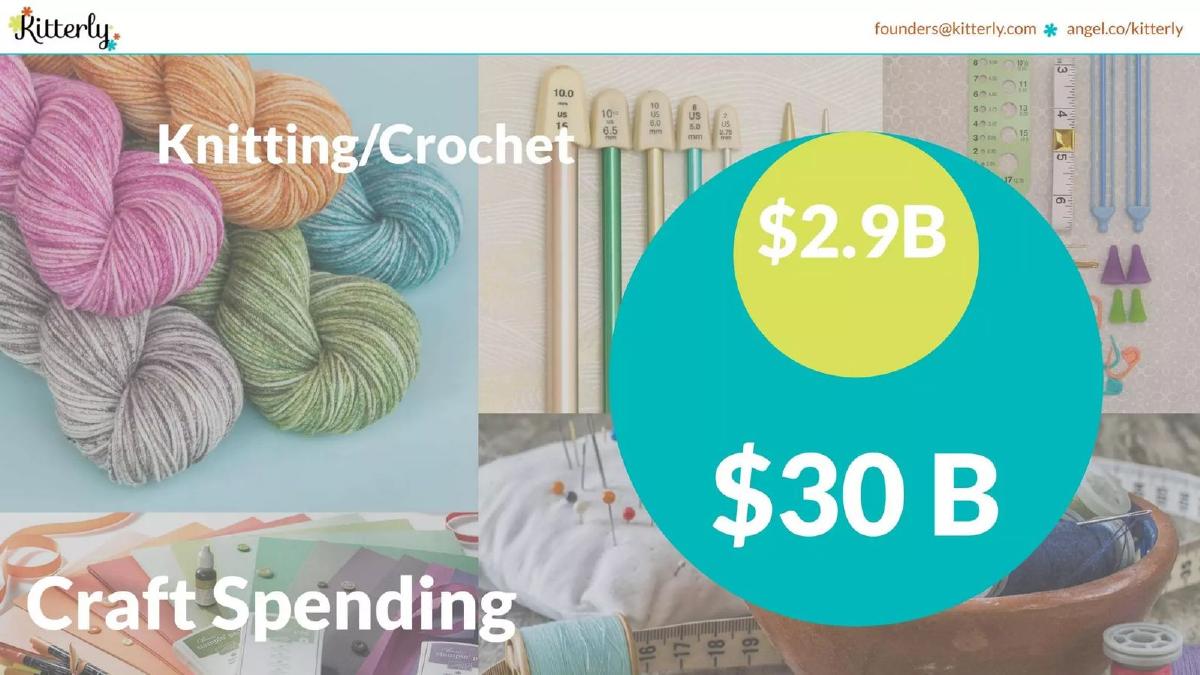
- The deck identifies a specific Total Addressable Market of $30B for craft spending, with a Serviceable Addressable Market of $2.9B for knitting and crochet on Slide 4.
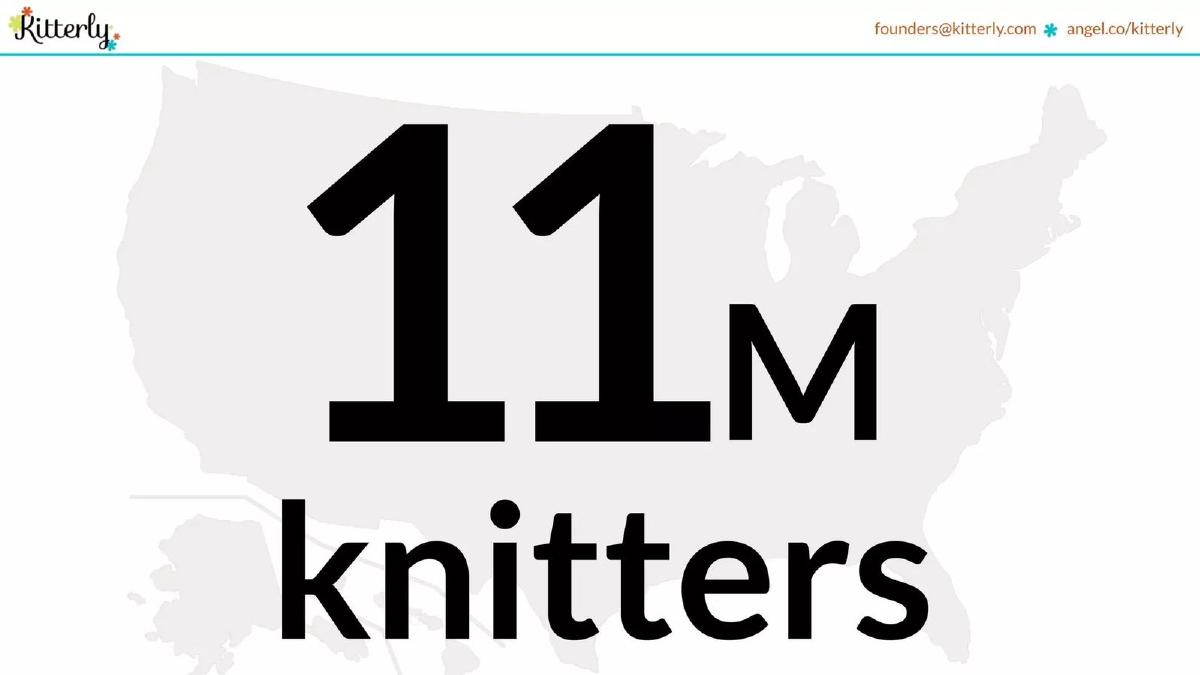
- Kitterly highlights a significant user base of 11 million knitters in the United States on Slide 2.
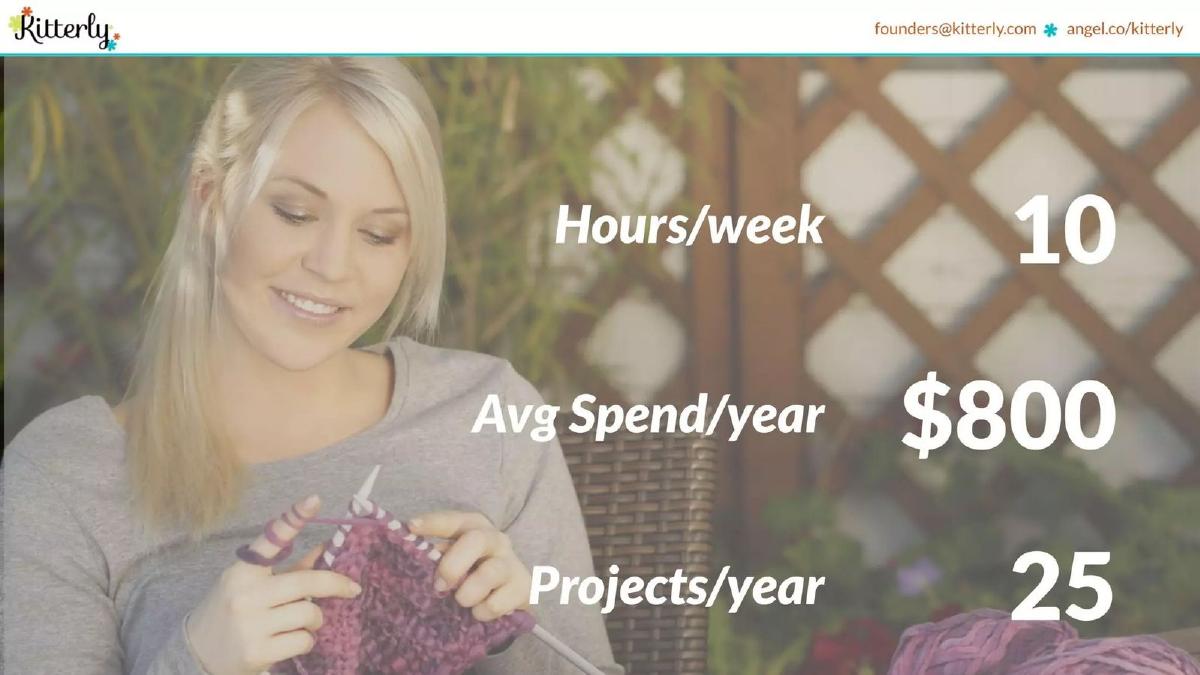
- The average enthusiast spends $800 per year and completes 25 projects, indicating a high-frequency, high-value customer profile on Slide 3.
- Traction is demonstrated through a 30% month-over-month growth rate, with revenue climbing from under $5,000 in August to over $30,000 by February on Slide 7.
- Customer retention is strong, with a stated repeat purchase rate of 20% or more on Slide 8.
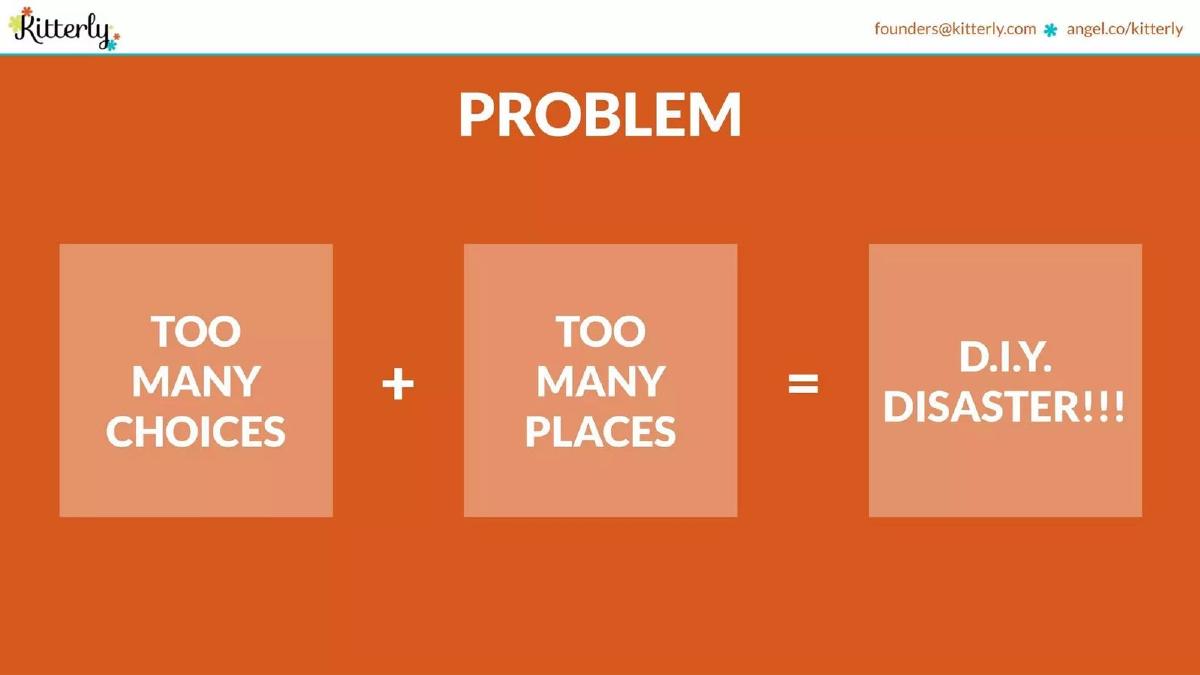
- The 'Problem' is framed as a 'D.I.Y. Disaster' caused by too many choices and too many places to shop on Slide 5.
- The team slide features founders with experience at high-profile companies like MySpace, Mattel, and MGA Entertainment on Slide 9.
- The deck omits a specific funding request, valuation, or breakdown of how the $850,000 would be spent.
The Art of the Lean E-Commerce Pitch
Kitterly’s pitch deck is a refreshing example of 'less is more.' In an era where founders often feel compelled to include 20+ slides covering everything from server architecture to five-year financial projections, Kitterly secured $850,000 with just 10 slides. This teardown examines how they used high-impact visuals and three 'magic numbers' to convince investors that knitting kits were a venture-scale opportunity in 2015.
Slides 1-4: Market Opportunity and the Enthusiast Profile
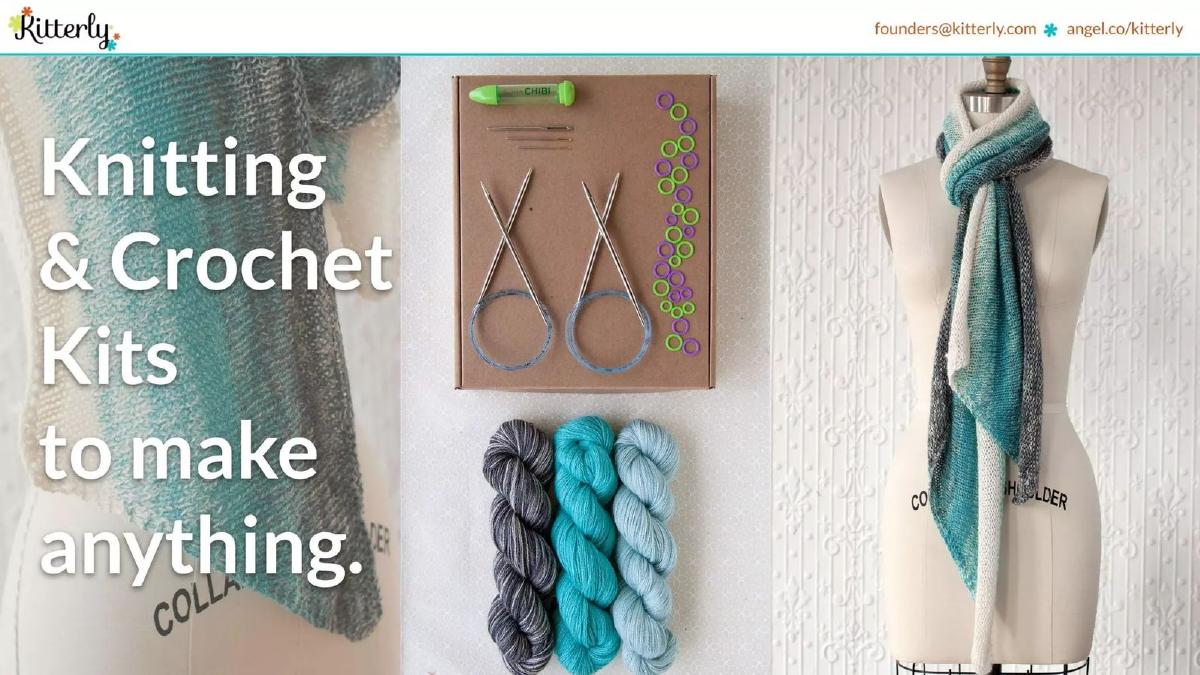
Slide 1: Title Slide The deck opens with a high-resolution, lifestyle-oriented image of a finished knitted scarf alongside a neatly organized kit. The text is simple: 'Knitting & Crochet Kits to make anything.' This immediately establishes the brand as premium and design-forward. There is no clutter; the contact information and AngelList link are tucked neatly into the header.
Slide 2: The 11 Million Kitterly moves straight into the 'Who.' By placing the number '11M' over a silhouette of the United States, they define their immediate target audience. It is a bold, clear statement of scale. They aren't just selling to a few hobbyists; they are targeting a massive domestic demographic.
Slide 3: The Enthusiast Economics This is one of the most important slides in the deck. It breaks down the behavior of the average knitter: 10 hours per week, $800 average spend per year, and 25 projects per year. For an investor, these numbers translate to high engagement and high Lifetime Value (LTV). A customer who completes 25 projects a year is a customer who needs 25 kits. This slide justifies the e-commerce model by showing that the 'habit' is already there; Kitterly just needs to capture the spend.
Slide 4: Market Size The deck uses a classic 'bubble' chart to show the Total Addressable Market (TAM) and Serviceable Addressable Market (SAM). They cite $30B in total craft spending and $2.9B specifically for knitting and crochet. By providing these figures, Kitterly positions itself within a multi-billion dollar niche that is large enough to support a significant exit, even if they only capture a small percentage of the market.
Slides 5-6: The Problem and the Curated Solution
Slide 5: The D.I.Y. Disaster The problem is framed through the lens of friction. 'Too Many Choices + Too Many Places = D.I.Y. Disaster!!!' This speaks to the pain point of the hobbyist who has to find a pattern on one site, yarn on another, and needles on a third, only to find they don't work together. It’s a simple, relatable problem that sets up the 'all-in-one' solution perfectly.
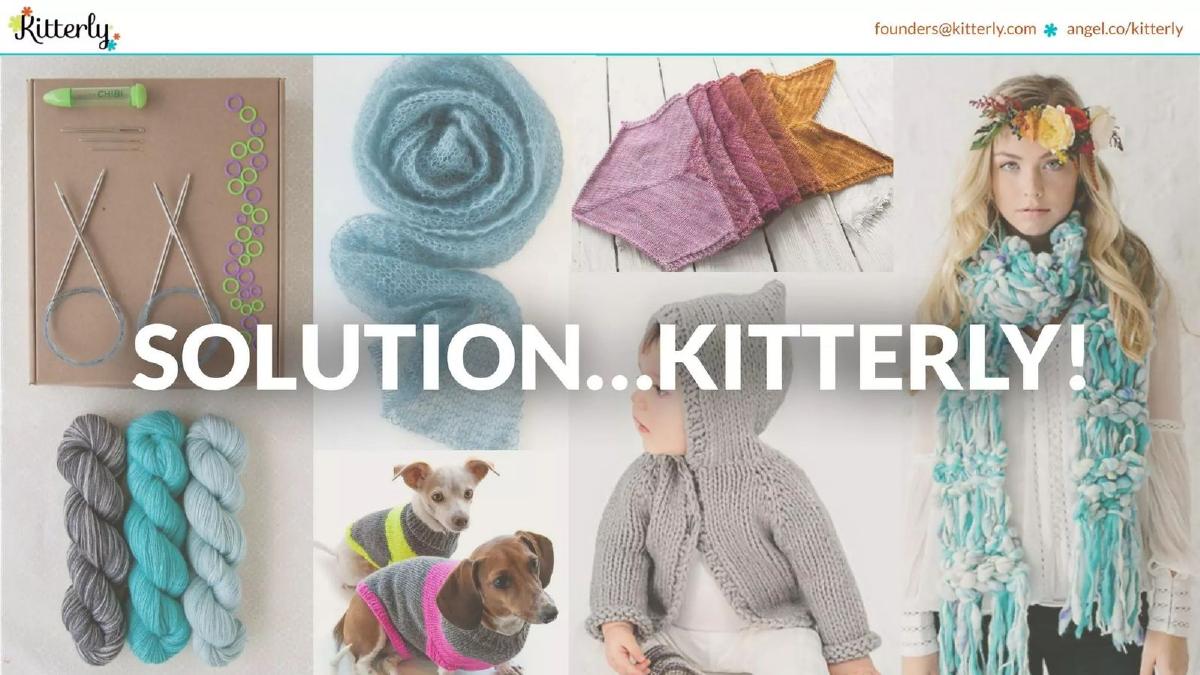
Slide 6: Solution... Kitterly! The solution slide is a collage of finished products—scarves, baby clothes, and even dog sweaters. It reinforces the 'make anything' claim from the title slide. By showing the end result rather than a screenshot of a website, Kitterly focuses on the emotional payoff of their product: the pride of a finished, high-quality handmade item.
Slides 7-8: Traction and Retention
Slide 7: The Growth Curve This is the 'money slide.' It shows a revenue graph from August to February. The revenue stays flat under $5,000 until October, then shoots up to over $30,000 by February. A '500' logo is placed at the inflection point, signaling that their participation in the 500 Startups accelerator was the catalyst for this 30% month-over-month growth. This provides social proof and demonstrates that the founders know how to scale when given resources.
Slide 8: Engagement and Stickiness To counter the argument that e-commerce has high acquisition costs and low loyalty, Kitterly presents a 'Repeat Purchases' rate of 20%+. They anchor this metric with a customer quote from 'Kathy P.' While one quote is anecdotal, the 20% figure is a hard metric that suggests the product has found 'product-market fit' with a core group of users.
Slides 9-10: Team and Closing
Slide 9: The Team The team slide features two founders: Mari Bower (CEO) and Elizabeth Rowen (CMO). The logos at the bottom—MySpace, Mattel, MGA Entertainment, and Knit Culture—show a blend of tech-scale experience and deep industry knowledge. Mari’s BSEE (Bachelor of Science in Electrical Engineering) suggests a technical foundation, while Elizabeth’s background in toy manufacturing and knitting retail suggests she understands the supply chain and the customer base.
Slide 10: The Summary The final slide repeats the three most compelling facts: 11M knitters, 30% MoM growth, and 20% repeat purchases. It’s a strong 'parting shot' that ensures the investor remembers the scale, the momentum, and the loyalty of the business.
What Works in This Deck
The 'Rule of Three': Kitterly identifies three core metrics (11M users, 30% growth, 20% retention) and repeats them. This makes the pitch incredibly easy to digest and remember.
Visual Storytelling: The use of high-quality photography is essential for a craft-based business. They aren't just selling yarn; they are selling the dream of a beautiful finished product. The deck feels like the brand it is trying to build.
The Inflection Point: Explicitly marking the 500 Startups entry on the growth chart is a smart move. It tells a story of 'before and after,' suggesting that the founders are coachable and that the business model is responsive to professional scaling techniques.
What is Missing
The Ask: There is no slide detailing how much money they are raising or what the terms are. While this information is often omitted from public versions of decks, its absence in a 10-slide deck feels like a missed opportunity to define the next milestones.
Unit Economics: While we see the $800/year spend, we don't see Kitterly's margins. In e-commerce, gross margin and Customer Acquisition Cost (CAC) are vital. Investors want to know if that 30% growth is profitable or if they are 'buying' revenue at a loss.
Competitive Landscape: The deck mentions 'too many places' to shop but doesn't name competitors like Etsy, Craftsy (now Bluprint), or local yarn stores. Acknowledging the competition and explaining why Kitterly’s curation is superior would have strengthened the 'Moat' argument.
What a Founder Should Copy
The 'Enthusiast Profile' Slide: Slide 3 is a masterpiece of market analysis. Instead of just saying 'it's a big market,' they explain why it's a valuable market by breaking down hours spent and dollars committed. Any founder in a niche hobby space should use this format.
Minimalist Text: Notice that no slide has more than 15 words. This forces the presenter to speak and the audience to listen, rather than everyone spending the meeting reading walls of text on a screen.
The Summary Slide: Ending on your three strongest metrics is a classic closing technique. It ensures that even if an investor was distracted during the middle of the pitch, they leave with the key data points firmly in mind.
Conclusion
Kitterly’s deck is a testament to the power of a clear value proposition. By 2015, the 'subscription box' and 'kit' craze was in full swing, but Kitterly differentiated itself by focusing on a high-spend, high-engagement niche. They didn't overcomplicate the technology; they focused on the growth and the market size. For a Seed round, showing that you have found a large group of people who are willing to buy from you repeatedly is often more important than having a 50-page business plan. Kitterly proved that with 10 slides and a $30,000 revenue run rate, you can successfully kickstart a $850,000 raise.
Frequently asked questions
- How much did Kitterly raise with this deck?
- According to the catalogue facts, Kitterly raised $850,000 in a Seed round in 2015. Interestingly, the deck itself does not mention the amount being raised, which suggests it may have been used as a teaser or in conjunction with a verbal pitch where the 'Ask' was handled dynamically.
- What is the primary market Kitterly is targeting?
- Kitterly targets the knitting and crochet market. Slide 4 quantifies this as a $2.9 billion segment within a larger $30 billion craft spending market. Slide 2 further narrows the focus to the 11 million knitters located in the United States.
- What are the key growth metrics shown in the deck?
- The deck emphasizes two main metrics: a 30% month-over-month growth rate in revenue (Slide 7) and a repeat purchase rate of over 20% (Slide 8). The revenue chart shows a sharp inflection point starting in November, coinciding with their participation in the 500 Startups accelerator.
- Who are the founders of Kitterly?
- The founders listed on Slide 9 are Mari Bower (CEO) and Elizabeth Rowen (CMO). Mari Bower holds a BSEE and has a background at MySpace and MySpace Music. Elizabeth Rowen brings industry-specific and marketing experience from Mattel, MGA Entertainment, Knit Culture, and Venice magazine.
- What is the 'Problem' Kitterly solves?
- On Slide 5, Kitterly defines the problem as 'Too Many Choices + Too Many Places = D.I.Y. Disaster!!!' This suggests that for hobbyists, the friction of sourcing patterns, the correct yarn, and the necessary tools from multiple vendors leads to project failure or abandonment.