Kinspire's 14-slide pitch deck successfully secured a $3.6M Seed round in 2024 by addressing the systemic failures of the traditional fee-for-service model in pediatric occupational therapy. The deck leans heavily on the founders' personal connection to the problem—a brother-sister duo combining lived experience with clinical expertise. By positioning the product as an extension of the family rather than just a clinical tool, Kinspire highlights a unique 'parent problem-solving loop' that drives outcomes through asynchronous support and data collection. While the deck is light on hard financi…
Key takeaways
- The deck uses a personal 'founder-market fit' story on Slide 3 to establish emotional resonance and clinical credibility.
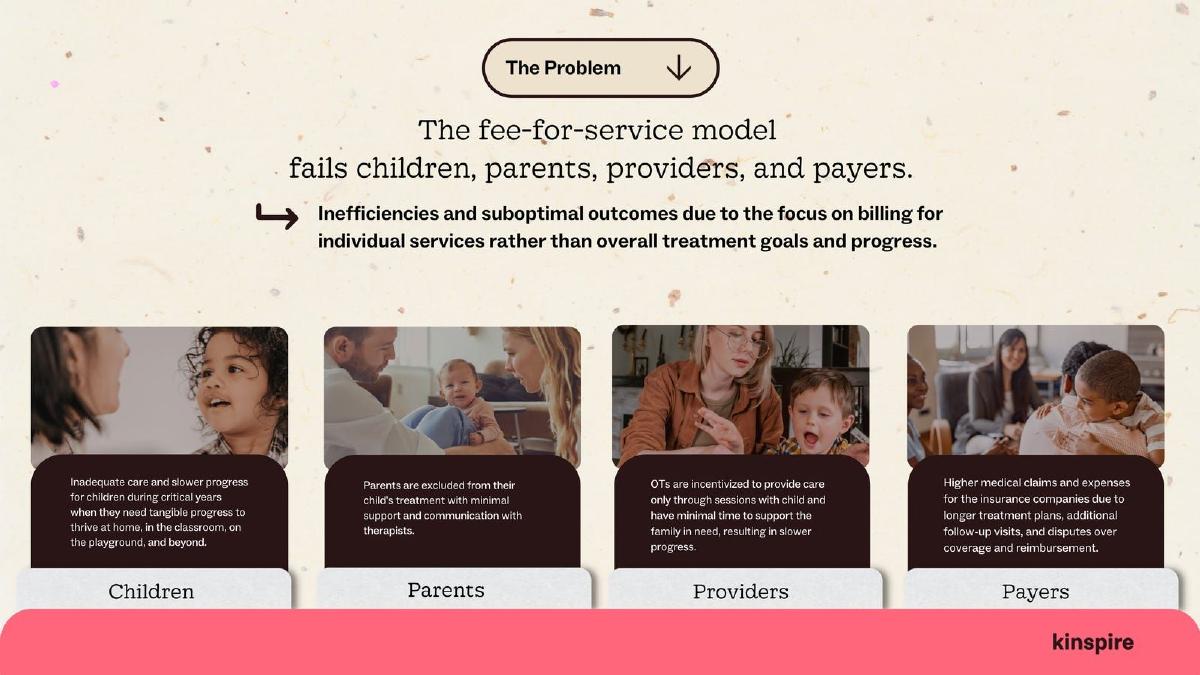
- It explicitly identifies the 'fee-for-service' model as the primary antagonist on Slide 4, setting up their 'value-based' solution.
- Kinspire defines its value proposition across four distinct stakeholders—children, parents, providers, and payers—on Slide 5.
- The product is positioned as a 'HIPAA-compliant mobile app' that enables asynchronous communication, as shown on Slide 7.
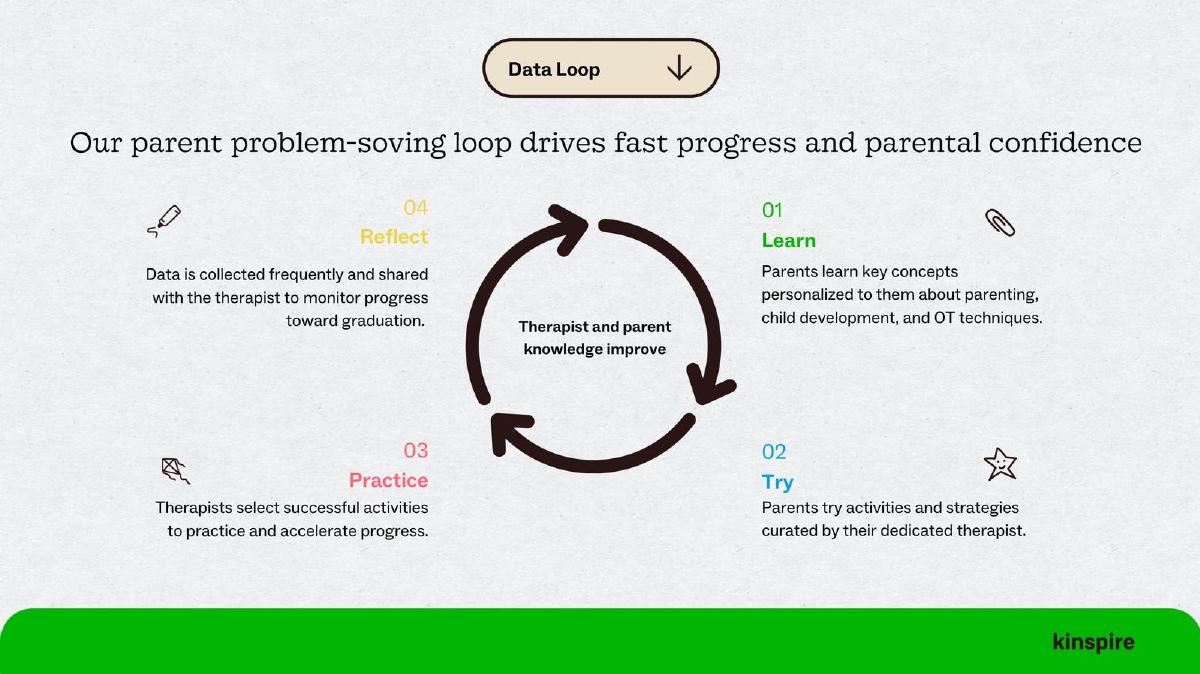
- A proprietary 'parent problem-solving loop' (Learn, Try, Practice, Reflect) is introduced on Slide 9 to explain the methodology.
- Provider supply is validated on Slide 11 with a reported waitlist of over 700 occupational therapists.
- Clinical authority is reinforced on Slide 13 through a Science Advisory Board featuring seven PhDs and OTDs from institutions like the University of Florida.
- The deck omits traditional venture slides, including a formal 'Ask,' market sizing (TAM/SAM/SOM), and financial projections.
Executive Summary: The Narrative-Driven Seed Deck
Kinspire’s pitch deck is a masterclass in narrative-driven fundraising. Used to secure a $3.6M Seed round in 2024, the presentation prioritizes the 'Why' and the 'How' over the 'How Much.' By focusing on the systemic friction in pediatric occupational therapy (OT), the founders—Rob Seigel and Lily Baiser—position themselves as the ideal team to bridge the gap between clinical requirements and the reality of daily parenting. The deck is visually clean, utilizing a warm, approachable color palette that mirrors the company’s mission of bringing 'better days' to families.
Slide 1: The Hook
The title slide introduces the company name, Kinspire, and its core mission: "Better occupational therapy begins at home." It identifies Rob Seigel as CEO and dates the deck to January 2023. The imagery—a mother and child interacting with a laptop—immediately signals a telehealth or digital health focus. This slide establishes the brand identity as family-centric and modern.
Slide 2: The Problem Statement
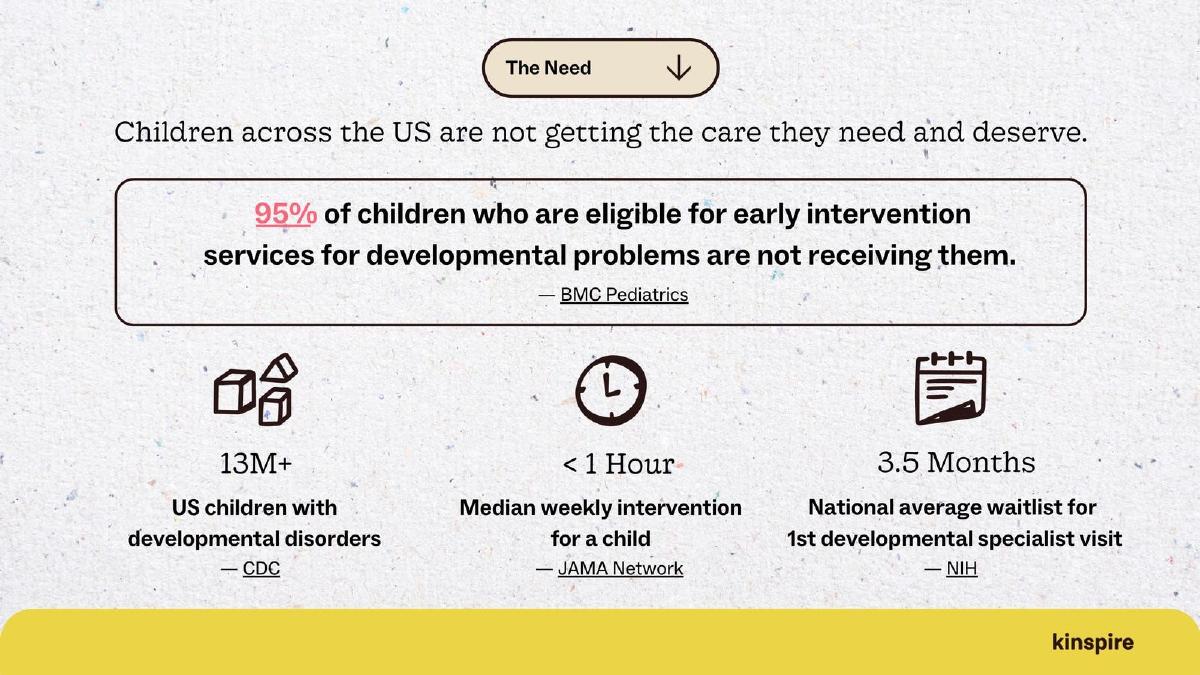
Slide 2 addresses the macro issue: "Children across the US are not getting the care they need and deserve." While the slide text is brief, it sets the stage for a massive underserved market. It implies a gap in access, quality, or consistency in the current pediatric care landscape.
Slide 3: The Origin Story
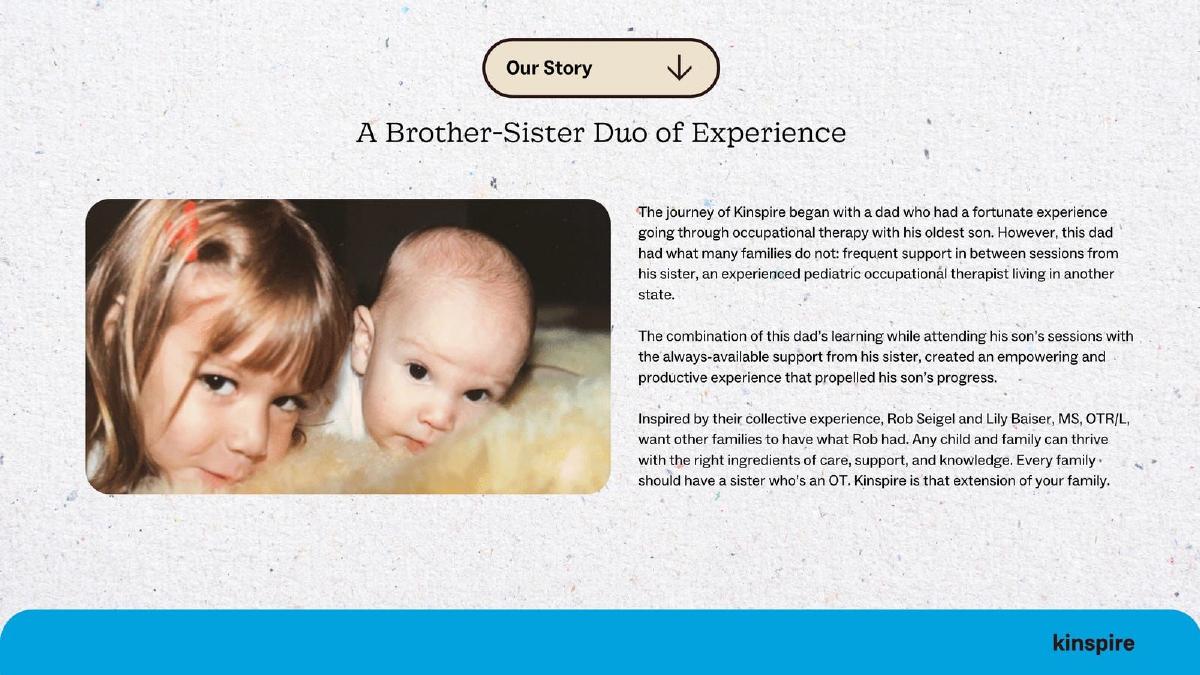
This is a pivotal slide for a Seed round. Titled "Our Story: A Brother-Sister Duo of Experience," it details the personal motivation behind the company. Rob Seigel’s experience as a father navigating OT for his son is paired with Lily Baiser’s clinical background as a pediatric occupational therapist. The text notes that Rob was "fortunate" to have his sister’s support between sessions—a luxury most families lack. This slide successfully establishes founder-market fit, showing that the team understands the problem from both the consumer and provider perspectives.
Slide 4: The Systemic Antagonist
Slide 4 identifies the specific structural failure: the "fee-for-service model." The deck argues that this model fails children, parents, providers, and payers. By attacking the billing structure rather than just the therapy itself, Kinspire positions itself as a systemic solution rather than just another telehealth app. This is a sophisticated move that appeals to healthcare-focused investors who understand the industry's shift toward value-based care.
Slide 5: The Value-Based Solution
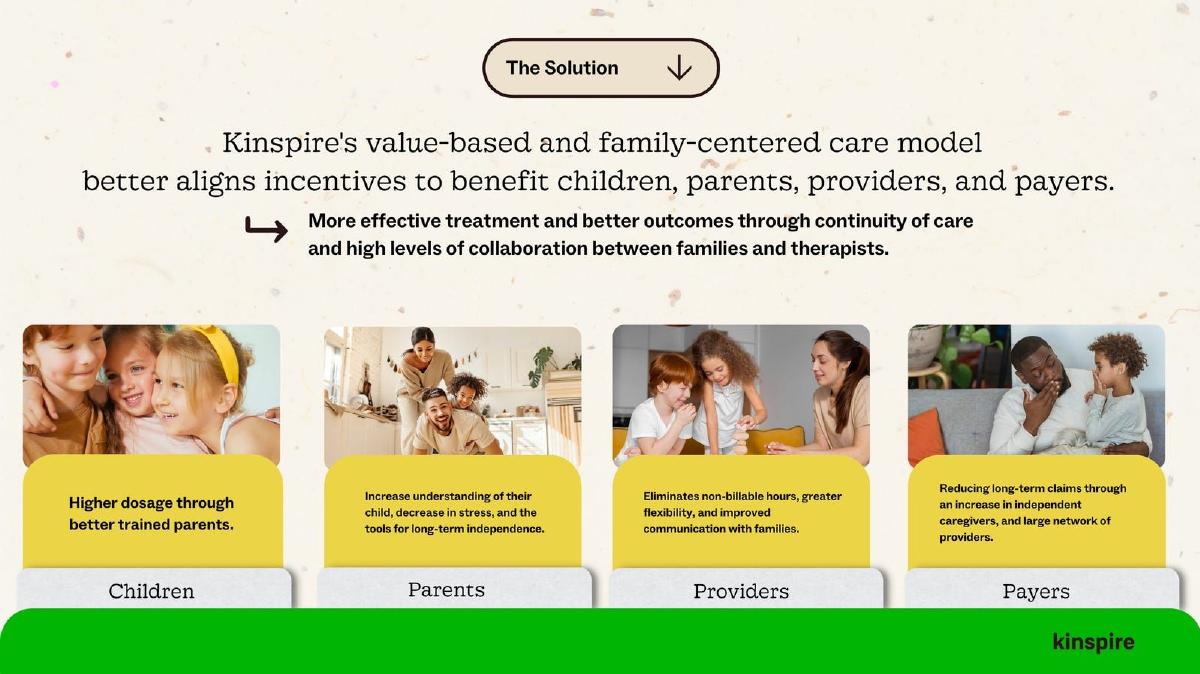
Slide 5 introduces the Kinspire model. It claims to better align incentives across four buckets:
Children: Higher dosage of care through trained parents. · Parents: Increased understanding, decreased stress, and tools for independence. · Providers: Elimination of non-billable hours and greater flexibility. · Payers: Reduction of long-term claims through independent caregivers and a large provider network.
This slide is the most important in the deck for explaining the business logic. It shows that Kinspire isn't just helping kids; it's saving money for insurance companies and reducing burnout for therapists.
Slides 6-8: Product Mechanics
These slides break down the user experience. Slide 6 mentions live 1:1 sessions, while Slide 7 focuses on the "secure HIPAA-compliant mobile apps" where therapists provide asynchronous guidance. Slide 8 highlights the feedback loop, where caregivers share video recordings. This combination of synchronous and asynchronous care is presented as the key to providing "on-call" support that feels like an extension of the family.
Slide 9: The Proprietary Methodology
Slide 9 introduces the "parent problem-solving loop." It consists of four stages: 01 Learn, 02 Try, 03 Practice, and 04 Reflect. This diagram explains how Kinspire actually drives progress. By formalizing the process into a loop, the company demonstrates that its product is built on a repeatable, data-driven methodology rather than just ad-hoc video calls.
Slide 10: The Outcome
This slide summarizes the emotional and functional benefits: building skills, strengthening relationships, and reducing stress. It serves as a bridge between the product mechanics and the business validation that follows.
Slide 11: Supply-Side Validation
One of the strongest data points in the deck appears on Slide 11: "Over 700 Occupational Therapists are on our provider waitlist." For a healthcare startup, recruiting providers is often the biggest hurdle. By showing massive demand from therapists who want "Fair Compensation" and "Work Flexibility," Kinspire proves it can scale its supply side effectively.
Slides 12-13: Team and Advisors
Slide 12 introduces the core team (though specific bios are not detailed in the provided text). Slide 13 is particularly impressive, showcasing a seven-member Science Advisory Board. The board includes PhDs and OTDs from the University of Florida, West Virginia University School of Medicine, and the STAR Institute. This level of clinical backing is crucial for a Seed-stage healthcare company to establish trust with both investors and potential medical partners.
Slide 14: The Closing
The final slide returns to the logo and the slogan "better days are here." It provides a clean, professional end to the narrative.
What Kinspire Does Well
1. Stakeholder Alignment: The deck does an excellent job of explaining how the product benefits everyone in the ecosystem. In healthcare, you cannot just solve for the end-user (the child); you must also solve for the person paying (the payer) and the person delivering the service (the provider). Slide 5 is a perfect example of this multi-faceted value proposition.
2. Clinical Credibility: By featuring a large Science Advisory Board on Slide 13, Kinspire mitigates the risk that this is just a "wellness app." The inclusion of professors and directors from major medical programs suggests that the methodology is rooted in actual occupational therapy science.
3. Supply-Side Proof: The mention of a 700+ therapist waitlist on Slide 11 is a powerful signal of market pull. It suggests that the "provider burnout" problem mentioned on Slide 4 is a real pain point that Kinspire is uniquely positioned to solve.
What is Missing from the Deck
1. Market Sizing (TAM/SAM/SOM): The deck never quantifies the financial opportunity. While it mentions that children across the US are underserved, it doesn't provide figures on how many children need OT or the total spend in the pediatric therapy market. Investors usually want to see that the market is large enough to support a venture-scale return.
2. Business Model and Unit Economics: We know the company uses a "value-based care model," but the deck doesn't explain how they actually make money. Is it a subscription for parents? A per-member-per-month (PMPM) fee from payers? A percentage of the billing? The lack of pricing or revenue data is a significant omission.
3. Competitive Landscape: There is no mention of other telehealth OT platforms or traditional brick-and-mortar competitors. A "Competitor Matrix" or a slide explaining why Kinspire's "parent loop" is superior to existing digital health solutions would have strengthened the case for their defensibility.
4. The Ask: The deck does not state how much money is being raised or what the milestones for the next 18-24 months are. While publisher reports confirm a $3.6M raise, the deck itself leaves the investor guessing about the funding requirements.
Founder Takeaways: What to Copy
Use the 'Antagonist' Strategy: Like Kinspire on Slide 4, identify a specific, widely-hated industry standard (like fee-for-service billing) and position your company as the antidote. This creates an immediate "us vs. them" narrative that is very compelling to investors.
Leverage Personal Narrative: If you have a personal connection to the problem, lead with it. The brother-sister story on Slide 3 is memorable and builds instant trust. It answers the question "Why you?" before the investor even asks it.
Visualize the Process: Don't just say your product works; show the loop. The "parent problem-solving loop" on Slide 9 makes a complex therapeutic process feel manageable, scalable, and proprietary. If your product involves a workflow, turn that workflow into a named, branded diagram.
Focus on Supply: In marketplaces or service-heavy businesses, proving you can get the 'supply' (in this case, therapists) is often more important than proving you can get the 'demand.' The waitlist metric on Slide 11 is a high-impact way to show that your platform is a place where professionals want to work.
Frequently asked questions
- What is Kinspire's core business model?
- Kinspire operates a value-based, family-centered care model for pediatric occupational therapy. Unlike traditional fee-for-service models, Kinspire focuses on aligning incentives for all stakeholders by providing continuous support through a mobile app. This includes 1:1 live sessions combined with asynchronous messaging and video feedback, aiming to reduce long-term insurance claims and improve child outcomes through better-trained parents.
- How does Kinspire validate its therapist supply?
- On Slide 11, the company claims to have a waitlist of over 700 occupational therapists. They attract these providers by offering 'Fair Compensation' (reducing non-billable hours), 'Family Communication' (integrating support into the job rather than overtime), and 'Work Flexibility' through asynchronous support that can be performed from anywhere.
- What specific product features are highlighted in the deck?
- The deck emphasizes a HIPAA-compliant mobile app that facilitates a 'parent problem-solving loop.' Key features include live 1:1 sessions, asynchronous messaging for guidance, the ability for caregivers to share video recordings of their children for therapist review, and a data collection system to monitor progress toward 'graduation' from the program.
- Who are the founders and what is their background?
- The company was founded by Rob Seigel (CEO) and Lily Baiser (MS, OTR/L). Slide 3 describes them as a 'brother-sister duo.' Rob brings the perspective of a father who navigated the OT system for his son, while Lily provides the clinical expertise as an experienced pediatric occupational therapist.
- What is missing from the Kinspire pitch deck?
- The deck is notably missing several standard venture components: there is no slide detailing the total addressable market (TAM), no competitive landscape analysis, no financial projections or unit economics, and no explicit 'Ask' slide detailing how the $3.6M will be spent. It functions more as a narrative and product vision deck than a data-heavy financial presentation.