SkyCell’s pitch deck is a masterclass in industrial problem-solving, focusing on the high-stakes world of pharmaceutical logistics. The narrative is built on two pillars: the massive $35B annual product loss due to temperature failures and the rising tide of biologics, which are increasingly temperature-sensitive. By contrasting their audited <0.1% temperature excursion rate against an industry standard that can reach 12%, SkyCell makes a compelling case for operational superiority. The deck successfully bridges the gap between traditional logistics and modern ESG requirements, demonstrating…
Key takeaways
- The market for high-end cold chain packaging is projected to grow 3x by 2030 (Slide 2).
- Temperature-sensitive drugs accounted for an estimated 60% of the market by 2021, up from 30% in 2010 (Slide 2).
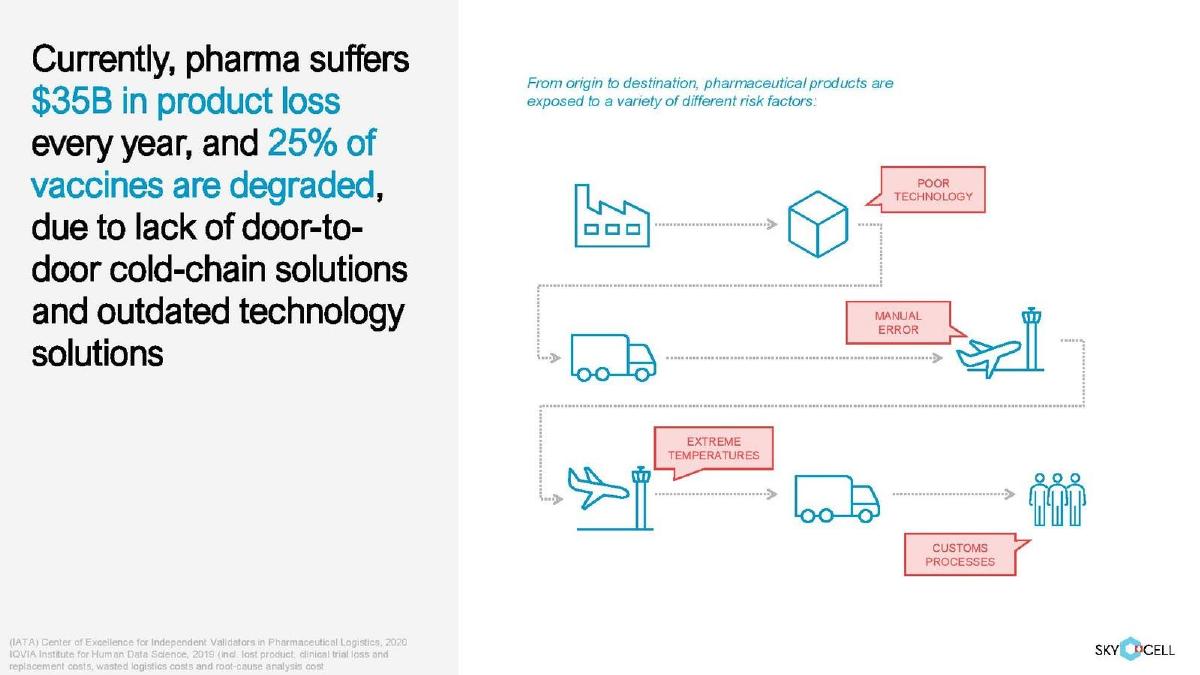
- Pharma companies lose $35B annually in product value, with 25% of vaccines degraded due to poor cold-chain solutions (Slide 3).
- SkyCell claims an audited temperature excursion rate of <0.1%, significantly lower than the 2-12% industry standard (Slide 4).
- Approximately 50% of temperature excursions occur during airport handling, according to IATA data (Slide 4).
- Switching to SkyCell containers can save up to 50% of CO2 emissions per shipment (Slide 5).
- A case study shows a global pharmaco could reduce 240k tons of CO2 and save $20M by switching solutions (Slide 5).
- The deck emphasizes a 'door-to-door' approach to eliminate risks at transfer points like customs and ground handling (Slide 4).
SkyCell: Decarbonizing the High-Stakes Pharma Supply Chain
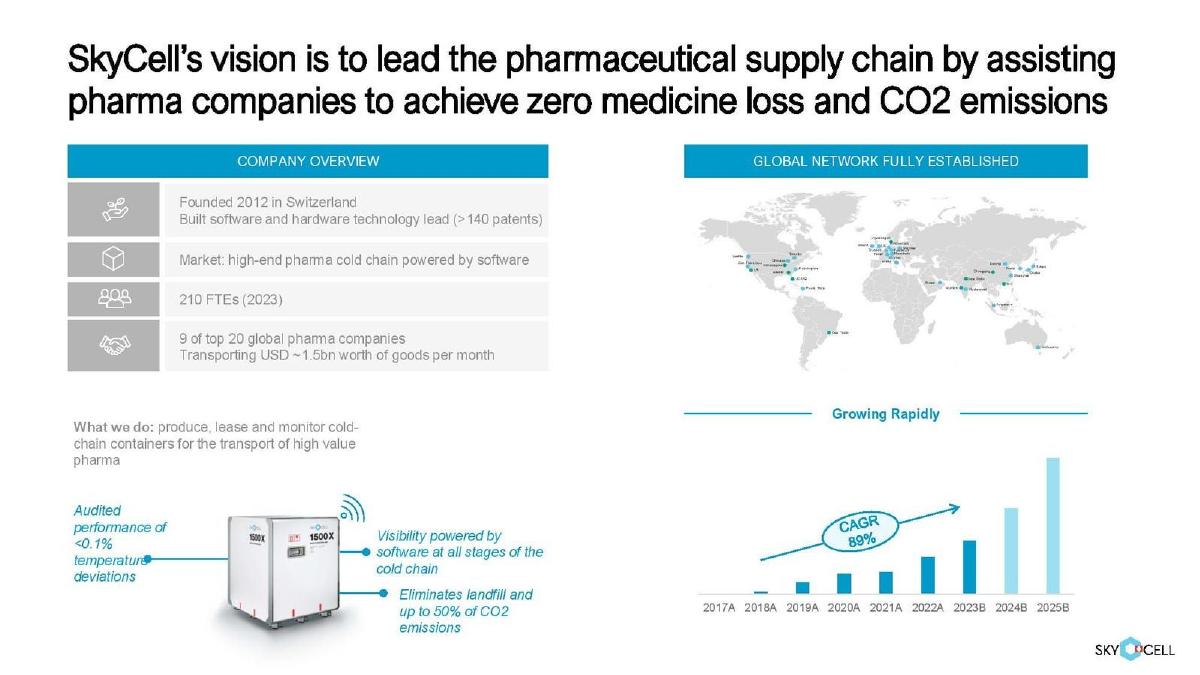
SkyCell’s growth deck, used to secure $57M in 2024, is a highly focused document that prioritizes technical reliability and market necessity over flashy branding. Operating in the healthcare logistics sector, SkyCell provides a hybrid solution of smart containers and software designed to prevent the catastrophic loss of temperature-sensitive medicines. The deck is structured to move the investor from a macro market problem to a specific technical solution, concluding with a powerful ESG-driven financial argument.
Slide 1 & 6: The Vision and Product Visuals
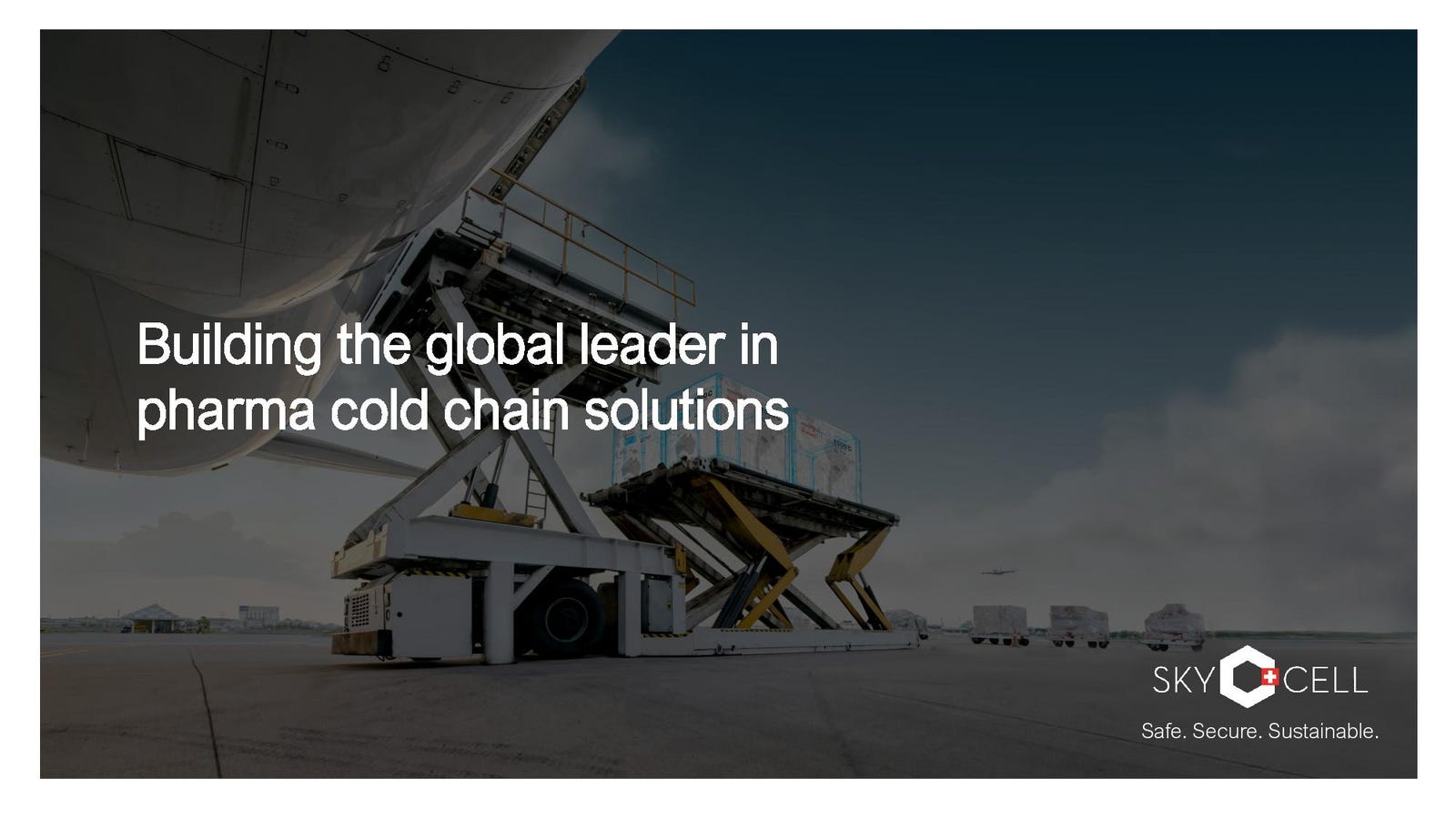
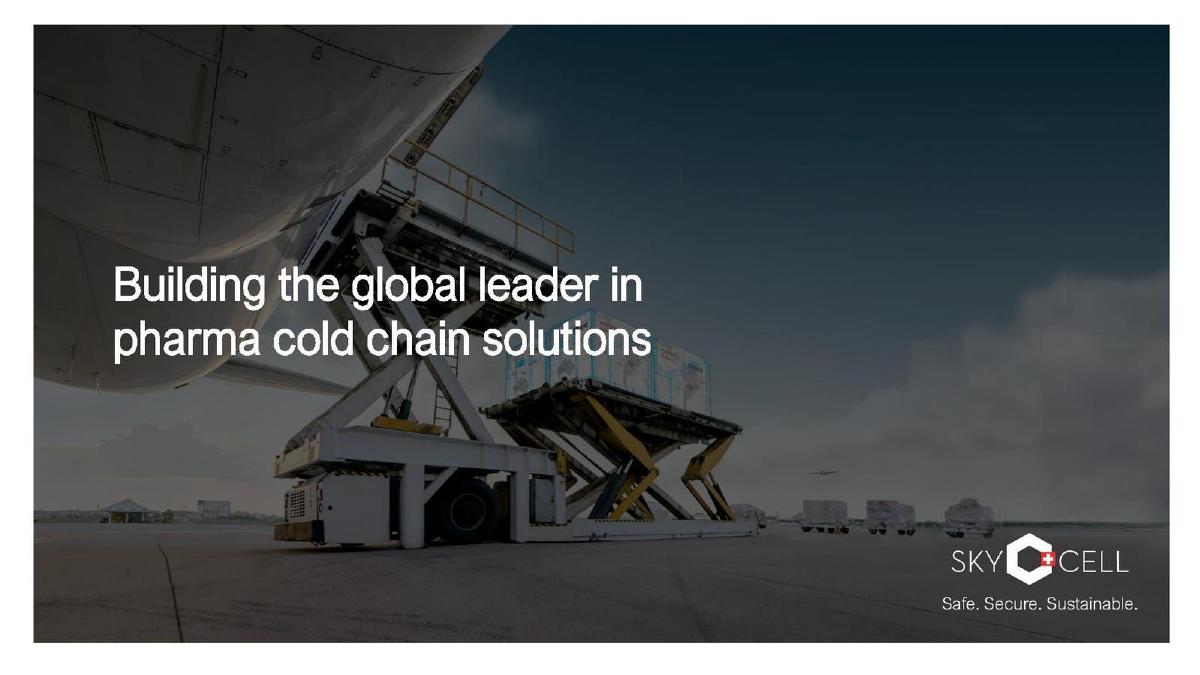
Slides 1 and 6 serve as bookends for the visual identity of the company. Both feature the tagline "Building the global leader in pharma cold chain solutions" set against high-resolution imagery of their containers in an airport tarmac environment. Slide 6 specifically showcases the 1500X model, emphasizing the physical reality of the product. The branding is clean, utilizing a logo that incorporates a medical cross within a hexagonal 'cell' structure, reinforcing the company's focus on the intersection of healthcare and logistics. The sub-tagline "Safe. Secure. Sustainable." summarizes the three pillars of their value proposition.
Slide 2: The Biologicals Tailwinds
Slide 2 establishes the 'Why Now?' by looking at the shift in pharmaceutical manufacturing. The headline states that the market for high-end cold chain packaging is "expected to grow by 3x by 2030." This growth is not just arbitrary; it is fueled by the transition from traditional small-molecule drugs to biologicals. The slide provides a bar chart showing that in 2010, only 30% of top-selling drugs were temperature-sensitive. By 2021, that estimate rose to 60%. This data point is crucial because it proves that SkyCell is not just entering a static market, but one where the demand for their specific high-end service is doubling as a percentage of the total industry.
Slide 3: Quantifying the $35B Failure
Slide 3 defines the problem in stark financial terms. It claims the pharma industry suffers "$35B in product loss every year" and that "25% of vaccines are degraded." The slide uses a flow chart to identify specific failure points: poor technology, manual error, extreme temperatures, and customs processes. By citing sources like the IATA and IQVIA Institute for Human Data Science, SkyCell grounds these massive figures in third-party credibility. This slide transitions the conversation from 'shipping' to 'risk management,' framing SkyCell as an insurance-like necessity for pharmaceutical giants.
Slide 4: The Performance Gap
This is arguably the most important slide in the deck. It compares SkyCell’s performance directly against the industry. The headline highlights an "audited <0.1% temperature excursions" rate compared to the ">2-12% industry standard." A diagram illustrates the 'door-to-door' journey, marking high-risk zones in red (Ground Handling and Customs). The slide notes that "50% of temperature excursions happen during airport handling according to IATA." By showing their container bypassing these risks with superior insulation and monitoring, SkyCell justifies a premium position in the market. The footnote mentioning an "Annual audit by big four auditor" adds a layer of institutional trust that is vital for growth-stage investments.
Slide 5: The ESG and Cost Synergy
Slide 5 addresses the modern requirement for decarbonization. It claims a "50% reduction of CO2 emissions per shipment" while "simultaneously reducing total cost for pharma." The visual on this slide is a complex graph comparing the cost of different carbon reduction methods. It shows that a global pharmaco switching to SkyCell could achieve a "240,000 tCO2 reduction" which results in a "-$20M" cost (a saving). This is contrasted against the "$250M" cost of achieving the same reduction through direct air capture or "$3.8M" through reforestation. This framing is brilliant: it presents SkyCell not as an expensive green alternative, but as the most cost-effective way to meet corporate sustainability goals.
What Works in the SkyCell Deck
The deck is exceptionally strong at quantifying the pain point . Many startups speak vaguely about 'inefficiency,' but SkyCell uses a specific $35B figure and a 25% vaccine degradation rate to create urgency. The use of audited performance metrics (<0.1% failure rate) provides a 'hard' competitive moat that is difficult for incumbents to hand-wave away. Furthermore, the deck successfully links sustainability to the bottom line. By showing that their solution is cheaper than carbon offsets, they remove the friction often associated with adopting 'green' technology in heavy industry.
What is Missing from the SkyCell Deck
Despite the strong narrative, the provided slides leave several questions unanswered. There is no team slide , which is a significant omission for a growth-stage company where operational expertise is as important as the technology. There is also a lack of competitive analysis ; while they compare themselves to the 'industry standard,' they do not name specific competitors like Envirotainer or Va-Q-tec. Finally, the financial mechanics are absent. While we see a case study for a single client, there is no mention of the company’s overall ARR, growth rate, or the specific 'Ask' for the $57M round. These elements were likely included in a full data room but are missing from this core pitch sequence.
Founder Takeaways: Selling Certainty in an Uncertain World
Founders building in the 'hard tech' or logistics space should study how SkyCell sells certainty . In a world of volatile supply chains, SkyCell doesn't sell 'containers'; they sell the guarantee that a billion-dollar batch of medicine won't spoil. Key lesson: If your product has a lower failure rate than the status quo, make that the centerpiece of your deck. Use third-party audits to back it up. Additionally, the way SkyCell frames ESG as a 'negative cost' (a saving) is the most effective way to sell sustainability to C-suite executives who are primarily focused on the P&L. If you can prove that being green is the cheapest way to operate, the sale becomes inevitable.
Frequently asked questions
- What is the primary problem SkyCell is solving?
- SkyCell addresses the massive failure rate in pharmaceutical shipping. According to Slide 3, the industry loses $35 billion annually due to product loss, and 25% of vaccines are degraded because of outdated technology and gaps in door-to-door cold-chain solutions. They solve this by providing smart containers that maintain strict temperature controls throughout the entire transit process.
- How does SkyCell's performance compare to the rest of the industry?
- The performance gap is the core of their value proposition. Slide 4 notes that SkyCell has an audited temperature excursion rate of less than 0.1%. In contrast, the industry standard for temperature excursions ranges from 2% to 12%. This reliability is critical for high-value biological drugs that are easily ruined by thermal fluctuations.
- Why is the cold chain market growing so rapidly?
- Slide 2 attributes the 3x market growth projected by 2030 to the rise of biologicals and higher-value products. In 2010, only 30% of top-selling drugs were temperature-sensitive; by 2021, that figure rose to 60%. As medicine becomes more complex and personalized, the requirement for stable shipping environments becomes mandatory rather than optional.
- What are the environmental benefits of using SkyCell?
- SkyCell positions sustainability as a cost-saver rather than a burden. Slide 5 states their containers save up to 50% of CO2 emissions per shipment. They illustrate this with a case study where a pharmaceutical company reduces 240,000 tons of CO2, which would cost $250M to offset via direct air capture, while actually saving $20M in direct costs by switching to SkyCell.
- What information is missing from this pitch deck?
- The provided 11-slide sequence is missing several standard venture components, including a leadership team slide, a detailed competitive landscape, and specific financial projections or unit economics. It also lacks a clear 'Ask' slide detailing how the $57M in growth capital will be deployed across specific regions or product lines.