Skyfire Systems secured $8.5M in Seed funding in 2024 to address a specific friction point in the AI boom: autonomous agents cannot easily pay for things. The 13-slide deck positions the company as the 'financial stack for the machine economy,' moving away from traditional credit card and subscription models toward on-chain, programmable micropayments. By leveraging stablecoins, Skyfire aims to provide AI agents with the identity and liquidity needed to purchase APIs, data, and infrastructure services independently. The deck relies heavily on massive market projections—citing a $171B AI infra…
Key takeaways
- The company defines its mission as building the financial system for the 'machine economy,' specifically targeting identity and micropayments (Slide 4).
- Skyfire identifies three core pillars for the future of AI commerce: Interconnected, On-Demand, and Instant (Slide 2).
- The deck cites three distinct market opportunities: AI Training Data ($7B), AI Application & Subscription ($73B), and AI Infrastructure ($171B) by 2029 (Slide 3).
- The solution is built on-chain and powered by stablecoins to ensure payments are 'fully programmable' and 'always-on, 24-7' (Slide 5).
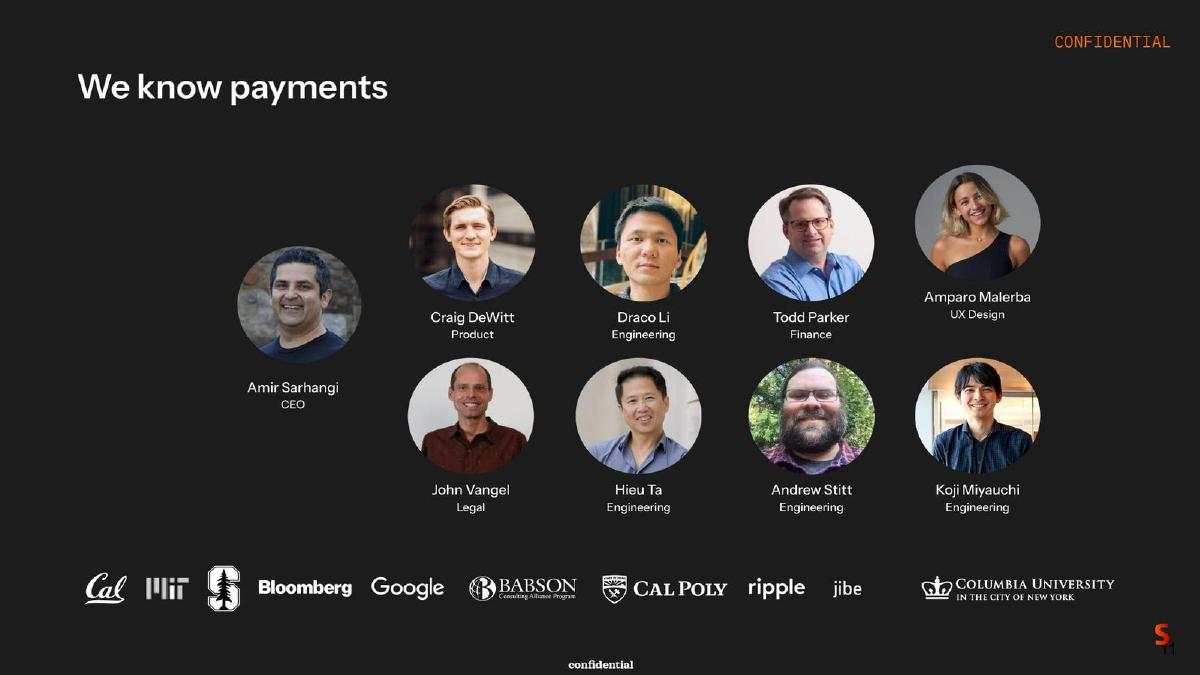
- The founding team features significant experience from Ripple, Google, and Bloomberg, positioning them as payment industry veterans (Slide 11).
- Skyfire raised $8.5M in a Seed round in 2024, as reported by Business Insider.
- The deck omits a traditional 'Ask' slide, current traction metrics, and a detailed competitive landscape analysis.
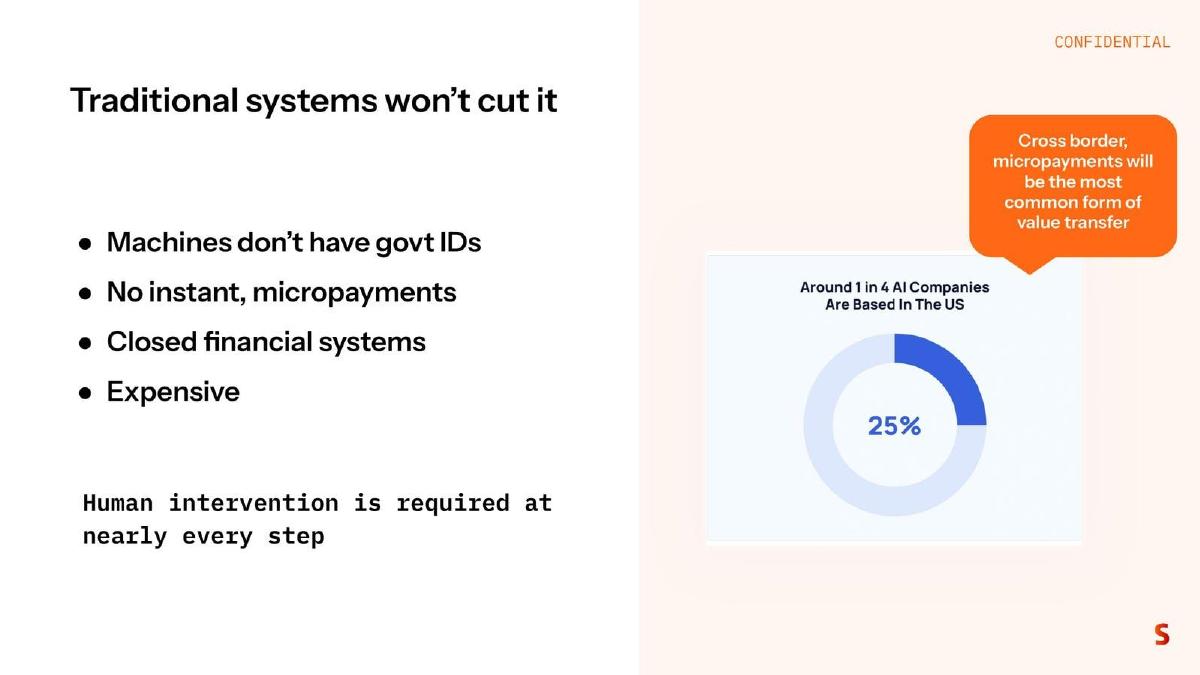
- The visual design is minimalist, using high-contrast dark and light themes to emphasize the transition from the old financial system to the new machine economy.
The Vision: Banking for Non-Humans
Skyfire Systems entered the market at a pivotal moment in 2024. As large language models (LLMs) evolved into autonomous agents capable of executing tasks, a fundamental bottleneck emerged: these agents had no way to pay for the resources they consumed. Most internet services require a credit card, a human-verified identity, and a subscription. Skyfire’s deck, which helped secure $8.5M in Seed funding, argues that the next phase of the internet belongs to the 'machine economy.'
Slide 1: Title Slide
The deck opens with a clean, minimalist aesthetic. The tagline, "The financial stack for the machine economy," immediately establishes the company’s category. It isn't just a payment app; it is 'the stack,' implying infrastructure that others will build upon. The use of 'machine economy' is a strategic choice to distance the company from generic AI hype and focus on the transactional nature of future software.
Slide 2: The Problem and Future State
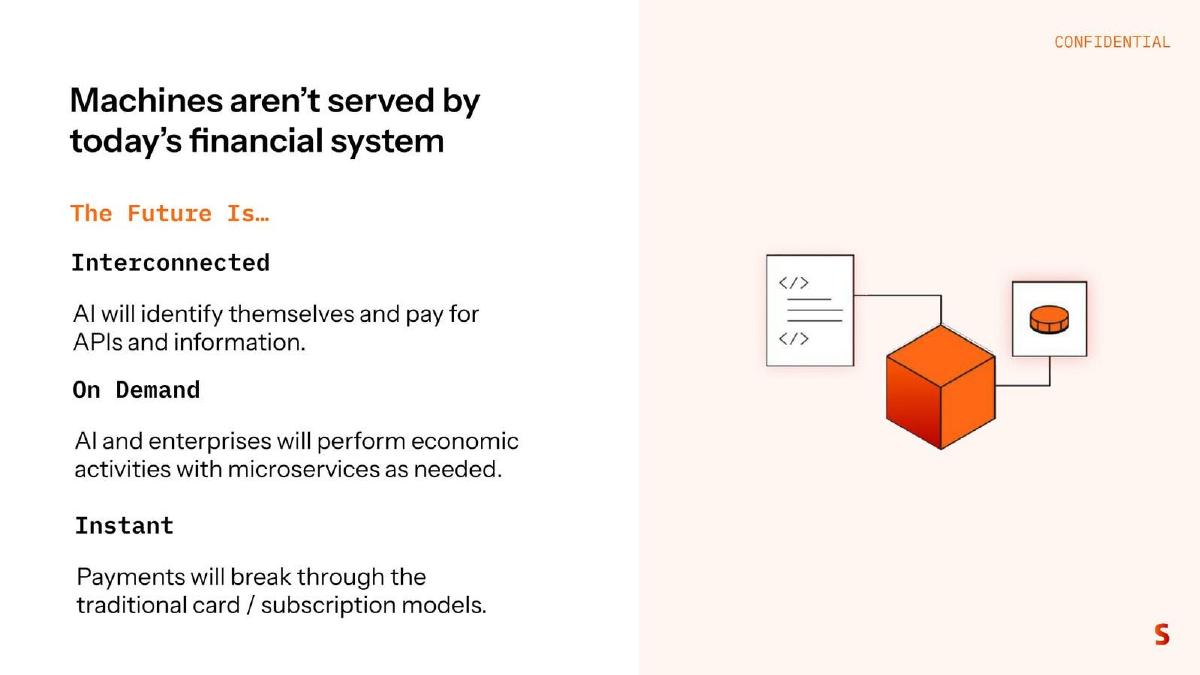
Slide 2 explicitly states, "Machines aren’t served by today’s financial system." This is the core thesis of the company. The slide breaks down the future into three characteristics: Interconnected (AI identifying themselves), On Demand (economic activities via microservices), and Instant (breaking through traditional card/subscription models). The graphic on the right shows a simplified flow of code interacting with a digital currency, reinforcing the idea of a direct, machine-to-machine transaction layer.
Slide 3: Massive Market Opportunity
To justify a venture-scale investment, Skyfire points to three massive, growing markets. Citing Polaris and Mador Market Research, the slide projects 2029 revenues for:
AI Training Data: $7B at a 21% CAGR. · AI Application & Subscription: $73B at a 37% CAGR. · AI Infrastructure: $171B at a 20% CAGR.
By showing these three pillars, Skyfire suggests that their payment rails are the connective tissue for the entire AI ecosystem, from the data used to train models to the infrastructure that hosts them.
Slide 4: The Mission Statement
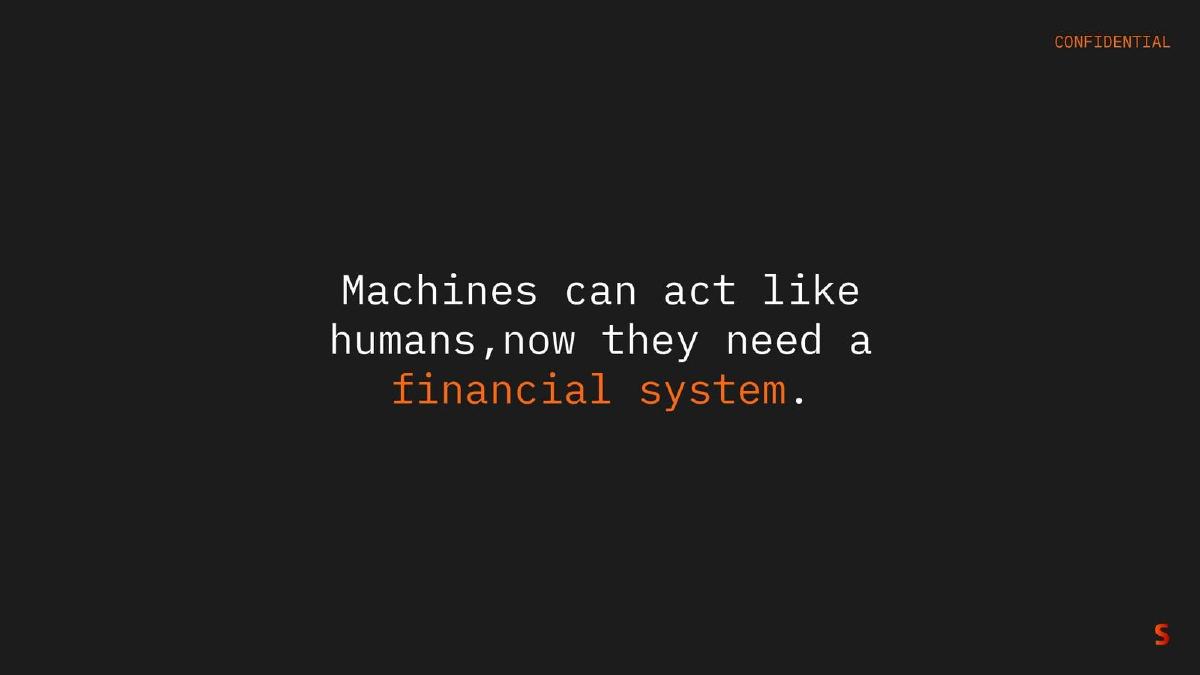
This is a transition slide that uses a high-contrast dark background to make a bold claim: "Skyfire is building the financial system for the machine economy starting with identity and micropayments." This is a critical distinction. They aren't just doing payments; they are doing 'identity.' For a machine to pay, it must first be a recognized entity. This slide sets the stage for the technical solution.
Slide 5: The Solution - On-Chain Payments
Skyfire reveals its technical preference here: "On chain machine payments, powered by stablecoins." The slide lists five benefits of this approach: Globally Open, Natively digital and global, Fully programmable, Low cost, and Always-on, 24-7. By choosing stablecoins, Skyfire bypasses the legacy banking system's 'working hours' and high fees for cross-border transactions, which are ill-suited for AI agents that might need to make thousands of sub-cent transactions per hour.
Slide 11: The Team
The 'We know payments' slide is a heavy hitter. Led by CEO Amir Sarhangi, the team boasts logos from Google, Ripple, Bloomberg, and Jibe. The engineering team is particularly deep, with four dedicated engineering heads shown. The inclusion of a Legal lead (John Vangel) is a subtle but important signal to investors that the company is navigating the complex regulatory landscape of crypto and fintech seriously. The academic pedigree (Stanford, MIT, Cal, Columbia) rounds out a team that looks 'safe' to institutional VCs.
Slide 13: Closing
The deck concludes with a simple "Thank you!" slide. Notably, the deck (as presented in this set) does not include a slide detailing the specific 'Ask' (the $8.5M figure is known from publisher reports, not the slides) or a roadmap of what will be built over the next 18 months. This suggests the deck was likely used as a narrative support for a conversation rather than a standalone document intended to answer every operational question.
What Works in the Skyfire Deck
The most successful element of this deck is its clarity of purpose. Many AI startups struggle to define exactly where they sit in the value chain. Skyfire avoids this by claiming a specific, underserved niche: the transaction layer. By focusing on 'identity' and 'micropayments,' they address the two biggest hurdles for autonomous agents.
The market sizing on Slide 3 is also effective. Rather than claiming a single, vague 'TAM' (Total Addressable Market), they break it down into segments that investors already understand and are likely already investing in. This makes Skyfire look like a 'pick and shovel' play for the broader AI gold rush.
Finally, the team slide provides the necessary credibility to execute a crypto-fintech hybrid. Building a payment network requires more than just good code; it requires regulatory knowledge and industry connections, which this team appears to have in abundance.
What is Missing
While the deck is strong on vision, it is light on mechanics. There is no slide explaining the 'Skyfire Protocol' or how the identity layer actually works. Is it a decentralized ID (DID)? Is it a centralized registry? For a Seed round, investors often want to see at least a high-level architecture diagram to ensure the 'moat' is technical and not just a first-mover advantage.
There is also a lack of competitive analysis. Skyfire is not the only company looking at AI agents and payments. Other blockchain projects (like Autonolas or various L2 solutions) are also targeting this space. A slide acknowledging the competition and explaining Skyfire's unique advantage (perhaps their focus on stablecoins over volatile tokens) would have strengthened the argument.
Lastly, the business model is absent. Does Skyfire charge a SaaS fee, a transaction fee, or a spread on the stablecoin conversion? In a fintech play, the path to revenue is usually as important as the technology itself.
Founder's Guide: What to Copy
Founders should emulate Skyfire's narrative arc. The deck moves logically from 'The world has changed' to 'The old tools don't work' to 'Here is the new tool.' It doesn't get bogged down in technical jargon until it has established the economic necessity of the product.
The visual consistency is also worth noting. The deck uses a limited color palette and plenty of white space, which makes it feel professional and 'enterprise-ready.' For a company dealing with money and identity, looking stable and serious is a branding requirement.
Finally, the use of specific, sourced market data (Slide 3) is a best practice. Instead of making up numbers, they point to third-party research, which adds a layer of objectivity to their growth claims.
Frequently asked questions
- What problem does Skyfire Systems solve?
- Skyfire addresses the fact that current financial systems are designed for humans, not machines. AI agents struggle with traditional credit cards and subscriptions. Skyfire provides a secure payment network that allows these agents to autonomously identify themselves and pay for services like APIs and data using programmable stablecoins.
- Why does Skyfire use stablecoins instead of traditional banking?
- According to Slide 5, stablecoins allow for payments that are natively digital, global, low-cost, and fully programmable. Traditional banking models are often too slow or expensive for the high-frequency, low-value micropayments required by autonomous AI agents operating 24/7.
- How large is the market Skyfire is targeting?
- Slide 3 highlights three growth areas by 2029: AI Training Data at $7B (21% CAGR), AI Applications at $73B (37% CAGR), and AI Infrastructure at $171B (20% CAGR). The company aims to be the payment layer across all these sectors.
- Who is behind Skyfire Systems?
- The team is led by CEO Amir Sarhangi and includes specialists in product, engineering, finance, and legal. Slide 11 highlights past experience at major firms including Google, Ripple, Bloomberg, and Jibe, as well as academic backgrounds from Stanford, MIT, and Columbia.
- What is missing from the Skyfire pitch deck?
- The deck is a high-level vision piece. It lacks a detailed business model (how they take a cut), a competitive analysis of other Web3 or fintech payment rails, and specific technical details on how the 'identity' layer of their stack functions.