Bstow’s 13-slide deck is an outlier in the world of fundraising, eschewing traditional dense data for a high-impact, visual-first approach. Raised in 2015, the $120,000 seed round was supported by a presentation that emphasized the massive gap between offline and digital giving. The deck uses cultural touchpoints—like the ACLU’s viral fundraising moments—to establish urgency before presenting a simple B2B2C revenue model. While it lacks a traditional team slide, competition matrix, or detailed financial projections, its strength lies in its clarity of purpose: moving a $340 billion market int…
Key takeaways
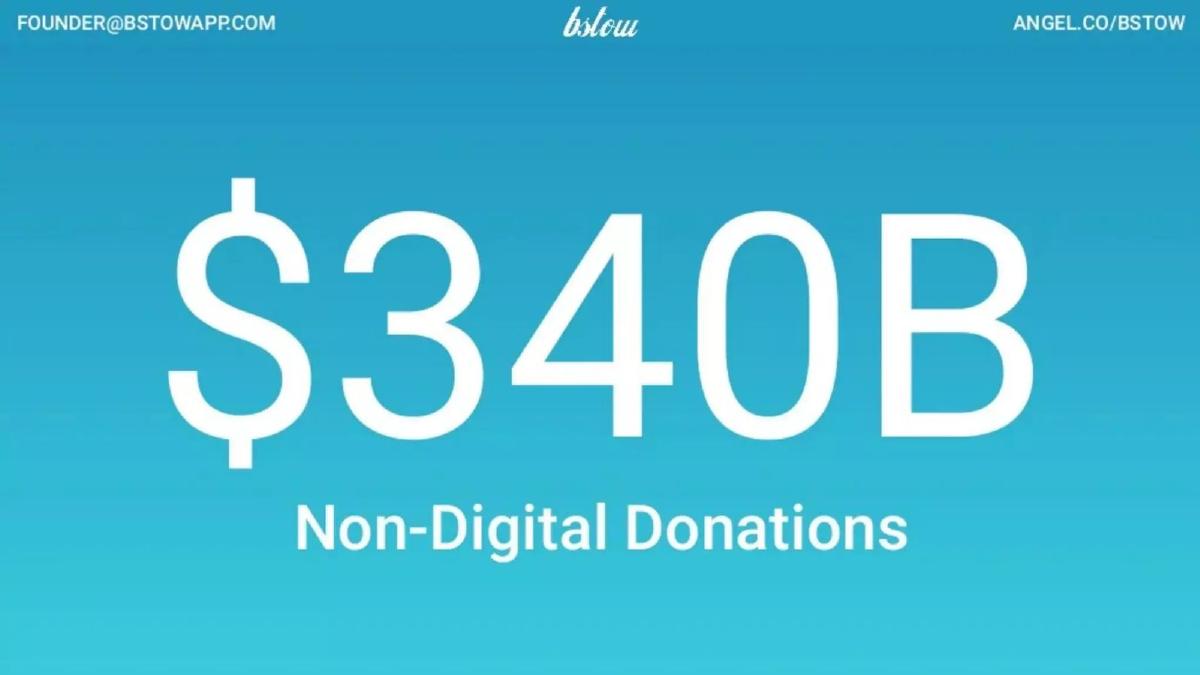
- The deck identifies a $340 billion market for non-digital donations on slide 5.
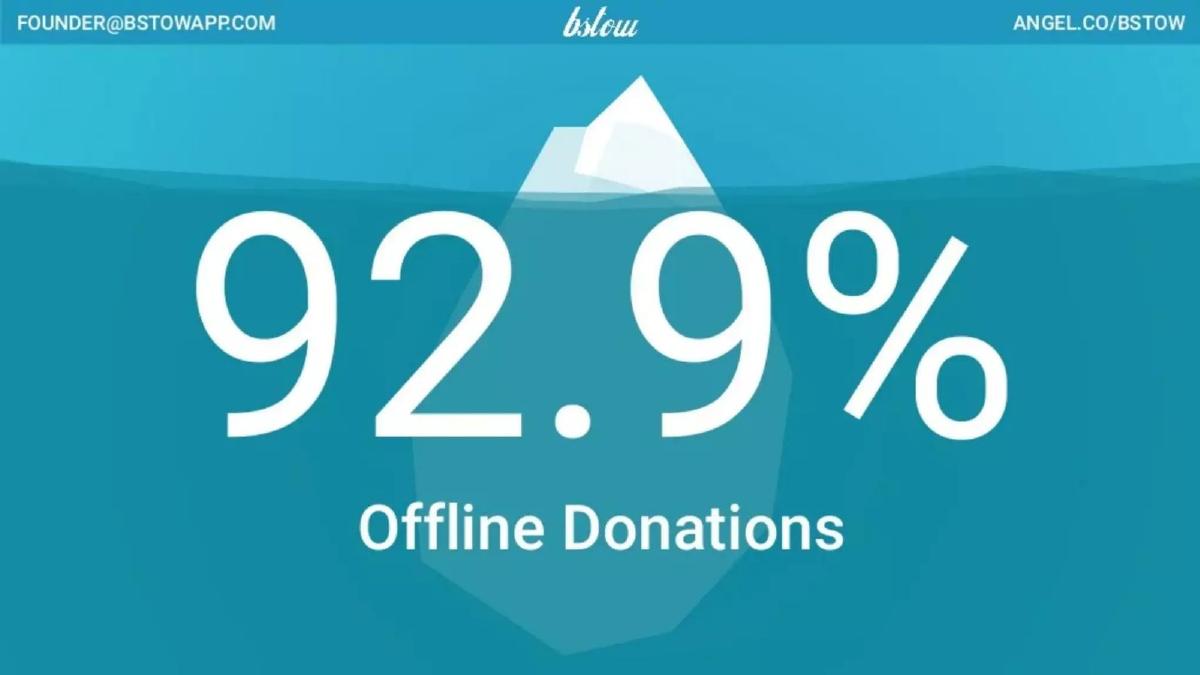
- Bstow claims that 92.9% of donations are currently offline, represented by an iceberg graphic on slide 6.
- The product interface focuses on 'Round-Ups' to automate spare change donations, as shown on slide 7.
- The business model is a B2B2C 'secret sauce' combining licensing fees and processing fees (slide 8).
- The company demonstrated early traction with $280,000 processed in six months (slide 9).
- A partnership or validation from Barclays is highlighted via licensing and security testing on slide 10.
- Bstow boasts a 91% monthly retention rate compared to a 29% sector average (slides 11 and 12).
- The deck completely omits a team slide, a roadmap, and a specific funding 'ask' or use of proceeds.
The Minimalist Approach to Seed Fundraising
Bstow’s 2015 pitch deck is a fascinating artifact from the mid-2010s fintech boom. At just 13 slides, it is remarkably sparse. There are no bulleted lists, no complex charts, and very little explanatory text. Instead, the founders chose to lead with a narrative of cultural shift and massive market inefficiency. This deck was clearly designed to be a backdrop for a live pitch, where the speaker provides the context that the slides intentionally omit.
Slides 1-4: Establishing Cultural Urgency
Slide 1: Title The deck opens with the Bstow logo and the tagline: "Donate Spare Change Automatically." It immediately defines the product category: a 'round-up' app for charity, similar to what Acorns did for investing.
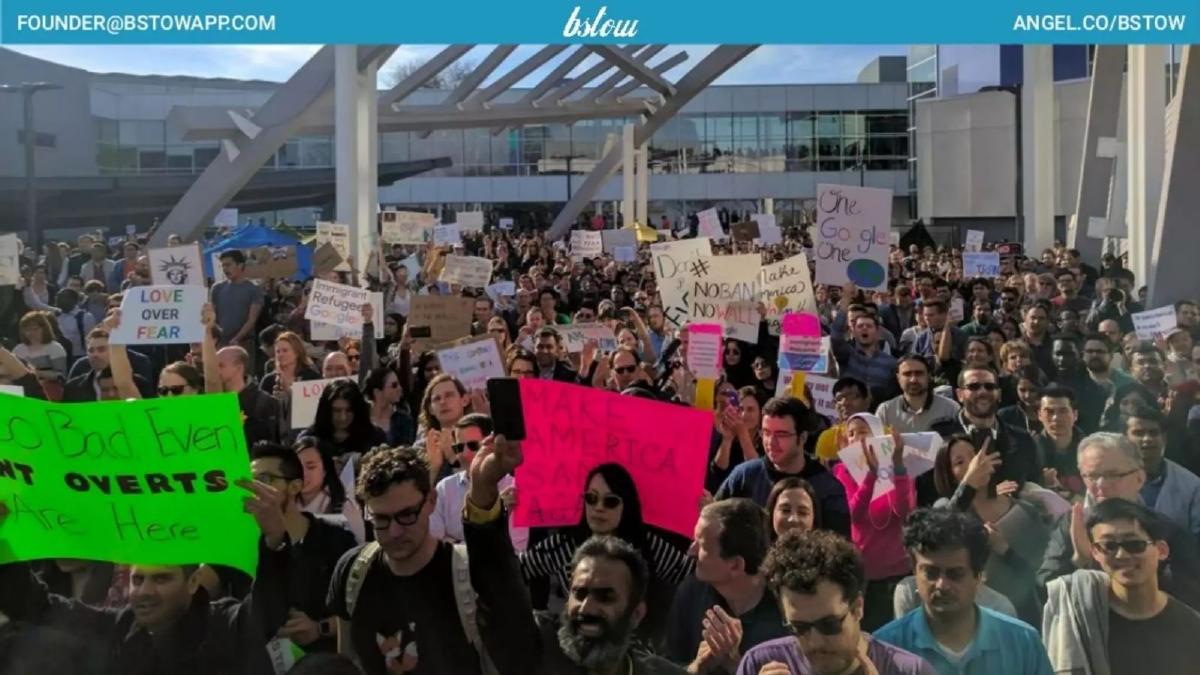
Slide 2: The Crowd This slide features a full-bleed photo of a large protest crowd with signs like "Love Over Fear" and "No Ban No Wall." There is no text on the slide other than the contact info in the header. It serves to anchor the product in a specific moment of heightened social and political activism, suggesting that people are more motivated than ever to give.
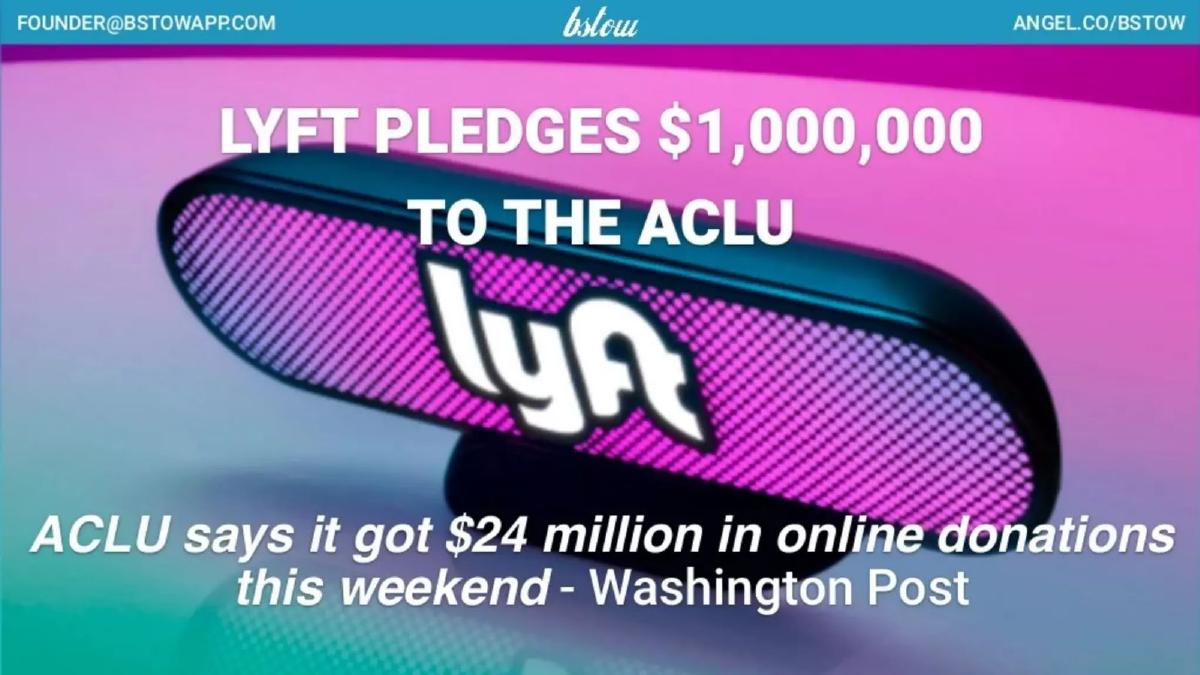
Slide 3: The Viral Moment Bstow uses a news headline to prove market timing: "Lyft pledges $1,000,000 to the ACLU" and "ACLU says it got $24 million in online donations this weekend - Washington Post." This slide validates that massive surges in giving are happening, but the implication (to be solved in later slides) is that these are currently sporadic and 'online' rather than integrated into daily life.
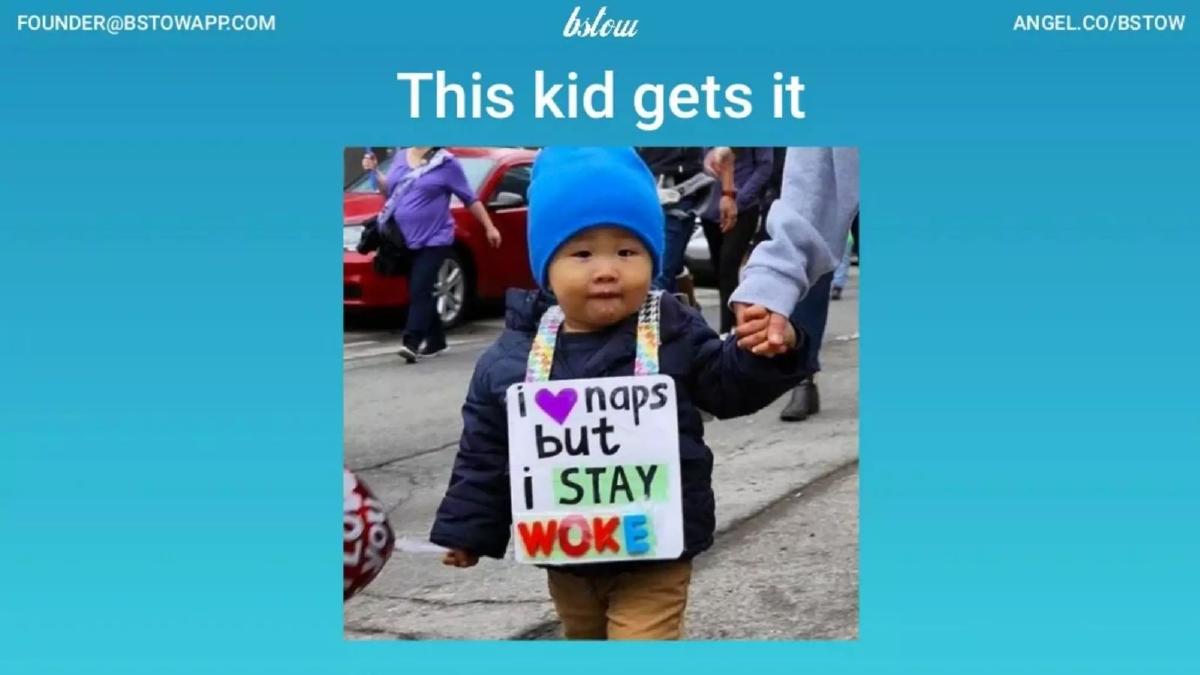
Slide 4: The 'Woke' Kid Continuing the cultural theme, slide 4 shows a child with a sign saying "I love naps but I stay woke." The caption "This kid gets it" is the only text. While this slide lacks data, it attempts to build rapport and signal that the brand understands the modern, younger donor demographic.
Slides 5-6: The $340 Billion Problem
Slide 5: The Market Size The deck shifts abruptly from culture to hard numbers. Slide 5 simply states "$340B" in massive font, with the subtext "Non-Digital Donations." This is a classic TAM (Total Addressable Market) slide, but it focuses specifically on the 'analog' portion of the market that Bstow intends to digitize.
Slide 6: The Iceberg To drive the point home, slide 6 shows an iceberg graphic with the number "92.9%" and the text "Offline Donations." This visualizes the opportunity: digital giving is just the tip of the iceberg, and the vast majority of the market is still waiting for a mobile solution. It frames Bstow not just as another app, but as a tool to unlock the 93% of the market that is currently inaccessible to modern digital marketing.
Slides 7-8: The Solution and Business Model
Slide 7: Product Interface We finally see the product. The slide shows a laptop and a smartphone displaying the Bstow interface. Key features visible include "Round-Ups," a "Getting Started Guide" (Link an account, select a monthly limit), and a monthly contribution total of "$11.23." It emphasizes a clean, user-friendly UI that mirrors consumer banking apps.
Slide 8: The Secret Sauce Bstow defines its business model as "B2B2C." The revenue is split into two components: a "Licensing Fee" and a "Processing Fee." By labeling this as their "secret sauce," they suggest that their advantage lies in their distribution strategy—partnering with organizations rather than just trying to acquire individual users directly through expensive consumer marketing.
Slides 9-10: Traction and Validation
Slide 9: Early Growth The traction slide is as minimalist as the rest: "$280K In 6 months." This figure represents the volume of donations processed. For a seed-stage startup in 2015, nearly $300k in processing volume within the first half-year is a strong indicator of product-market fit.
Slide 10: Institutional Trust The Barclays logo appears on slide 10, accompanied by "Licensing Fee" and "Security Testing." This is a critical slide for a fintech company. It tells investors that a global bank has not only audited their security but is also paying them a licensing fee. This mitigates the 'risk' profile of the investment significantly.
Slides 11-13: Retention and Conclusion
Slide 11: The Industry Standard Slide 11 shows "29% Sector Average Retention." This sets the stage for a comparison, highlighting a major pain point in the nonprofit world: donor churn.
Slide 12: The Bstow Advantage The following slide reveals "91% Bstow Retention" next to the faded 29% figure. This is perhaps the most impressive data point in the deck. A 91% retention rate suggests that once a user connects their bank account for round-ups, they rarely disconnect it, creating a predictable, recurring stream of donations for charities and fees for Bstow.
Slide 13: Summary and Contact The final slide aggregates the three biggest 'hits' of the deck: the $340B market, the $280K processed, and the 91% monthly retention. It provides the founder's email and an AngelList link.
What Works in This Deck
Extreme Clarity: By putting only one major idea on each slide, Bstow ensures that the investor never gets lost in the weeds. You cannot look at slide 5 and not understand that the market is huge.
The 'Iceberg' Narrative: The transition from slide 5 to slide 6 is a perfect example of framing. It doesn't just say the market is big; it says the market is unconverted . This creates a sense of 'land grab' urgency.
Comparative Metrics: Comparing their 91% retention to the 29% industry average (slides 11-12) is a powerful way to demonstrate that their product isn't just a different way to give—it's a better way to give that solves the industry's biggest problem (churn).
What Is Missing
The Team: There is no team slide. In a seed round, the founders are often more important than the idea. Investors want to know: who are these people? Do they have fintech experience? Do they have a background in the nonprofit sector? This is a glaring omission.
The Competition: The deck ignores other 'round-up' apps or established donation platforms like Blackbaud or GoFundMe. A slide explaining why Bstow wins against incumbents would have strengthened the case.
The Ask: The deck never specifies how much money they are looking for or what they will do with it. While the catalogue facts state they raised $120,000, a slide detailing the use of funds (e.g., 50% engineering, 30% sales, 20% ops) is standard and missing here.
What a Founder Should Copy
The 'One Big Idea' Rule: If you are presenting your deck in person, copy Bstow’s layout. Use your slides as visual punctuation for your speech, not as a teleprompter. Large numbers and simple graphics are much more memorable than 12-point font bullet points.
Validation Through Association: If you have a pilot or a contract with a major player (like Barclays on slide 10), give it its own slide. Don't bury it in a list of 'partners.' The visual weight of a trusted logo does more work than a paragraph of text.
Focus on Retention: In the world of SaaS and Fintech, retention is king. Bstow correctly identified that their 91% retention was their strongest selling point and saved it for the climax of the deck. Founders should identify their 'hero metric' and ensure it gets the spotlight it deserves.
Frequently asked questions
- How much did Bstow raise with this deck?
- According to the catalogue facts, Bstow raised $120,000 in 2015 during its Seed stage. The deck itself does not state the amount being raised or the valuation, focusing instead on the market opportunity and early traction metrics.
- What is Bstow's primary revenue model?
- As detailed on slide 8, Bstow utilizes a B2B2C model. They generate revenue through two primary streams: a licensing fee paid by the organizations using the platform and a processing fee on the donations facilitated through the app.
- What is the 'iceberg' metric mentioned in the teardown?
- Slide 6 uses an iceberg graphic to illustrate that 92.9% of donations are 'offline.' This suggests that the current digital donation market is only the 'tip' of the total philanthropic market, positioning Bstow as the bridge to capture the remaining massive offline volume.
- Does the deck show any institutional validation?
- Yes. Slide 10 features the Barclays logo prominently, noting 'Licensing Fee' and 'Security Testing.' This implies that a major financial institution has vetted their technology and is a paying client, which serves as a powerful trust signal for a fintech startup.
- What are the most significant omissions in this deck?
- The deck is missing several standard components: a team slide (founders and advisors), a competitive landscape analysis, a detailed financial roadmap, and a specific 'ask' slide detailing how the $120,000 would be spent.