BubbleMotion, a Finnish startup by BM Design Ltd., pitched an automated rickshaw system in 2013 aimed at bridging the gap between private cars and mass transit. The deck outlines a vision for 2-3 person cabins capable of operating in floods up to 3 meters and climbing 90-degree inclines. While the technical ambitions were high, the deck reveals significant hurdles common in hardware startups: a lapsed patent due to lack of funds and a heavy reliance on government subsidies for pilot projects. The funding roadmap requested a modest 150-300k Seed round to bridge toward a massive 13-15M Pilot ph…
Key takeaways
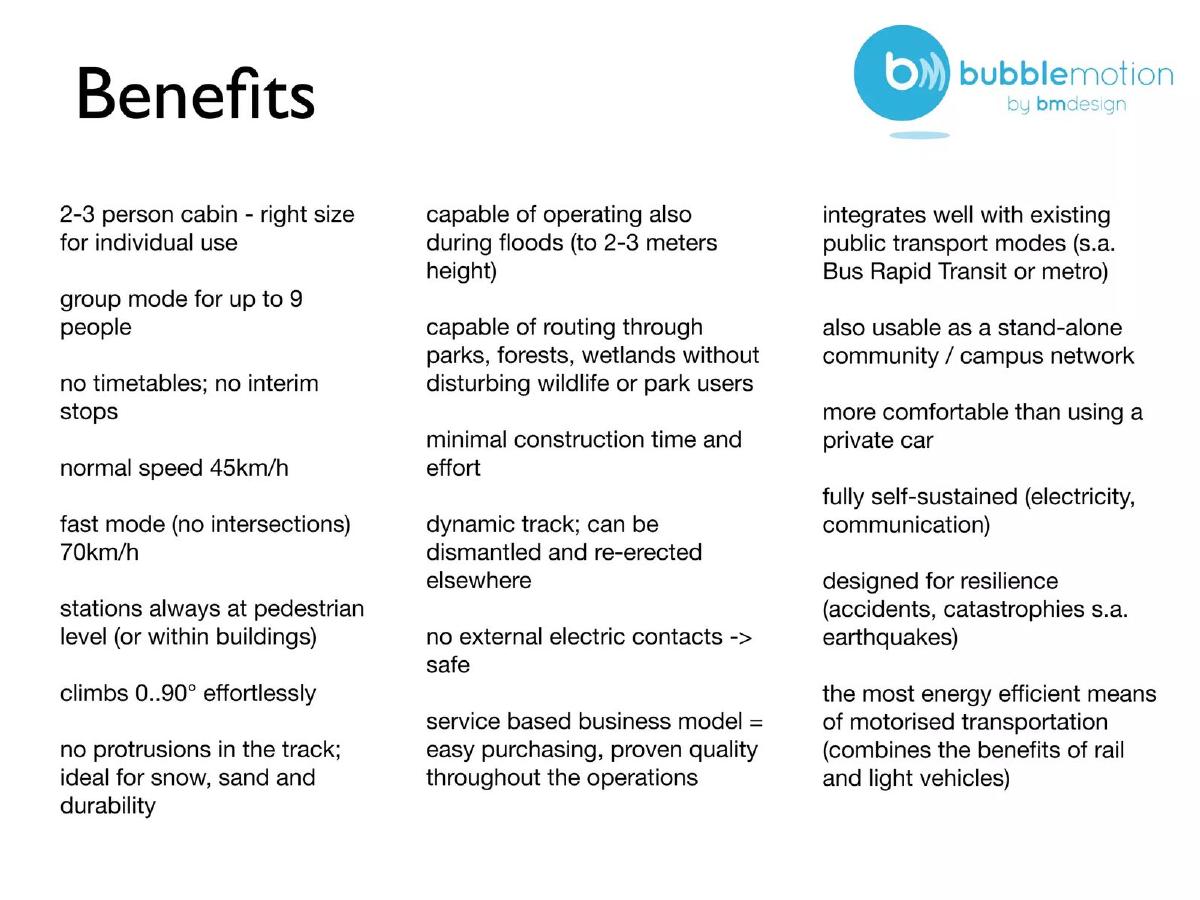
- The product is designed for extreme resilience, including the ability to operate during floods up to 2-3 meters in height (Slide 3).
- BubbleMotion identifies a specific market niche between traditional rickshaws and bus rapid transit, targeting capacities of 100 to 5,000 people per hour per direction (Slide 4).
- The company admits that a patent application filed in 2010 expired due to a lack of funds, a significant red flag for intellectual property protection (Slide 6).
- The roadmap shows a 2013 Seed funding target of 150k-300k, following a 60k launch phase in 2011 (Slide 7).
- A massive jump in capital requirements is projected for 2016, with a Pilot phase estimated at 13-15M (Slide 7).
- The business model relies heavily on government 'Smart cities' projects for part-financing pilot cases (Slide 6).
- Technical claims include the ability for vehicles to climb 0 to 90-degree inclines effortlessly (Slide 3).
- The deck lists established competitors in the PRT space, including ULTra at Heathrow and 2GetThere in Masdar City (Slide 5).
BubbleMotion Pitch Deck Teardown: Automated Rickshaws from Finland
The BubbleMotion deck, dated April 2013, presents a vision for Personal Rapid Transit (PRT) that is both technically ambitious and financially precarious. Originating from BM Design Ltd. in Finland, the project attempts to solve the 'last mile' problem using automated, small-cabin vehicles. However, the deck reveals the immense difficulty of launching a hardware-heavy transportation startup without significant early-stage capital.
Slide 1: Title Slide
The deck opens with a simple title: "Automatic rickshaws from Finland." It identifies the parent company as BM Design Ltd. and the lead contact as Asko Kauppi. The branding is clean, featuring a blue circular logo. A small copyright notice at the bottom indicates the project had been in development since at least 2010.
Slide 2: Visual Concept (Light Station)
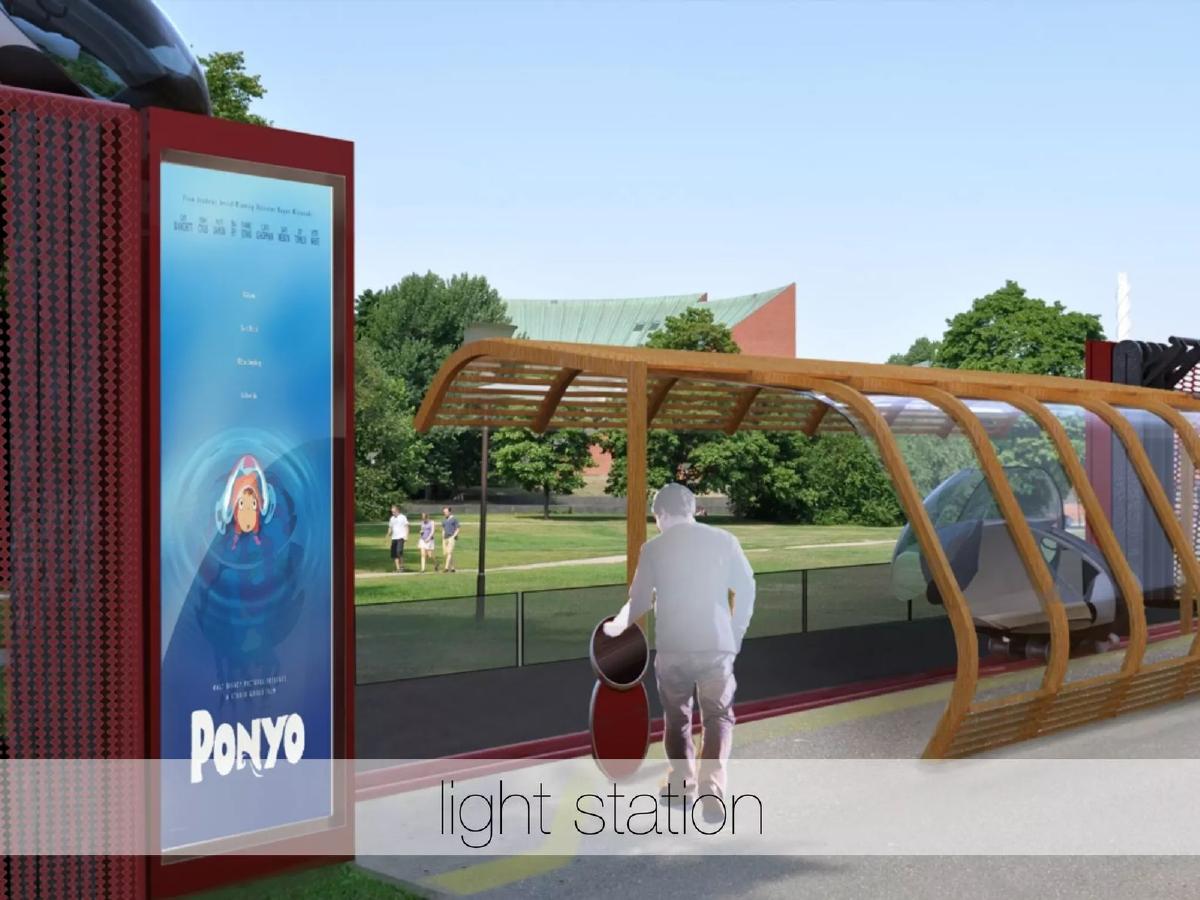
This slide is a full-page architectural render of a "light station." It depicts a minimalist, wood-ribbed shelter in a park-like setting. A translucent, pod-like vehicle is visible on a track. The inclusion of a movie poster for "Ponyo" on a digital display suggests an integrated advertising model for the stations, though this is not explicitly detailed in the text. The render emphasizes the low-impact, aesthetic nature of the infrastructure.
Slide 3: Benefits and Technical Specifications
This is the most information-dense slide in the deck, listing 18 distinct benefits. Key technical claims include:
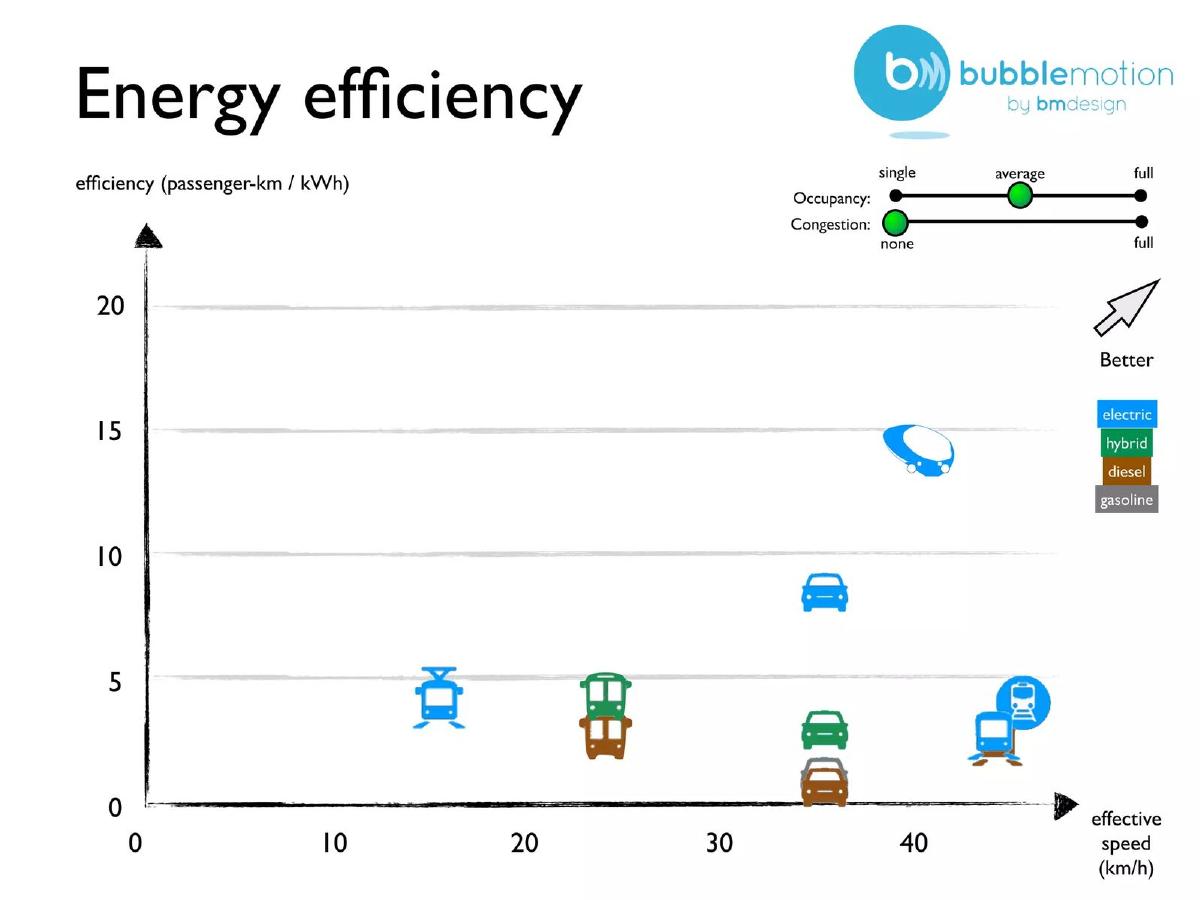
2-3 person cabins for individual use, with a group mode for up to 9 people. · Normal speeds of 45km/h and a "fast mode" of 70km/h. · The ability to climb 0..90 degree inclines "effortlessly." · Resilience features: capable of operating during floods (up to 2-3 meters) and designed for earthquakes. · Environmental claims: "the most energy efficient means of motorised transportation."
The mention of a "service based business model" suggests the company intended to sell the operation and maintenance rather than just the hardware, aiming for "easy purchasing" for municipalities.
Slide 4: Application Areas and Market Mapping
Slide 4 uses a quadrant-style graph to map BubbleMotion (BM) against other transport modes based on distance (km) and capacity (people per hour per direction - pphpd). It positions BM with small stations as a competitor to taxis and rickshaws (100-500 pphpd) and BM with parallel stations as a competitor to local buses and Bus Rapid Transit (500-5,000 pphpd). This slide effectively argues that the technology is flexible enough to scale across multiple urban transport needs.
Slide 5: Competitive Landscape
The founders acknowledge three major players in the PRT space: ULTra (UK), 2GetThere (Netherlands), and Vectus (Sweden). The slide includes photos of these systems in real-world locations like Heathrow Airport and Masdar City. By showing these competitors, BubbleMotion validates the category but also highlights that they are entering a field where others have already achieved commercial deployment.
Slide 6: Current State and IP Issues
This slide uses progress bars to show the project's status. "Concept feasibility" is shown as complete, while "CAD modeling" and "Finnish government contacts" are in the early stages. Two critical pieces of information are buried in the text boxes:
They are chasing a 'Smart cities' project from the Finnish government starting in Spring 2013 to finance pilots. · Critical Failure: A patent application filed in 2010 expired due to "lack of funds." The company claims the current design doesn't offend others' patents, but they currently lack their own proprietary IP protection.
Slide 7: Funding Needs and Roadmap
The roadmap shows a timeline from 2010 to 2017. The company spent 60k on "Launch" in 2011. For 2013, they are seeking a Seed round of 150-300k. The capital requirements then scale aggressively: 2-5M for a prototype in 2014-2015, and 13-15M for a pilot in 2016. A text box notes that most pilot funding would ideally come from government grants paid to the customer, which is a high-risk dependency for a startup.
Slide 8: Contact and Closing
The final slide features a photo of a tree frog, the company logo, and the tagline "we want to move you." It provides an email address and a Twitter handle. The imagery is likely intended to reinforce the "green" and "natural" aspects of the transport system, though it lacks a final call to action or a summary of the investment opportunity.
What BubbleMotion Does Well
The deck is excellent at defining the product-market fit within the broader transportation ecosystem. Slide 4, which maps capacity against distance, is a masterclass in positioning. It clearly shows where the product sits compared to a taxi versus a metro line, helping an investor understand the specific use case (medium-density urban transit).
Furthermore, the technical specifications on Slide 3 are specific. Instead of saying the vehicle is "durable," they specify it can handle 3-meter floods and 90-degree inclines. This level of detail allows engineers and urban planners to immediately grasp the operational limits of the system.
What is Missing from the Deck
The most significant omission is a Team Slide . There is no information regarding the engineering background of the founders or their ability to execute a complex robotics and infrastructure project. In hardware startups, the team's pedigree is often more important than the initial CAD drawings.
There is also a complete lack of Unit Economics . While the deck mentions a "service based business model," it does not provide the cost per kilometer, the cost per vehicle, or the projected revenue per passenger. Without these numbers, the 15M pilot request looks like a shot in the dark rather than a calculated business move.
Finally, the Intellectual Property situation is a major detractor. Admitting that a patent expired due to lack of funds (Slide 6) signals to investors that the company has been struggling for survival for years and has already lost its primary defensive moat. A founder should never highlight a lost patent without immediately following it up with a new filing strategy.
What a Founder Should Copy
Founders should emulate the visual clarity of the application areas on Slide 4. Many startups struggle to explain how they fit into a crowded market; using a graph with clear axes (Capacity vs. Distance) makes the value proposition undeniable.
The honesty regarding competition on Slide 5 is also a positive trait. By showing real-world competitors like ULTra, the founders prove that the market for PRT is real and that the technology is physically possible. It moves the conversation from "is this science fiction?" to "how is your version better?"
Final Analysis
The BubbleMotion deck is a cautionary tale of the "Hardware is Hard" mantra. By 2013, the company had already lost its patent protection and was essentially asking for seed money to chase government grants. While the vision of a flood-proof, vertical-climbing rickshaw is compelling, the lack of a team profile and the admission of financial distress regarding IP likely made this a difficult sell for private VCs. For a transportation startup to succeed, the deck must bridge the gap between a cool vehicle design and a viable, defensible infrastructure business—a bridge that this deck unfortunately fails to build.
Frequently asked questions
- What is the core value proposition of BubbleMotion?
- BubbleMotion proposes an automated, on-demand transportation system using small cabins. Unlike traditional transit, it offers no timetables and no interim stops, aiming to be more comfortable than a private car while maintaining the energy efficiency of rail. Its primary differentiator is resilience, claiming the ability to operate in floods, snow, and sand, and even climb vertical surfaces.
- How does BubbleMotion plan to compete with existing public transport?
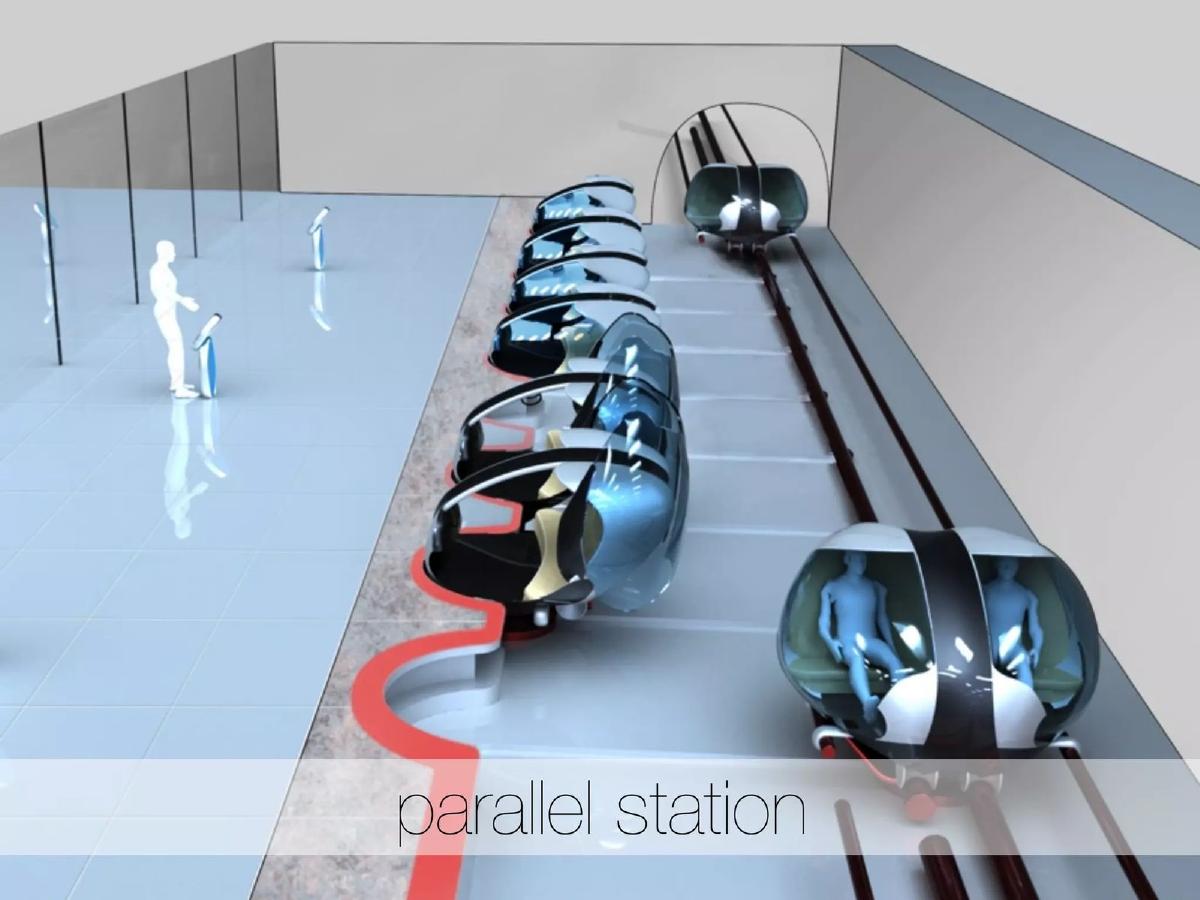
- According to Slide 4, BubbleMotion targets a 'middle ground' in urban density. It aims to provide higher capacity than taxis or traditional rickshaws but requires less infrastructure than a full metro system. The deck suggests it can serve as a stand-alone campus network or integrate as a feeder system for Bus Rapid Transit and metro lines.
- What is the biggest risk identified in the deck?
- The most glaring risk is the loss of intellectual property. Slide 6 explicitly states that a patent application filed in 2010 expired because the company lacked the funds to maintain it. While they claim 'clearance' that they do not offend others' patents, the lack of their own protected IP makes the 13-15M capital requirement for pilots very difficult to justify to private investors.
- What are the projected funding stages for the company?
- The funding roadmap on Slide 7 is divided into four main phases: a 60k Launch (2011), a 150-300k Seed round (2013), a 2-5M Prototype phase (2014-2015), and a 13-15M Pilot phase (2016). The company notes that the majority of the pilot funding would ideally come from government funds paid directly to the customers (cities).
- Who are the primary competitors in the automated rickshaw space?
- Slide 5 identifies three main competitors: ULTra (operating at Heathrow T5, Amritsar, and Gurgaon), 2GetThere (operating in Masdar, Abu Dhabi), and Vectus (operating in Suncheon, South Korea). These are all established Personal Rapid Transit (PRT) providers with existing physical deployments, highlighting the uphill battle for a new entrant like BubbleMotion.