Buddy-Watcher is a hardware startup targeting the scuba diving, snorkeling, and freediving markets with a wearable device designed to prevent buddy separation. The deck identifies a critical safety gap: divers often drift apart due to underwater distractions, which becomes dangerous in emergencies. Their solution uses ultrasonic technology to trigger vibration alarms when a predefined distance is exceeded. The deck is notable for its transparency regarding unit economics, citing a production cost of €64.00 per set and a target retail price of €199.98. While the primary focus is recreational d…
Key takeaways
- The product addresses the safety risk of divers drifting apart due to underwater distractions (Slide 3).
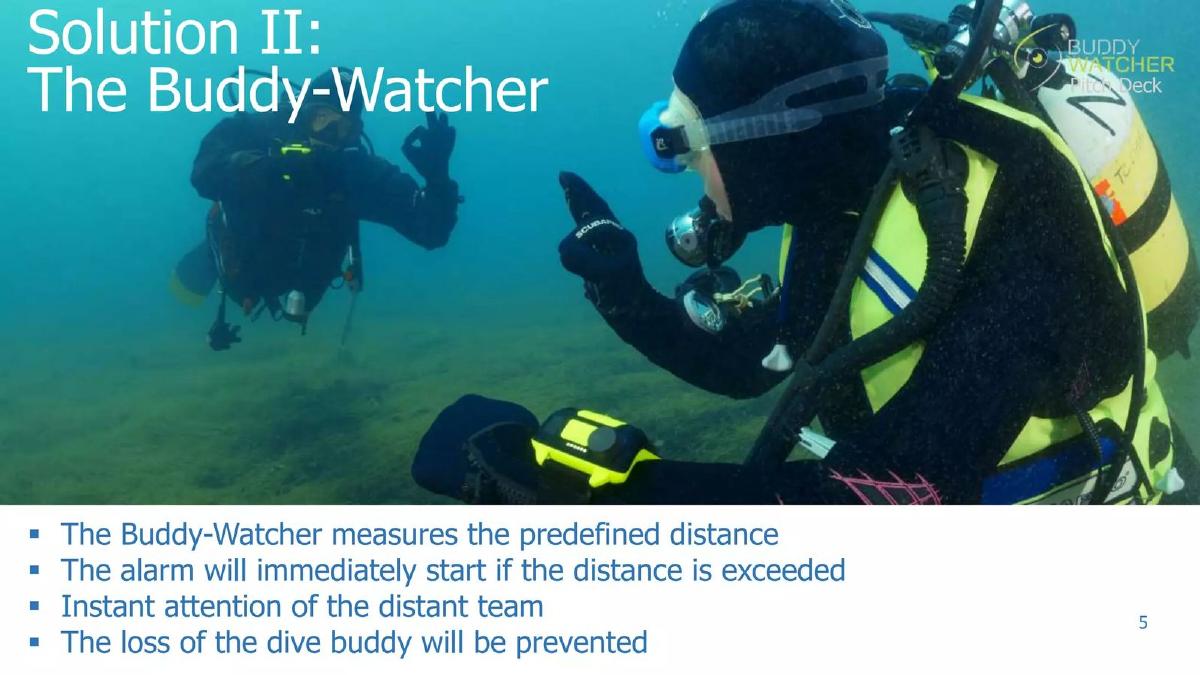
- The device uses a vibration alarm to alert divers when they exceed a predefined safety distance (Slide 5).
- Functionality includes a boat-to-diver recall feature and the ability to call safety divers from depths of up to 80 meters (Slide 7).
- Target customers include individual active divers and B2B partners like Robinson tour operators and AIDA cruise lines (Slide 9).
- Competitive analysis positions the product between low-cost tank bangers (€7) and high-end communication systems like Casio Logosease (€1,400) (Slide 11).
- Unit economics show a margin ratio of €71.00 based on an average sale price of €135.00 (Slide 13).
- The company aims to reduce production costs from €64.00 to €45.00 per set of two devices (Slide 13).
- The technology is pitched as scalable to industrial pipeline supervision and automotive driving assistance markets (Slide 15).
Buddy-Watcher Pitch Deck Analysis
The Buddy-Watcher pitch deck focuses on a specific niche within the sports technology and safety equipment market: underwater communication. The deck uses a clean, image-heavy layout to explain a technical hardware solution for scuba divers, snorkelers, and freedivers. It transitions from a safety-first problem statement to a detailed breakdown of hardware economics and future scalability into industrial sectors.
Slide 1: Title Slide
The opening slide establishes the brand name, "Buddy-Watcher," and the subtitle "Communication in Scuba Diving 4.0." The imagery is a high-quality underwater shot of two divers, which immediately identifies the target industry. The logo is visible in the top right corner, maintaining a consistent brand presence that appears throughout the deck.
Slide 3: Problem Identification
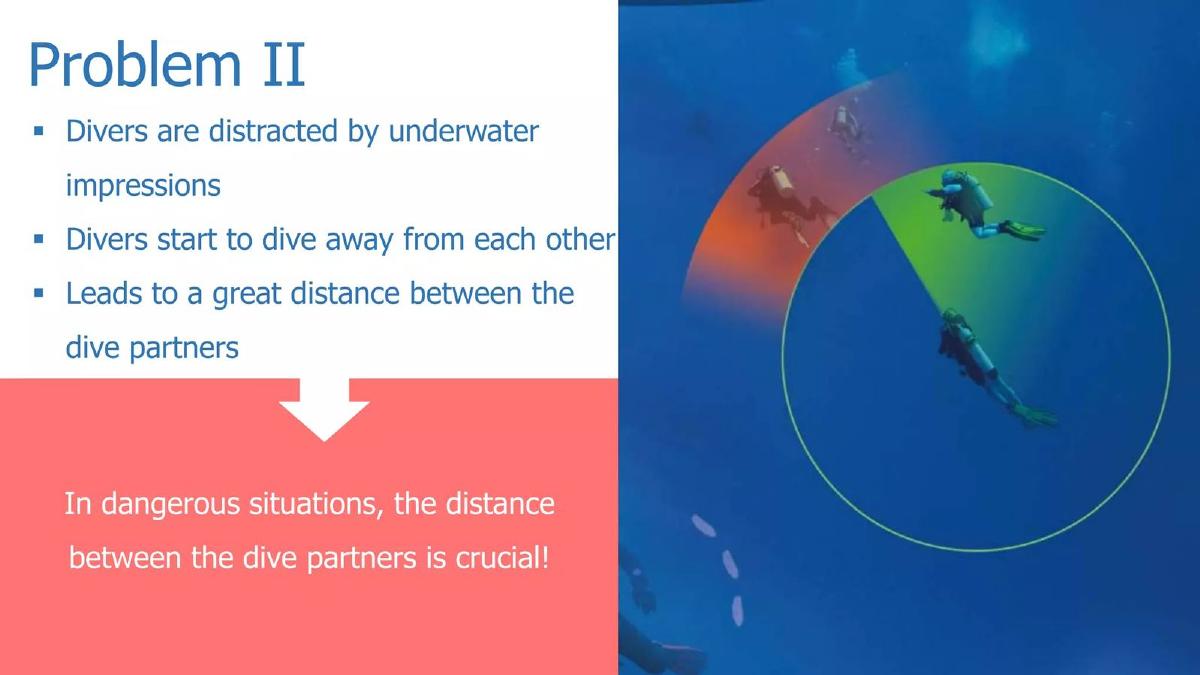
Slide 3, titled "Problem II," focuses on the psychological and physical realities of diving. It notes that divers are easily distracted by "underwater impressions," leading them to drift away from their partners. The slide emphasizes that in dangerous situations, the distance between partners is "crucial." A graphic overlay on a diving photo illustrates a 'safe zone' versus a 'danger zone' based on proximity, providing a visual representation of the risk the product intends to mitigate.
Slide 5: The Solution
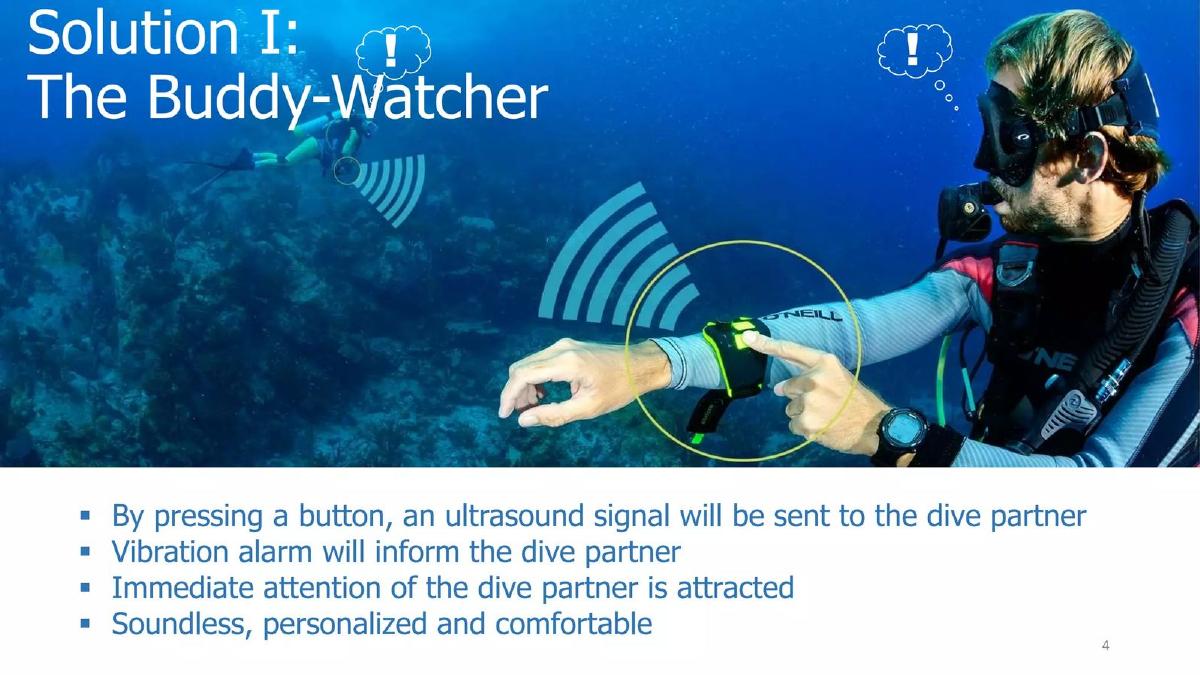
The solution slide introduces the physical hardware: a wearable device worn on the arm. The slide lists four key value propositions: measuring predefined distance, triggering an immediate alarm if that distance is exceeded, gaining the "instant attention" of the distant team member, and preventing the loss of a dive buddy. The photo shows the device in use, highlighting its high-visibility yellow casing and wearable form factor.
Slide 7: Product Functions
This slide provides a comprehensive overview of the device's capabilities across different user types. It identifies six specific functions: 1) calling a snorkeler-buddy, 2) calling a safety-diver from depths up to 80 meters to signal the start of an ascent, 3) calling a buddy to indicate "special experiences" (likely wildlife sightings), 4) calling a whole group, 5) a vibration alarm for distance alerts, and 6) a "Boat-Unit" recall function for emergencies like upcoming storms. This slide is critical as it demonstrates that the device is not just a passive safety sensor but an active communication tool.
Slide 9: Target Group
The deck segments its market into three categories: Active divers, Snorkelers & Freedivers; Tour Operators (specifically naming Robinson); and Cruise Liners (specifically naming AIDA). By including specific corporate names like Robinson and AIDA, the deck suggests either existing partnerships or a very clear B2B2C sales strategy. The imagery reinforces these segments with photos of a snorkeler, a scuba diver, and a freediver.
Slide 11: Competitive Landscape
Slide 11 compares Buddy-Watcher to existing market alternatives. It lists five competitors with their price points: Dive Alert (€90), Casio Logosease (€1,400), Tank Banger (€7), Ocean Reef (€800), and Shaker (€15). The slide concludes that Buddy-Watcher serves an "so far uncovered market segment," presumably by offering electronic distance monitoring at a price point between low-tech noise makers and high-end vocal communication systems.
Slide 13: Unit Economics
This is one of the most data-dense slides in the deck. It provides a transparent look at the financial model for the hardware. The figures are: Sale price for end customers: €199,98 ; Net Sale price wholesale: €108,00 ; Average sale price: €135,00 ; Margin ratio: €71,00 ; Customer Acquisition Costs (CAC): €39,00 ; Production cost for a set of 2: €64,00 . It also includes a future goal: Production cost aim p. set of 2: €45,00 . Providing CAC and wholesale margins is a strong signal of business maturity.
Slide 15: Scalability of Technology
To appeal to venture-scale investors, Slide 15 looks beyond the diving market. It identifies three massive adjacent markets where their ultrasonic sensor technology could apply: US $62 billion for deep-water pipeline supervision (citing the Deepwater Horizon disaster), €17 billion for automotive driving safety and assistance, and US $700 million for child supervision wearables. This slide attempts to reframe the company from a "diving accessory" business to a "sensor technology" platform.
Slide 17: Capital Requirements & Utilization
The "Ask" slide is explicit. The company is seeking €300.000 in exchange for an 8,45% share . The allocation of funds is broken down via a donut chart: 40% for Marketing & Sales (including social media, magazines, and trade fairs), 40% for Production (purchase, manufacturing, assembling), and 20% for Re-Design (transforming products and processes for mass production). This indicates the company is at the transition point from low-volume prototype/early production to scale.
Slide 19: Conclusion
The final slide features a satellite view of Earth with the text "Over 70% of our Earth is covered with water – let’s conquer it together!" It serves as a thematic closing but does not provide additional data or contact information (though contact info may be on the omitted slides 18 or 20).
What Works in the Buddy-Watcher Deck
Clear Problem/Solution Fit: The deck does an excellent job of explaining a niche problem (buddy separation) that is easily understood even by non-divers. The use of vibration as the primary alert mechanism is presented as a logical solution to the limitations of sight and sound underwater.
Transparent Unit Economics: Many early-stage hardware decks hide their margins or ignore CAC. Buddy-Watcher’s inclusion of wholesale vs. retail pricing and a specific target for production cost reduction shows a disciplined approach to manufacturing and distribution.
Functional Versatility: Slide 7 effectively communicates that the device is a platform with multiple use cases (boat recall, safety diver signaling, group chat) rather than a single-feature gadget.
What is Missing from the Buddy-Watcher Deck
No Team Slide: In the 10 slides provided, there is no mention of the founders, their technical background, or their experience in hardware manufacturing or the diving industry. For a hardware startup, the engineering pedigree is a critical omission.
Lack of Traction Data: While the deck mentions target groups like AIDA and Robinson, it does not state if they have signed LOIs, pilot programs, or existing sales. There are no figures for units sold to date or current revenue, making it difficult to assess the "Production cost for a set of 2: €64,00" as a historical fact or a projection.
Regulatory and IP Status: Hardware involving ultrasonic frequencies and underwater safety often requires specific certifications (like CE or FCC) and is ripe for patent protection. The deck does not mention the status of their intellectual property or regulatory compliance.
Founder Takeaways
Use Visual Overlays for Technical Concepts: The use of colored arcs to represent sensor ranges on Slide 3 and Slide 7 is a highly effective way to explain how a wireless, invisible technology works in a physical environment. Founders of sensor-based startups should emulate this visual clarity.
Address the 'Small Market' Objection Early: By including Slide 15 (Scalability), the founders proactively address the concern that the diving market might be too small for significant VC returns. They link their core IP to much larger industrial and automotive sectors, even if those are long-term goals.
Be Specific with Fund Allocation: The breakdown on Slide 17 is a model for how to present a seed-stage ask. It ties the money directly to business milestones: re-designing for mass production and specific marketing channels like trade fairs and magazines.
Frequently asked questions
- What is the primary problem Buddy-Watcher solves?
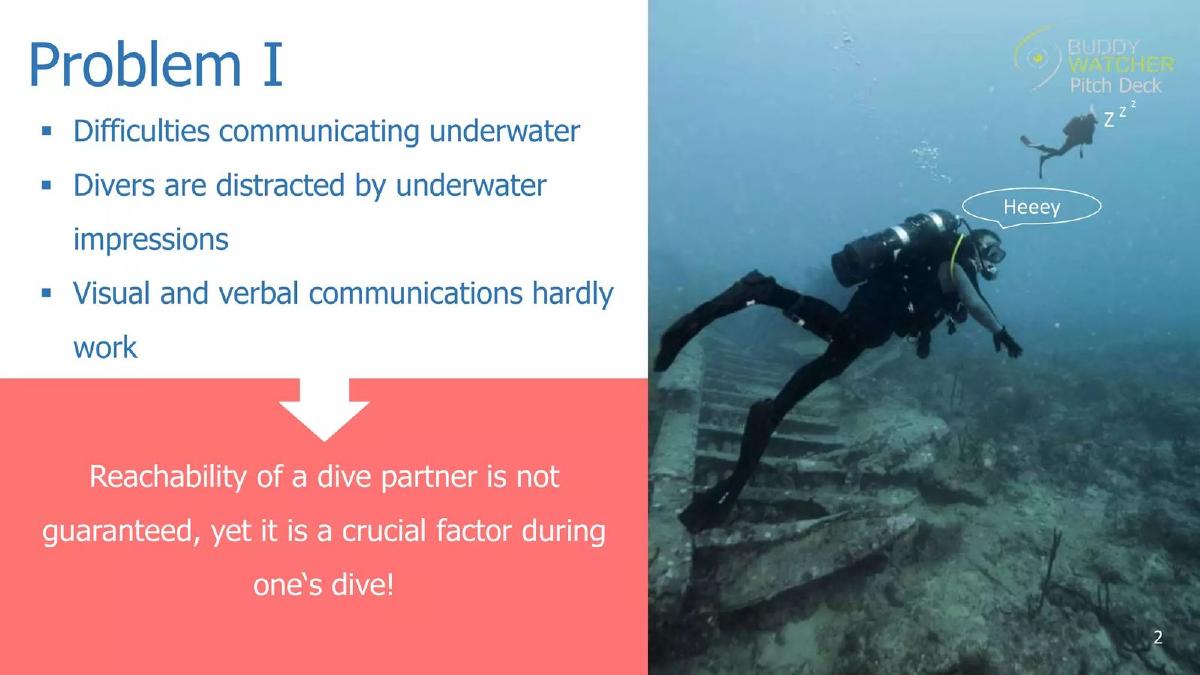
- According to Slide 3, the primary problem is that divers become distracted by underwater impressions and drift away from their partners. In dangerous situations, the distance between buddies is crucial for safety. The device acts as an automated monitor to ensure divers remain within a safe proximity, using ultrasonic sensors to measure distance constantly.
- How does the device communicate with the diver?
- The device uses vibration alarms rather than audio or visual cues, which can be missed underwater. Slide 5 and Slide 7 specify that the alarm triggers immediately if the safety distance is exceeded. It also allows for intentional communication, such as calling a 'safety-diver' during an ascent from depths up to 80 meters.
- What are the specific unit economics for the hardware?
- Slide 13 provides a detailed breakdown: the end-customer price is €199.98, while the wholesale price is €108.00. With an average sale price of €135.00 and production costs of €64.00 per set of two, the current margin is €71.00. The company also notes a Customer Acquisition Cost (CAC) of €39.00.
- What is the long-term vision for the technology beyond diving?
- Slide 15 outlines 'Scalability of technology,' suggesting the ultrasonic sensors can be used for pipeline supervision (referencing the $62 billion Deepwater Horizon catastrophe), automotive driving safety (€17 billion market), and child supervision wearables ($700 million market). This indicates the founders view diving as an entry market for a broader sensor platform.
- What are the terms of the investment sought in this deck?
- Slide 17 states the company is seeking €300,000 in exchange for an 8.45% equity stake. This implies a post-money valuation of approximately €3.55 million. The funds are split: 40% for marketing and sales, 40% for production (manufacturing and assembly), and 20% for product re-design for mass production.