BullFrog AI (NASDAQ: BFRG) positions itself as a next-generation AI drug discovery company focused on reducing the high failure rates of clinical trials. The deck emphasizes the 'bfLEAP' platform's ability to handle incomplete, multi-modal data to identify 'clusters of factors' that predict patient response, specifically showcased through a schizophrenia trial collaboration with the Lieber Institute. While the company holds exclusive rights to several early-stage programs, including a Phase 2-ready glioblastoma candidate, the deck is heavily weighted toward technical capabilities and team ped…
Key takeaways
- The company is publicly traded on NASDAQ under the ticker BFRG (Slide 1).
- The proprietary platform, bfLEAP, is touted for its ability to generate predictions from incomplete data and its 'no code' scalability (Slide 7).
- A key technical differentiator is 'Explainable AI,' which aims to provide transparency in how the model reaches its conclusions (Slide 7).
- The company showcases a multivariate signature for schizophrenia, identifying genetic variants and physiological biomarkers in partnership with LIBD (Slide 10).
- BullFrog AI holds exclusive rights to a Glioblastoma program (bf-222/bf-223) currently at the Phase 1/Phase 2 transition (Slide 13).
- The pipeline includes early-stage 'planned' programs for Liver Cancer, Morbid Obesity, NASH, and NAFLD (Slide 13).
- The neuropsychiatric market is cited as a $100 billion opportunity, projected to reach $200 billion by 2028 (Slide 16).
- Founder and CEO Vin Singh previously co-founded MaxCyte Inc., which reached a ~$1B market cap (Slide 19).
Executive Summary and Brand Positioning
Slide 1: Title Slide
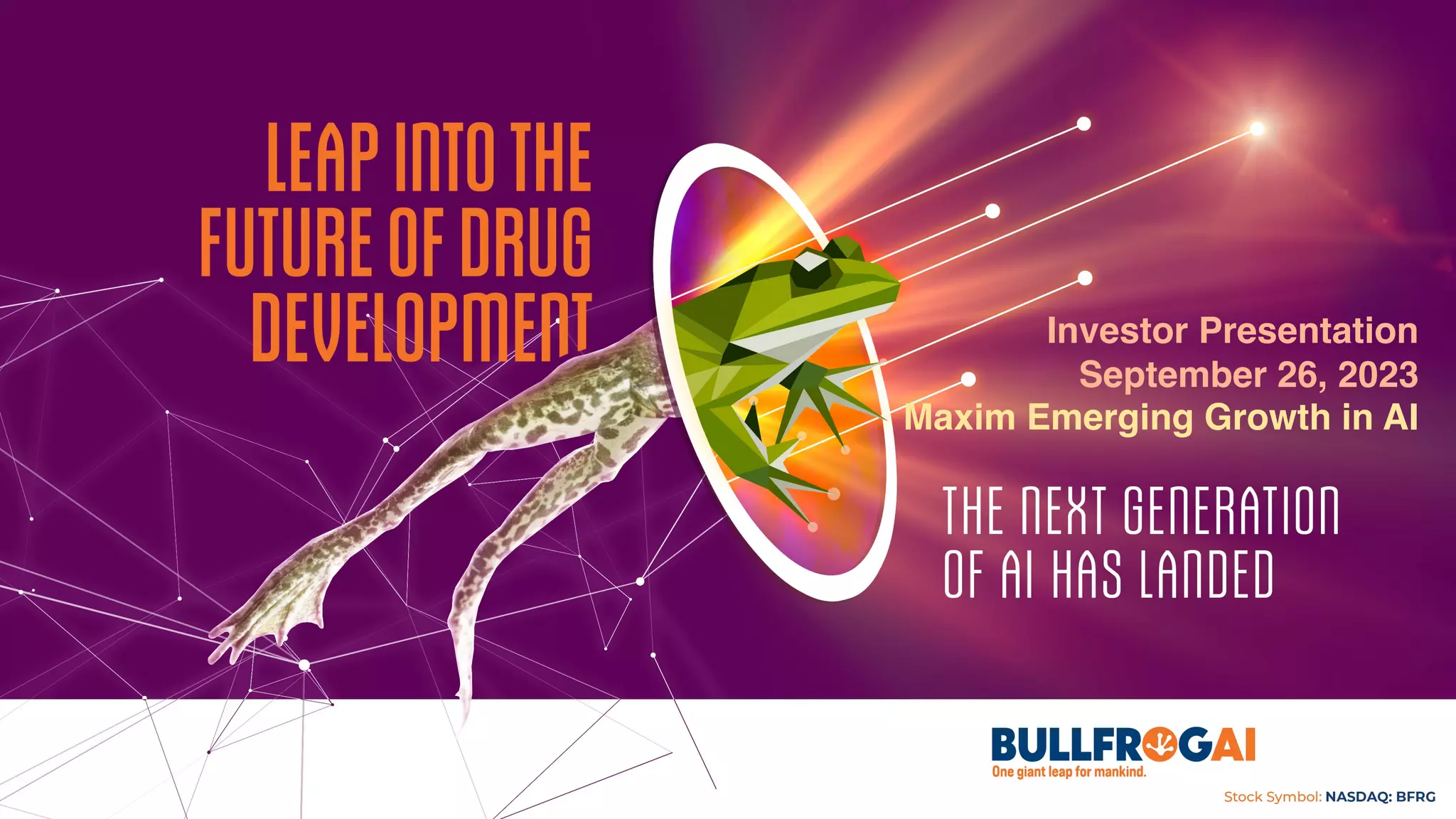
The deck opens with a high-concept visual featuring a geometric frog jumping through a portal, accompanied by the tagline 'Leap into the future of drug development.' It establishes the company as an AI-first entity, specifically mentioning the 'Maxim Emerging Growth in AI' presentation dated September 26, 2023. The NASDAQ ticker 'BFRG' is clearly displayed in the bottom right corner, signaling the company's public status immediately.
Slide 2: Mission Statement
This slide provides a concise value proposition: 'Using AI to accelerate the process of drug development and clinical testing, leading to effective treatments faster.' The layout is simple, placing the text in a centered box against a background of DNA and molecular imagery. It defines the company's role as a bridge between technology and clinical outcomes.
The Technology Platform
Slide 7: What makes BullFrog AI special?
This slide lists six core technical advantages of the 'bfLEAP' platform. These include: 1. Feature selection, 2. Predictions from incomplete data, 3. Scale with no code, 4. Multimodal data, 5. Disease Agnostic, and 6. Explainable AI. The inclusion of 'Explainable AI' is a strategic choice, as it addresses a common criticism of AI in healthcare—that models are often uninterpretable. The 'no code' mention suggests an emphasis on operational efficiency and accessibility for non-technical researchers.
Slide 10: Clusters of Factors to Predict Response
This is a highly technical slide demonstrating a case study in Schizophrenia. It features a complex network graph showing 'Clusters of Factors' used to predict patient response. The legend identifies Genetic Variants (SNPs), Physiological Biomarkers (Drug Clearance), Categorical Correlates (e.g., CT site), and Outliers. The slide credits the Lieber Institute for Brain Development (LIBD). This serves as proof-of-concept for the platform's ability to handle multi-variate signatures in complex neurological conditions.
Pipeline and Market Opportunity
Slide 13: World-wide Exclusive Rights
The pipeline slide is a standard but essential component of a biotech deck. It lists six programs. The lead candidate, bf-222/bf-223 for Glioblastoma, is a 'repurposed small molecule' that has progressed through Phase 1. The slide indicates a 'PARTNER' status for Phase 2. Other programs for Liver Cancer, Morbid Obesity, NASH, and NAFLD are in the discovery phase and utilize siRNA. A Colorectal Cancer program involving an Oncolytic Virus is listed as a co-development with JCVI. The chart clearly distinguishes between active progress and 'planned' stages using a color-coded legend.
Slide 16: Current Market Challenges
This slide builds the macro-economic case for the company. Citing a 2023 Deloitte report, it notes that the neuropsychiatric pharmaceutical market is currently $100 billion and projected to grow to $200 billion by 2028. It highlights the 'high failure rates in development' and the inability to perform brain tissue biopsies without harm as primary hurdles that BullFrog AI's technology is designed to solve. The slide also outlines a three-step process—Analyze, Identify, and Design/Screen—to reduce drug failure rates and increase repurposing insights.
Leadership and Expertise
Slide 19: Our Team
The team slide is exceptionally strong in terms of pedigree. CEO Vin Singh is noted as a co-founder of MaxCyte Inc., which achieved a ~$1B market cap. CFO Dane Saglio has experience with SEC compliance and multiple biotech mergers. The technical leadership includes Enrique Garcia-Rivera (VP of AI) with experience from the Broad Institute, and J.T. Koffenberger (CIO) with 30+ years in IT. The scientific side features Dr. Dave Recker (CMO), a former Senior VP at Takeda, and Dr. Kristin Bigos (Director CNS) from Johns Hopkins. This slide aims to de-risk the investment by showing that the leadership has 'been there before' in terms of both scientific discovery and corporate exits.
What BullFrog AI Does Well
The deck excels at establishing credibility through association. By prominently featuring logos and partnerships with Johns Hopkins, the Lieber Institute, and George Washington University, BullFrog AI positions itself as a serious player in the academic-industrial complex. The 'bfLEAP' platform is described with enough technical specificity (e.g., 'multimodal data,' 'explainable AI') to interest a specialist investor without becoming a white paper.
Furthermore, the pipeline slide (Slide 13) is honest about the stage of development. By marking several programs as 'planned,' the company avoids the trap of over-promising immediate clinical results for its entire portfolio, focusing instead on the Glioblastoma lead candidate as the primary value driver.
What is Missing from the Deck
As a teardown of the provided slides, several standard investor requirements are absent. There is no slide dedicated to the competitive landscape. In the crowded 'AI for Drug Discovery' space (populated by giants like Recursion or Exscientia), failing to differentiate against specific competitors is a notable omission.
Additionally, there is a lack of unit economics or specific financial data. While the market size is mentioned (Slide 16), the company does not provide its current burn rate, cash runway, or specific milestones tied to future funding. For a public company, this information is usually in the 10-K or 10-Q, but its absence in a 'pitch' format makes it harder for an investor to gauge immediate capital needs.
Founder Takeaways
Pedigree Matters: If your team has successful exits (like the MaxCyte $1B market cap mentioned on Slide 19), lead with it. It is the fastest way to build trust. · Visualizing Data: Slide 10 is a great example of how to show a 'black box' technology at work. The network graph makes the abstract concept of 'AI analysis' feel tangible and scientific. · Strategic Partnerships: Don't just list partners; show what they provide. BullFrog AI links specific institutions to specific drug candidates, which validates their pipeline. · Address the 'Black Box': If you are an AI company, explicitly mention 'Explainability.' Investors are increasingly wary of AI models that cannot be audited or understood by human scientists.
Frequently asked questions
- What is the primary technology behind BullFrog AI?
- The core technology is the bfLEAP platform, an analytical engine designed to process multi-modal data. According to slide 7, its key features include feature selection, the ability to make predictions from incomplete data, and 'Explainable AI.' This suggests the platform is built to overcome the 'black box' problem often associated with deep learning in highly regulated fields like drug development.
- What stage are BullFrog AI's drug programs currently in?
- The company's most advanced program is for Glioblastoma (bf-222/bf-223), which is shown on slide 13 as having completed Phase 1 and moving toward a 'Partner' phase for Phase 2. Other programs, including those for Liver Cancer and Morbid Obesity, are in the discovery or preclinical stages, with several marked as 'planned' rather than active.
- Who are the company's primary research partners?
- BullFrog AI highlights several prestigious academic and research collaborators. Slide 13 lists The Johns Hopkins University, The George Washington University, and JCVI as collaborators for specific drug programs. Additionally, slide 16 emphasizes a relationship with the Lieber Institute for Brain Development (LIBD) for neuropsychiatric research.
- How does the company justify the market need for its AI?
- Slide 16 points to high failure rates in drug development and the extreme complexity of the human brain compared to animal models. It cites a 2023 Deloitte report stating that 1 in 8 people have a neuropsychiatric disorder, representing a $100 billion market that is expected to double by 2028, creating a massive tailwind for more efficient discovery tools.
- Does the deck include a specific funding ask or valuation?
- No. As a publicly traded company (NASDAQ: BFRG), this deck serves as a general investor presentation rather than a private seed or Series A pitch. It omits a specific 'ask' slide, valuation metrics, or a detailed breakdown of how new capital will be deployed, which are standard in private fundraising decks.