BusRight raised $7M by presenting a compelling case for modernizing the U.S. school bus system, which they describe as the nation's largest mass transit system. The deck excels by identifying a specific buyer—the Transportation Director—rather than the school district at large, which effectively shortens the sales cycle from 18 months to just 2.5 months. While the deck uses placeholders ($X) for specific revenue figures in this public version, it clearly communicates high-velocity growth, 111% net revenue retention, and a 7.6x year-over-year increase in traction. The narrative is anchored by…
Key takeaways
- The company identifies school buses as the nation's largest mass transit system on slide 1.
- BusRight differentiates its sales strategy by targeting Transportation Directors, reducing the sales cycle from 12-18 months to 2.5 months as shown on slide 2.
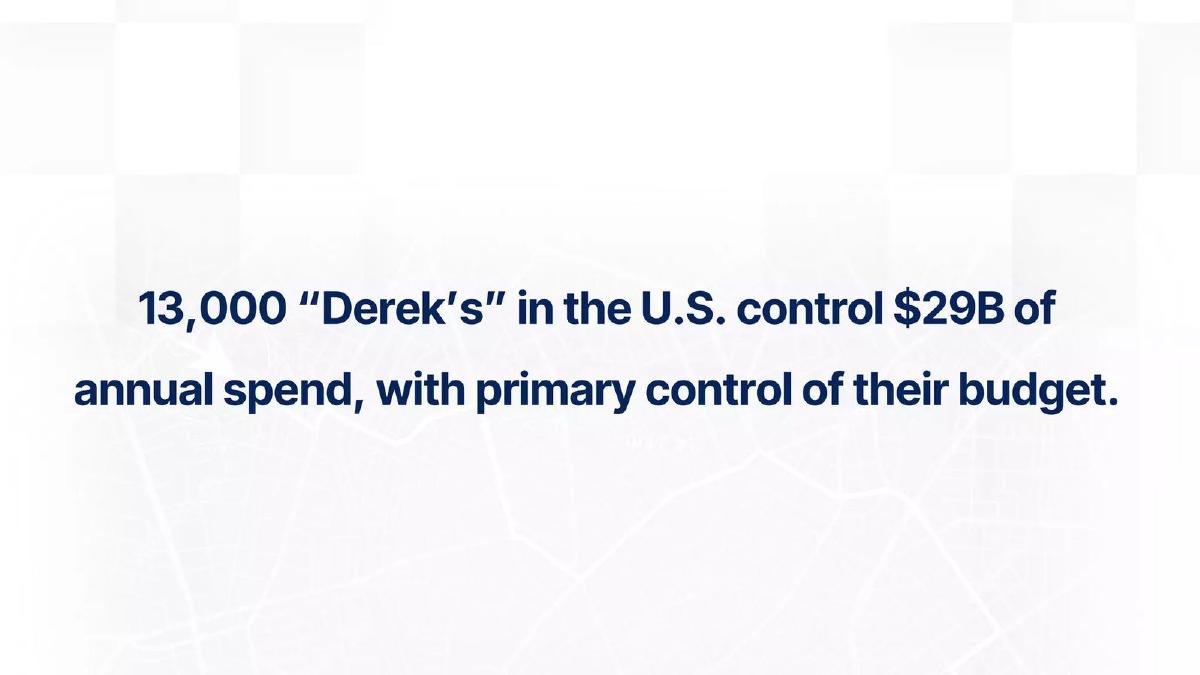
- There are 13,000 Transportation Directors in the U.S. controlling $29B in annual spend, according to slide 4.
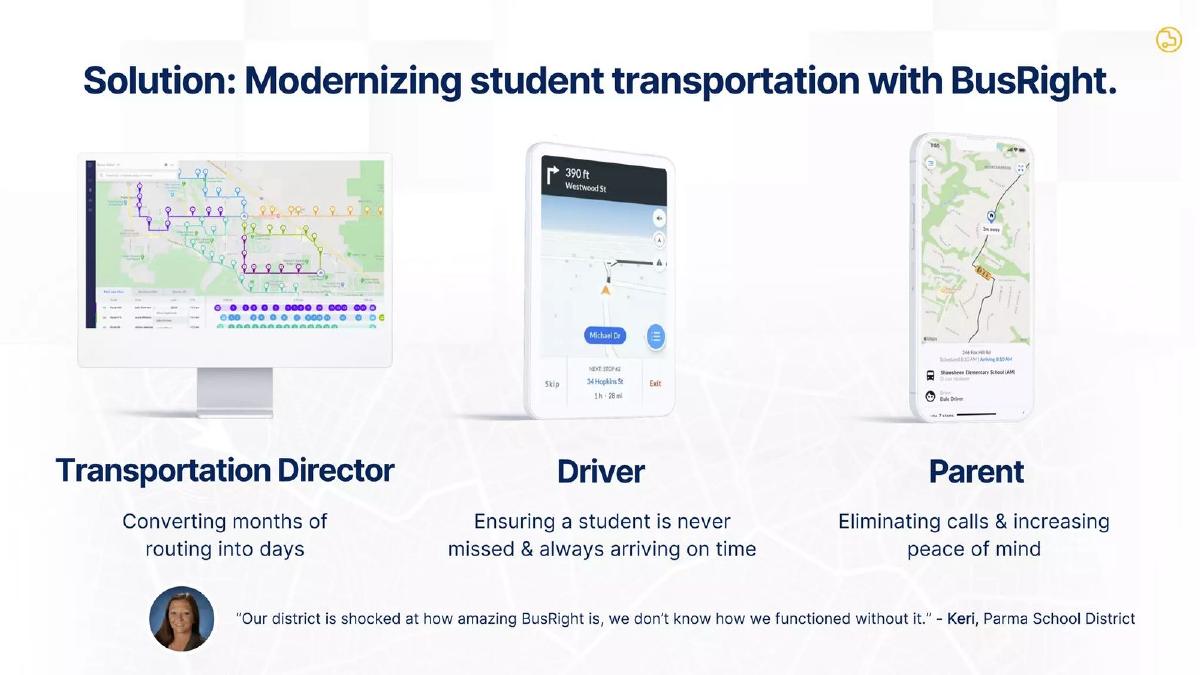
- The platform serves three distinct users: Transportation Directors, Drivers, and Parents, each with specific value propositions detailed on slide 6.
- Traction metrics on slide 7 show 111% Net Revenue Retention and a 1.3% ARR churn since inception.
- Go-to-market efficiency is high, with 70% of ARR coming from inbound referrals and website leads, per slide 8.
- Pricing has increased 3x since 2020, demonstrating growing market leverage on slide 9.
- Slide 11 highlights a massive funding tailwind, including $190B in ESSER funds and $1.8B in annual NY state aid.
Executive Summary: The Modernization of the Yellow Bus
BusRight’s pitch deck for their $7M Series A is a textbook example of how to sell a 'boring' but essential vertical SaaS product. By framing school buses not as a niche educational service, but as the 'nation’s largest mass transit system,' they immediately elevate the scale of the opportunity. The deck focuses heavily on the efficiency of their sales engine and the depth of their industry-specific expertise.
Slide 1: The Hook
The cover slide establishes a clear, bold vision: 'Software that runs our nation’s largest mass transit system, school buses.' This is a strategic re-framing. Investors who might be wary of 'EdTech' are instead presented with a 'Mass Transit' infrastructure play. The background features a subtle map and a single yellow bus icon, keeping the focus entirely on the value proposition.
Slide 2: The Sales Cycle Breakthrough
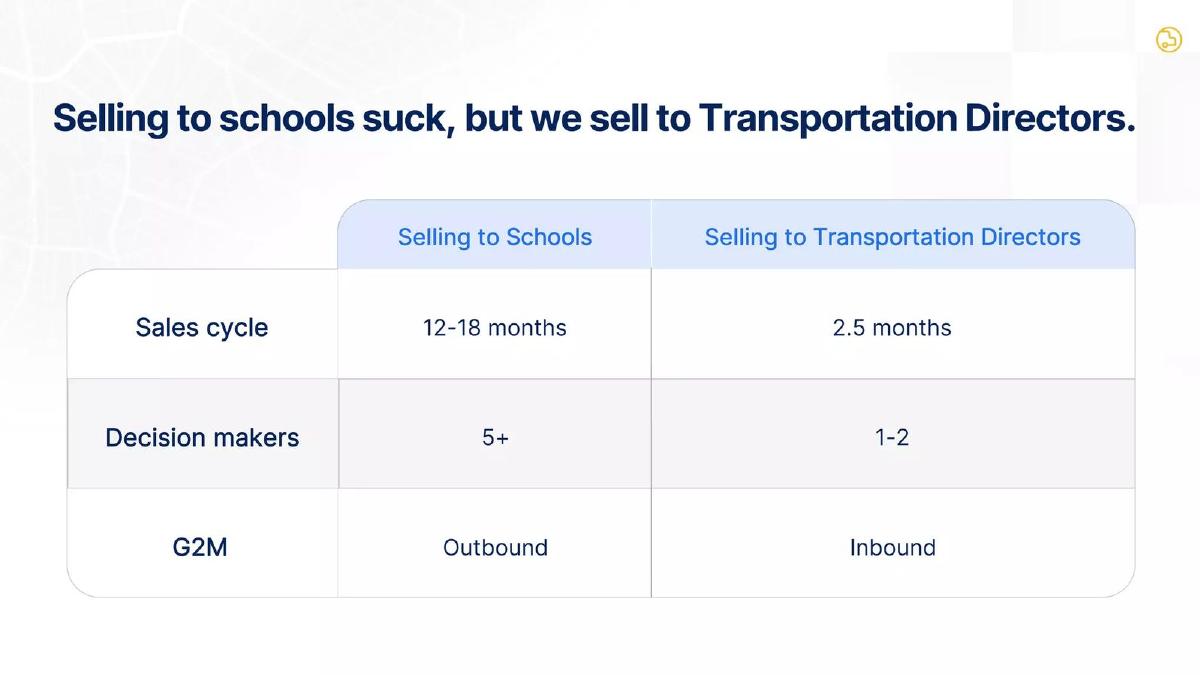
This is arguably the most important slide in the deck for any company selling to government or educational institutions. It addresses the 'EdTech Death Spiral' (long sales cycles) head-on. By comparing 'Selling to Schools' (12-18 months, 5+ decision makers) against 'Selling to Transportation Directors' (2.5 months, 1-2 decision makers), BusRight proves they have found a 'backdoor' into the budget that allows for venture-scale growth speeds.
Slide 3 & 4: The Customer Persona and Market Size
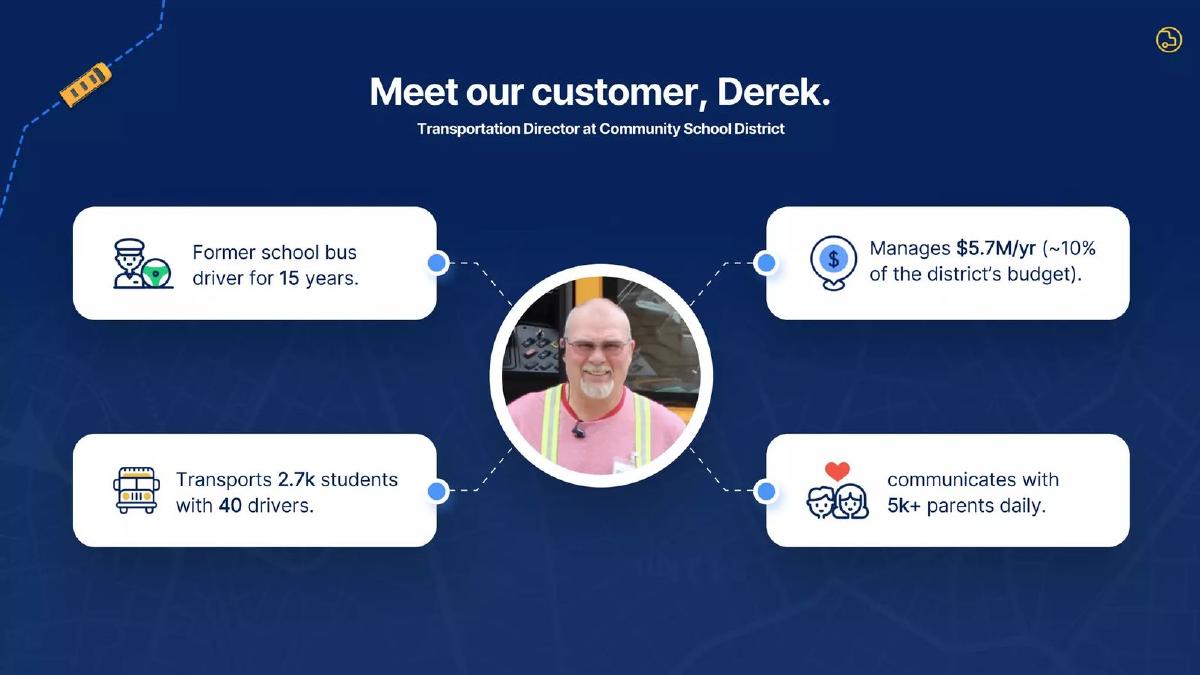
Slide 3 introduces 'Derek,' a Transportation Director. This humanizes the data. We learn Derek manages a $5.7M/yr budget and communicates with 5k+ parents daily . Slide 4 then scales this persona, stating there are 13,000 'Dereks' in the U.S. who control $29B of annual spend . This bottom-up market sizing is much more convincing than a generic top-down TAM slide.
Slide 5: The Systemic Problem
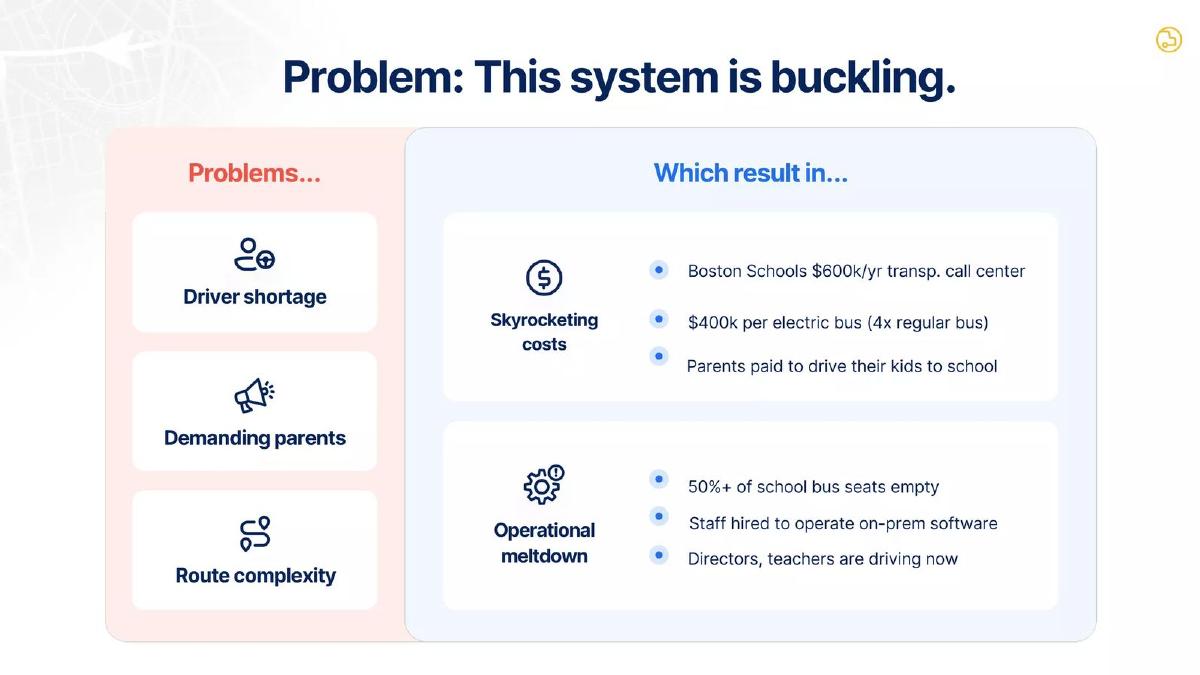
The deck identifies three core problems: Driver shortage, Demanding parents, and Route complexity. It lists specific, painful consequences, such as Boston Schools spending $600k/yr on a transportation call center and the fact that 50%+ of school bus seats are empty . This slide builds the 'burning platform'—the reason why districts must buy this software now rather than later.
Slide 6: The Three-Sided Solution
BusRight shows how its product serves three distinct stakeholders. For the Transportation Director , it converts 'months of routing into days.' For the Driver , it ensures students are never missed. For the Parent , it eliminates calls and provides peace of mind. Including a testimonial from a district official at the bottom adds immediate social proof to these claims.
Slide 7: Traction and Retention
While the revenue figures are redacted as $X , the percentages tell a strong story. The company claims 7.6x YoY growth . The most impressive metrics are the 111% Net Revenue Retention and the 1.3% ARR churn . In SaaS, these numbers indicate a product that is 'sticky' and has successfully implemented a land-and-expand strategy within its customer base.
Slide 8: Go-To-Market Efficiency
This slide doubles down on the sales efficiency mentioned earlier. It claims 70% of ARR comes from referrals and the website (inbound) . It also highlights a 7x return on conference spend ($1 spent leads to $7 in ARR). For a Series A investor, this demonstrates that the company knows exactly where to put capital to generate a predictable return.
Slide 9: Pricing Power
BusRight shows they have increased pricing 3x since 2020 . This is a key indicator of product-market fit and value realization. If a company can triple its price while maintaining a 1.3% churn rate, it proves the software is significantly undervalued by the market or provides immense ROI.
Slide 10: Social Proof
A dedicated slide for testimonials from an Assistant Superintendent, a Parent, and a Transportation Director. The quote from the Transportation Director— 'this is better than a margarita on the beach on a hot day' —is particularly effective because it uses the authentic voice of their target customer rather than corporate-speak.
Slide 11: The 'Free' Software Angle
To further de-risk the investment, BusRight explains how their customers pay for the software. They note that 50-90% of the cost is reimbursed by states . They also point to $190B in ESSER funds . This effectively tells the investor that the 'customer' isn't actually spending their own limited discretionary budget, but rather tapping into massive, pre-allocated government funds.
Slide 12: Projections
The projections slide shows a transition from 'Finding PMF (Actuals)' to 'Scaling PMF (Projections)' through 2024. It outlines the plan to hire 2 Account Executives and 7 others across engineering and design. This gives a clear view of how the Series A capital will be deployed to reach the next milestone.
Slide 13: The Team
The team slide is strong, featuring Keith Corso (CEO) and Phil Dunn (CPO). Dunn’s background as the former Tech Director for Broward County Schools (the 6th largest district in the U.S.) is a massive credibility booster. It shows they aren't just tech outsiders trying to disrupt a market; they have an insider who has managed $100M+ of K12 technology spend . The logos at the bottom (Google, NVIDIA, Penn, Cornell) signal a high talent bar.
Slide 14: Contact Information
A simple closing slide with the CEO's direct phone number and email. It maintains the clean, professional branding seen throughout the deck.
What Works in This Deck
The 'Derek' Persona: By focusing on a specific user, the deck makes the problem and solution tangible. It moves away from abstract 'district' problems to specific 'Director' pains.
Sales Velocity: The comparison of sales cycles is the strongest part of the deck. It directly addresses the biggest fear investors have about the education market: that it is too slow to support a venture-backed startup.
Funding Awareness: Highlighting the 50-90% reimbursement rate is brilliant. It transforms the software from a 'cost' into a 'subsidized infrastructure improvement.'
What Is Missing
Unit Economics: While the deck mentions sales efficiency, it does not explicitly state the Customer Acquisition Cost (CAC) or the Lifetime Value (LTV). Given the 1.3% churn, the LTV is likely very high, but seeing the CAC would help validate the 7x conference ROI claim.
Competitive Landscape: There is no slide addressing competitors. In the school bus routing space, there are legacy incumbents (like Tyler Technologies or Transfinder). Investors would want to know how BusRight wins against these established players beyond just having 'modern' software.
The 'Ask': The public version of this deck does not include a slide stating the specific amount being raised or the intended valuation, though the source listing identifies this as a $7M Series A deck.
What You Should Copy
The 'Backdoor' Sales Strategy: If you are selling into a slow-moving industry, find the specific job title that has the most pain and the most autonomous budget. Show investors how you've bypassed the traditional, slow procurement process.
The Reimbursement Slide: If your product qualifies for government grants, tax credits, or insurance reimbursements, make that a central part of your pitch. It makes your product feel 'free' or 'discounted' to the end user, which drastically lowers sales friction.
Authentic Testimonials: Use quotes that sound like real people. The 'margarita on the beach' quote is memorable because it’s unexpected in a professional pitch deck, yet it perfectly captures the relief the product provides.
Frequently asked questions
- What is the primary problem BusRight is solving?
- According to slide 5, the school transportation system is 'buckling' due to three main factors: a driver shortage, demanding parents, and route complexity. These lead to operational meltdowns where 50% of seats are empty and school staff are forced to drive buses themselves. BusRight provides software to optimize these routes and improve communication.
- How does BusRight handle the notoriously slow sales cycle of school districts?
- Slide 2 explicitly addresses this by shifting the target buyer. Instead of selling to 'Schools' generally (which involves 5+ decision makers), they sell to 'Transportation Directors.' This strategy reportedly reduces the sales cycle from 12-18 months down to 2.5 months and shifts the G2M strategy from outbound to inbound.
- What are the key financial metrics mentioned in the deck?
- While specific dollar amounts are redacted as '$X', slide 7 highlights a 7.6x YoY growth rate. More importantly, it shows a 100% booking-to-ARR conversion rate, 111% Net Revenue Retention, and a very low 1.3% ARR churn since the company's inception. Slide 9 also notes that their Average Selling Price (ASP) has tripled since 2020.
- Is the software affordable for cash-strapped school districts?
- BusRight addresses budget concerns on slide 11 by pointing out that 50-90% of the software cost is reimbursed by several states. They also highlight massive federal pools like the $190B ESSER funds and specific state aid, such as New York's $1.8B annual transportation fund, making the purchase effectively subsidized for the customer.
- Who is on the founding team?
- The team, shown on slide 13, consists of Keith Corso (CEO), who has met with over 500 Transportation Directors and was formerly an investor at MassMutual Ventures, and Phil Dunn (CPO), the former Tech Director for Broward County Schools. The slide also lists experience from Google, NVIDIA, and Robinhood among their broader team.