Buus is a Brazilian transit-tech startup addressing the lack of real-time information for bus commuters in Rio de Janeiro. The deck identifies a significant market, noting that 60% of transport is via bus (Slide 4), yet commuters suffer from 'Sem Informação Alguma' (no information at all) as shown on Slide 1. The solution is a mobile app providing live arrival times and route tracking (Slide 3). Interestingly, the deck highlights a 'Mobile Marketing' revenue stream (Slide 6), suggesting location-based advertising at bus stops. While the deck shows strong early traction with 200 buses and 100,…
Key takeaways
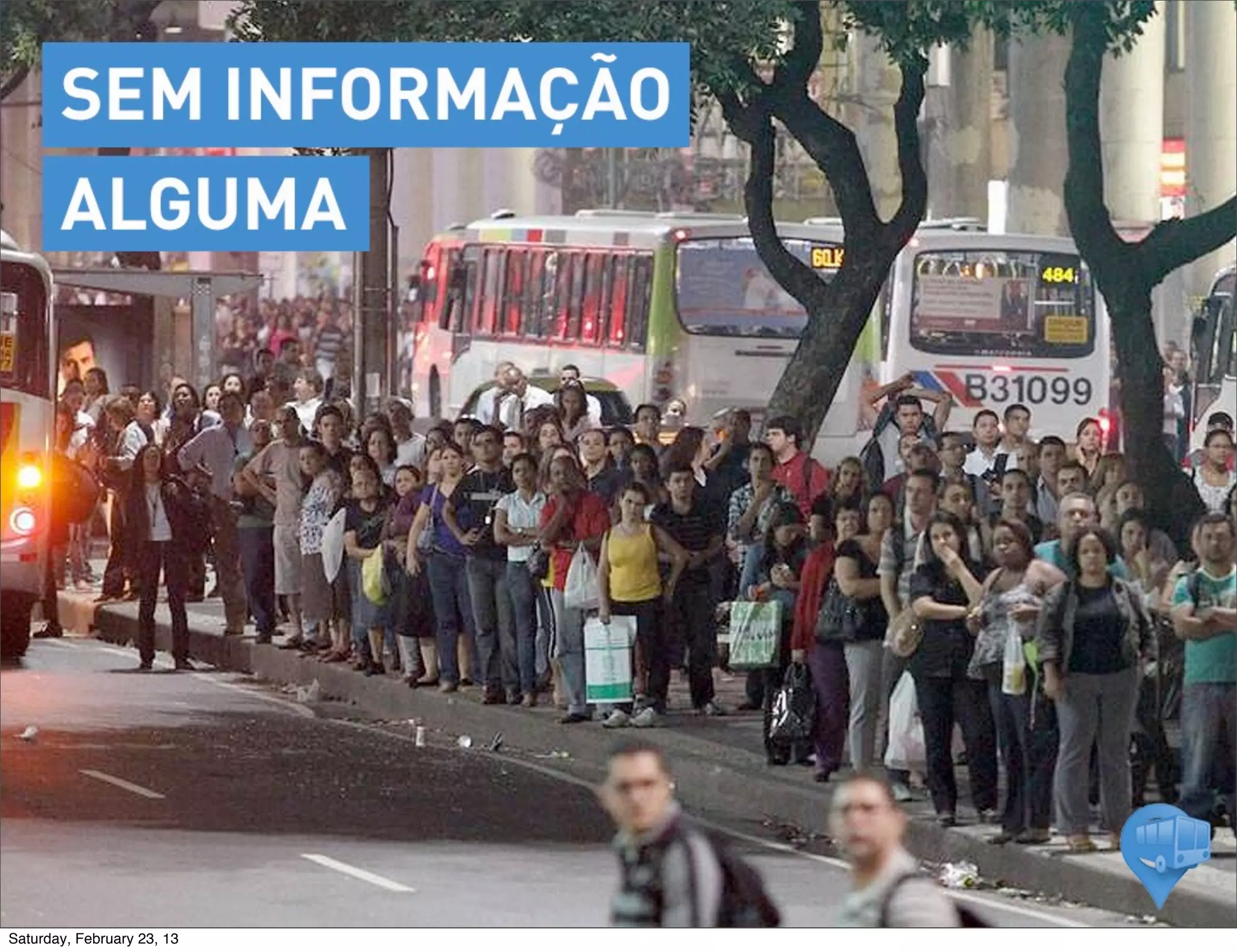
- The primary problem identified is the total lack of information for commuters at bus stops (Slide 1).
- Buses represent the dominant mode of transport in the target market at 60%, followed by cars at 20% (Slide 4).
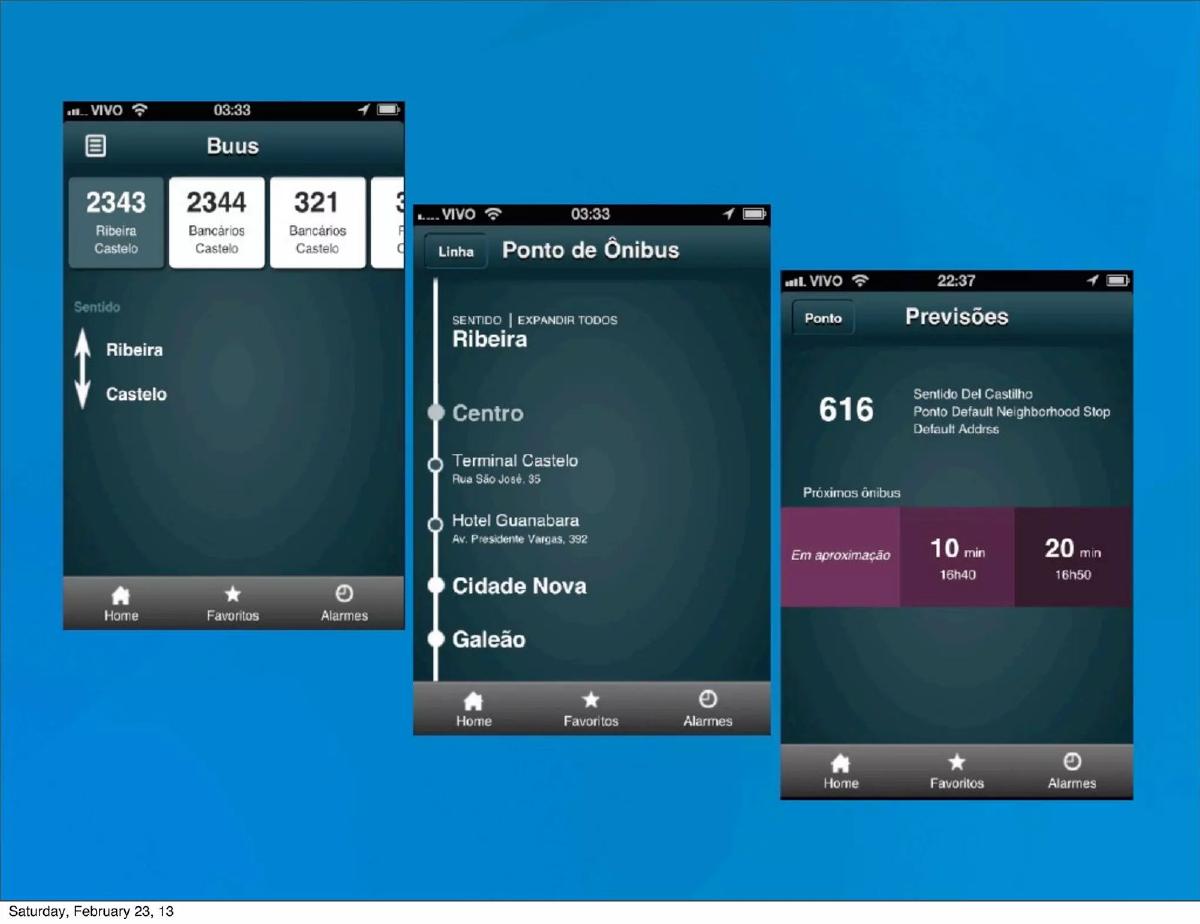
- The product is a mobile application featuring real-time arrival predictions, such as '10 min' and '20 min' windows for specific lines (Slide 3).
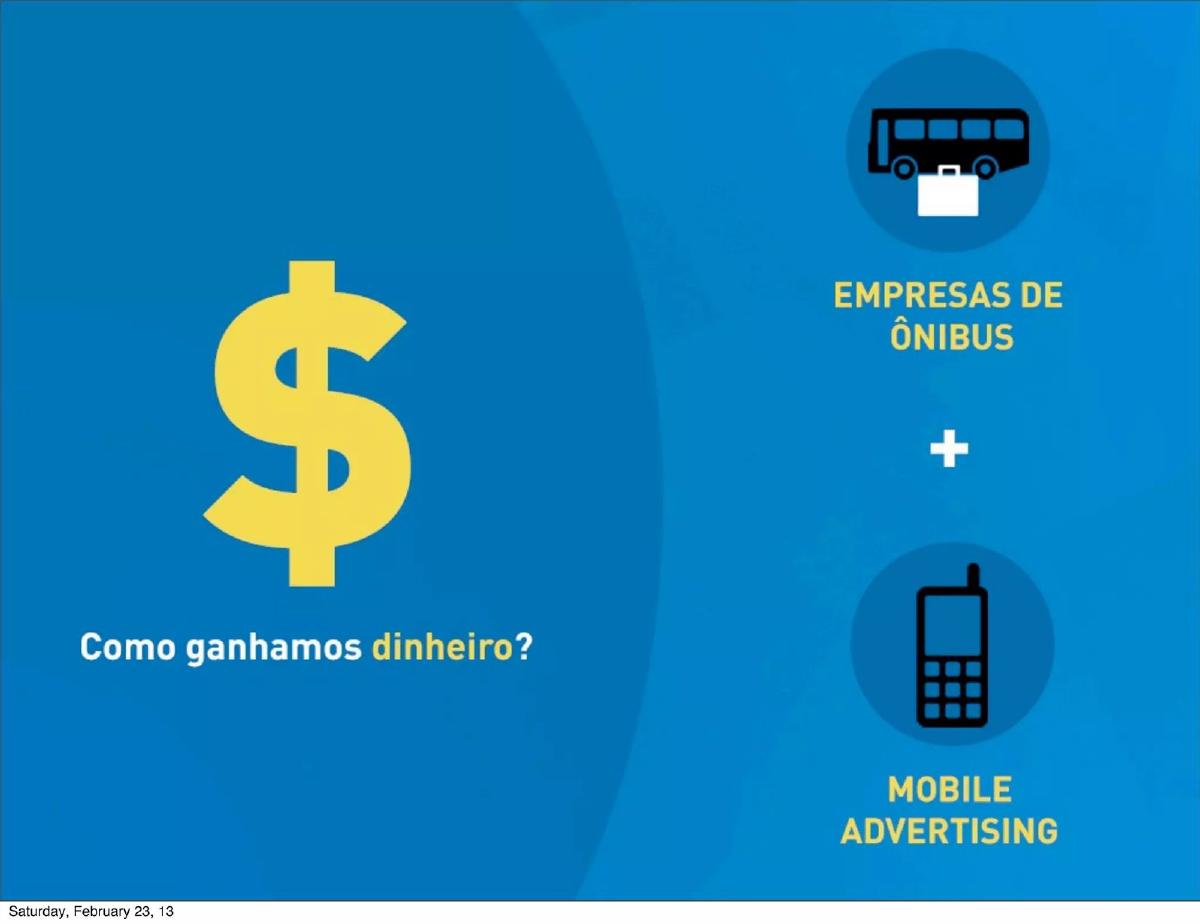
- Buus intends to monetize through location-based mobile marketing, illustrated by a McDonald's promotion triggered by proximity to a bus stop (Slide 6).
- The startup claims current service on 200 buses across 13 lines with a reach of 100,000 passengers (Slide 8).
- Expansion plans are aggressive, targeting 8,000 buses in Rio within one month and 60,000 buses across other cities within one year (Slide 8).
- The deck lists several major partners or integrated entities including MetrôRio, Nokia, and Google Play (Slide 7).
- Current seat occupancy is reported at 40% to 50%, suggesting an opportunity to optimize transit demand (Slide 5).
Buus Pitch Deck Teardown: Navigating the Chaos of Rio Transit
The Buus pitch deck, dated February 2013, focuses on a hyper-local problem with massive scale: the lack of real-time data in the Brazilian public transportation sector. With a heavy emphasis on visual storytelling and market data, the deck attempts to position Buus as the essential layer between transit infrastructure and the mobile consumer.
Slide 1: The Emotional Hook
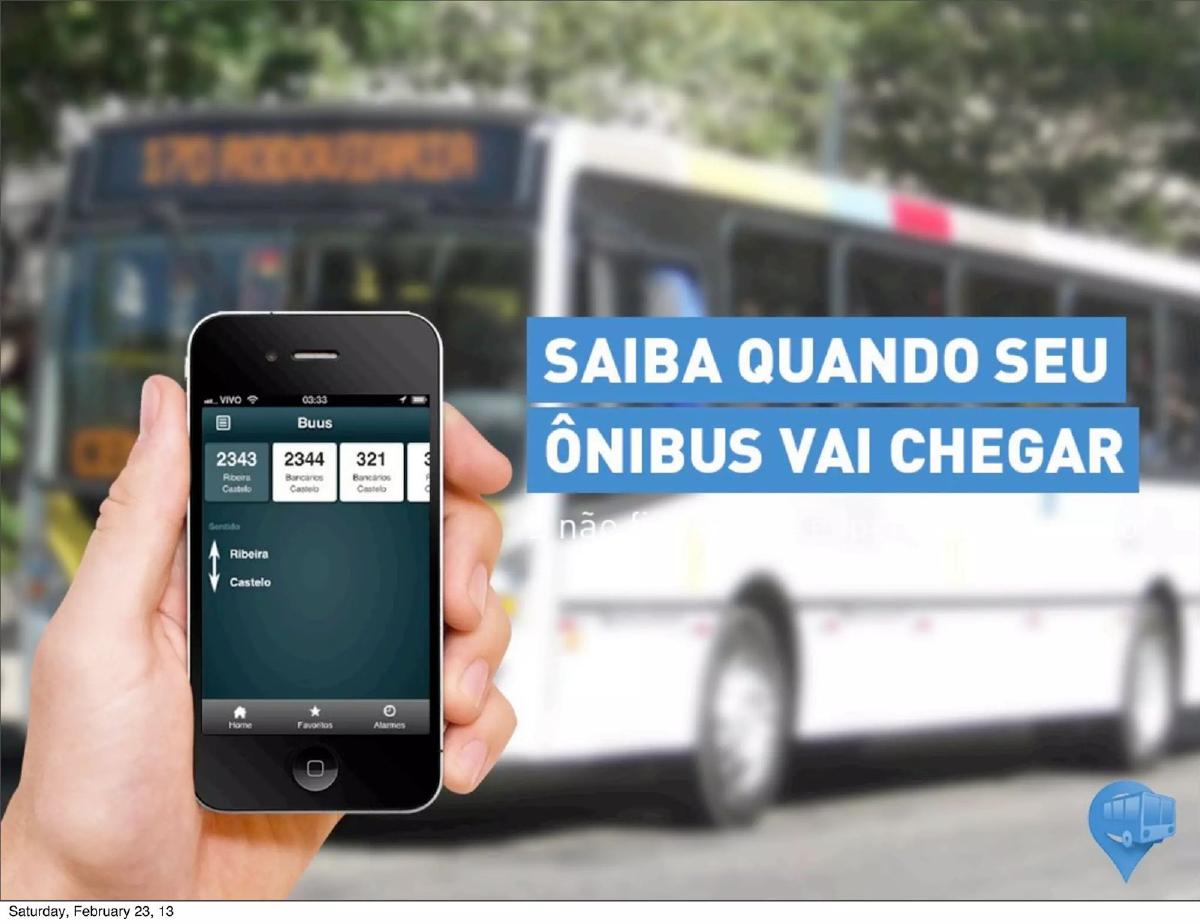
The deck opens not with a logo, but with a visceral image of a crowded bus stop in Rio de Janeiro. The text overlay "SEM INFORMAÇÃO ALGUMA" (Without any information) immediately identifies the pain point. It targets the frustration of the commuter who has no visibility into their journey. This is a classic 'problem-first' opening that establishes the necessity of the product before the product is even shown.
Slide 2: Brand Identity
Slide 2 introduces the company name, Buus , and its logo: a bus icon inside a location pin. This is a standard branding slide that reinforces the core value proposition—location-based transit services. The design is clean, using a blue palette that evokes trust and technology.
Slide 3: The Product Interface
This slide provides three screenshots of the mobile application. It shows a list of bus lines (2343, 2344, 321), a route map with specific stops like Terminal Castelo and Cidade Nova , and a 'Previsões' (Predictions) screen. The predictions screen is the most critical, showing arrival times of 10 min and 20 min . This proves the technical capability of the app to provide the real-time data promised in the opening slide.
Slide 4: Market Composition
Slide 4 uses a horizontal bar chart to break down transportation modes. Buses represent 60% of the market, followed by cars at 20%, vans at 15%, and motorcycles at 5%. By highlighting that 60% of the population uses the service they are tracking, Buus establishes a massive Total Addressable Market (TAM) within the city of Rio.
Slide 5: Demand and Occupancy Optimization
This slide uses bell curves to compare 'Demanda Atual' (Current Demand) with 'Demanda Futura' (Future Demand). It points to peak morning and afternoon hours ('Pico da Manhã' and 'Pico da Tarde'). At the bottom, it notes 'Ocupação de Cadeiras (Hoje)' (Seat Occupancy Today) at 40% to 50% . This suggests that the transit system is inefficiently used, and Buus could potentially help smooth out demand or improve occupancy through better information.
Slide 6: The Business Model - Mobile Marketing
One of the most important slides for an investor, Slide 6, titles itself 'MOBILE MARKETING' . It shows a user holding a phone in front of a McDonald's. The app displays a notification: 'Vá até o McDonalds do mapa e ganhe um hamb...' (Go to the McDonald's on the map and get a burg...). This clearly defines the revenue model: location-based advertising. By knowing where a commuter is and where they are going, Buus can serve hyper-targeted ads for businesses located near bus stops.
Slide 7: The Ecosystem and Partnerships
Slide 7 is a logo wall. It includes transit authorities and companies like Rio Ônibus , Fetranspor , and MetrôRio . It also features technology partners like Nokia , Google Play , and M2M Solutions . The inclusion of the Rio Prefeitura (City Hall) logo is particularly important, as it suggests the startup has the necessary government relationships to access transit data or operate within the city's infrastructure.
Slide 8: Market Timeline and Traction
The final slide in the set provides a roadmap. Under 'HOJE' (Today), they claim to be serving 200 buses across 13 lines with a reach of 100,000 passengers . The growth targets are aggressive: 8,000 buses in Rio within one month ('1 Mês') and 60,000 buses in other cities within one year ('1 Ano'). This indicates a plan to scale from a pilot to a city-wide and then a national solution rapidly.
What Works in the Buus Deck
Clear Problem Identification: The first slide is a masterclass in identifying a relatable, high-friction problem without using a single word of jargon. · Visual Product Proof: Slide 3 shows a functional UI that directly addresses the problem stated on Slide 1. · Defined Revenue Stream: Many transit apps struggle to explain how they will make money. Buus explicitly points to location-based marketing, which is a logical fit for a transit app. · Market Dominance: Highlighting that 60% of transport is via bus makes the opportunity feel inevitable rather than niche.
What is Missing from the Buus Deck
The Team: There is no information on who is building this. In early-stage startups, the 'who' is often more important than the 'what.' · Financials and Unit Economics: The deck does not explain the cost of acquiring a user (CAC) or the expected Lifetime Value (LTV) from the mobile marketing model. · The Ask: The deck ends without telling the investor how much money is needed or what the milestones for that funding will be. · Competition: In 2013, apps like Moovit were already gaining traction. The deck fails to mention how Buus is different or how it will defend its market share against global competitors.
Founder's Guide: What to Copy
The 'Pain' Image: Use a high-quality, non-stock photo that captures the exact moment your customer feels the most frustration. It sets the tone for the entire pitch. · The Logo Wall: If you have integrations or are using specific hardware (like M2M Solutions for GPS), show those logos. It builds technical credibility. · The Timeline Format: Slide 8 uses a simple, linear timeline that clearly separates 'Current Traction' from 'Future Goals.' This is much easier to read than a complex Gantt chart.
Frequently asked questions
- What is the core problem Buus is solving?
- Buus addresses the 'Sem Informação Alguma' (zero information) problem in Rio de Janeiro's public transit. Slide 1 depicts a crowded bus stop where commuters have no way of knowing when the next bus will arrive. By providing real-time tracking, the app aims to reduce wait-time anxiety and improve the efficiency of the 60% of the population that relies on buses.
- How does Buus plan to make money?
- Slide 6 introduces 'Mobile Marketing' as a key strategy. The slide shows a smartphone displaying a map near a McDonald's with a notification encouraging the user to visit the restaurant. This suggests a B2B2C model where local businesses pay to advertise to commuters based on their real-time location and proximity to specific bus stops.
- What is the current scale of the Buus platform?
- According to the 'Market Timeline' on Slide 8, the service is currently ('Hoje') in use by 200 buses across 13 lines. This gives them a reach of up to 100,000 passengers. This represents a small pilot phase compared to their immediate goal of expanding to 8,000 buses in Rio de Janeiro.
- Who are the partners mentioned in the deck?
- Slide 7 displays a logo wall including Ideal, Rio Ônibus, Fetranspor, 1001, MetrôRio, Rio Prefeitura (City Hall), Supervia, GPS Conecta, Nokia, Google Play, and M2M Solutions. This implies a mix of data providers, hardware partners (GPS), and distribution platforms, though the specific nature of each partnership is not detailed.
- What are the biggest omissions in this pitch deck?
- The provided slides lack several critical components for a professional fundraise: there is no team slide introducing the founders, no financial slide showing unit economics or burn rate, and no 'Ask' slide detailing how much capital is being raised and how it will be deployed. Additionally, there is no competitive analysis against global players like Moovit.