IRLY’s 15-slide pitch deck is a masterclass in demographic-specific branding, successfully raising $350,000 in 2022. The deck leans heavily into the 'Gen-Z' aesthetic, utilizing Memojis and vibrant purple hues to signal cultural alignment. By citing 350+ user interviews, the founders established early credibility despite a lack of live traction data. The presentation identifies a clear gap in the market: the shift from 'text and photo-based' apps like Tinder to 'video-first' transparency. While the deck is light on unit economics and detailed technical architecture, it compensates with a robu…
Key takeaways
- The company established problem-solution fit by citing over 350 user interviews on Slide 3.
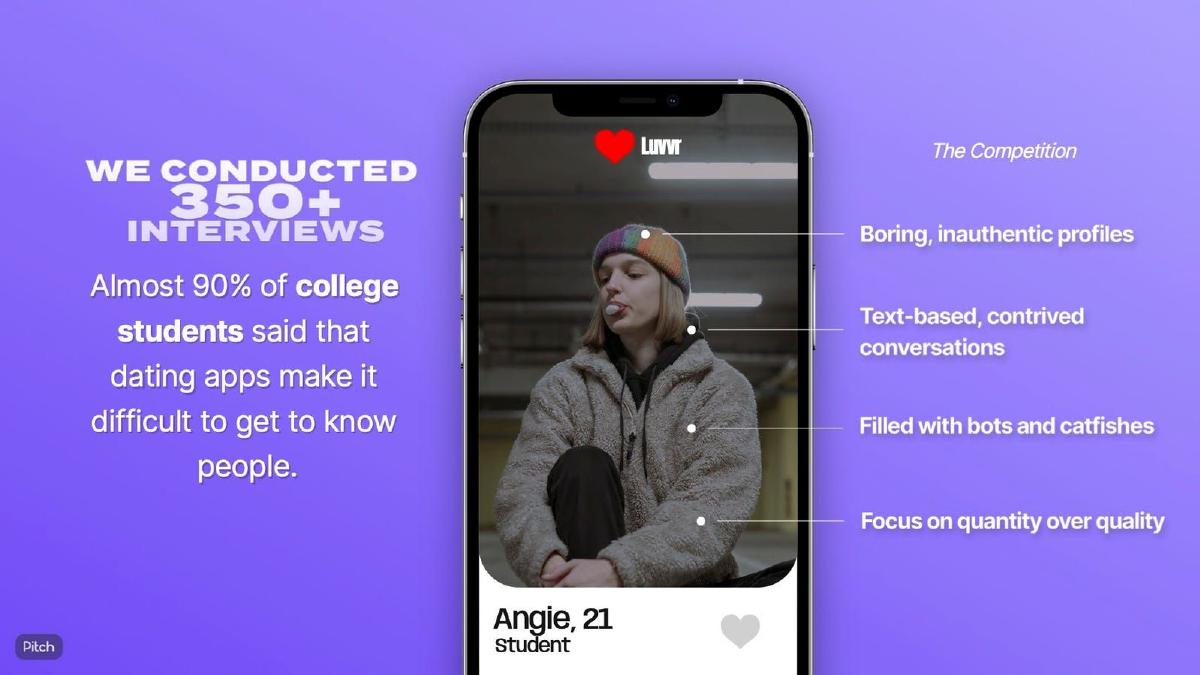
- Slide 3 claims that almost 90% of college students find current dating apps make it difficult to get to know people.
- The deck positions IRLY in the high-transparency, video-centric quadrant of the competitive landscape on Slide 11.
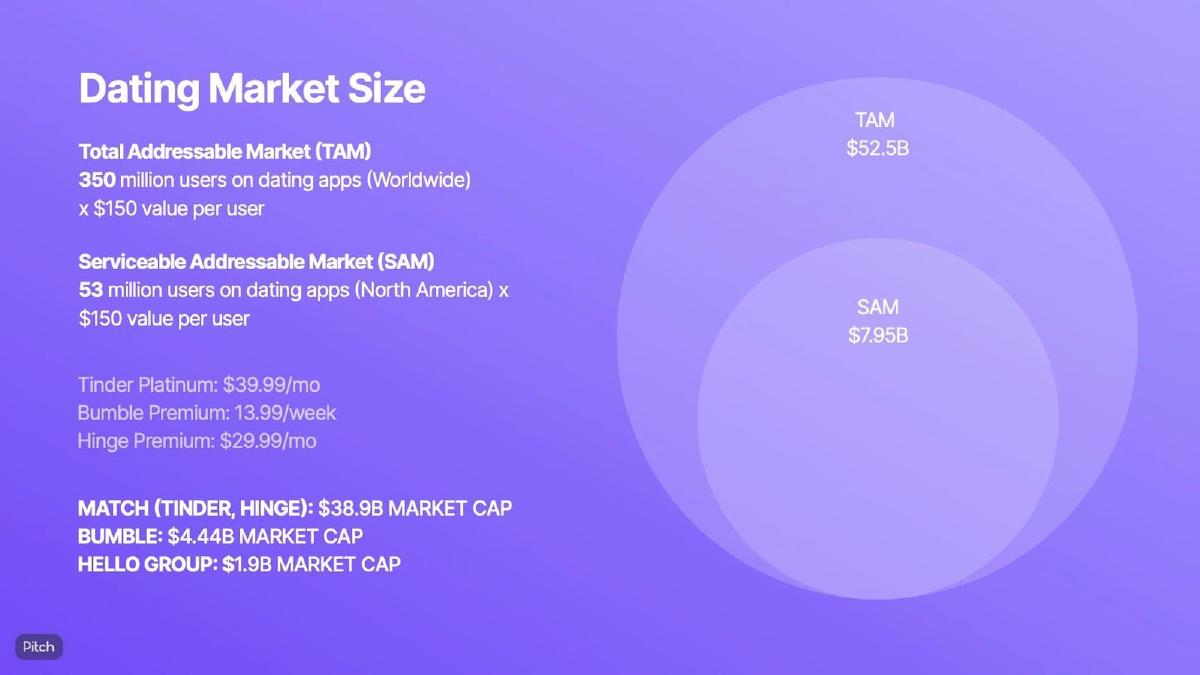
- Market sizing on Slide 7 estimates a Total Addressable Market of $52.5 billion based on 350 million worldwide users.
- The revenue model on Slide 12 relies on three pillars: premium subscriptions, in-app purchases, and advertising.
- Slide 13 showcases a large team of 13 members, primarily students from the University of British Columbia and Ryerson University.
- The deck includes high-profile advisors from Skip The Dishes, Twitter, Fandom, and StockX on Slide 13.
- Slide 14 provides a use of proceeds breakdown via a pie chart, though it lacks specific dollar amounts for each category.
Introduction: The Gen-Z Dating Pivot
IRLY (In Real Life, Y'know) entered the crowded dating app market in 2022 with a specific focus on the youngest cohort of daters. The company, based in North America, successfully raised $350,000 in pre-seed funding. Their pitch deck is a visual representation of the demographic they serve: colorful, emoji-heavy, and focused on video-first communication. This teardown examines how they framed a 'solved' problem—online dating—as a broken system in need of a generational overhaul.
Slide 1: The Hook
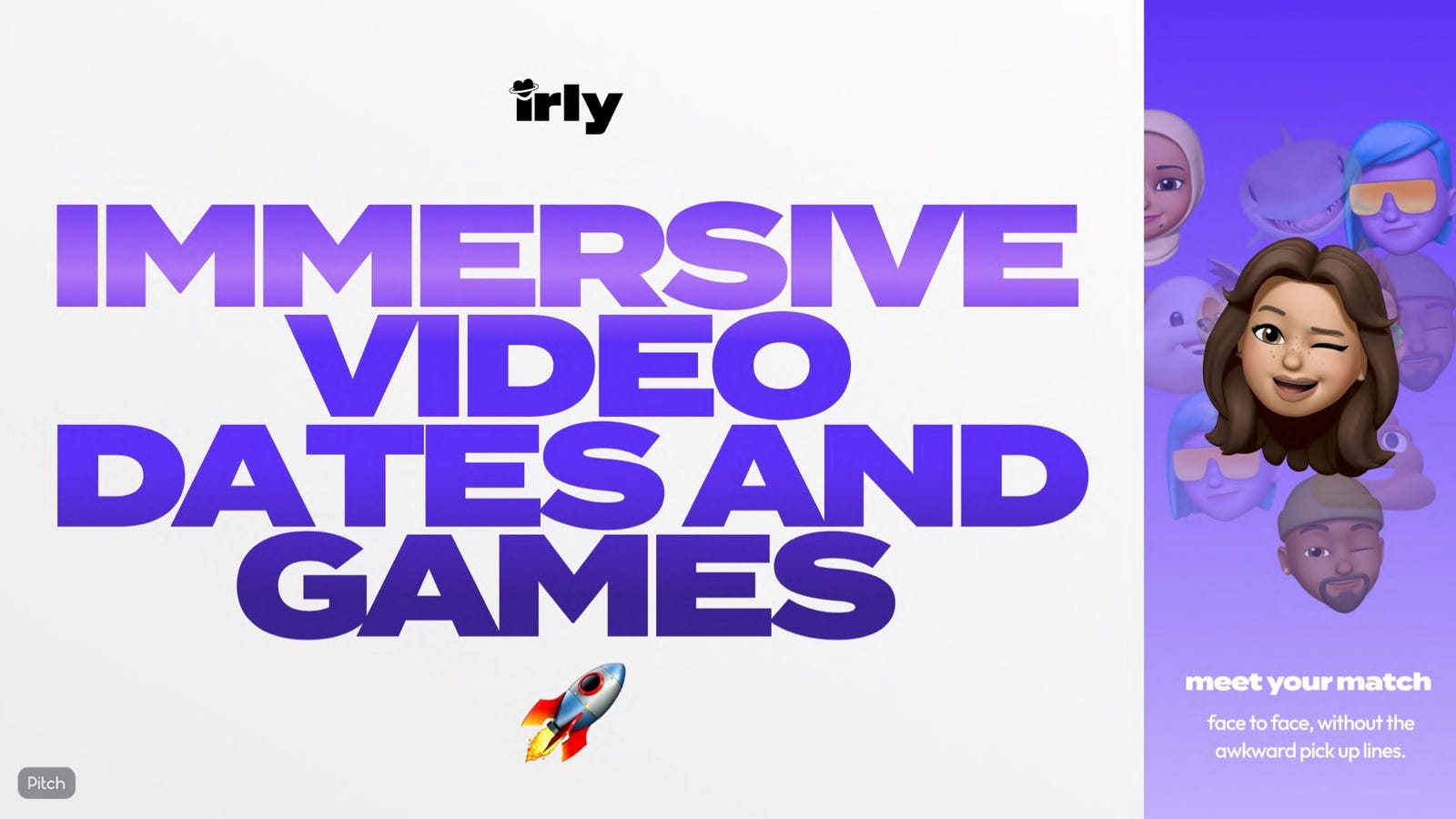
The title slide sets a clear tone with the headline "Immersive video dates and games." It uses a bold purple and white color palette. The sub-headline, "meet your match face to face, without the awkward pick up lines," immediately identifies the value proposition: reducing the friction of text-based introductions. The use of Memojis on the right side of the slide signals that this is a mobile-first, personality-driven platform.
Slide 2: Personal Connection
Slide 2 introduces co-founder Laura Rollock. In pre-seed decks, the 'Founder Market Fit' is often more important than the product itself. By giving a slide to a single founder early on, IRLY attempts to humanize the brand. However, this is an unusual placement; typically, the full team is reserved for the end. It suggests that the founders' personal brands or insights are the primary drivers of the initial concept.
Slide 3: The Research Foundation
This is one of the strongest slides in the deck. It states, "We conducted 350+ interviews." For a pre-revenue startup, data from potential users is the best substitute for traction. The slide claims that "Almost 90% of college students said that dating apps make it difficult to get to know people." By quantifying the problem through direct outreach, IRLY moves from an anecdotal 'hunch' to a data-backed hypothesis. The right side of the slide lists four specific pain points of 'The Competition': boring profiles, contrived conversations, bots/catfishes, and quantity over quality.
Slide 4: Validating Frustration
Slide 4 uses social proof in the form of tweets and messages to illustrate that "Gen-Z is frustrated." This slide reinforces the emotional aspect of the problem. It doesn't provide new data but serves to build empathy with the investor, showing that the 'dating app fatigue' mentioned in Slide 3 is a trending cultural sentiment.
Slide 5: The Vision Statement
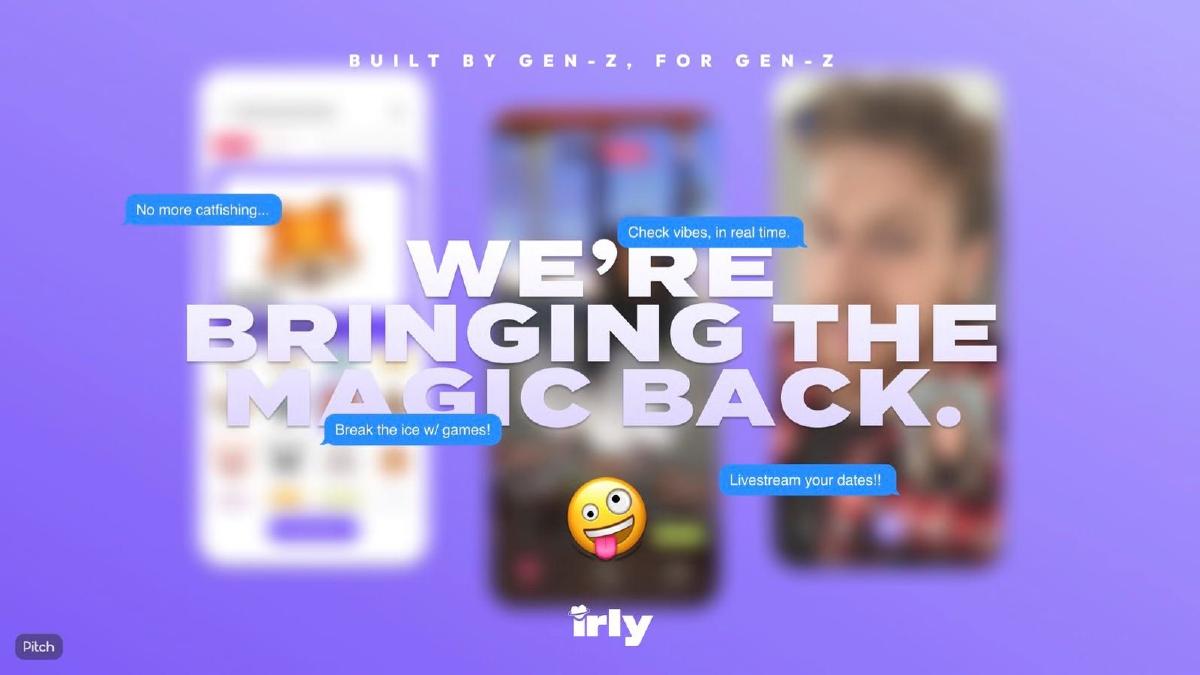
"We're bringing the magic back" is the central claim of Slide 5. It explicitly states the app is "Built by Gen-Z, for Gen-Z." The slide uses call-out bubbles to highlight features: "No more catfishing," "Break the ice w/ games!" "Check vibes, in real time," and "Livestream your dates!!" This slide bridges the gap between the 'frustrated' user and the proposed solution.
Slide 6: The Solution in Practice
Slide 6 provides a more detailed look at the solution. It features an iPhone mockup on the left, though the text description is the focus. It reiterates the move away from text-based interaction toward video-first experiences. This slide is intended to show the 'how' behind the 'what' mentioned in the previous vision slide.
Slide 7: Market Size and Economics
IRLY presents a Total Addressable Market (TAM) of $52.5B and a Serviceable Addressable Market (SAM) of $7.95B . They calculate this using a "$150 value per user." To justify this valuation, they list the pricing of incumbents: Tinder Platinum at $39.99/mo, Bumble Premium at $13.99/week, and Hinge Premium at $29.99/mo. They also cite the market caps of Match Group ($38.9B) and Bumble ($4.44B). This slide successfully argues that even a small slice of this market is worth hundreds of millions of dollars.
Slide 8: Service Offering
This slide provides a breakdown of the app's services. It uses a camera icon to emphasize the video aspect. While it overlaps somewhat with Slide 5, it serves to formalize the product features for the investor, moving from 'magic' to specific utility.
Slide 9: The Mission
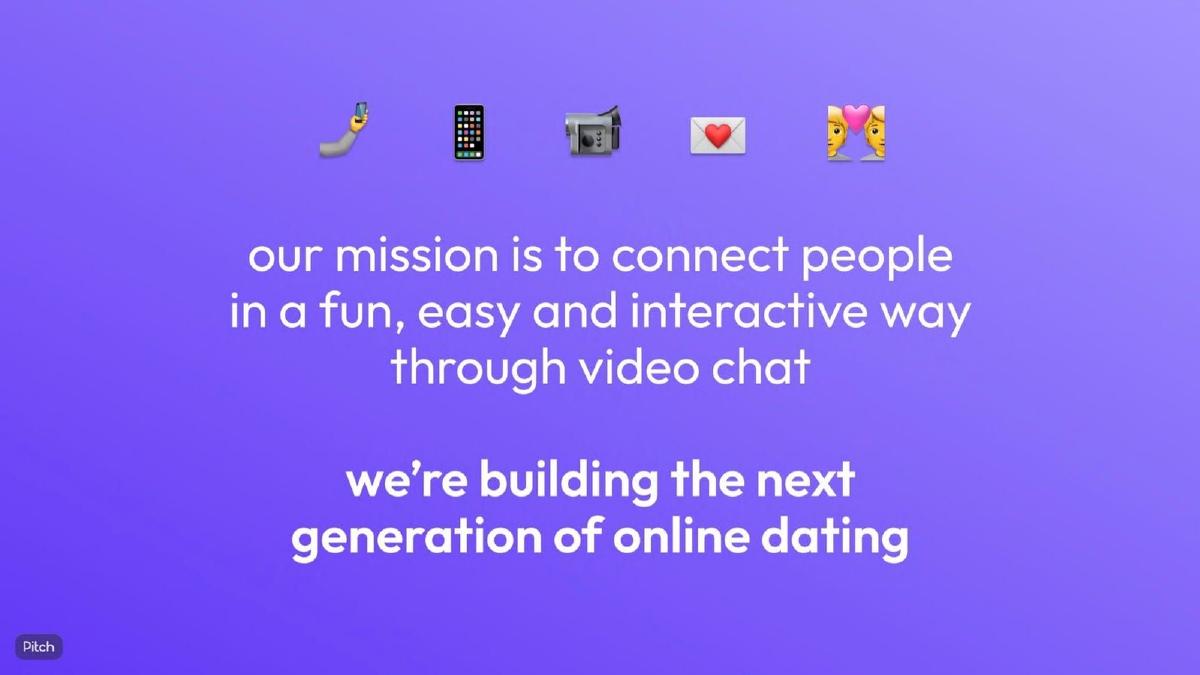
Slide 9 is a simple mission statement: "our mission is to connect people in a fun, easy and interactive way through video chat." It repeats the phrase "we're building the next generation of online dating." This slide acts as a transition point in the deck, moving from the 'what' and 'why' to the 'how' and 'who.'
Slide 10: Why Now?
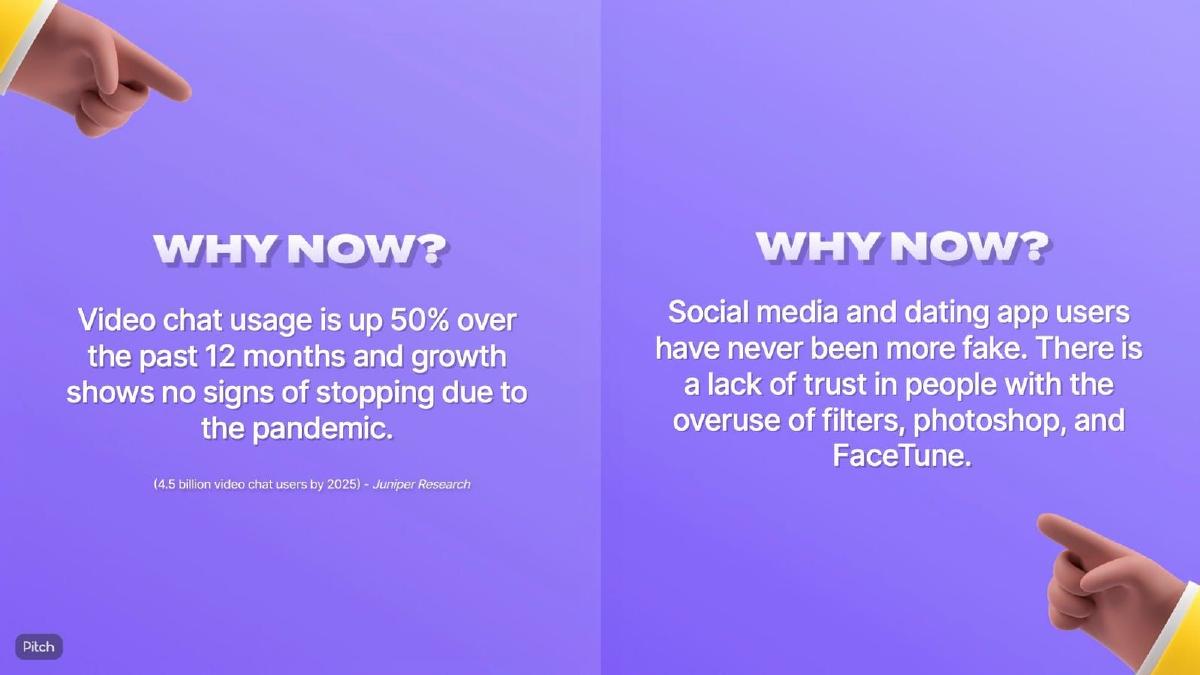
The 'Why Now' slide is a staple of successful pitch decks. IRLY uses this to explain the timing of their entry into the market. While the specific text is not fully detailed in the prompt, the visual of hands pointing to the center suggests a convergence of trends—likely the rise of video-first social media (TikTok) and the post-pandemic desire for more authentic digital connection.
Slide 11: Competitive Landscape
The competitive matrix uses two axes: "Video/Video Chat vs. Text & Photo Based" and "Low level of profile transparency vs. High level of profile transparency." IRLY places itself in the top-right quadrant (High Transparency, Video-Based). Interestingly, they include niche competitors like Lolly and Snack , noting they have "TikTok-style profiles, no video chat." This positions IRLY as the only player offering real-time, interactive video, rather than just asynchronous video clips.
Slide 12: Revenue Model
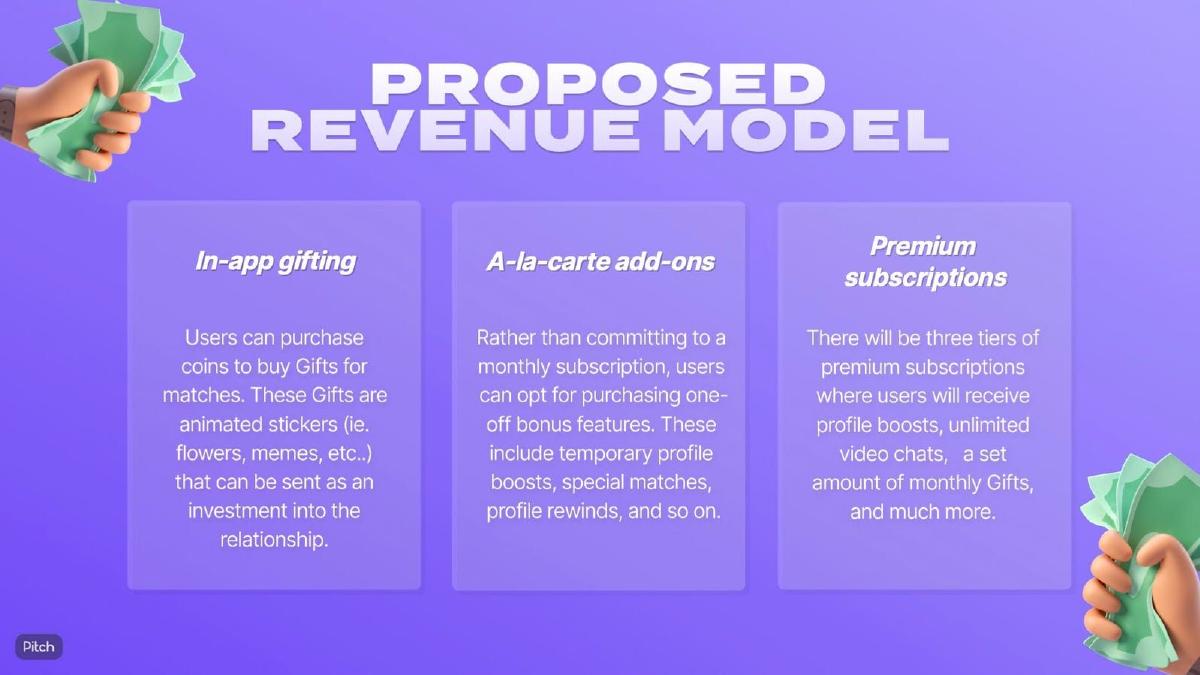
IRLY outlines a three-pronged monetization strategy: Premium Subscriptions, In-app Purchases, and Advertising. This is a standard model for consumer social apps. By listing these, they show they aren't just building a 'cool app' but a business with multiple paths to profitability. However, the slide lacks specific pricing tiers or projected Average Revenue Per User (ARPU) for their own platform.
Slide 13: The Team and Advisors
This slide is remarkably dense for a pre-seed startup. It features 13 team members, mostly developers and designers from the University of British Columbia and Ryerson University . The founders, Connor Rose (CEO) and Laura Rollock (CCO) , highlight their backgrounds in viral content and influencer marketing. The top of the slide features four heavy-hitting advisors: Kevin Edwards (CEO at Skip The Dishes), Matthew Derella (ex-CCO at Twitter), Stephanie Fried (CMO at Fandom), and Chris Kaufman (Co-founder at StockX). This advisor roster likely did the heavy lifting in securing the $350,000 raise, providing institutional credibility to a young team.
Slide 14: Use of Proceeds
The deck concludes its business case with a pie chart showing how the funds will be spent. While the prompt notes the chart exists, it does not specify the percentages. Typically, for a pre-seed round, this is split between Product Development (Engineering), Marketing (User Acquisition), and Operations.
Slide 15: The Closer
The final slide features a character in a sloth onesie with the text "That's all folks!" It is a whimsical, brand-consistent end to the presentation, reinforcing the 'fun' and 'interactive' nature of the brand they are building.
What Works in This Deck
Demographic Alignment: The deck looks and feels like the product it is describing. The use of Memojis, purple gradients, and informal language signals that the founders understand the Gen-Z aesthetic. · Quantified Problem: Citing 350+ interviews is a powerful way to show market research. It proves the founders didn't just guess that people were unhappy; they asked them. · Advisor Credibility: For a team of students and recent grads, having executives from Twitter and StockX on the advisor slide is a massive signal of quality to investors. · Clear Differentiation: The competitive landscape slide (Slide 11) makes a very specific claim: others have video profiles, but we have real-time video chat. This is a defensible 'wedge' into the market.
What Is Missing
The Ask: The deck does not explicitly state how much money they are looking for or the terms of the round. While this is often discussed in person, including a 'The Ask' slide is standard practice to anchor the conversation. · Traction Metrics: There is no mention of a beta test, a waitlist size, or any early user engagement data. The deck relies entirely on 'interviews' and 'market size.' · Unit Economics: While they mention a $150 value per user, they don't explain how they arrived at that number or what their projected Customer Acquisition Cost (CAC) might be. · Technical Architecture: For a video-heavy app, investors often want to see how the company handles the high costs and technical challenges of real-time video streaming and moderation.
Founder Takeaways
Use proxies for traction: If you don't have users yet, do what IRLY did on Slide 3: conduct hundreds of interviews and turn that qualitative feedback into quantitative data points. · Leverage your advisors: If your core team is young or lacks 'exit' experience, put your high-profile advisors front and center. It acts as a de-risking mechanism for the investor. · Define your 'Quadrant': Don't just say you are better than the competition. Use a matrix like Slide 11 to show that you are fundamentally different in a way that the market currently lacks. · Keep the branding consistent: Your deck is your first product. If you are building a 'fun' consumer app, your deck shouldn't look like a corporate banking presentation. IRLY's use of color and icons reinforces their brand mission.
Frequently asked questions
- How much did IRLY raise with this deck?
- As reported by Business Insider, IRLY raised $350,000 in a pre-seed round in 2022. The deck itself does not state the specific dollar amount requested, though it includes a 'Use of Proceeds' slide to explain how capital would be allocated across development and marketing.
- What is IRLY's primary competitive advantage according to the slides?
- IRLY differentiates itself through 'High level of profile transparency' and 'Video/Video Chat' functionality. Slide 11 contrasts this against 'Text & Photo Based' incumbents like Tinder and Bumble, as well as TikTok-style video apps that lack real-time video chat features.
- Who is the target audience for the IRLY app?
- The deck explicitly states the app is 'Built by Gen-Z, for Gen-Z' on Slide 5. The problem slides specifically reference the frustrations of college students and the prevalence of 'bots and catfishes' in existing dating ecosystems.
- What features does the app offer beyond standard matching?
- According to Slide 5 and Slide 8, the app includes immersive video games to 'break the ice,' real-time video chat to 'check vibes,' and a livestreaming component for dates. These are intended to make the experience more interactive than traditional swiping.
- Is there any mention of existing user traction in the deck?
- No, the deck does not include a traction slide with metrics like Monthly Active Users (MAU) or retention rates. It relies on '350+ interviews' as a proxy for market validation, suggesting the company was in the pre-launch or very early beta stage during the fundraise.