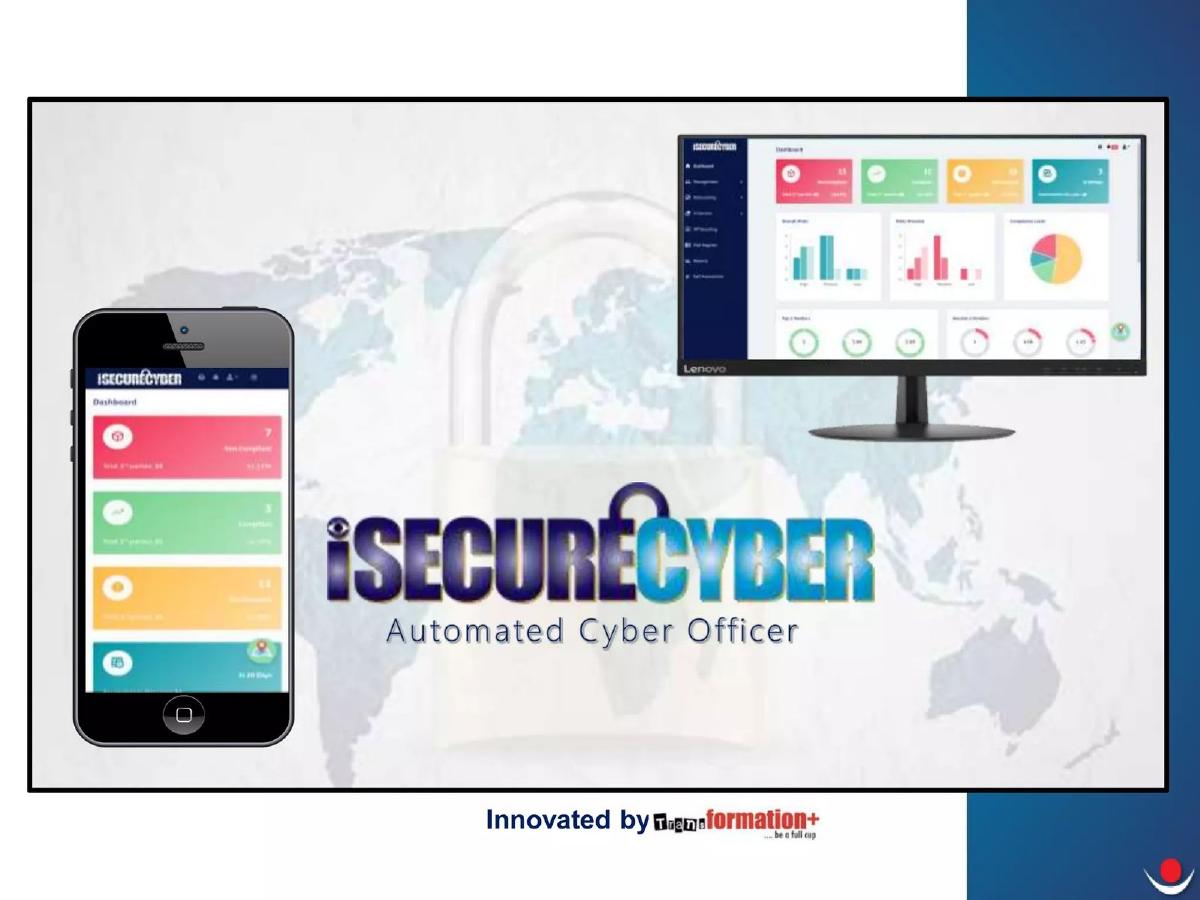
iSecureCyber targets the underserved SMB market with an 'automated cyber officer' platform, addressing the fact that 70% of SMBs experience cyber attacks while lacking internal expertise. The deck outlines a clear product evolution from supply chain security (launched August 2020) to a comprehensive 'Cyber Automation Hub' projected for December 2022. Seeking $5M in Series A funding, the company aims to generate $7.5M in revenue over 48 months by capturing a portion of a massive $240B Serviceable Obtainable Market. While the deck provides strong testimonials and a clear roadmap, it lacks detai…
Key takeaways
- The company identifies a critical gap where existing cybersecurity solutions cater primarily to large organizations and require high technical expertise (Slide 3).
- The product is positioned as an 'implement and forget' cloud platform specifically tuned for non-technical novice users in the SMB sector (Slide 4).
- A detailed product roadmap shows a progression from 'Base' supply chain security in 2020 to a 'Giant Leap' automation hub by late 2022 (Slide 5).
- Market sizing estimates a $240B SOM based on 40M+ target SMBs and an average revenue per SMB of $6,000 (Slide 8).
- The marketing strategy is bifurcated into an initial stage focused on SEO and POCs, followed by a growth stage involving high-level partnerships with ISACA and AISA (Slide 9).
- The $5M Series A ask is precisely allocated: 40% for operations, 40% for human resources, and 20% for marketing (Slide 12).
- Revenue projections estimate $7.5M in total revenue over the 48 months following the investment (Slide 12).
- The leadership team consists of three key members: a Chief Product Owner, an Executive Director, and a CTO, all with LinkedIn profiles provided (Slide 11).
Executive Summary and Title
The iSecureCyber pitch deck opens with a clear branding statement: "Automated Cyber Officer." The cover slide (Slide 1) features mockups of the software on both a desktop monitor and a mobile device, immediately signaling a cross-platform, dashboard-driven user experience. The deck is attributed to "Transformationplus," suggesting it may be a spin-off or a product within a larger innovation lab. The visual theme is professional, utilizing a blue and white palette consistent with the cybersecurity industry.
The Problem and Market Gap
Slide 2 defines the problem space with a single, high-impact statistic: 70% of Small Medium Businesses (SMBs) experience cyber attacks, yet half of them are unprepared. This sets the stage for the "Gap in Market" identified on Slide 3. The company argues that current cybersecurity solutions are flawed for the SMB segment because they cater to large organizations, require deep technical expertise to operate, and often only address specific, siloed problems rather than providing a holistic view.
The Solution: The Automated Cyber Officer
Slide 4 introduces the "Our Solution" as an integrated cloud-based platform. The three core pillars of the product are that it is "Tuned for SMB," designed for the "non-technical novice user," and functions as an "Implement and forget" system. By framing the software as an automation of the "Cyber officer" role, the company positions itself as a cost-saving alternative to hiring expensive specialized personnel.
Product Roadmap and Evolution
Slide 5, titled "Our Journey," provides a chronological roadmap of product development. It shows a progression from a "Base" launch in August 2020 focused on Supply Chain Security to an "Advanced" Centralized Cyber Platform in July 2021. The roadmap culminates in a "Giant leap" toward a "Cyber Automation Hub" scheduled for December 2022. This slide is useful for investors to see both the history of execution and the future vision of the technology stack.
Detailed Product Features
Slides 6 and 7 break down the features of the "Base" and "Advanced" versions of the platform. The Base version includes seamless risk reporting, end-to-end automation, integration with apps like DocuSign, and continuous supplier monitoring. The Advanced version focuses on centralized management, the ability for clients to showcase their own cybersecurity maturity as a selling point, and the maintenance of certifications such as ISO27001 and SOC2-type 2. This distinction helps clarify the upsell potential and the depth of the compliance features.
Market Size and Opportunity
Slide 8 presents the market sizing using the standard TAM/SAM/SOM model. The Total Addressable Market (TAM) is cited as 400M+ SMBs worldwide representing $2 trillion. The Serviceable Addressable Market (SAM) narrows this to 200M+ SMBs in North America, the Middle East, Europe, and Asia Pacific ($1 trillion). Finally, the Serviceable Obtainable Market (SOM) is defined as 40M+ target SMBs (20% of the SAM), resulting in a massive $240,816,000,000 opportunity. The slide notes an "Average per SMB = 6000$" as the basis for these calculations.
Go-to-Market and Marketing Strategy
Slide 9 outlines a two-stage marketing strategy. The "Initial Stage" relies on content marketing (video), digital marketing, SEO, Proof of Concepts (POCs), and a referral strategy. The "Growth Stage" shifts toward events, local sponsorships, and high-level partnerships with industry bodies like ISACA (Information Systems Audit and Control Association) and AISA (Australian Information Security Association). This shows a logical progression from digital-first customer acquisition to institutional relationship building.
Social Proof and Team
Slide 10 provides testimonials from Nick Gatland (COO & CRO at Locii) and Rakesh Routhu (Co-Founder & COO at Aerologix). The quotes emphasize the "simplicity of the product" and its "ease of use." Slide 11 introduces the leadership team: Gokul Srinivasan (Chief Product Owner), Prabir Saha (Founder & Executive Director), and Prakash Balasubramanian (CTO). Each member has a LinkedIn icon, though no specific biographical details or past company successes are listed on the slide itself.
The Ask: Series A Funding
Slide 12 contains the formal investment opportunity. iSecureCyber is seeking $5M in Series A funding. The allocation is split 40/40/20 between operations, human resources, and marketing. The company explicitly states that this funding will allow them to generate $7.5M in revenue over the next 48 months. The deck concludes on Slide 13 with contact information and the company's headquarters in Sydney, Australia.
What Works Well in This Deck
The deck is highly focused on a specific, underserved persona: the non-technical SMB owner. By repeatedly emphasizing "ease of use" and "implement and forget," the founders address the primary friction point in cybersecurity sales to small businesses. The product roadmap is also a highlight, as it shows a clear evolution from a niche tool (supply chain security) to a comprehensive platform (automation hub), which suggests a long-term vision for increasing Customer Lifetime Value (LTV).
The inclusion of specific industry certifications like ISO27001 and SOC2 on Slide 7 is a strong move. For many SMBs, the primary driver for purchasing cybersecurity software is the need to pass audits to win larger enterprise contracts. Positioning the software as a tool to "showcase cybersecurity maturity as a selling point" aligns the product with the customer's revenue goals, not just their security goals.
What Is Missing from the iSecureCyber Deck
The most significant omission is a detailed breakdown of current traction. While the deck mentions a launch in August 2020, it does not state how many active users, paying customers, or POCs are currently on the platform. For a Series A ask of $5M, investors typically expect to see Monthly Recurring Revenue (MRR) figures, churn rates, and Customer Acquisition Cost (CAC) metrics.
Furthermore, there is no competitive landscape slide. The cybersecurity market is extremely crowded, with players ranging from legacy antivirus companies to modern cloud-security startups. Failing to mention how iSecureCyber differentiates itself from competitors like Vanta or Drata (in the compliance space) or smaller SMB-focused MSP tools leaves a significant question unanswered for potential investors. Finally, the revenue projection of $7.5M over 48 months from a $5M investment seems relatively conservative for a venture-backed Series A, which might lead to questions about the scalability of the sales model.
Founder's Guide: What to Copy
Founders should look at Slide 8 as a good example of how to ground a massive TAM in a specific unit price. By stating the "Average per SMB = 6000$", the company makes its $240B SOM calculation transparent. Even if an investor disagrees with the 20% market capture assumption, they can easily adjust the math because the base unit cost is provided.
The "Our Journey" slide (Slide 5) is also a best-practice example of a roadmap. Instead of just listing features, it categorizes stages of the company's life ("Base," "Interim," "Advanced," "Futuristic") and assigns them both dates and themes. This helps investors understand the narrative of the company's technological growth. Lastly, the clear allocation of the "Ask" on Slide 12—breaking down the $5M into percentage buckets—is a standard but necessary component that many early-stage decks forget to include.
Frequently asked questions
- What is the core value proposition of iSecureCyber?
- iSecureCyber offers an 'Automated Cyber Officer' for small and medium businesses. It is a cloud-based platform designed to be 'implement and forget,' allowing non-technical users to manage cybersecurity, compliance (ISO27001, SOC2), and supply chain risk without needing in-house cyber experts.
- How does the company justify its market size?
- The deck calculates a Serviceable Obtainable Market (SOM) of $240.8 billion. This is derived from targeting 40 million SMBs (20% of the available market in North America, Europe, Middle East, and Asia Pacific) with an estimated average spend of $6,000 per SMB.
- What is the specific funding request and its intended use?
- iSecureCyber is seeking $5 million in Series A funding. The capital is earmarked for three areas: 40% for operations, 40% for human resources, and 20% for marketing. They project this investment will lead to $7.5 million in revenue over the next four years.
- What milestones has the company achieved so far?
- According to the 'Our Journey' slide, the company launched its base supply chain security product in August 2020. By March 2021, it added cyber certification management, and by July 2021, it transitioned to a centralized cyber platform.
- Who are the key people behind the startup?
- The management team includes Gokul Srinivasan (Chief Product Owner & Co-founder), Prabir Saha (Founder & Executive Director), and Prakash Balasubramanian (Chief Technical Officer). The company is headquartered in Sydney, Australia, and is an innovation of Transformationplus.