iTrustCapital’s Series A deck is a masterclass in efficiency, using only nine slides to communicate a high-growth, profitable business model. The company highlights its unique position as a low-fee, tax-advantaged crypto IRA platform, contrasting itself against giants like Coinbase and Binance that lacked similar retirement account structures at the time. With $3B in total transaction volume and 18K active monthly clients as of late 2021, the deck focuses on hard traction rather than theoretical roadmaps. The financing request for $100M in growth equity—which eventually resulted in a $125M ro…
Key takeaways
- The company successfully raised $125M despite having a very short 9-slide deck that omitted a traditional product roadmap.
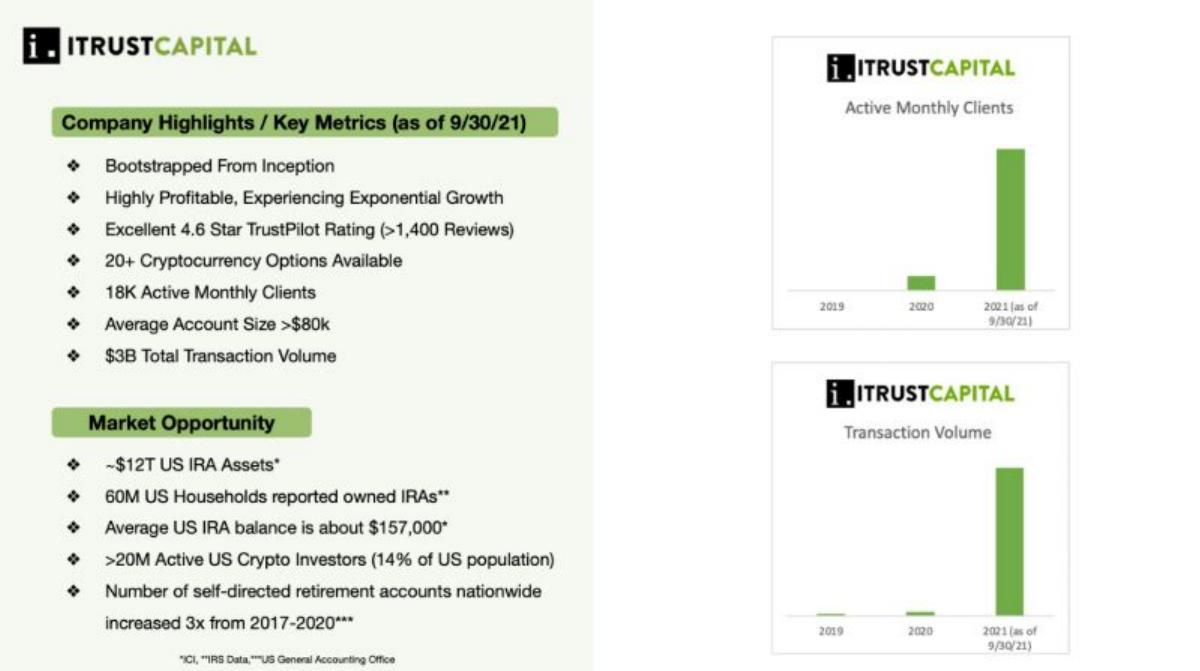
- iTrustCapital emphasizes its status as a bootstrapped and highly profitable entity prior to the Series A round (Slide 3).
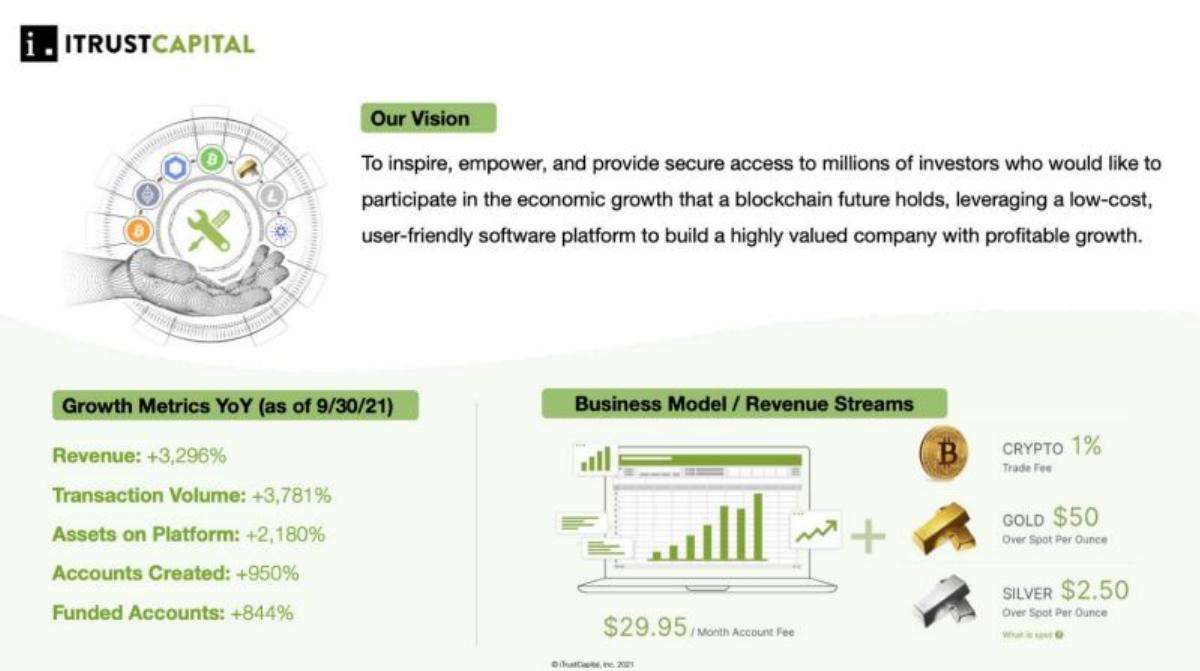
- Transaction volume growth is the primary hook, showing a 3,781% year-over-year increase as of September 2021 (Slide 5).
- The deck clearly identifies a $12 trillion market opportunity in US IRA assets to justify the scale of the raise (Slide 3).
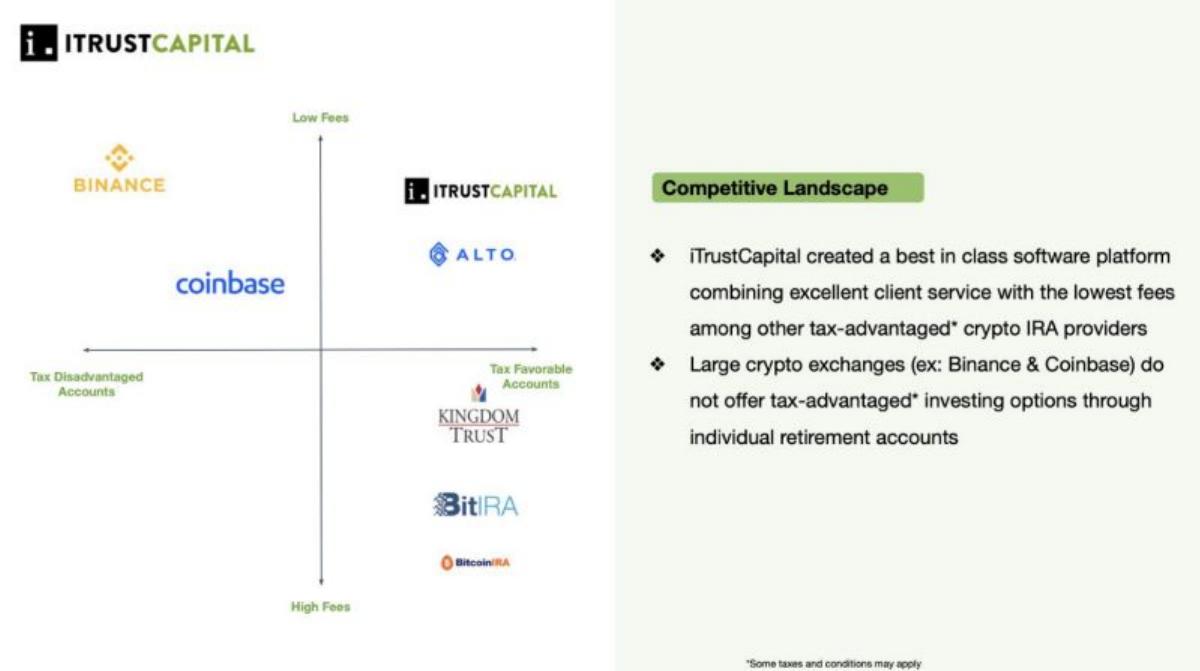
- A competitive matrix positions the company as the only low-fee, tax-advantaged option compared to Binance, Coinbase, and Alto (Slide 4).
- The business model is transparently broken down into a $29.95 monthly fee plus spreads on crypto (1%), gold ($50/oz), and silver ($2.50/oz) (Slide 5).
- The team slide highlights deep institutional experience, specifically noting multiple former PIMCO executives (Slide 7).
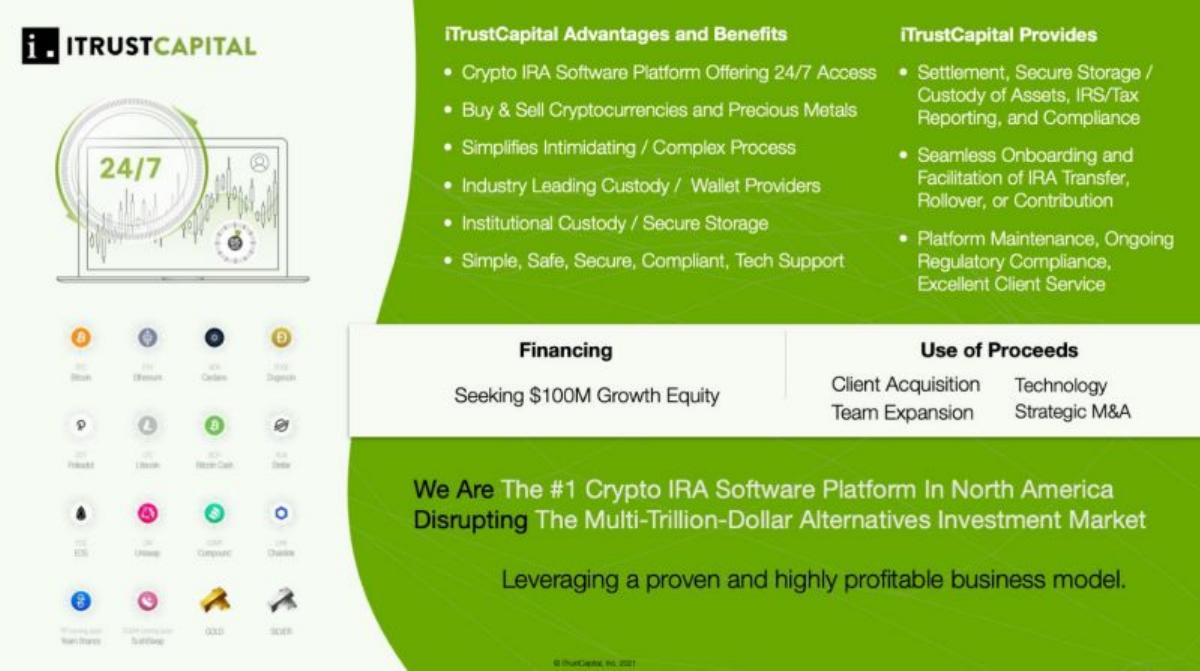
- The ask was originally for $100M in Growth Equity, primarily for client acquisition and strategic M&A (Slide 6).
iTrustCapital: The Power of Profitable Traction
The iTrustCapital Series A pitch deck, dated September 2021, is a lean document that focuses almost entirely on the company's explosive growth and market positioning. In an era where pitch decks often stretch to 20 or 30 slides with complex visions of the future, iTrustCapital secured a massive $125M round (exceeding their $100M ask) by proving they had already built a profitable, high-growth engine. The deck is characterized by its green-and-white aesthetic and a heavy reliance on year-over-year percentage increases to tell the story.
Slide 1: Title Slide
The deck opens with a clean title slide featuring the iTrustCapital logo. It explicitly states the purpose: 'Series A Investment Opportunity' and the date 'September, 2021.' There are no taglines or mission statements here, just a professional introduction to the round.
Slide 2: Company Overview
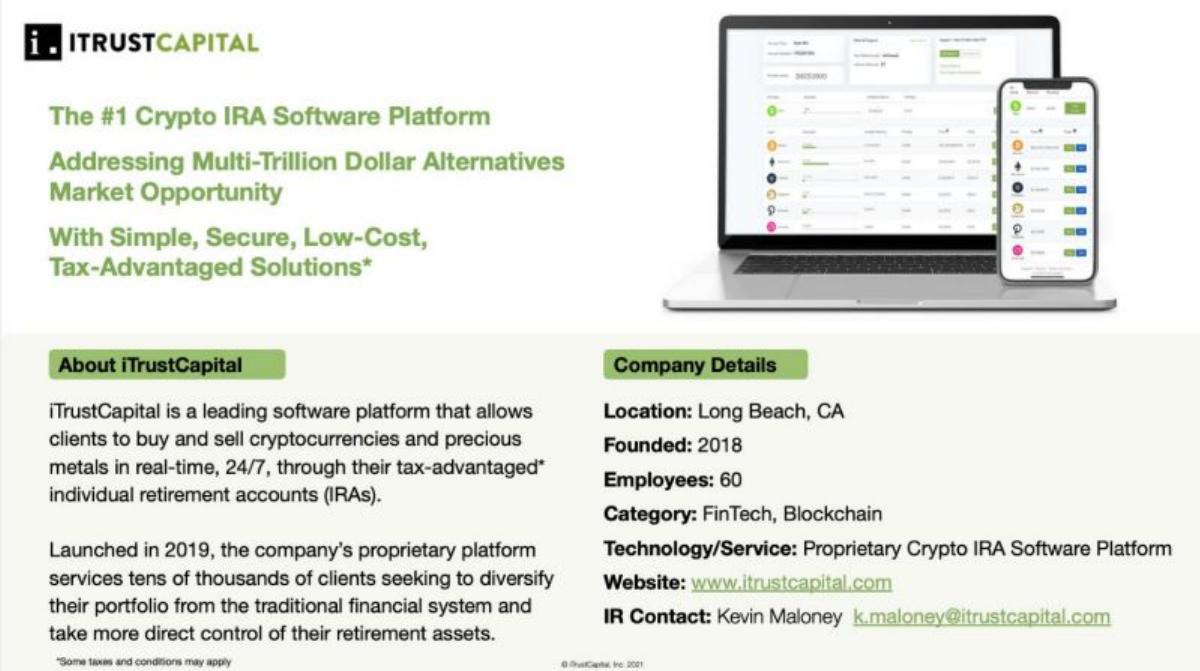
This slide serves as a combined 'Executive Summary' and 'Product' slide. It identifies iTrustCapital as the '#1 Crypto IRA Software Platform' and highlights the 'Multi-Trillion Dollar Alternatives Market Opportunity.' Key company details are listed on the right: the company was founded in 2018, is based in Long Beach, CA, and had 60 employees at the time of the deck's creation. The text explains that the platform allows clients to trade cryptocurrencies and precious metals 24/7 through tax-advantaged individual retirement accounts (IRAs). A mockup of the software on a laptop and smartphone provides a visual of the user interface.
Slide 3: Key Metrics and Market Opportunity
Slide 3 is the most important slide in the deck for establishing credibility. Under 'Company Highlights,' it notes that the firm was 'Bootstrapped From Inception' and is 'Highly Profitable.' The metrics as of 9/30/21 are staggering: 18K active monthly clients, an average account size of over $80k, and $3B in total transaction volume. Two bar charts on the right visually represent the 'exponential growth' in active monthly clients and transaction volume from 2019 to 2021. The bottom half of the slide quantifies the market: $12T in US IRA assets and 60M US households owning IRAs. By citing the average US IRA balance ($157,000) against their own average ($80k+), they demonstrate significant room for growth within their existing user base.
Slide 4: Competitive Landscape
The company uses a standard four-quadrant competitive matrix to differentiate itself. The Y-axis measures fees (Low to High) and the X-axis measures tax status (Tax Disadvantaged to Tax Favorable). iTrustCapital places itself in the top-right corner—the only player with both low fees and tax-favorable accounts. They explicitly name Binance and Coinbase as 'Tax Disadvantaged' and competitors like Alto, Kingdom Trust, and BitIRA as having higher fees. The slide notes that large crypto exchanges do not offer tax-advantaged investing options through IRAs, which is their primary moat.
Slide 5: Vision and Business Model
This slide bridges the gap between what the company is and how it makes money. The vision is to provide secure access to the 'blockchain future' through a low-cost, user-friendly platform. The 'Growth Metrics YoY' section is a wall of green text: Revenue is up 3,296%, Transaction Volume is up 3,781%, and Assets on Platform are up 2,180%. The 'Business Model' section is equally clear, showing a $29.95 monthly account fee plus specific transaction fees for crypto (1%), gold ($50/oz), and silver ($2.50/oz).
Slide 6: The Ask and Use of Proceeds
Slide 6 contains the 'Financing' request: 'Seeking $100M Growth Equity.' It lists four areas for the use of proceeds: Client Acquisition, Team Expansion, Technology, and Strategic M&A. The bottom of the slide reiterates their status as the '#1 Crypto IRA Software Platform in North America' and emphasizes their 'proven and highly profitable business model.' The left side of the slide displays icons for the various assets supported, including Bitcoin, Ethereum, Cardano, and precious metals.
Slide 7: Management Team
The team slide highlights a mix of serial entrepreneurs and institutional finance veterans. CEO Todd Southwick is noted as a co-founder of three startups with 15 years of experience. President Blake Skadron is credited with growing a precious metals firm's revenue from $15M to $86M. The institutional 'heft' comes from COO Rich Hauschild (former SVP of Technology at PIMCO) and Advisor Tim Shaler (former SVP Portfolio Manager at PIMCO). Having former PIMCO executives on the team likely provided significant comfort to Series A investors regarding the company's ability to manage large-scale financial operations and regulatory compliance.
Slide 8: Disclosure
A standard legal disclosure slide. It specifies that the document is for informational purposes only and does not constitute an offer to sell securities. It also includes a 'Last Modified' date of 30 September 2021.
Slide 9: Appendix/Source Credit
This is a promotional slide for the source of the deck and is not part of the iTrustCapital presentation itself.
What iTrustCapital Does Well
The strength of this deck lies in its unapologetic focus on traction . By Slide 3, any investor can see that the company has achieved massive scale without outside capital. The use of 'Bootstrapped' and 'Highly Profitable' are powerful signals that reduce the perceived risk of the investment. Furthermore, the business model slide (Slide 5) is exceptionally transparent. Many fintech decks hide their take-rates or fee structures in the appendix, but iTrustCapital puts them front and center, showing exactly how they monetize both the account and the transaction.
The competitive positioning is also very effective. By identifying a specific regulatory niche (IRAs) that the largest competitors (Coinbase/Binance) were ignoring at the time, they carved out a defensible market segment. The deck doesn't try to be everything to everyone; it focuses entirely on being the best at crypto-integrated retirement accounts.
What is Missing from the iTrustCapital Deck
The most notable omission is a detailed product roadmap . While they mention 'Technology' as a use of proceeds, there is no information on what new features, assets, or platform improvements are planned for the next 12-24 months. For a Series A, investors usually want to see how the product will evolve to maintain its lead.
Additionally, there is no discussion of the regulatory environment . Given that the company operates at the intersection of the IRS (IRAs) and the SEC/CFTC (Crypto), the regulatory risks are substantial. While the presence of PIMCO veterans on the team slide hints at regulatory competence, a dedicated slide addressing compliance and the legal moat would have strengthened the presentation.
Finally, the deck lacks unit economics beyond the basic fee structure. While they mention being profitable, they do not disclose Customer Acquisition Cost (CAC) or Lifetime Value (LTV). In a 'Growth Equity' round where $100M is being requested for 'Client Acquisition,' showing the efficiency of their marketing spend is usually a requirement.
Founder Takeaways
Traction trumps storytelling. If your metrics are as strong as iTrustCapital’s (3,000%+ growth), you don't need a 20-slide narrative about the future of the world. Let the numbers do the heavy lifting. Founders should aim to get to their 'hero metrics' as early as possible in the deck.
Define your 'Blue Ocean.' iTrustCapital didn't just say they were a crypto exchange. They defined a specific quadrant (Low Fee + Tax Favorable) where they were the only occupant. If you are entering a crowded market like FinTech, you must identify the specific cross-section of features or regulations that makes you unique.
Highlight institutional pedigree. If your team has experience at 'Gold Standard' firms in your industry (like PIMCO for finance), feature it prominently. It acts as a shortcut for trust, especially in sectors involving high-stakes asset management.
Be clear about the 'Ask.' iTrustCapital didn't just ask for money; they asked for 'Growth Equity' and specified 'Strategic M&A' as a use of proceeds. This tells investors that the company is thinking about consolidation and market leadership, not just keeping the lights on.
Frequently asked questions
- How did iTrustCapital justify a $100M+ raise with only 9 slides?
- The deck relies on 'traction over talk.' By showing $3B in total transaction volume and 3,296% revenue growth, the founders proved product-market fit was already achieved. When a company is already profitable and growing at triple-digit percentages, investors require less narrative and more data verification, which this deck provides through its Key Metrics and Growth slides.
- What is the specific competitive advantage mentioned in the deck?
- iTrustCapital positions itself at the intersection of 'Low Fees' and 'Tax Favorable Accounts.' According to Slide 4, major exchanges like Coinbase and Binance are 'Tax Disadvantaged,' while other IRA-specific competitors like Kingdom Trust or BitIRA suffer from 'High Fees.' This four-quadrant map creates a 'blue ocean' for iTrustCapital as the only low-cost, tax-advantaged provider.
- What are the primary revenue streams for the platform?
- As detailed on Slide 5, the company utilizes a multi-pronged revenue model. This includes a recurring $29.95 monthly account fee and transaction-based fees: a 1% trade fee for cryptocurrencies, a $50 over-spot fee per ounce of gold, and a $2.50 over-spot fee per ounce of silver. This diversification across assets and fee types suggests a stable income base.
- Who are the key people behind the company?
- The leadership team combines startup experience with heavy institutional finance backgrounds. CEO Todd Southwick is a three-time founder, while COO Rich Hauschild and Advisor Tim Shaler both bring senior experience from PIMCO. This mix was likely crucial in convincing Series A investors that the company could handle the regulatory and technical complexities of the IRA and crypto markets.
- What was the intended use of the $100M investment?
- Slide 6 outlines four specific pillars for the use of proceeds: Client Acquisition, Team Expansion, Technology, and Strategic M&A. By including 'Strategic M&A,' the company signaled its intent to consolidate the market or acquire complementary technologies, moving beyond just simple organic growth.