Iterable’s pitch deck is a high-signal, low-friction presentation designed for later-stage institutional investors. Rather than spending time explaining what marketing automation is, the deck focuses on the sheer scale of their existing operations and the quality of their customer base. With 13 slides, the company highlights that they have already raised $140 million and are managing over 2 billion user profiles. The deck leans heavily on social proof, dedicating entire slides to a diverse set of logos across seven different verticals and a comprehensive partner ecosystem. While it lacks spec…
Key takeaways
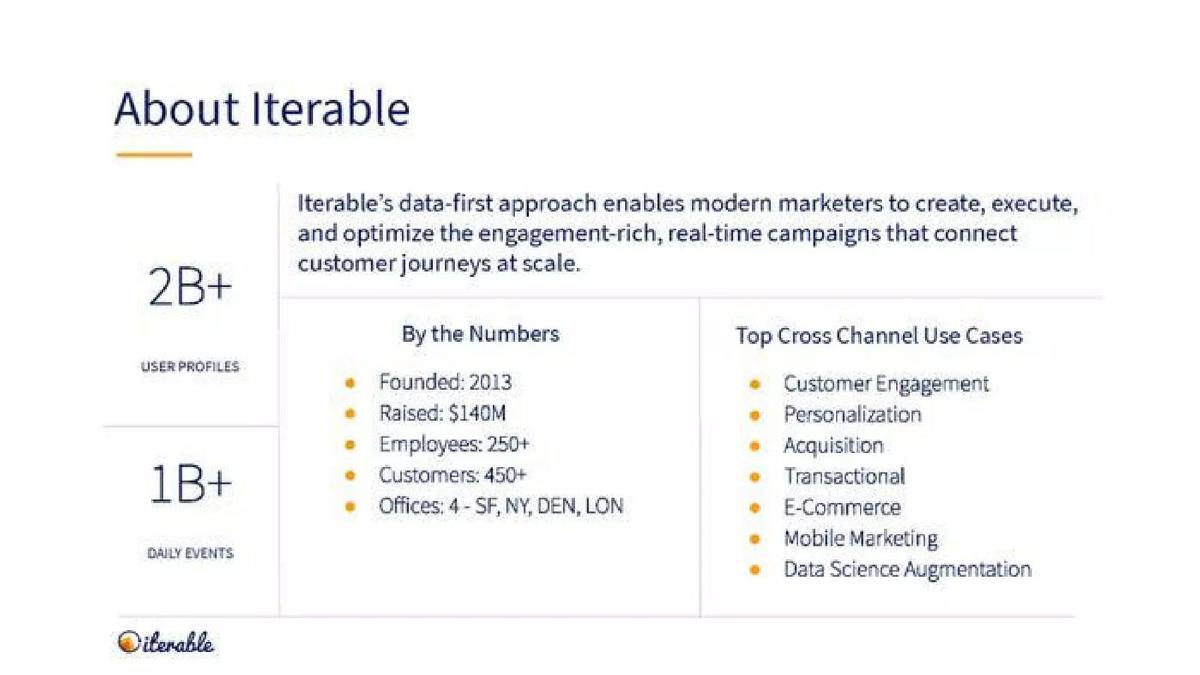
- The company leads with massive scale, citing 2B+ user profiles and 1B+ daily events on slide 2.
- Iterable explicitly mentions having already raised $140M and employing 250+ people on slide 2.
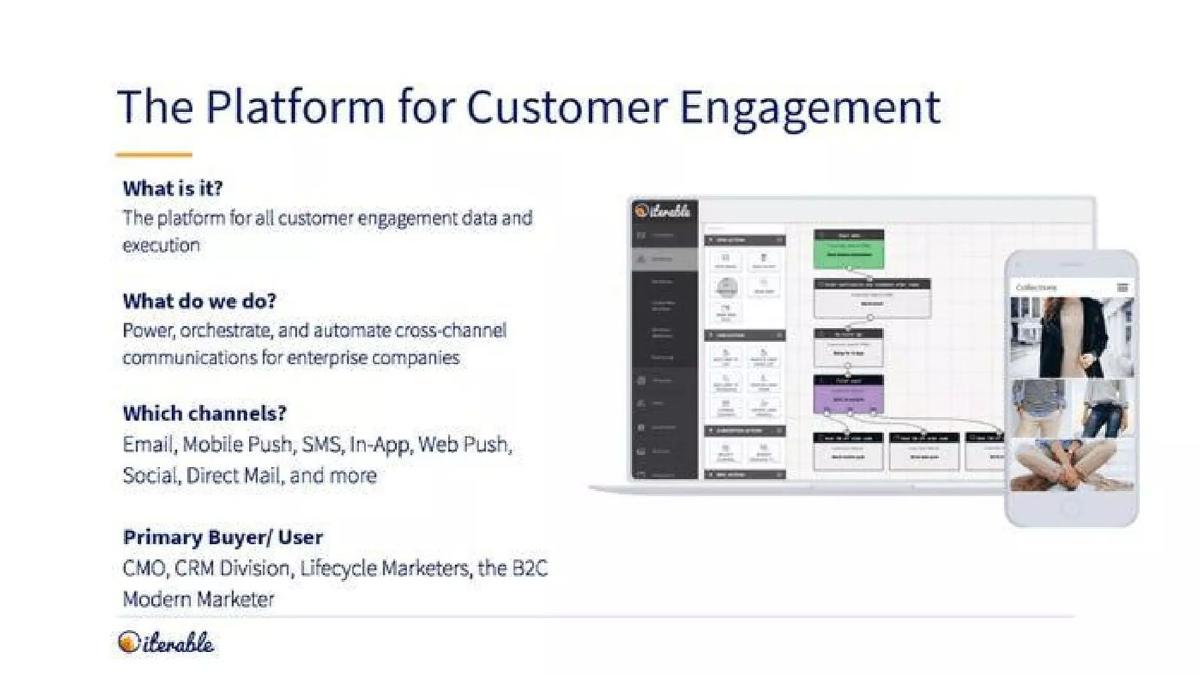
- The deck identifies the primary buyer as the CMO and CRM Division, specifically targeting the B2C Modern Marketer on slide 3.
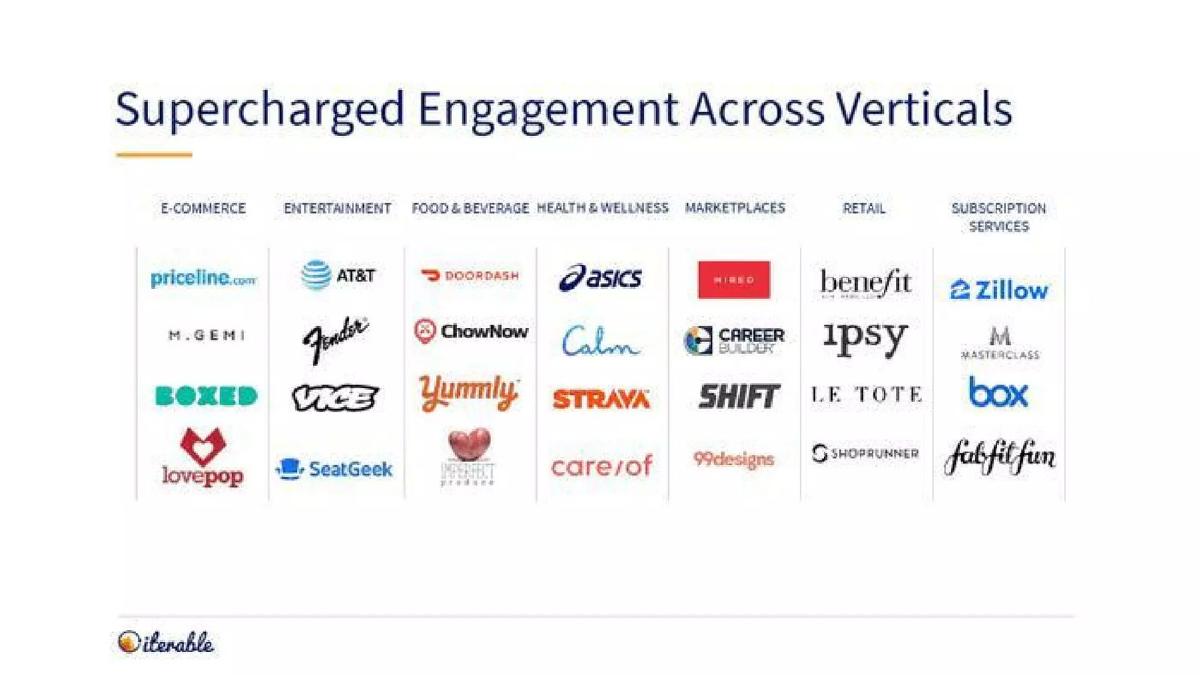
- Social proof is a core pillar of the deck, showcasing 32 major brand logos across 7 verticals on slide 4.
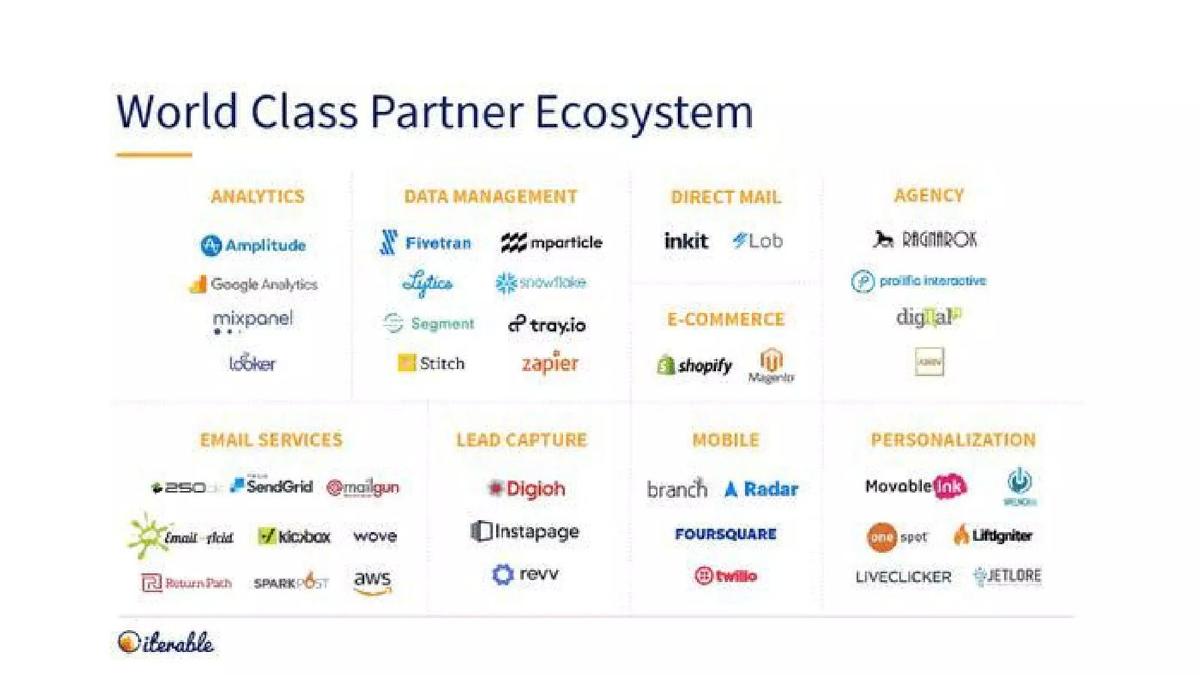
- The partner ecosystem is presented as a competitive moat, featuring 40+ integrations across analytics, data management, and email services on slide 5.
- The deck utilizes third-party validation from Gartner to highlight that only 12% of marketers leverage integrated data on slide 7.
- Market size is quantified at $32.6 billion by 2024, citing P&S Intelligence research on slide 9.
- The technical solution is framed around four pillars: native cross-channel, limitless data, real-time journeys, and rapid testing on slide 10.
Executive Summary: The Power of Scale and Social Proof
Iterable’s pitch deck is a concise, 13-slide presentation that prioritizes traction and ecosystem integration over long-winded problem definitions. At the time of this deck's creation, the company had already established significant market presence, which is reflected in the high-level metrics shared early in the flow. The deck serves less as an introduction to a new concept and more as a status report on a high-growth enterprise SaaS leader. By focusing on the 'who' (top-tier customers) and the 'how much' (billions of events), Iterable builds a compelling case for its continued dominance in the marketing automation space.
Slides 1-2: The Identity and Momentum
Slide 1 is a standard title slide, establishing the brand identity with the tagline "Customer Engagement for the Modern Marketer." The visual language is clean and professional, utilizing a dark blue palette that suggests enterprise stability.
Slide 2 , titled "About Iterable," is the most important slide for establishing immediate credibility. It does not bury the lead. It highlights two massive numbers: 2B+ User Profiles and 1B+ Daily Events . Under the "By the Numbers" section, it discloses that the company was founded in 2013, has already raised $140M , employs 250+ people , and serves 450+ customers across four global offices (SF, NY, DEN, LON). This slide effectively tells an investor that the startup phase is over and the scale-up phase is in full swing. It also lists top use cases like Personalization, Acquisition, and Data Science Augmentation, defining the platform's utility.
Slides 3-5: Product Scope and The Ecosystem
Slide 3 defines "The Platform for Customer Engagement." It answers three critical questions: What is it? What do we do? Which channels? The slide lists Email, Mobile Push, SMS, In-App, Web Push, Social, and Direct Mail as supported channels. Crucially, it identifies the primary buyer as the CMO and CRM Division , signaling to investors that Iterable sells to the C-suite and high-budget departments.
Slide 4 is a pure social proof play titled "Supercharged Engagement Across Verticals." It displays 32 logos categorized into seven sectors. Notable names include AT&T, DoorDash, Zillow, and Box . This variety proves that the software is not a niche tool for one industry but a versatile solution for any B2C enterprise. The inclusion of high-growth tech companies alongside traditional retail brands like Benefit suggests a wide Total Addressable Market (TAM).
Slide 5 showcases the "World Class Partner Ecosystem." This is a strategic inclusion for enterprise software. By showing integrations with Snowflake, Segment, Shopify, Amplitude, and AWS , Iterable demonstrates that it fits seamlessly into a modern company's existing tech stack. This reduces the perceived risk of "implementation heavy platforms" mentioned later in the deck.
Slides 6-9: The Market Opportunity and Pain Points
Slide 6 acts as a transition titled "The Customer Opportunity."
Slide 7 uses a Gartner quote to provide third-party validation of the problem: "Only 12% of respondents are leveraging integrated customer data to drive multichannel marketing execution." This 12% figure highlights a massive gap in the market—88% of companies are failing at this, representing the untapped opportunity for Iterable.
Slide 8 outlines "Marketers' Challenges." It identifies four specific pain points: Siloed Channel Execution, Data Ingestion & Activation issues, Implementation Heavy Platforms, and the difficulty to Test and Optimize. These are the "villains" of the story that Iterable’s solution is designed to defeat.
Slide 9 quantifies the market size. Citing P&S Intelligence from February 2019, it states the Marketing Automation Software Market will reach $32.6 Billion in spend by 2024 . This provides the necessary macro-context for why a $140M+ investment in a single player makes sense.
Slides 10-11: The Solution and Technical Moat
Slide 10 mirrors the challenges slide but presents the "Iterable Solution." The four pillars are Native Cross-Channel, Limitless Data Ingestion & Activation, Real-Time Individualized Journeys, and Rapid Testing & Optimization. This direct mapping of solution to problem is a classic, effective pitch deck technique.
Slide 11 goes deeper into the architecture, titled "Iterable Solution - Built for Scale." It highlights four technical advantages: Flexible Data Architecture, Architected for AI, Visual No-code Interfaces, and Co-located Data & Execution Engines . The mention of "No-code" is particularly relevant for the target buyer (marketers), as it implies they can use the tool without constant reliance on engineering teams.
Slides 12-13: The Team and Conclusion
Slide 12 introduces the leadership team. It features 12 individuals, led by Co-founders Justin Zhu (CEO) and Andrew Boni . The bottom of the slide is lined with logos of former employers, including Twitter, Google, Cisco, Marketo, Heroku, Workday, and OpenDNS . This "pedigree bar" is a shorthand way to communicate that the team has the experience to handle a multi-billion dollar enterprise.
Slide 13 is a simple "Thank you" slide, which is common but lacks a call to action or contact information, which might be omitted for confidentiality in public versions of the deck.
What Works in This Deck
Immediate Credibility: By putting the $140M raised and 2B+ user profiles on Slide 2, the company eliminates any doubt about their market position within the first 60 seconds of a presentation. · Visual Social Proof: Slides 4 and 5 are masterclasses in using logos to build trust. They don't just list names; they categorize them to show depth and breadth. · Third-Party Validation: Using a Gartner statistic (Slide 7) and a P&S Intelligence market projection (Slide 9) adds an objective layer of urgency that founder-generated claims often lack. · Clear Buyer Persona: Explicitly naming the CMO and CRM division as the buyers (Slide 3) helps investors understand the sales cycle and the size of the contracts Iterable is chasing.
What Is Missing From This Deck
Financial Performance: There is no mention of Annual Recurring Revenue (ARR), Net Revenue Retention (NRR), or Customer Acquisition Cost (CAC). For a later-stage deck, these omissions are significant and suggest this version was intended for a general audience or as a high-level teaser. · Competitive Landscape: The deck does not name competitors like Braze, Adobe (Marketo), or Salesforce (Marketing Cloud). While Slide 8 hints at their weaknesses, a direct comparison is missing. · The Ask: There is no slide detailing the purpose of the current fundraise, the amount being sought, or the specific milestones the company intends to hit with the new capital. · Case Studies: While there are many logos, there are no specific "Before and After" stories or ROI metrics (e.g., "Company X increased conversion by 20%") to prove the platform's effectiveness.
What a Founder Should Copy
The 'By the Numbers' Slide: Every founder should have a slide like Slide 2 that summarizes the core health of the business in 5-6 bullet points. It grounds the rest of the pitch in reality. · Problem-Solution Mapping: The way Slide 10 uses the exact same icons and layout as Slide 8 to show how the product solves specific pain points is a very effective way to communicate product-market fit. · Ecosystem Positioning: If your product relies on data from other sources, follow Iterable’s lead on Slide 5. Show that you are a team player in the enterprise stack rather than a siloed tool that requires a complete rip-and-replace of existing systems. · Vertical Segmentation: If you have customers in multiple industries, don't just dump their logos in a pile. Categorizing them as Iterable did on Slide 4 shows strategic thinking about market expansion.
Frequently asked questions
- What is the primary value proposition of Iterable according to the deck?
- Iterable positions itself as a 'data-first' platform that enables modern marketers to create, execute, and optimize real-time, cross-channel campaigns. According to slide 2, the platform is designed to connect customer journeys at scale, moving away from the siloed execution and heavy implementation cycles that plague traditional marketing automation tools.
- How does Iterable demonstrate market fit across different industries?
- Slide 4 is dedicated entirely to vertical-specific social proof. It lists customers across E-commerce (Priceline, Boxed), Entertainment (AT&T, Fender), Food & Beverage (DoorDash, Yummly), Health & Wellness (Asics, Calm), Marketplaces (Hired, 99designs), Retail (Benefit, Ipsy), and Subscription Services (Zillow, Box). This breadth suggests the platform is horizontal and adaptable.
- What specific technical advantages does the deck highlight?
- On slides 10 and 11, Iterable emphasizes a 'Flexible Data Architecture' and 'Visual, No-code Interfaces.' They claim to offer 'Limitless Data Ingestion' and 'Co-located Data & Execution Engines,' which addresses the common marketer challenge of slow data activation and difficult implementation mentioned on slide 8.
- Who is the target audience for the Iterable platform?
- Slide 3 explicitly identifies the primary buyers and users as the CMO, CRM Division, and Lifecycle Marketers. They specifically use the term 'B2C Modern Marketer' to define their niche, focusing on companies that need to manage high-volume consumer interactions across email, SMS, push, and social channels.
- What is missing from this pitch deck that an investor might expect?
- The deck is notably missing a specific 'Ask' slide detailing how much they are currently raising and the valuation terms. It also lacks a detailed financial slide showing Revenue, ARR growth, or Burn Rate. Furthermore, there is no explicit 'Competition' slide, though the 'Marketers' Challenges' slide (Slide 8) alludes to the weaknesses of legacy platforms.