Island’s Series B deck is a study in high-conviction narrative building. With only 11 slides, the company successfully raised $115M by positioning the web browser not as a utility, but as the primary security vulnerability in the modern enterprise. The deck leverages an exceptionally strong team and board—featuring heavyweights from Sequoia and Insight Partners—to validate a bold technical shift: moving security controls from the network edge directly into a Chromium-based enterprise browser. By focusing on 'last-mile control' and specific high-value use cases like VDI reduction and BYOD acce…
Key takeaways
- The deck relies heavily on social proof, dedicating two of its first three slides to a high-profile leadership team and board of directors (Slides 2-3).
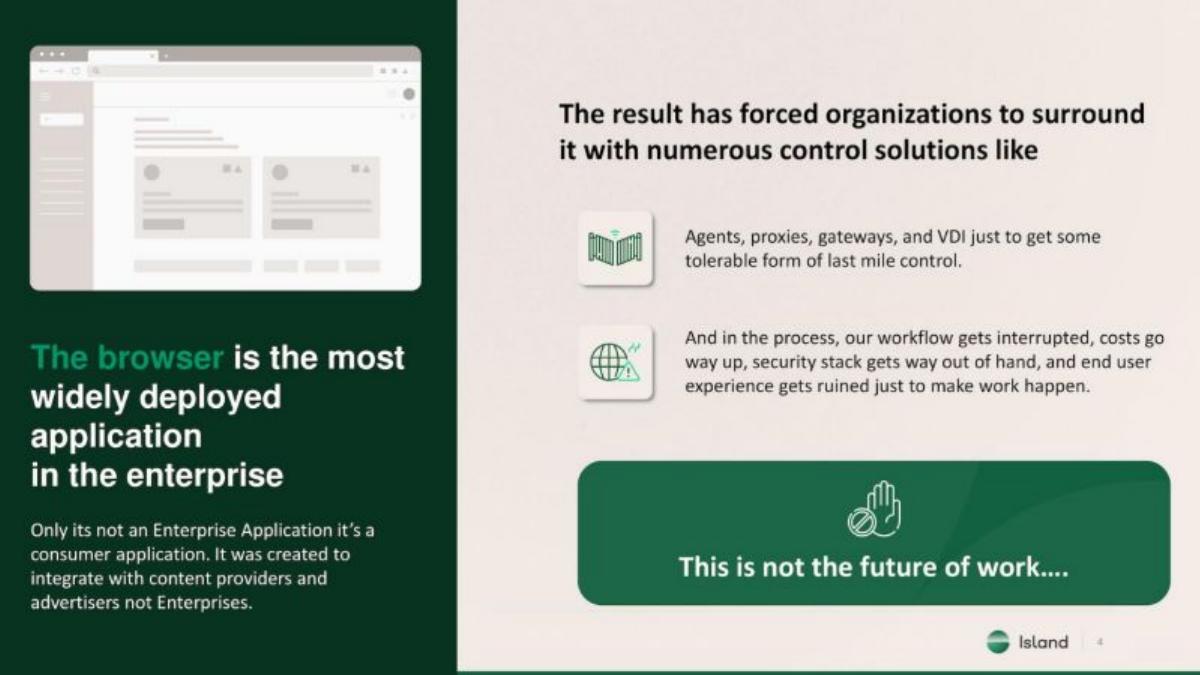
- Island frames the problem as an architectural mismatch, stating the browser is a 'consumer application' forced into an enterprise role (Slide 4).
- The technical solution is built on the Chromium open-source project, which the deck identifies as the 'standard for the modern browser' (Slide 7).
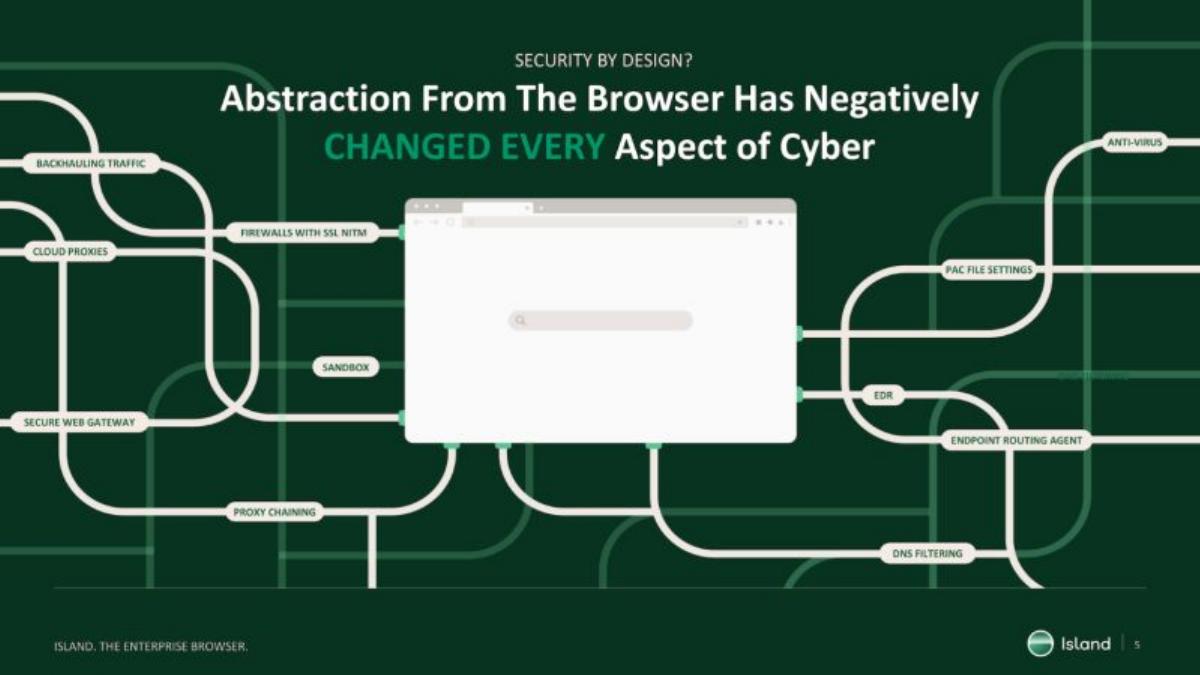
- A complex visualization on Slide 5 illustrates how current security abstractions have 'negatively changed every aspect of cyber.'
- The product value proposition is centered on 'last-mile control,' specifically mentioning cut/copy/paste, screen capture, and download/upload restrictions (Slide 9).
- Island positions its browser as a replacement for costly legacy infrastructure, specifically targeting 'VDI Reduction' as a key use case (Slide 9).
- The deck contains zero financial metrics, revenue figures, or growth charts, relying entirely on the product vision and team pedigree.
- The presentation concludes with a placeholder for a live demo, suggesting the Series B pitch was highly interactive rather than purely static (Slide 10).
The Power of Pedigree: Island’s $115M Series B Narrative
Island’s Series B pitch deck is a masterclass in minimalist, high-stakes storytelling. In just 11 slides, the company outlines a vision to fundamentally re-architect how enterprises handle security. It is important to note what this deck is not : it is not a data-heavy operational review. There are no charts showing Month-over-Month growth, no CAC/LTV calculations, and no specific revenue targets. Instead, Island relies on the strength of its team and the clarity of its architectural vision to secure a massive $115M round.
Slide 1: The Introduction
The title slide is clean and professional, immediately establishing the brand's aesthetic: dark forest green with a minimalist logo. It introduces Mike Fey as the CEO and Founder and, crucially, lists the heavy-hitting backers at the bottom: Cyberstarts, Insight Partners, Sequoia, and Stripes. This is an immediate signal of quality to any prospective investor.
Slide 2 & 3: The Team and The Board
Island takes a bold approach by placing the team and board slides at the very beginning. Slide 2, titled "Decades of Leadership Experience," features eight executives including Mike Fey (CEO), Dan Amiga (CTO), and Brian Kenyon (CSO). Slide 3 follows suit with the Board of Directors, featuring Gili Raanan (Cyberstarts), Doug Leone (Sequoia), Jeff Horing (Insight Partners), and Ken Fox (Stripes). By dedicating 20% of the deck to people, Island is telling investors that the execution risk is minimal because this team has 'been there, done that' in the cybersecurity space.
Slide 4: The Core Problem
Slide 4 identifies the central tension in modern enterprise IT. It states: "The browser is the most widely deployed application in the enterprise." However, it argues that because the browser is a consumer application designed for advertisers, organizations are forced to surround it with a bloated stack of agents, proxies, and VDI just to get "tolerable form of last mile control." The slide concludes with a stark warning: "This is not the future of work...."
Slide 5: The Complexity Map
This slide uses a complex, circuit-like graphic to show how "Abstraction From The Browser Has Negatively CHANGED EVERY Aspect of Cyber." It lists various legacy security layers—Cloud Proxies, Secure Web Gateways, Anti-Virus, and DNS Filtering—all branching out from a central browser window. The visual argument is clear: the current security model is a series of patches for a fundamental flaw in the browser itself.
Slide 6: The Solution
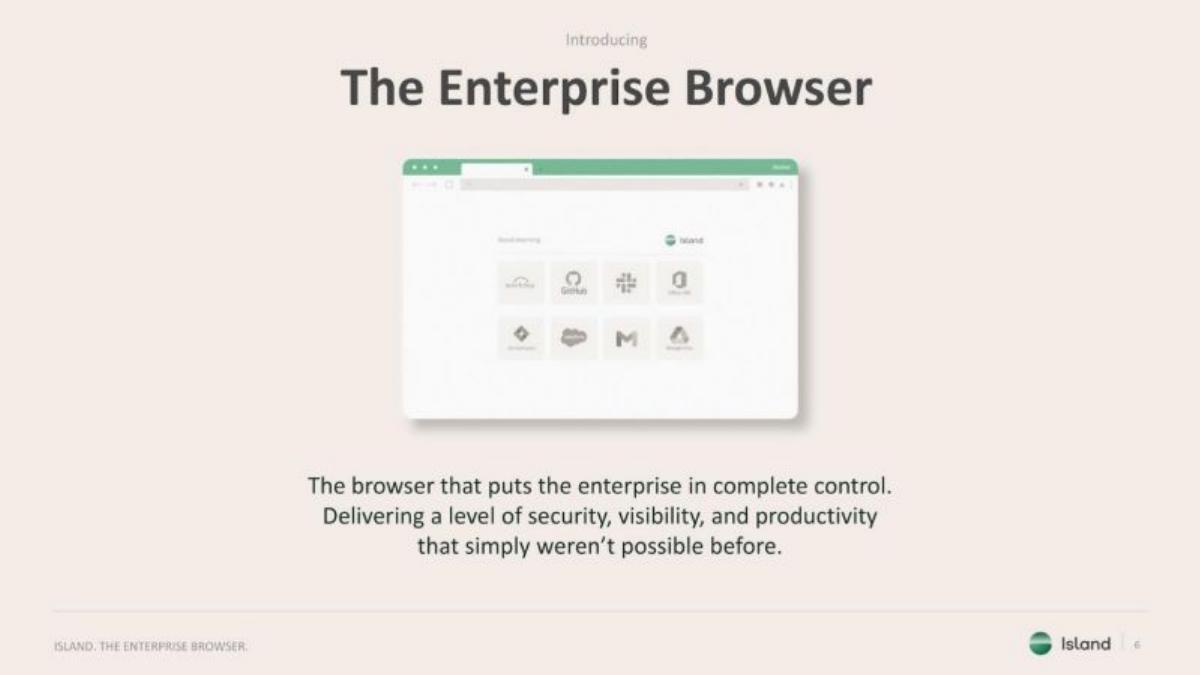
Slide 6 introduces "The Enterprise Browser." The copy is concise: "The browser that puts the enterprise in complete control. Delivering a level of security, visibility, and productivity that simply weren’t possible before." The image shows a clean browser interface with icons for common enterprise apps like GitHub, Slack, and Salesforce, suggesting a seamless user experience.
Slide 7: The Chromium Foundation
To address potential concerns about compatibility and performance, Slide 7 explains "The Rise of the Chromium Browser." It notes that Chromium has become the industry standard. By showing logos for Chrome, Edge, Opera, and Brave, Island positions itself as a specialized version of a proven technology rather than a completely new, unproven engine. This mitigates the technical risk in the eyes of the investor.
Slide 8: Consumer Features vs. Enterprise Capabilities
This slide provides a side-by-side comparison. On the left are "Consumer Browser Features" (Networking, Extensions, User Experience). On the right are "Enterprise Capabilities" (Forensic Audit Logging, Browser-Based RPA, Last-Mile Control, and Traffic Management). This slide defines the product's unique value proposition: it does everything a normal browser does, plus everything a CISO needs.
Slide 9: Key Use-Cases
Slide 9 is the most information-dense slide in the deck. It lists ten specific use cases, including:
Critical SaaS & Web Apps: Monitored access to Salesforce, Workday, etc. · Contractor / BYOD Access: Native access without MDM tools. · VDI Reduction: Replacing expensive virtual desktops with a secure browser. · Zero-Trust Access: Providing strong authentication and monitoring.
The left sidebar highlights "Shared Capabilities" like "Last-Mile Controls" (Cut/Copy/Paste, Screen Capture, Print/Save, Download/Upload), which are the specific pain points Island solves.
Slide 10: The Demo
Slide 10 is a simple placeholder for a "Demo." This indicates that the deck was intended to be presented live, allowing the product to speak for itself. In a Series B for a technical product, a live demonstration of the 'last-mile controls' is often more persuasive than any slide could be.
Slide 11: Closing
The final slide is a standard call to action, though in this version, it serves as a promotional slide for the source of the deck, bestpitchdeck.com.
What Island Does Well
Island excels at Category Creation . They aren't just selling a security tool; they are selling a new category of software: the Enterprise Browser. By framing the browser as the 'last mile' of security, they make all other security layers seem like inefficient workarounds. The deck is also visually cohesive, using a professional color palette and high-quality headshots that reinforce the 'enterprise-grade' nature of the business.
What is Missing from the Deck
For a Series B deck, there are several glaring omissions that would typically be required for a company without such a high-profile team:
Market Size (TAM): There is no mention of the total addressable market, though investors likely assumed it was massive given the ubiquity of browsers. · Financials: There are no mentions of ARR, growth rates, or burn. · Competition: The deck does not explicitly name competitors like Talon or legacy VDI providers like Citrix, though it alludes to them. · The Ask: There is no slide detailing how much money is being raised or how the funds will be used (though the catalogue listing confirms the $115M figure).
Founder Takeaway: Copy the Narrative, Not the Omissions
Founders should study how Island uses Slide 4 and 5 to create a 'villain' (the consumer browser) and a 'hero' (the enterprise browser). This narrative arc is incredibly effective for enterprise sales. However, most founders should not copy the omission of metrics. Island earned the right to skip the data slides because of their team's track record. For everyone else, the 'Vision' must be backed by 'Validation' in the form of hard numbers.
Frequently asked questions
- How did Island raise $115M without showing any revenue or growth metrics in the deck?
- At the Series B stage, investors typically demand rigorous unit economics. However, Island's deck focuses on 'Category Creation.' By showcasing a team with 'decades of leadership experience' and a board including Doug Leone (Sequoia) and Jeff Horing (Insight Partners), the company established enough credibility to sell a vision of fundamental infrastructure change. The lack of metrics in this specific deck suggests it was likely a supporting document for a high-level narrative pitch where the data was handled in a separate data room.
- What is the core 'Problem' Island identifies in the enterprise security market?
- Island argues that the browser is the most widely deployed application in the enterprise, but it was built for advertisers and content providers, not for security. Slide 4 explains that organizations are currently forced to surround this 'consumer application' with a messy stack of agents, proxies, and gateways just to achieve 'tolerable' control. This creates a fragmented security posture that ruins the end-user experience and drives up costs.
- Why does Island emphasize its use of Chromium?
- Slide 7 highlights the 'Rise of the Chromium Browser.' By building on the Chromium open-source project, Island ensures that its enterprise browser maintains the 'look and feel' and compatibility that users expect from Chrome or Edge. This reduces friction for adoption, as employees don't have to learn a new interface, while allowing Island to insert proprietary security and management layers into the core architecture.
- What are the primary use cases Island targets to justify its valuation?
- Slide 9 lists several high-value scenarios, most notably 'VDI Reduction.' Virtual Desktop Infrastructure (VDI) is notoriously expensive and slow; Island proposes that a secure browser can provide the same 'last-mile' protection natively. Other key use cases include managing 'Contractor / BYOD Access' without cumbersome MDM tools and providing 'Zero-Trust Access' for critical SaaS applications like Salesforce and Workday.
- Is this deck a good template for early-stage founders?
- Only if the team has an elite pedigree. This deck works because of the names on Slides 2 and 3. For most founders, omitting traction, market size (TAM), and a clear 'Ask' slide would be a mistake. Island’s deck is a 'Vision' deck designed to facilitate a conversation between industry veterans and top-tier VCs who are already familiar with the cybersecurity landscape.