Iris Audio’s pitch deck is a highly professional, enterprise-focused presentation that prioritizes technical superiority and social proof over typical startup storytelling. Raising $7M in a 2024 Series A, the company leveraged a 'PESQ' benchmark graph to prove its AI outperforms competitors in voice clarity while maintaining a low CPU footprint of less than 3%. The deck excels by naming specific high-value sectors—contact centers, AI speech analytics, and specialized communications—and providing a concrete case study with Ascensos. While it lacks a traditional slide-by-slide financial breakdo…
Key takeaways
- The deck explicitly states a target raise of $7M for a Series A equity round on Slide 2.
- Technical performance is anchored by a PESQ score of 3.47 out of 4.5, compared to a competitor score of 1.19, as noted on Slide 2.
- Iris Clarity claims a low computational overhead with CPU usage as low as 2.9% and zero latency (Slide 2).
- The company identifies a massive total addressable market within contact centers, citing 15 million desks worldwide (Slide 2 and 4).
- A dedicated case study slide for Ascensos validates the ROI in the BPO sector across the UK, Romania, and South Africa (Slide 5).
- The deck highlights a 'SaaS unicorn growth expert' and a 'number one networked call centre executive' as key hires for the US market expansion (Slide 4).
- Investor credibility is bolstered by the presence of the Ojjeh family (TAG Group/McLaren) and Charles Dunstone (Carphone Warehouse) on Slide 7.
- Media validation is extensive, featuring quotes from the Financial Times and Digital Trends (Slide 6).
Iris Audio: A Technical Deep-Dive into Enterprise AI
Iris Audio Technologies, a London-based startup founded in 2018, raised a $7M Series A in 2024 to scale its AI-driven voice isolation software. The deck is a clinical, data-driven presentation that avoids the 'fluff' often found in seed-stage decks, instead focusing on technical benchmarks, high-tier media validation, and institutional-grade governance. For an enterprise software company, this approach signals maturity and readiness for the 'huge US market' mentioned on Slide 4.
Slide 1-2: The Executive Summary and The Ask
Slide 1 is a simple title slide, but Slide 2 does the heavy lifting usually reserved for a full deck. It functions as a comprehensive Executive Summary. It clearly states the fundraising goal: a $7m series A equity round . This is refreshing honesty in a deck; many founders hide the 'ask' until the final slide or a separate document.
The slide also introduces IRIS Clarity , their flagship product. The technical claims are bold: 'CPU as low as 2.9% and ZERO latency.' For enterprise call centers running legacy hardware, low CPU usage is a deal-breaker or a deal-maker. The slide includes a PESQ (Perceptual Evaluation of Speech Quality) graph, showing Iris scoring a 3.47 out of 4.5 , while a competitor sits at 1.19. This visual data point immediately establishes a competitive moat based on performance rather than just marketing.
Slide 3: Product Visualization
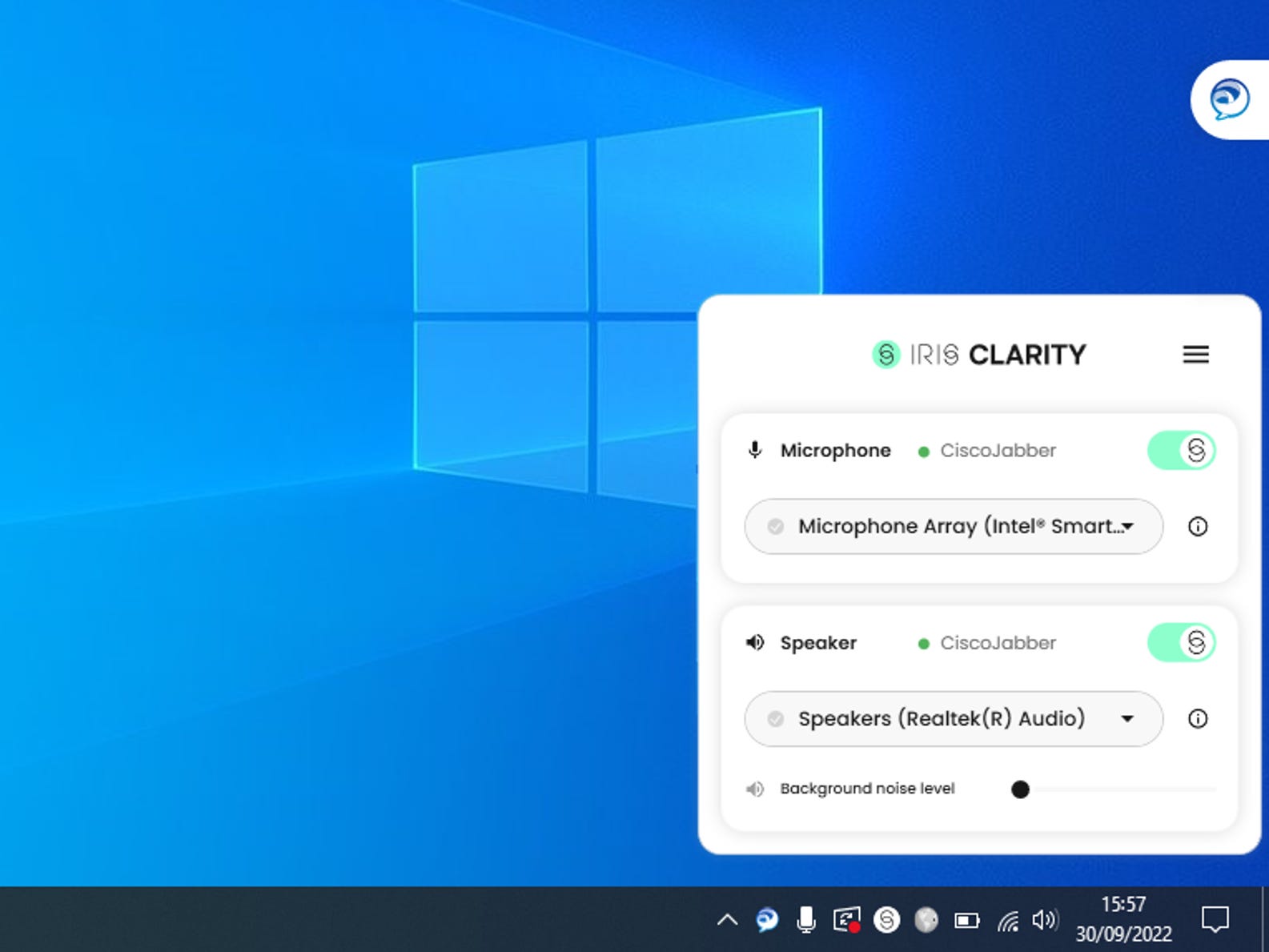
Slide 3 provides a visual of the software interface. It shows a simple toggle for Microphone and Speaker, emphasizing the 'bi-directional' nature of the tech. This means the software cleans the audio going out (the agent's voice) and the audio coming in (the customer's voice). The imagery of a call center agent reinforces the primary use case. By showing the software running alongside common tools like Google Meet and MacBook Pro hardware, they demonstrate ease of integration.
Slide 4: The Growth Strategy (Company Progress)
Slide 4, titled 'Ready to scale, targeting the huge US market,' breaks the company's status into three pillars: Software, Traction, and Team. Under 'Traction,' they note that contracts are 'already signed and active in all 3 targeted sectors.' This is a crucial proof point for Series A investors who are looking for product-market fit. The mention of hiring a 'Number one networked call centre executive' as VP Global Sales suggests that the $7M will be heavily allocated toward aggressive sales recruitment and US expansion.
Slide 5: The Case Study (Ascensos)
Social proof is vital in BPO (Business Process Outsourcing) sales. Slide 5 features Ascensos , a leading UK outsourcer. The slide details the deployment across the UK, Romania, and South Africa. The quote from CEO John Devlin—'what could be better than a solution with proven ability to achieve that'—serves as a powerful endorsement. It moves the conversation from 'what the tech does' to 'how the tech helps a business make money' by reducing repetition and improving agent experience.
Slide 6: Media and Thought Leadership
Slide 6 is a 'logo wall' on steroids. Instead of just showing logos, it includes specific, high-praise quotes. The Financial Times quote—'IRIS is the most remarkable innovation in its genre I’ve come across in 10 years'—is a standout. The slide also highlights a research paper titled 'The role of audio in an increasingly digital world,' positioning the company as a thought leader in the neuroscience of sound, not just a software vendor. This elevates the brand from a utility to a strategic partner.
Slide 7: Board and Investors
The final slide in this set (Slide 7) focuses on governance and backing. This is perhaps the strongest slide for a Series A investor. It lists Andre Keijsers (former CEO of Kempen Capital Management) as Chairman and Toby Brzoznowski (who took LLamasoft to unicorn status) as a SaaS Growth Specialist. The 'Highlight of Investors' section includes the Ojjeh Family (TAG Group/McLaren) and Charles Dunstone (Carphone Warehouse). This level of backing suggests that the company has already passed significant due diligence by some of the UK's most successful business figures.
What Iris Audio Does Exceptionally Well
Technical Benchmarking: By using the PESQ scale (Slide 2), Iris Audio moves away from subjective claims like 'we sound better' to objective, industry-standard metrics. This is essential when selling to CTOs and technical leads at large enterprises.
Sector Specificity: The deck doesn't just say 'we work for everyone.' It identifies three specific high-value targets: 15 million call center desks, AI speech analytics (where clean audio improves transcription accuracy), and specialized comms like aviation. This shows a focused Go-To-Market (GTM) strategy.
Governance as a Feature: Most Series A decks focus on the founders. Iris focuses on the Board. By highlighting a Chairman with deep capital management experience and a Finance Director trained at KPMG, they signal to VCs that the 'boring' parts of the business (compliance, legal, finance) are already institutionalized.
What is Missing from the Iris Audio Deck
Detailed Financials: While the 'ask' is clear ($7M), the deck (as presented) lacks a slide on current ARR (Annual Recurring Revenue), burn rate, or specific projections. For a Series A, investors typically expect to see a 'bridge' showing how the previous seed funding was spent and how the $7M will get them to Series B.
The Founder Story: Curiously, the actual founders are not featured on the 'Board & Investors' slide. While the board is impressive, VCs invest in people. The absence of the CEO/CTO's personal background and 'why' is a notable omission in the narrative flow.
Unit Economics: There is no mention of CAC (Customer Acquisition Cost), LTV (Lifetime Value), or churn rates. While the Ascensos case study is great, investors need to know if the sales model is repeatable and profitable at scale.
Founder's Guide: What to Copy
The 'Bi-Directional' Visual: If your product solves a problem for two parties simultaneously, use a visual like Slide 3 to show how it sits in the middle of the interaction. It clarifies the value proposition instantly.
The 'Progress' Framework: Use the three-column layout from Slide 4 (Software, Traction, Team) to summarize your current state. It’s a clean way to show that you are firing on all cylinders, not just product development.
Leverage Your Board: If you have high-profile investors or advisors, don't just put their logos on a slide. Give them a headshot and a short bio that explains their specific value to the company (e.g., 'focused on sales in the US' or 'expertise in governance'). It makes the company look much larger and more stable than a typical startup.
Frequently asked questions
- What is the specific 'Ask' in the Iris Audio deck?
- On Slide 2, the deck explicitly states that the board has agreed to raise a $7M Series A equity round. The funds are designated as growth capital to target three specific sectors: contact centers, AI speech analytics, and specialized communications (aviation, sports, emergency services).
- How does Iris Audio prove its technical superiority?
- They use the PESQ (Perceptual Evaluation of Speech Quality) scale. On Slide 2, they show a graph where Iris Clarity achieves a score of 3.47 out of 4.5, while a 'known competitor' scores significantly lower at 1.19. They also emphasize a sub-3% CPU usage, which is critical for enterprise hardware.
- Which industries is Iris Audio targeting first?
- According to Slide 2 and Slide 4, the initial focus is on three sectors: Call & Contact centers (15 million desks), AI Speech Analytics, and Specialized Communications, which includes high-stakes environments like aviation and emergency services.
- Does the deck include a team slide?
- Slide 7 focuses on the 'Board & Investors' rather than the full operational team. It highlights heavyweights like Andre Keijsers (Chairman), Toby Brzoznowski (SaaS Growth Specialist), and investors like the Ojjeh family and Charles Dunstone. It lacks a traditional 'Founders' slide with bios.
- What evidence of market traction is provided?
- Slide 5 is a dedicated client testimonial from Ascensos, a leading UK customer service outsourcer. It confirms the software is active across their global estate in the UK, Romania, and South Africa, resulting in 'smoother call interactions' and 'less repetition.'