IQM’s 15-slide Series A deck is a masterclass in establishing technical authority within a highly complex deep-tech sector. By 2020, the company had already secured €11.45m in seed funding—the largest in Finland’s history—and scaled to over 70 experts. The deck successfully pivots from abstract quantum theory to a concrete business model: selling fully integrated, on-premise hardware with a benchmark price of €41m. While many quantum startups focus on cloud access, IQM emphasizes 'hardware-software co-design' and application-specific processors for finance and chemistry. The teardown explores…
Key takeaways
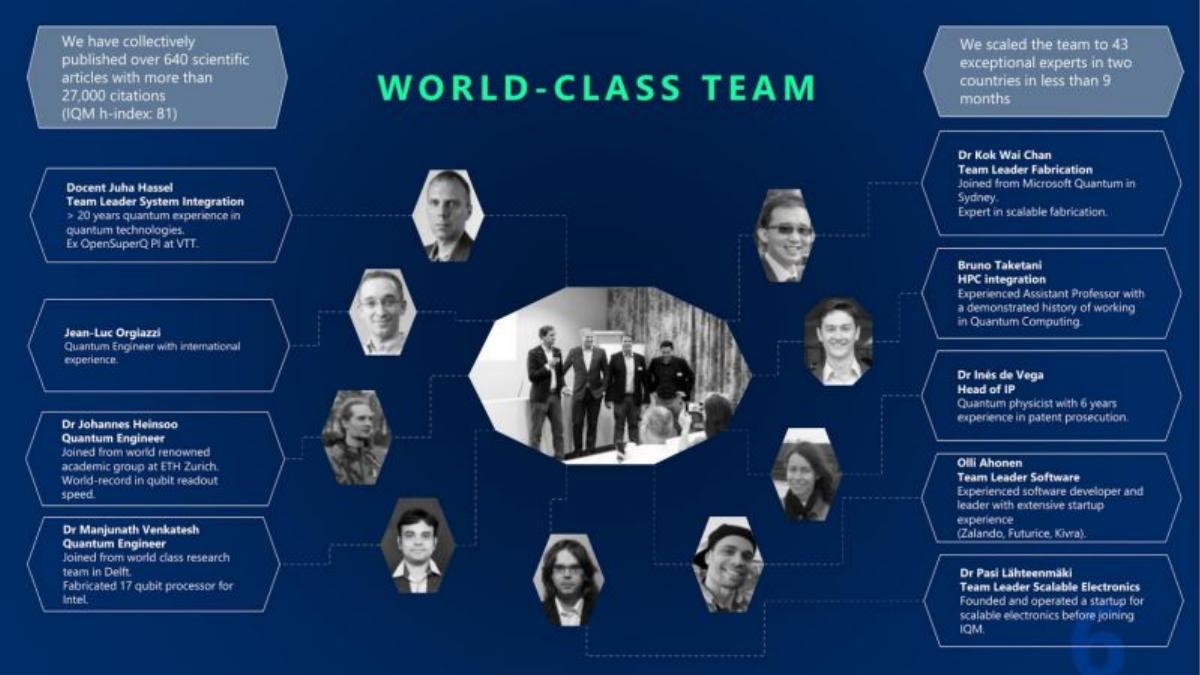
- The company highlights a massive academic foundation, citing over 640 scientific articles and 27,000 citations (Slide 6).
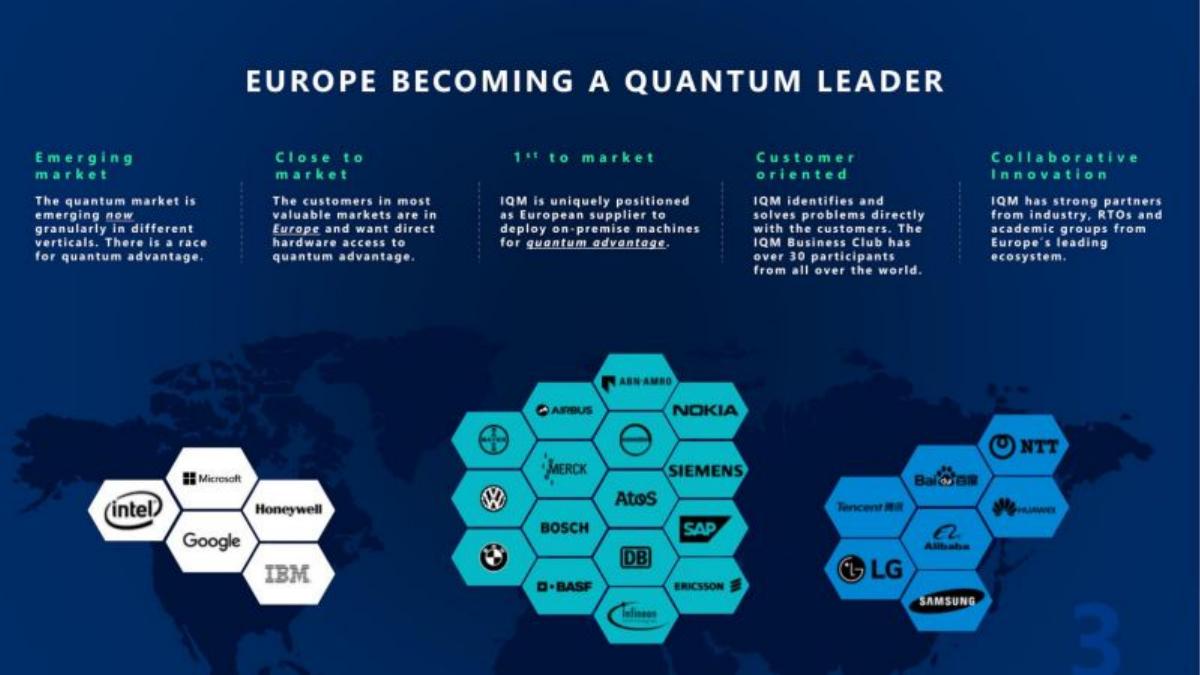
- IQM positions itself as the primary European supplier for on-premise quantum machines, contrasting with US-based cloud giants (Slide 3).
- The business model includes a specific benchmark price of €41m for an IBM system to anchor their value proposition (Slide 12).
- A clear technical roadmap targets the delivery of 54-qubit 'quantum supremacy' machines by 2023 (Slide 13).
- The deck emphasizes 'Application-Specific Processors' as a shortcut to quantum advantage over universal machines (Slide 9).
- Rapid organizational scaling is proven with a staff growth chart moving from ~10 to over 70 employees in 15 months (Slide 7).
- Revenue strategy focuses on a 6-12 month sales cycle targeting state research centers and large HPC centers (Slide 12).
- The 'Unique Chip Technology' slide provides specific technical differentiators like multichannel readout and tunable couplers (Slide 10).
The Deep-Tech Masterclass: IQM's Path to $46M
Fundraising for quantum computing is notoriously difficult because it requires investors to bet on physics that is often years away from commercial viability. IQM’s Series A deck, used in 2020 to secure $46M, succeeds by grounding high-level science in traditional business metrics. They don't just talk about qubits; they talk about sales cycles, benchmark pricing, and regional market dominance. This teardown examines how IQM moved from a record-breaking seed round in Finland to becoming a global contender in the quantum hardware race.
Slide 1: Title and Identity
The cover slide is minimalist, featuring the IQM logo and the tagline: "WE BUILD QUANTUM COMPUTERS." It includes direct contact information for Dr. Jan Goetz, CEO & Co-Founder. The branding is professional and clean, establishing an immediate tone of industrial-grade engineering rather than academic experimentation.
Slide 2: The Problem Space
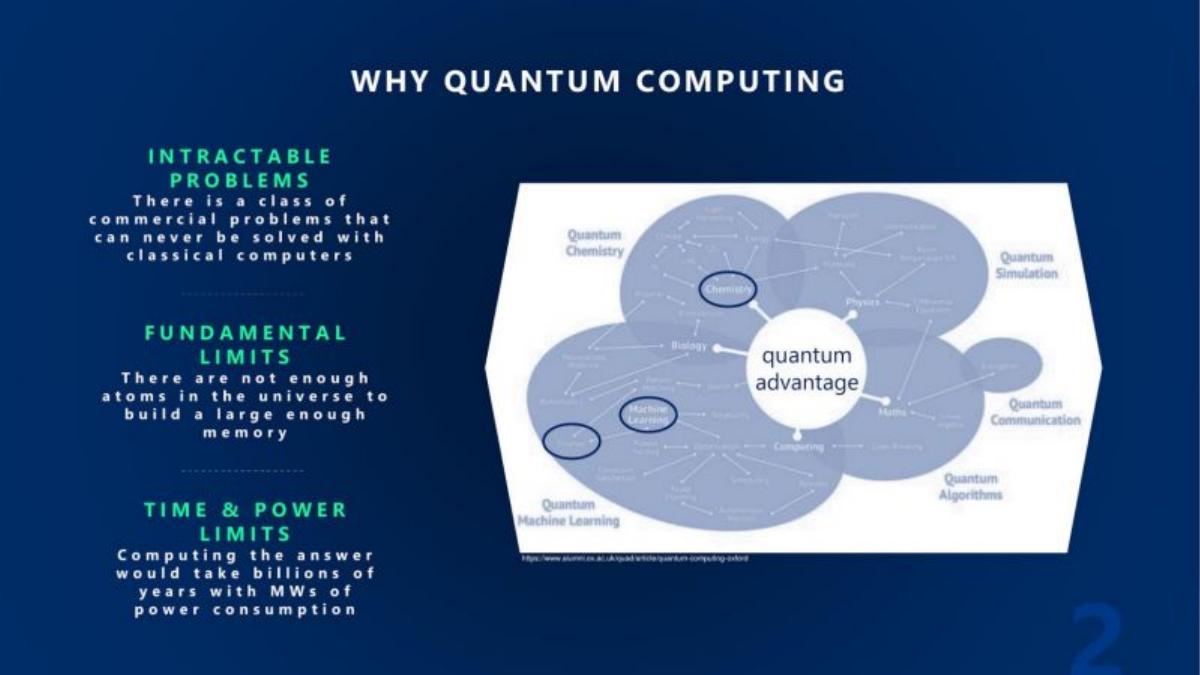
Titled "WHY QUANTUM COMPUTING," this slide defines the limitations of classical computing. It identifies three core pillars: Intractable Problems (commercial problems classical computers can never solve), Fundamental Limits (lack of atoms in the universe to build enough classical memory), and Time & Power Limits (billions of years and megawatts of power required for certain calculations). A central graphic illustrates the 'quantum advantage' across chemistry, machine learning, and finance.
Slide 3: Regional Strategy and Market Positioning
IQM makes a bold geopolitical play here, titled "EUROPE BECOMING A QUANTUM LEADER." They argue that the most valuable markets are in Europe and that these customers want "direct hardware access." The slide features a map showing US competitors (Intel, Google, IBM, Microsoft, Honeywell) on the left, and a massive cluster of European industrial giants (Airbus, BMW, Bosch, SAP, Siemens) in the center. This positions IQM as the local alternative for European sovereignty in deep tech.
Slide 4: The Secret of Success (Timeline)
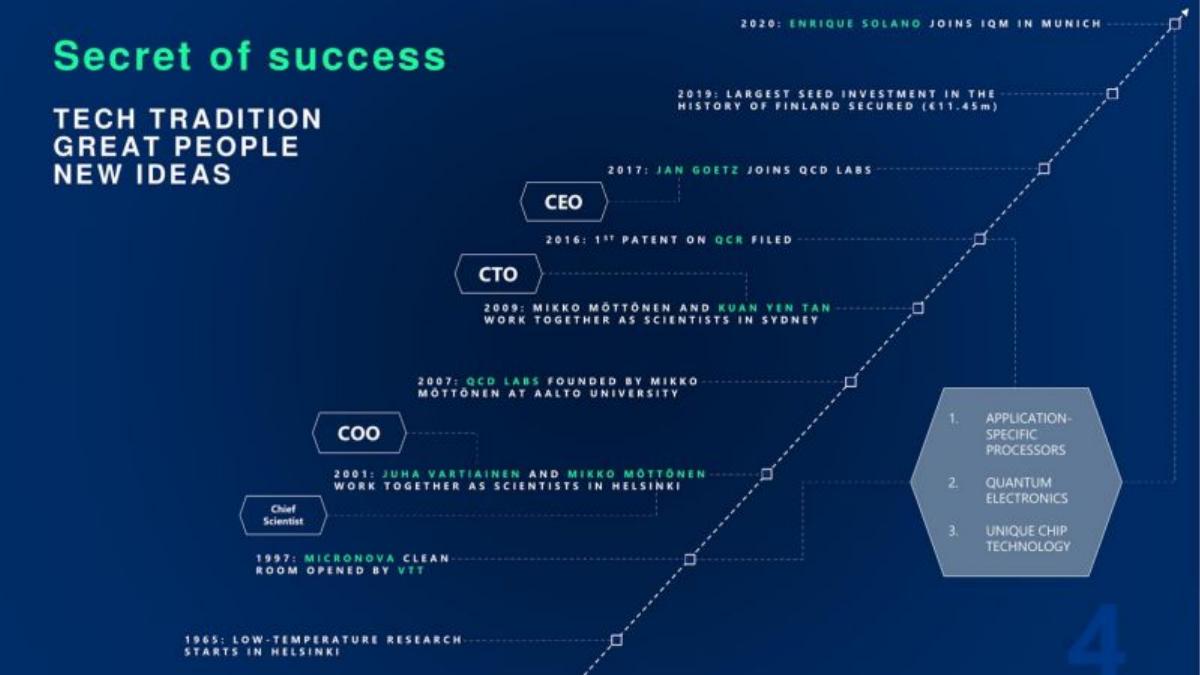
This slide presents a timeline of "Tech Tradition, Great People, New Ideas." It traces the company's roots back to 1965 low-temperature research in Helsinki. Key milestones include the founding of QCD Labs in 2007, the first patent on QCR in 2016, and securing the "largest seed investment in the history of Finland" (€11.45m) in 2019. This builds a narrative of long-term stability and rapid recent execution.
Slide 5: Leadership
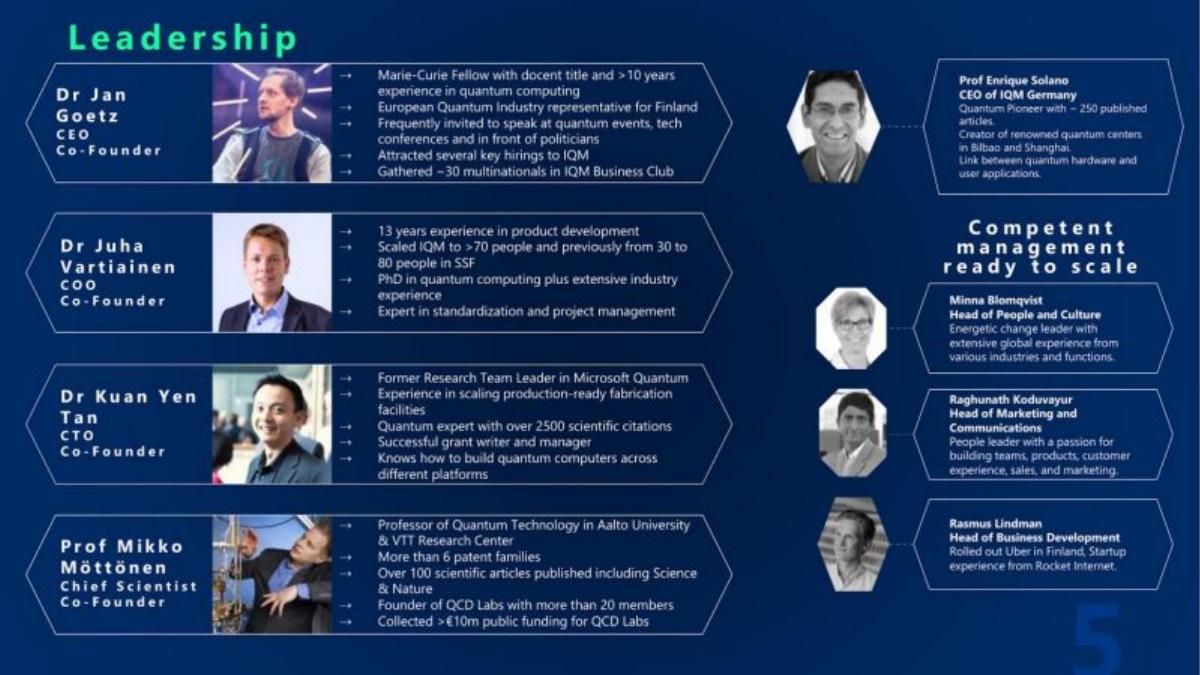
The leadership slide highlights the four co-founders: Dr. Jan Goetz (CEO), Dr. Juha Vartiainen (COO), Dr. Kuan Yen Tan (CTO), and Prof. Mikko Möttönen (Chief Scientist). Each profile emphasizes specific credentials, such as "2500 scientific citations" for the CTO and ">€10m public funding" for the Chief Scientist. It also introduces management hires from Uber and Microsoft, signaling a transition from lab to market.
Slide 6: World-Class Team
Deepening the credibility play, Slide 6 focuses on the broader team. It cites an IQM h-index of 81 and over 27,000 citations. It lists specific team leads, noting they were recruited from Microsoft Quantum, Intel, and ETH Zurich. This slide is designed to prove that IQM can win the global war for quantum talent.
Slide 7: Company Growth
This slide uses a simple bar chart to show staff growth from July 2019 to October 2020. The team grew from roughly 10 people to over 70 in just 15 months, split between Helsinki and Munich. Visualizing this growth proves the company's ability to deploy capital and scale operations effectively.
Slide 8: The Technical Roadmap
Titled "FAST LANE TO QUANTUM ADVANTAGE," this slide outlines the three-part technical strategy: 1. Application-Specific Processors, 2. Quantum Electronics (cryogenic and room-temperature), and 3. Unique Chip Technology. It creates a vertical arrow moving from "near-term advantage" to "long-term advantage" (error correction).
Slide 9: USP - Application-Specific Processors
This slide addresses a major industry hurdle: universal quantum computers require millions of qubits, which are years away. IQM’s solution is a "hardware-software co-design" for unique QuASICs (Quantum Application-Specific Integrated Circuits). They are creating a "shortcut" to quantum advantage by focusing on specific algorithms for finance, chemistry, and machine learning.
Slide 10: USP - Unique Chip Technology
Slide 10 gets into the engineering weeds. It identifies the problem (quantum operations are too error-prone and slow) and offers three solutions: Faster Reset (10x speedup), Faster Readout (multichannel instead of single drive), and Faster Gates (tunable couplers). This slide is essential for technical due diligence, showing exactly where IQM’s IP resides.
Slide 11: Market Size
IQM breaks down the market using 2019 IQT report data. They project a Total Addressable Market (TAM) of €2.5 Billion by 2029 . They narrow this down to a Serviceable Addressable Market (SAM) of €1 Billion for on-premise computers and a Serviceable Obtainable Market (SOM) of €0.5 Billion for Europe and parts of Asia/US. The chart shows hardware as the dominant revenue driver in the early years.
Slide 12: Near-Term Business Model
This is perhaps the most important slide for a Series A investor. IQM defines its revenue model: selling fully integrated hardware. They provide a benchmark price of €41m (referencing an IBM system) and state that IQM is the only provider delivering superconducting hardware to customer premises. They estimate a sales cycle of 6-12 months and list target customers like state research centers and large HPC centers.
Slide 13: The Summary and Goal
The penultimate slide summarizes the company's strengths: strongly backed (€11.45m seed), world-class team, and fast scaling. It concludes with a concrete Series A goal: "Deliver 2nd generation quantum supremacy machines with 54 qubits by 2023." This gives investors a clear finish line for their capital.
Slide 14: Contact
A simple thank you slide with a background image of a dilution refrigerator (quantum hardware) and contact details.
What Works in This Deck
The "European Champion" Narrative: By explicitly contrasting themselves with US tech giants, IQM creates a unique value proposition for European investors and governments concerned about technological sovereignty. · Quantifiable Credibility: Using the h-index (81) and citation counts (27,000+) provides a objective metric for the quality of the team in a field where "expertise" can be hard to verify. · Concrete Business Model: Many quantum decks are vague about how they will actually make money. IQM is specific: they sell hardware, the benchmark is €41m, and the sales cycle is 6-12 months. · Technical Specificity: Slide 10 provides enough detail (tunable couplers, multichannel readout) to satisfy technical reviewers without overwhelming generalist investors.
What Is Missing
Unit Economics: While they provide a benchmark price of €41m, there is no mention of the cost of goods sold (COGS) or the margin on these machines. Building quantum hardware is capital intensive, and investors would want to see the path to profitability. · Competitive Matrix: While they mention US giants on Slide 3, they don't provide a feature-by-feature comparison. How does IQM's 54-qubit roadmap compare to IBM's or Google's at that same point in time? · The "Ask": The deck does not explicitly state the amount they are looking to raise in the Series A (though we know from the catalogue it was $46M). It also doesn't detail the specific allocation of funds (e.g., % to R&D vs. % to Sales).
What Other Founders Should Copy
The Use of Benchmarks: If you are in a new or opaque market, use a known competitor's price point (like the €41m IBM reference) to anchor your value. It makes a theoretical business feel real. · The Growth Bar Chart: If you are raising a Series A, you need to prove you can manage a growing organization. The staff growth chart on Slide 7 is a simple, effective way to show operational momentum. · The "Shortcut" Strategy: If the "ultimate" version of your product is a decade away (like a universal quantum computer), show investors the "shortcut" (like application-specific processors) that generates revenue in the interim.
Frequently asked questions
- What is IQM's primary product offering according to the deck?
- IQM builds scalable hardware for universal quantum computers, specifically focusing on superconducting technology. Unlike many competitors who focus solely on cloud access, IQM emphasizes selling fully integrated, on-premise hardware systems. Their approach utilizes 'hardware-software co-design' to create application-specific processors (QuASICs) for sectors like finance, chemistry, and machine learning, which they argue provides a faster path to 'quantum advantage' than universal systems.
- How does IQM differentiate itself from US-based quantum companies?
- IQM leans heavily into its identity as 'The European Quantum Computing Company.' On Slide 3, they argue that the most valuable markets are in Europe and that customers there want direct, on-premise hardware access rather than relying on US-based cloud providers like Google, IBM, or Microsoft. They position themselves as the unique European supplier capable of deploying these machines locally to ensure data sovereignty and performance.
- What are the key technical milestones mentioned in the Series A deck?
- The deck outlines a progression from near-term 'Application-Specific Processors' to long-term 'Error Correction.' A major stated goal for the Series A round is the delivery of 2nd generation quantum supremacy machines featuring 54 qubits by 2023. They also highlight specific hardware innovations, such as a 10x speedup in qubit reset times using 'QCR without feedback' and multichannel readout schemes to reduce on-chip overhead.
- What does the team's track record look like?
- The team is presented as world-class with deep academic and industrial roots. Collectively, they have published over 640 scientific articles with more than 27,000 citations, resulting in an h-index of 81. Key leadership includes Dr. Jan Goetz (CEO), who has over 10 years of quantum experience, and Dr. Kuan Yen Tan (CTO), a former research lead at Microsoft Quantum. The deck also notes they scaled the team to 43 experts in less than 9 months.
- What is the projected market size for IQM's technology?
- On Slide 11, IQM cites an IQT report from 2019, projecting the total addressable market for quantum computing (hardware, software, and cloud) to reach €2.5 billion by 2029. Within that, they identify a Serviceable Addressable Market (SAM) of €1 billion for on-premise quantum computers and a Serviceable Obtainable Market (SOM) of €0.5 billion specifically within Europe and parts of Asia and the US.