Vital's Series A deck is a masterclass in addressing industry-specific friction. By focusing on the Emergency Department (ED)—traditionally viewed as a cost center—Vital positions its AI-driven follow-up tool as a revenue generator. The deck highlights a significant reduction in the hospital sales cycle, dropping it from the industry standard of 12-18 months to a mere 2-4 months. With 67 hospitals already contracted or in pilots across 13 health systems, the company demonstrates clear product-market fit. The $15M raise is earmarked for scaling the team from 20 to 35 FTEs and expanding into in…
Key takeaways
- The company positions itself as a UI + AI layer for hospitals, starting specifically with the emergency department (Slide 1).
- Vital claims to have reduced the standard 12-18 month hospital sales cycle to just 2-4 months (Slide 6).
- The Follow-Up AI product is already active in 10 hospitals, identifying high-value patients for human calls (Slide 4).
- Traction is shown through 67 hospitals across 13 health systems, representing a 9% US market expansion opportunity (Slide 8).
- Pricing is tiered by facility, with an average revenue of approximately $100k per hospital (Slide 9).
- The Series A ask is $10-12M to grow the team from 20 to 35 employees and build new inpatient products (Slide 10).
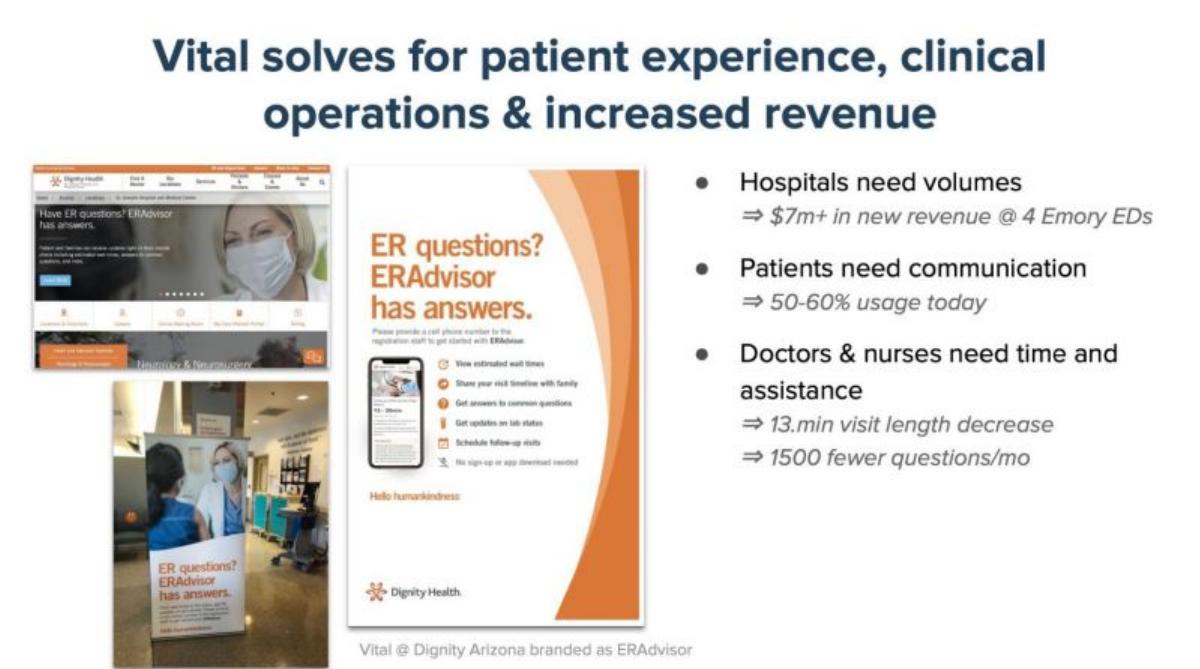
- Clinical results at Dignity Health show a 226% increase in 'Likelihood to recommend' after implementing Vital (Slide 11).
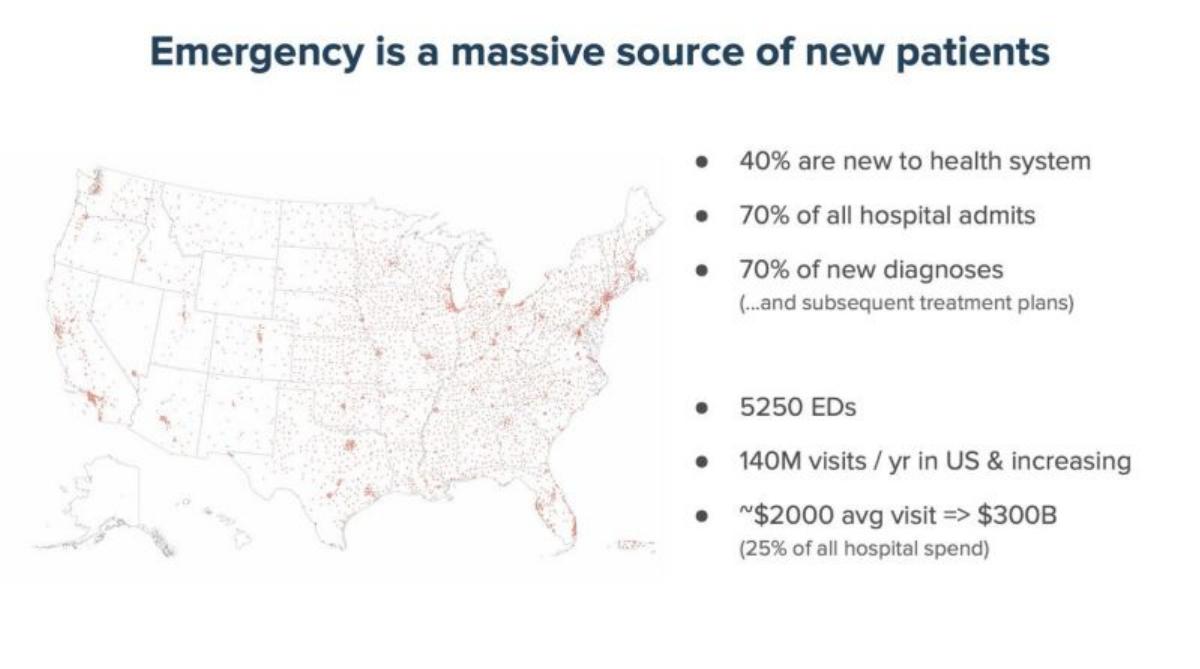
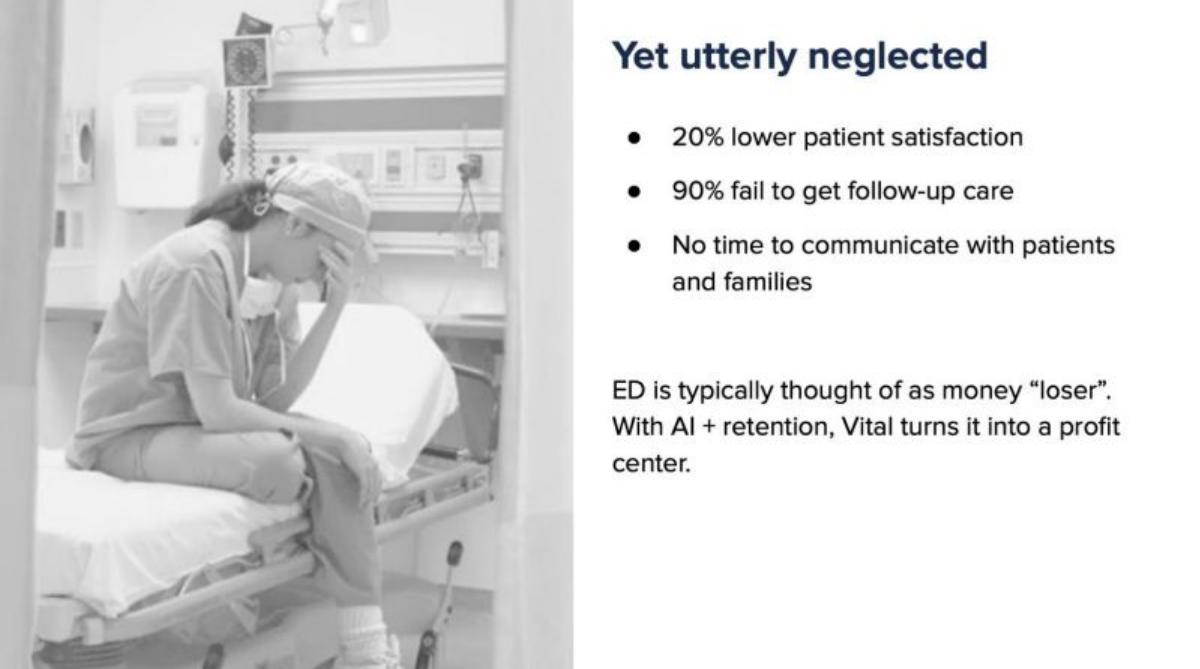
- The deck identifies that 90% of emergency department patients fail to receive follow-up care, representing a major revenue leak (Slide 2).
Executive Summary: The UI Layer for the Modern Hospital
Vital’s pitch deck for their $15M Series A is a focused argument on efficiency and revenue recovery. In a sector known for sluggish innovation and decade-old legacy software, Vital pitches itself as a modern "UI + AI layer" that sits on top of existing hospital systems. The deck is structured to move quickly from the problem—neglected emergency departments—to a solution that has already demonstrated significant financial and clinical ROI.
Slide 1: The Hook
The cover slide is minimalist but strategic. It defines the company as a "UI + AI layer for all hospitals" and immediately identifies their beachhead market: the emergency department (ED). By stating "Own the emergency dept," Vital signals a land-and-expand strategy that starts where patient volume is highest and most chaotic.
Slide 2: The Problem of the Neglected ED
Vital identifies a massive gap in the current healthcare experience. Slide 2 notes that patient satisfaction is 20% lower in the ED and, crucially, 90% of patients fail to get follow-up care. The slide frames the ED not just as a medical challenge, but as a financial one, stating it is typically thought of as a "money loser." Vital’s counter-thesis is that AI and better retention can turn it into a profit center.
Slide 3 & 4: Product Suite and Follow-Up AI
Slide 4 introduces "Vital: Follow-Up AI," which is already deployed in 10 hospitals. The product uses AI to categorize follow-ups into high, medium, and low value. High-value patients receive a human call, while low-value ones receive an SMS. The results from Emory Healthcare (4 EDs) are impressive: 1,000 new patients per month and $5M+ in new, immediate revenue. This slide effectively bridges the gap between a software tool and a revenue generator.
Slide 6: Solving the Sales Cycle
Perhaps the most important slide for a healthcare investor is Slide 6. The "Hospital sales cycle is 12-18 months" is a notorious barrier to entry. Vital claims to have reduced this to 2-4 months. They achieve this by compressing the "Sell" phase to 1-5 months and virtually eliminating the traditional 6-month I.T. and implementation phase by using third-party integrators like Redox and PatientPing. This slide addresses the "execution risk" head-on.
Slide 8: Traction and Market Expansion
Vital shows significant momentum with 67 hospitals across 13 health systems. The visualization on Slide 8 uses a bar chart to show current contracts (green), pilots (blue), and the massive expansion opportunity (dotted lines) within those same health systems. They claim this represents 9% of the US market, providing a clear path to scale without needing to win new logos constantly.
Slide 9: The Pricing Model
The pricing is transparent and facility-based. Slide 9 outlines three tiers: $0 (3 months free), $5k/month (ERAdvisor), and $10k/month (ERAdvisor + Follow Up AI). With an average revenue of ~$100k per hospital annually, the unit economics are easy for an investor to model against their current traction of 67 hospitals.
Slide 10: The Series A Ask
Slide 10 targets a $10-12M raise (noting the final raise was $15M). The plan is to increase headcount from 20 to 35 FTEs and expand the product line into "Inpatient" and "Clinical alerts." They also claim a 3-year runway, which is a conservative and attractive signal for Series A investors.
Slide 11 & 23: Clinical Validation and Social Proof
The deck concludes with hard data and soft testimonials. Slide 11 shows a 226% increase in the "Likelihood to recommend" at Dignity Health, a key metric for hospital reimbursement. Slide 23 provides quotes from ED managers and staff, emphasizing that the tool is "easily incorporated" and that patients "don't need any help using it," addressing potential concerns about staff burden and patient tech-literacy.
What Vital Does Well
Vital excels at translating technical AI capabilities into CFO-friendly language. By focusing on "revenue recovery" and "profit centers," they move the conversation away from being a "nice-to-have" patient experience tool to a "must-have" financial tool. The emphasis on reducing the sales cycle is a brilliant move that speaks directly to the primary pain point of healthcare venture capital.
What is Missing
The provided slides do not include a dedicated Team slide, which is a significant omission for a Series A teardown, as the founders' backgrounds in healthcare or AI are critical at this stage. There is also no explicit competitor matrix. While they mention legacy systems are "neglected," they don't explicitly name other modern startups in the patient engagement space. Finally, while they mention $5M in revenue for Emory, a slide detailing the company's total ARR (Annual Recurring Revenue) or burn rate is absent from this selection.
Founder Takeaways
Address the Sales Cycle: If you are in a slow-moving industry like healthcare or gov-tech, dedicate a slide to how you are hacking the traditional procurement timeline. · Quantify the "Loss": Vital didn't just say the ED is bad; they said 90% of patients are lost to follow-up. Find the specific metric where your customers are losing money. · Tiered Pricing: Showing a clear path from a free trial to a $10k/month premium tier makes the revenue growth feel inevitable rather than speculative. · Use HCAHPS: In healthcare, use the metrics the industry already uses to grade itself. By showing HCAHPS improvements, Vital proves they speak the language of hospital administrators.
Frequently asked questions
- What is Vital's core value proposition for hospitals?
- Vital positions the Emergency Department (ED) as a potential profit center rather than a 'money loser.' By using AI to coordinate follow-up care, they ensure patients stay within the health system. Slide 4 notes that at Emory Healthcare, this resulted in 1,000 new patients per month and over $5M in new, immediate revenue.
- How does Vital solve the long sales cycle problem in healthcare?
- Slide 6 illustrates their strategy: they bypass the traditional 6-month I.T. and implementation phase by leveraging existing integrations like Redox, PatientPing, and Audacious Inq. This allows them to move from 'Sell' to 'Launch' in 2-4 months, compared to the industry average of 12-18 months.
- What are the specific tiers of Vital's pricing model?
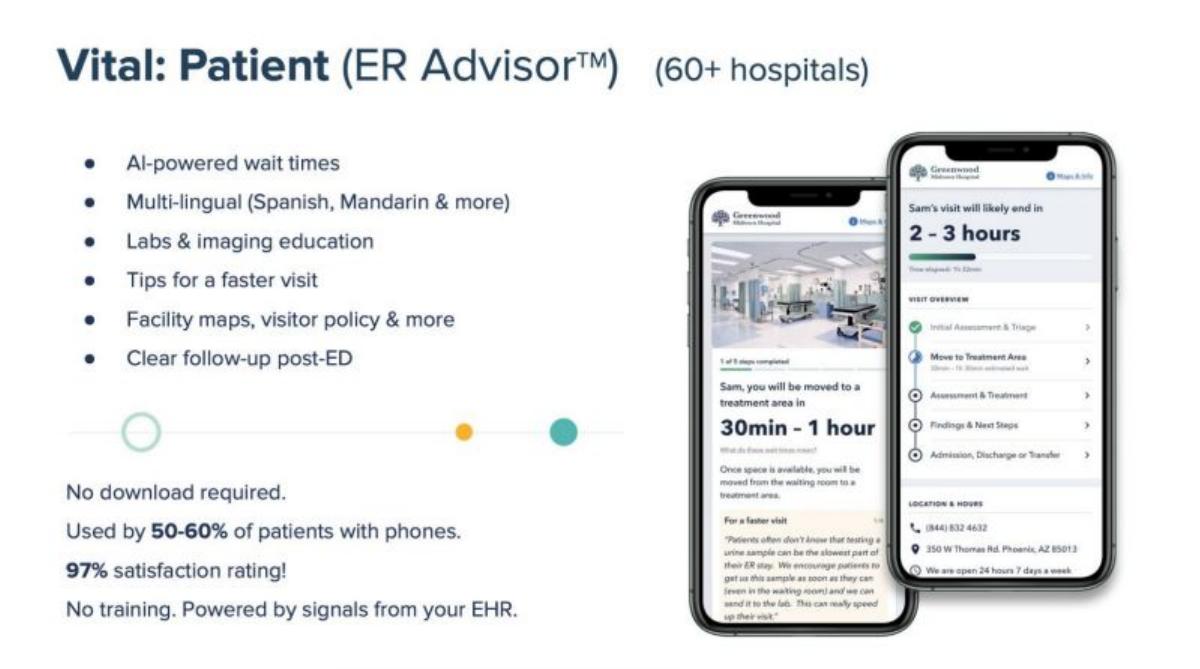
- According to Slide 9, Vital offers three tiers: a 3-month free trial, 'ERAdvisor' at $5k per facility monthly, and 'ERAdvisor + ED Follow Up AI' at $10k per facility monthly. The top tier includes readmission risk stratification and prioritized outreach.
- What metrics does Vital use to prove clinical impact?
- Vital relies heavily on HCAHPS (Hospital Consumer Assessment of Healthcare Providers and Systems) scores. Slide 11 shows a 38% increase in information about delays and a massive 226% increase in the likelihood to recommend at St. Joseph’s Hospital and Medical Center.
- What is the planned use of funds for the Series A?
- Slide 10 specifies a raise of $10-12M (though catalogue facts indicate $15M was eventually raised). The funds are intended to increase headcount from 20 to 35 FTEs, scale sales and implementation, and develop new products for inpatient care and clinical alerts.