The VisionX pitch deck is an exercise in extreme brevity, consisting of only seven slides. It targets the friction between insurance carriers and digital sales channels, positioning itself as the 'X' factor connecting the two. Despite the lack of traditional slides like Market Size, Competition, or a detailed Financial Proforma, the deck relies heavily on social proof and existing volume. By highlighting $10MM+ transacted through their 'tacerto' brand and a rollout to over 6,000 points of sale, the founders focused on execution rather than theory. This teardown examines how a lean narrative c…
Key takeaways
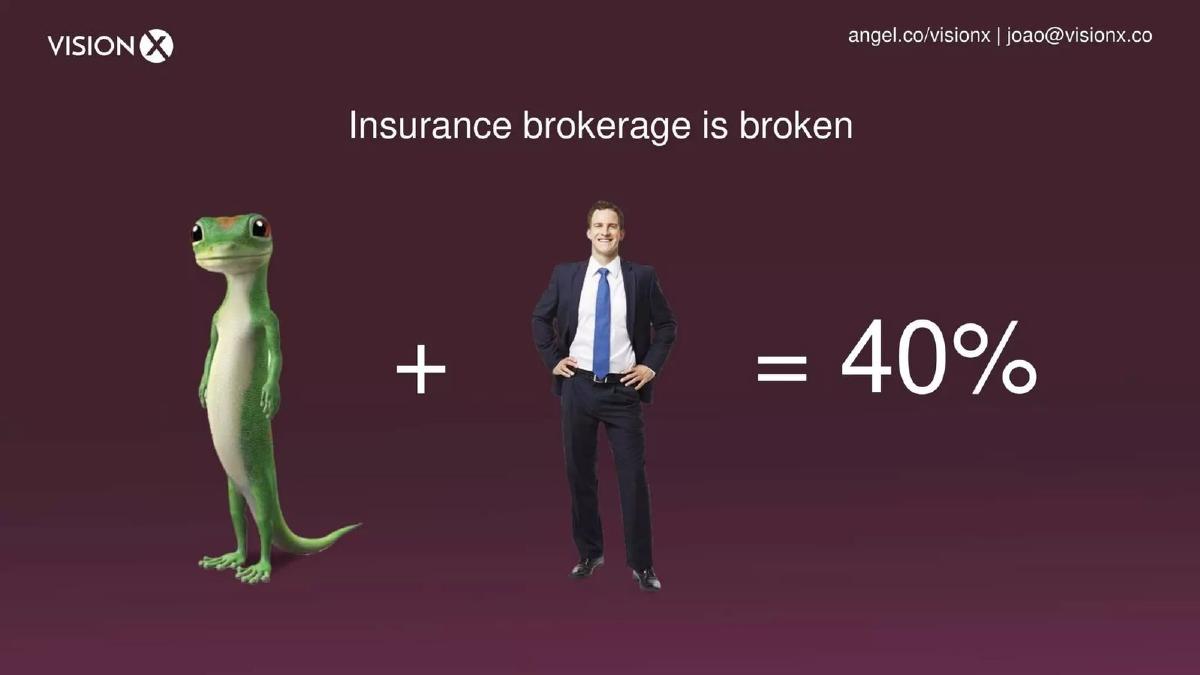
- The deck identifies a specific 40% inefficiency in the current insurance brokerage model on slide 2.
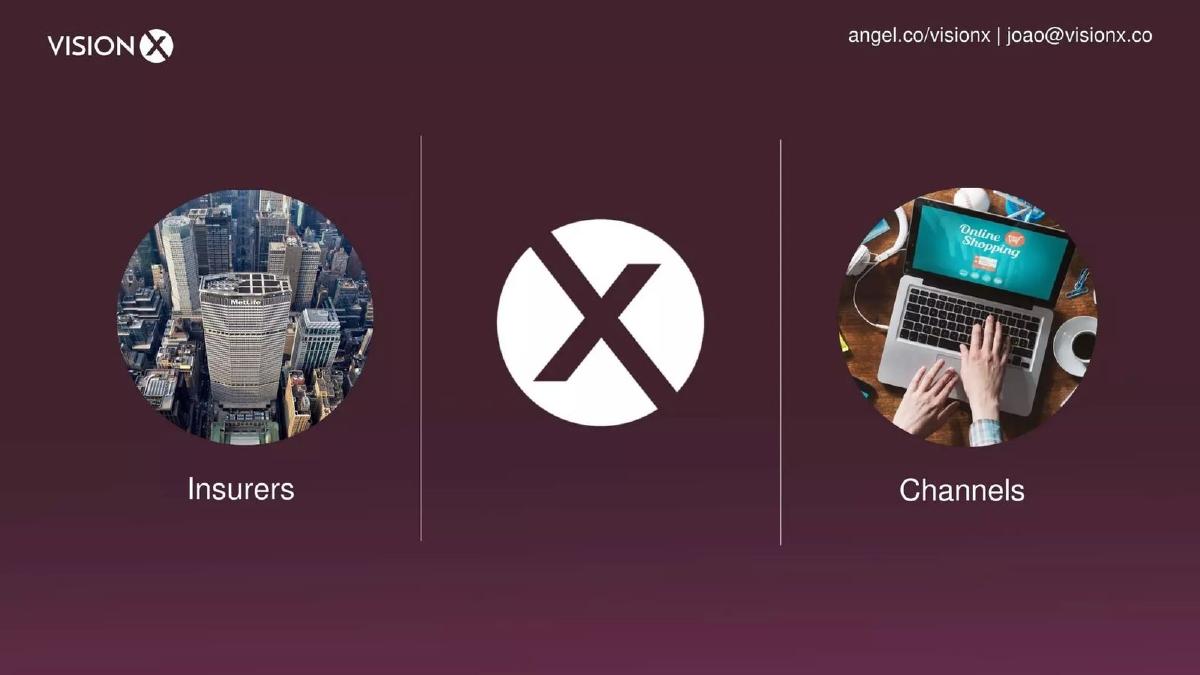
- VisionX positions itself as the connective tissue between 'Insurers' and 'Channels' using a simple visual metaphor on slides 3 and 4.
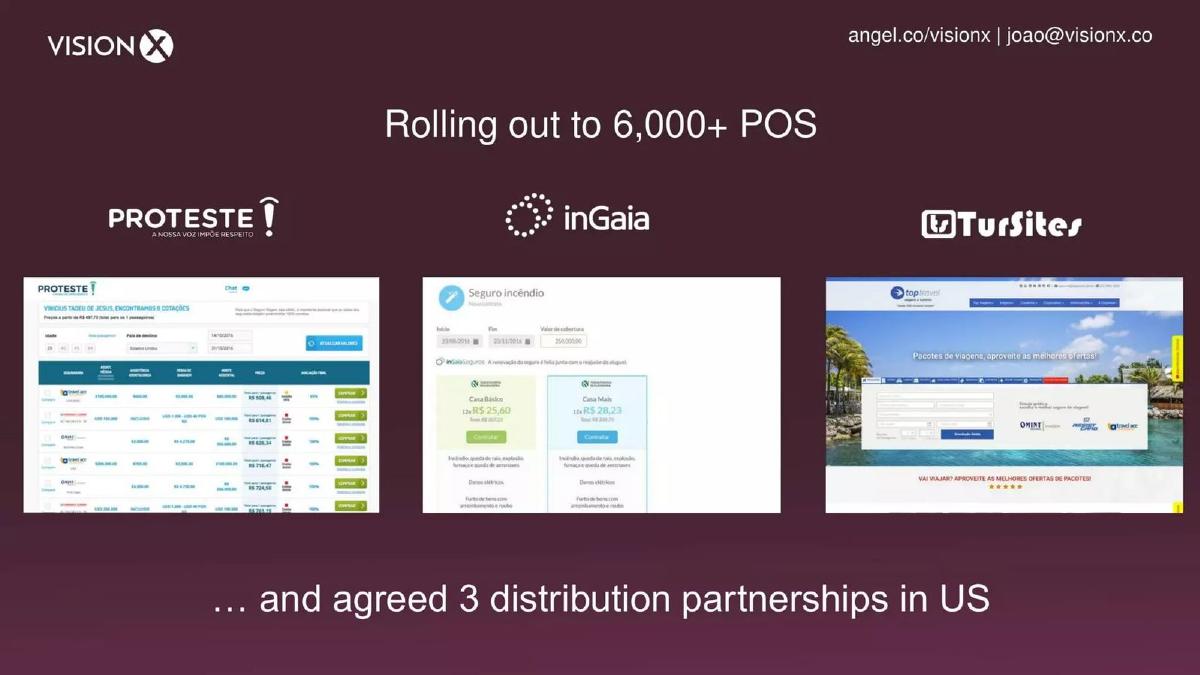
- The company claims a rollout to over 6,000 points of sale (POS) across three specific partners: PROTESTE, inGaia, and TurSites on slide 5.
- The founders highlight international expansion by stating they have agreed to 3 distribution partnerships in the US on slide 5.
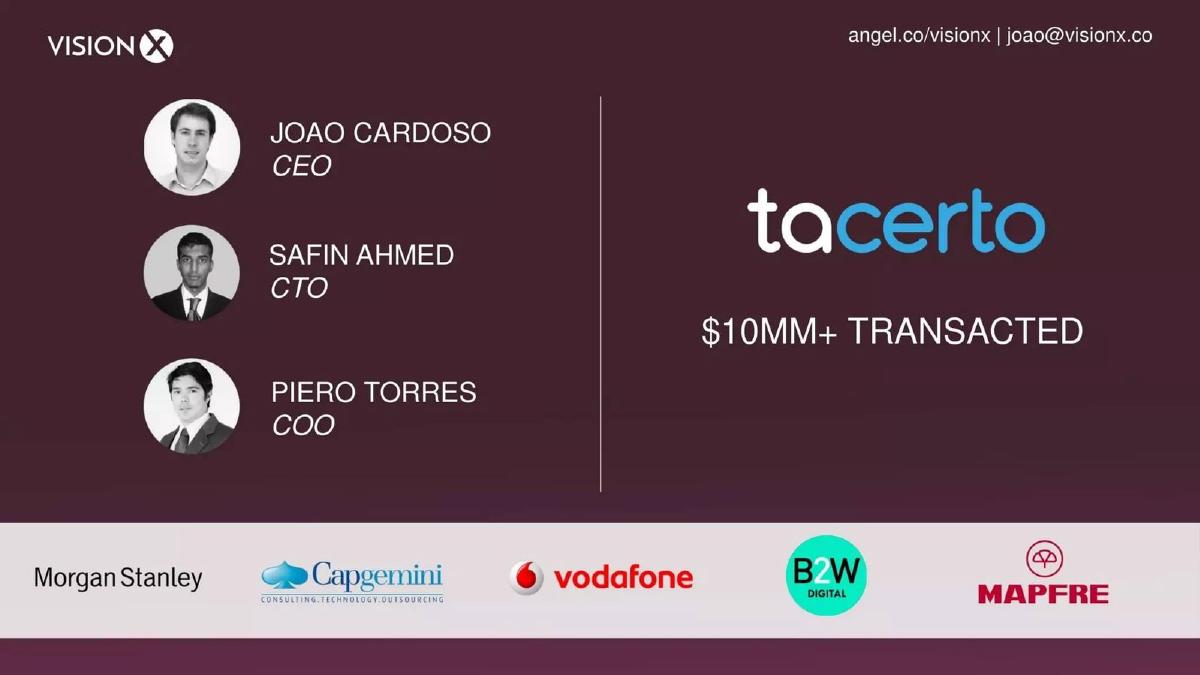
- Significant traction is demonstrated through the 'tacerto' brand with over $10MM transacted as shown on slide 6.
- The team slide (slide 6) leverages high-profile corporate logos including Morgan Stanley, Capgemini, Vodafone, B2W Digital, and MAPFRE to establish credibility.
- The deck completely omits a formal 'Ask' slide, failing to specify the amount of capital being raised or the intended use of funds.
- There is no mention of unit economics, revenue models, or a competitive landscape analysis within the 7 slides.
The VisionX Teardown: Minimalist Middleware
The VisionX pitch deck from 2016 is a rare example of a 'less is more' approach to fundraising. At only seven slides, it skips almost every conventional section found in a standard Sequoia-style deck. There is no market size slide (TAM/SAM/SOM), no competitor matrix, and no financial projections. Instead, the deck functions as a high-level visual aid for a conversation, focusing almost exclusively on the problem and the team's ability to execute.
Slide 1: Title and Product Visualization
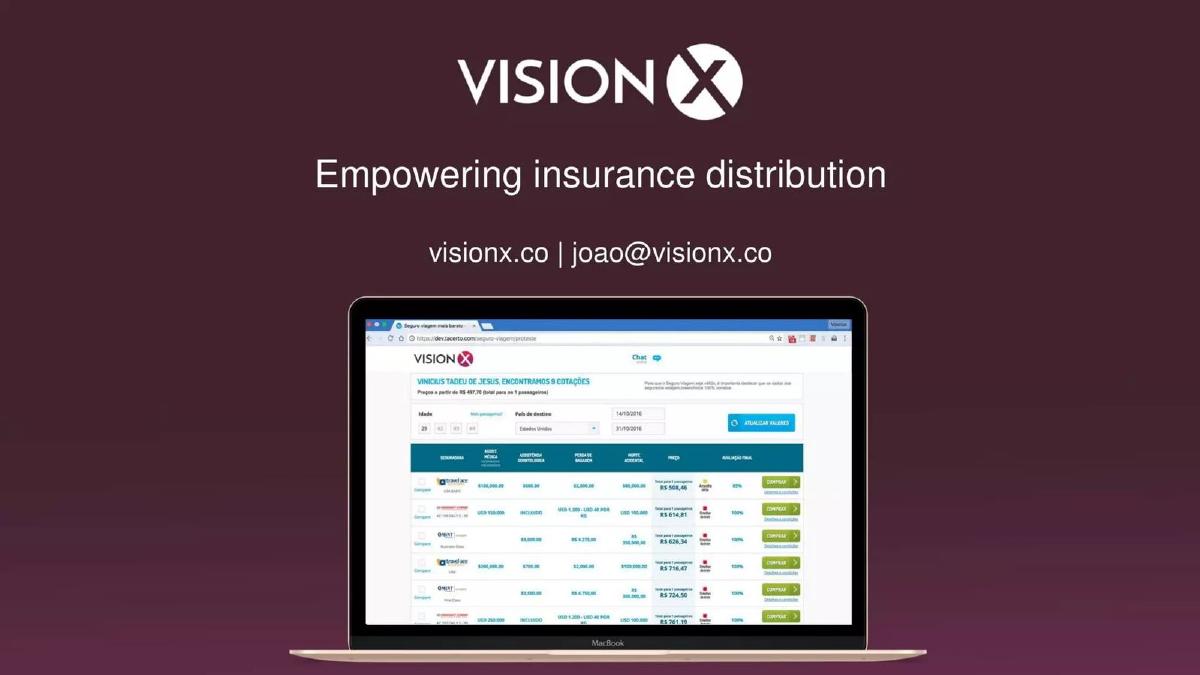
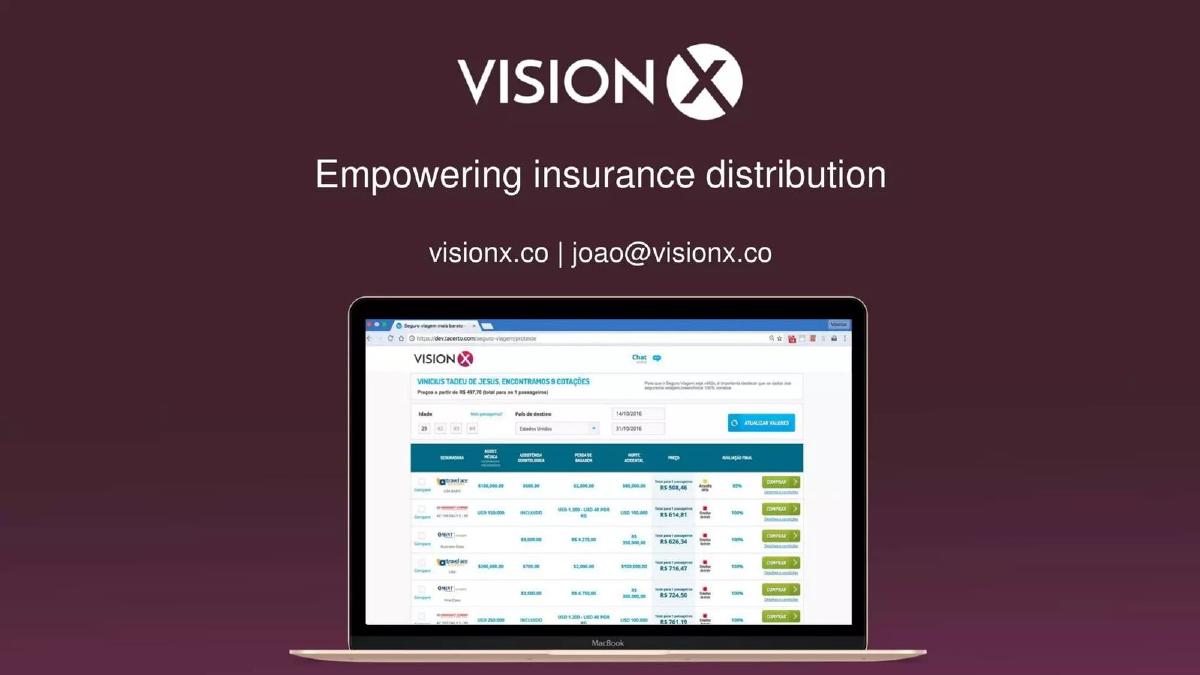
The cover slide introduces the company with the tagline 'Empowering insurance distribution.' It features a prominent screenshot of the product on a laptop, showing a comparison engine. The interface displayed is in Portuguese, which immediately signals the company's initial geographic focus (Brazil), even though the deck is in English. This slide sets the stage for a B2B or B2B2C platform rather than a direct consumer play.
Slide 2: The 40% Problem
Slide 2 is the most 'aggressive' slide in the deck. It features a well-known insurance mascot and a generic broker with the text 'Insurance brokerage is broken.' The equation '+ = 40%' is the central focus. While the slide doesn't explicitly define what the 40% represents, in the context of insurance, it typically refers to the high commission and administrative load embedded in premiums. By leading with this number, VisionX identifies the 'fat' in the industry they intend to trim or capture.
Slides 3 & 4: The Solution as the 'X'
These two slides function as a build. Slide 3 shows 'Insurers' on the left and 'Channels' on the right with a question mark in the middle. Slide 4 replaces the question mark with the VisionX logo. This is a classic 'middleware' pitch. It positions the company as the essential infrastructure that connects legacy insurance carriers with modern digital sales channels. It avoids technical jargon, opting instead for a clear conceptual role for the company.
Slide 5: Traction and Distribution
This slide provides the 'proof of life' for the business. It lists three partners: PROTESTE, inGaia, and TurSites. The headline 'Rolling out to 6,000+ POS' is a significant claim for a seed-stage company. It also mentions 'agreed 3 distribution partnerships in US,' suggesting that while the current traction is in the Brazilian market (indicated by the R$ currency in the screenshots), the ambition and the model are global.
Slide 6: Team and Transaction Volume
The team slide is dense with social proof. It introduces Joao Cardoso (CEO), Safin Ahmed (CTO), and Piero Torres (COO). To the right of the team photos, it highlights 'tacerto' with the metric '$10MM+ TRANSACTED.' This is the most important figure in the deck, as it moves the company from 'idea phase' to 'validated infrastructure.' The bottom of the slide is lined with logos from Morgan Stanley, Capgemini, Vodafone, B2W Digital, and MAPFRE. This suggests the team has the institutional pedigree to navigate the highly regulated insurance industry.
Slide 7: Contact Information
The final slide is a simple repetition of the logo and contact details. Notably, it includes an AngelList link (angel.co/visionx), which explains the deck's brevity. Many decks designed for AngelList are intended to be 'teasers' that lead a viewer to a more detailed profile or a data room.
What Works
The 40% Anchor: By putting a specific, large percentage on the problem slide, VisionX gives investors a clear 'why.' If 40% of a multi-billion dollar industry is lost to inefficiency, the value of a solution that reduces that friction is self-evident.
Execution Over Theory: The deck doesn't spend time explaining why insurance is a big market. It assumes the investor knows that. Instead, it spends its limited real estate showing that they are already in 6,000 points of sale and have already moved $10 million. For a $125k seed round, this level of traction is often enough to close the deal.
Visual Simplicity: The deck is remarkably uncluttered. It uses high-quality imagery and very little text, which forces the viewer to focus on the key metrics: 40%, 6,000 POS, and $10MM transacted.
What is Missing
The Business Model: This is the most glaring omission. An investor has no idea if VisionX is a SaaS company, a licensed broker taking a cut, or a lead-generation platform. Without knowing the 'take rate' on that $10MM transacted, it is impossible to value the business.
The Ask: There is no slide stating how much money is being raised or what the milestones are for the next 18 months. While this might be available on their AngelList profile, a standalone deck should always include the 'Ask.'
Competitive Landscape: The insurtech space was already becoming crowded in 2016. The deck does not explain how VisionX differs from other API-based insurance distributors or legacy GDS (Global Distribution Systems) in the travel and insurance sectors.
What a Founder Should Copy
The 'Middleware' Visual: If you are building a platform that connects two existing parties, the 'Insurers -> X Logo Bar for Credibility: If your team has worked at major firms or your product is used by recognizable brands, use those logos prominently. In the Seed stage, investors are betting on the team's ability to navigate the industry; the Morgan Stanley and MAPFRE logos do more work here than three paragraphs of text would.
Focus on a Single Metric: VisionX chose '$10MM+ Transacted' as their hero metric. Founders should identify the one number that proves their product works at scale and make it the centerpiece of their traction slide.
Final Thoughts
The VisionX deck is a 'teaser' deck. It is not designed to answer every question, but rather to provoke a single question: 'How are you moving $10MM with only a Seed investment?' For a small raise of $125,000, this deck successfully establishes the founders as credible operators in a high-friction industry. However, for a larger Series A, the lack of unit economics and a clear revenue model would be a significant barrier.
Frequently asked questions
- How much did VisionX raise with this deck?
- According to the catalogue listing, VisionX raised $125,000 in 2016 during its Seed stage. The deck itself does not actually state the amount being raised, which is a common omission in decks used for initial conversations or those hosted on platforms like AngelList where the 'ask' is listed in the profile metadata rather than the slide content.
- What is the core problem VisionX is solving?
- The deck identifies that 'Insurance brokerage is broken' on slide 2. It uses a graphic of a gecko (representing direct-to-consumer digital brands) and a traditional broker to suggest that the combined friction or cost in the system equals 40%. The platform aims to solve this by making the distribution of products more efficient through real-time quoting and purchasing technology.
- What evidence of traction does the deck provide?
- VisionX provides two primary data points for traction. On slide 5, they cite a rollout to 6,000+ points of sale through partners like inGaia and PROTESTE. On slide 6, they highlight their 'tacerto' product, which has transacted over $10 million. This suggests the technology was already functional and processing significant volume at the time of the raise.
- Who are the founders and what is their background?
- The team consists of Joao Cardoso (CEO), Safin Ahmed (CTO), and Piero Torres (COO). While their individual biographies are not detailed on slide 6, the deck displays logos of former employers or partners, including Morgan Stanley, Capgemini, Vodafone, B2W Digital, and MAPFRE, to signal a high level of professional experience in finance and technology.
- Is there a clear business model in the deck?
- No. The deck is entirely silent on how VisionX makes money. It does not specify if they take a commission on transactions, charge a SaaS fee to insurers, or use a per-quote pricing model. This is a significant gap that would require a follow-up conversation for any prospective investor to understand the scalability of the revenue.