1919 Visual Productions LLC is a pre-revenue media production company seeking $10M in equity funding as part of a larger $50M capital goal. The deck outlines a vertically integrated business model covering everything from concept development to distribution contacts. The founders have bootstrapped the venture with $600,000 and are targeting the 18-55+ demographic with original content for TV, film, and digital streaming. While the deck lists a comprehensive range of services and potential economic impacts, it lacks specific project slates, historical performance data, or detailed competitive…
Key takeaways
- The company is currently pre-revenue and in the Angel/Launch phase (Slide 9).
- Founders have collectively bootstrapped the company with $600,000 (Slide 9).
- The funding ask is $10M for the current round, with a total target of $50M (Slide 9).
- The business model targets a revenue example of $2M per episode for a 13-episode series (Slide 8).
- The team consists of 4 founders and 2 staff members, with 4 additional staff 'convinced to quit their jobs' (Slide 8).
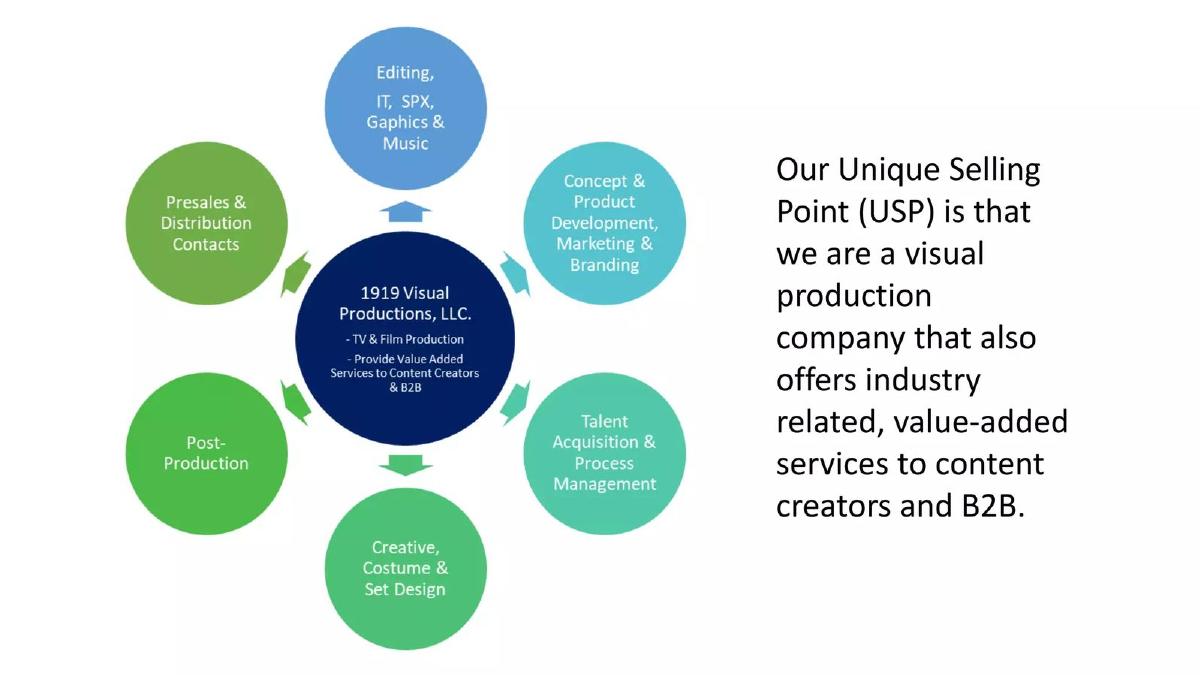
- The company claims a Unique Selling Point of offering value-added services to B2B and other content creators alongside their own productions (Slide 2).
- Geographic focus begins in North America with plans to expand to European, African, and Asian markets (Slide 8).
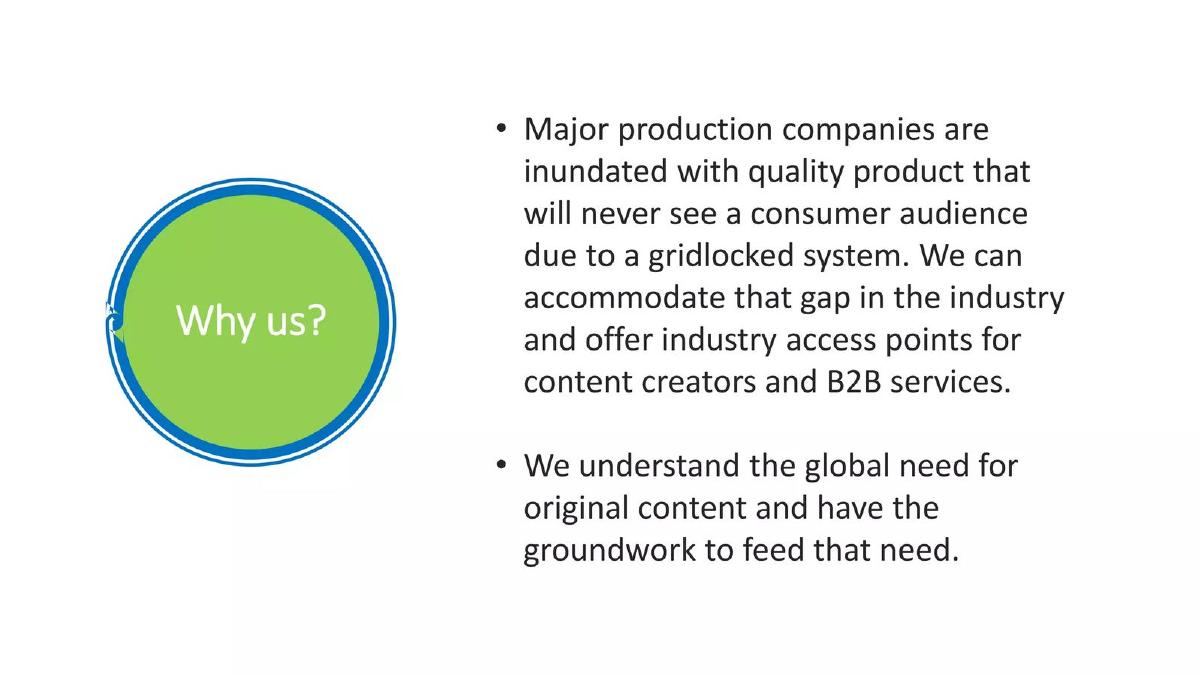
- The deck identifies a 'gridlocked system' in major production companies as the primary market problem (Slide 3).
Deck Overview
The 1919 Visual Productions LLC pitch deck is a 10-slide presentation designed to secure significant early-stage capital for a media production entity. The deck focuses heavily on the company's internal capabilities and its philosophical approach to storytelling, rather than specific intellectual property (IP) or existing contracts. It positions the company as a full-service solution for the film and television industry, covering the entire lifecycle of content creation.
Slide 1: Title and Vision
The cover slide introduces the company name, 1919 Visual Productions LLC, accompanied by a logo featuring a stylized eye. A collage of black-and-white headshots and production-related imagery (a cinema, film reels, a clapperboard) sets the tone. The tagline states: "Everyone has a story... and we are amazing storytellers."
Slide 2: Unique Selling Point (USP)
This slide uses a hub-and-spoke diagram to illustrate the company's integrated services. The central node is the company itself, surrounded by six service areas: Editing, IT, SPX, Graphics & Music ; Concept & Product Development, Marketing & Branding ; Talent Acquisition & Process Management ; Creative, Costume & Set Design ; Post-Production ; and Presales & Distribution Contacts . The text clarifies that their USP is being a production company that also offers these "value-added services to content creators and B2B."
Slide 3: The Problem ("Why us?")
The company identifies a market gap, claiming that major production companies are "inundated with quality product that will never see a consumer audience due to a gridlocked system." They position themselves as the solution to this gap, offering "industry access points" and claiming to have the "groundwork" to feed the global need for original content.
Slide 4: Our Unique Solution
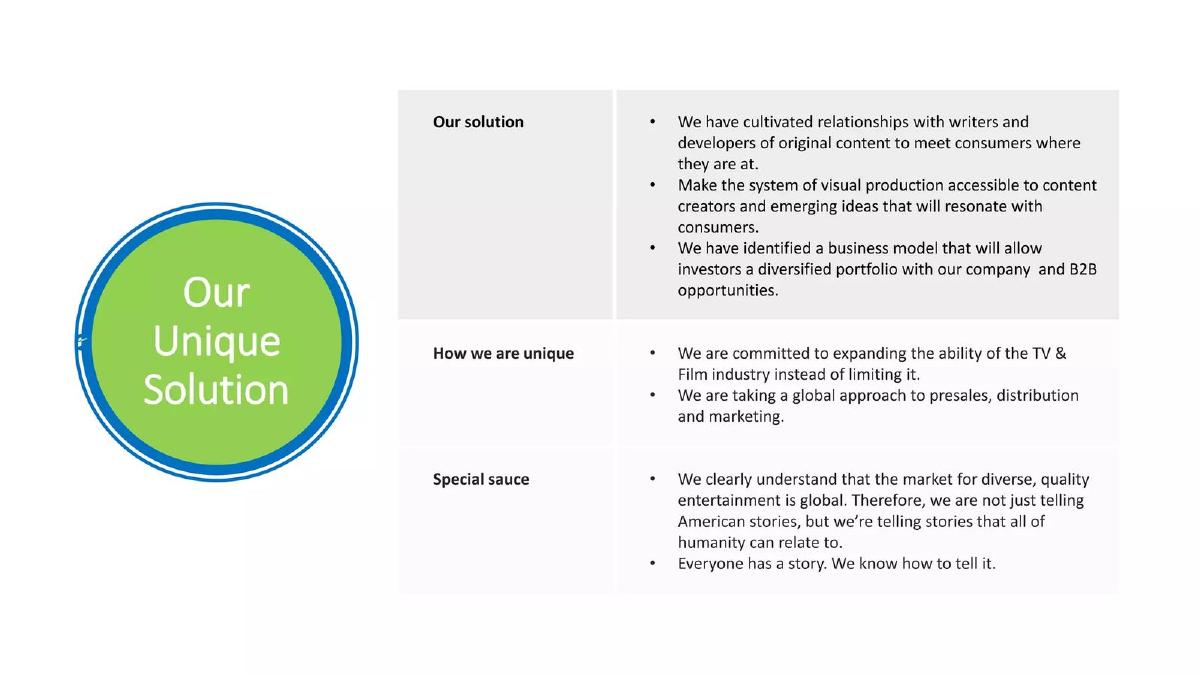
This slide breaks down the solution into three categories: Our solution , How we are unique , and Special sauce . Key points include cultivating relationships with writers, making visual production accessible to emerging ideas, and taking a "global approach" to distribution. The "special sauce" section emphasizes that they are not just telling American stories, but stories that "all of humanity can relate to."
Slide 5: Competitive Advantage
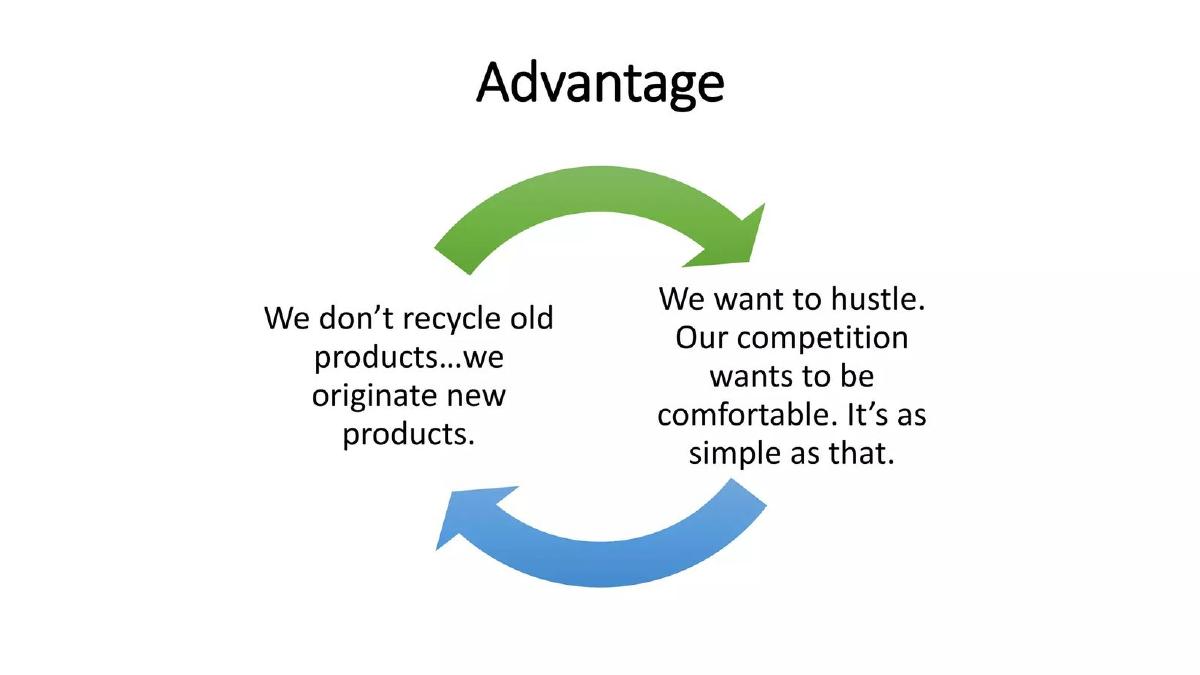
The advantage is presented as a simple binary. The slide states: "We don’t recycle old products... we originate new products." It further contrasts the company with its competition by stating, "We want to hustle. Our competition wants to be comfortable. It’s as simple as that." No specific competitors are named.
Slide 6: Economic Development & Job Creation
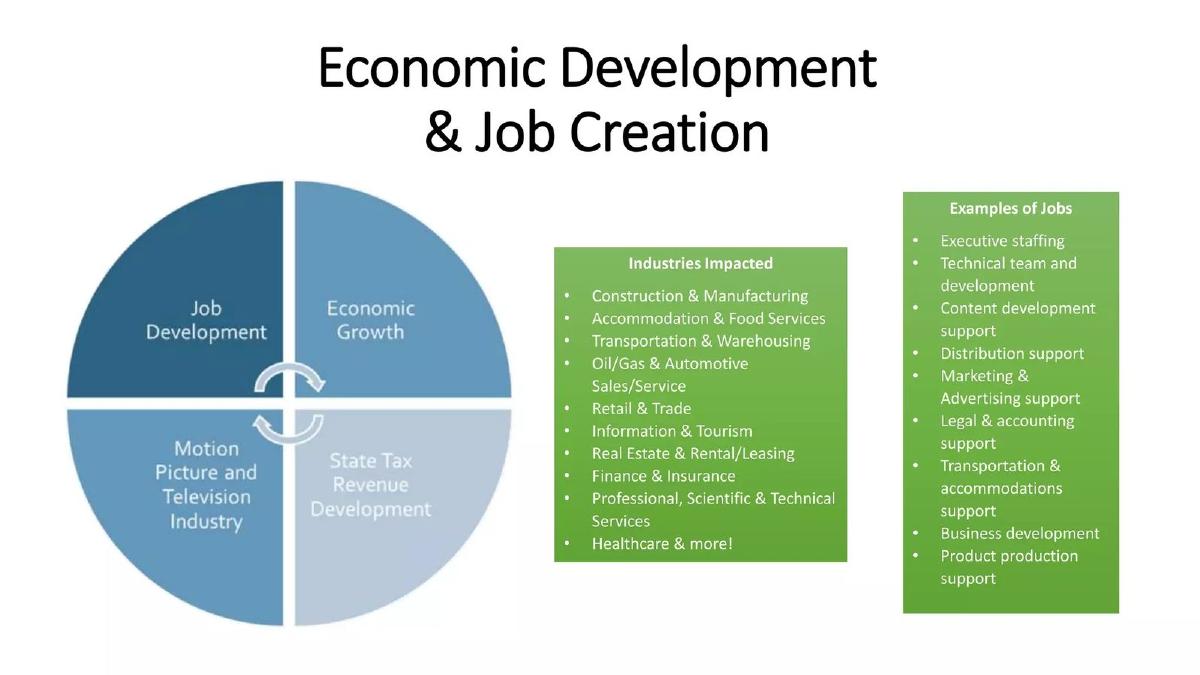
This slide attempts to show the broader impact of the company. A four-quadrant circle links Job Development , Economic Growth , State Tax Revenue Development , and the Motion Picture and Television Industry . It lists 10 impacted industries, ranging from Construction & Manufacturing to Healthcare. It also lists examples of jobs created, such as executive staffing, technical teams, and product production support.
Slide 7: Product Roadmap
The product slide distinguishes between "Current" and "Future" focuses. Current products are listed as Television and Movies . The future focus is Digital Streaming . A circular diagram on the right side of the slide lists the formats for original content creators: Shorts , 30 Minute Format , Hour Long Series , and Movie Production .
Slide 8: Company Summary
This slide provides the most concrete organizational data. The business model targets the 18-55+ demographic with a revenue example of "$2M per episode x 13 episodes." The geographic focus is currently North America, with future plans for Europe, Africa, and Asia. The team section lists 4 Founders (CEO, COO, CLCO, CSO) and 2 Staff members. Notably, it mentions that 4 additional staff are "in the pipeline convinced to quit their jobs."
Slide 9: The Ask
The financial request is detailed here. The company is seeking $10M for this round and $50M overall . It is structured as Equity Funding . The slide notes that revenue has "Not yet" been generated and that founders have bootstrapped $600,000 . It also mentions one (1) commitment from an investor, though the investor is not named. The funds are intended for production expenses (Above and Below the Line), facilities, and administrative costs.
Slide 10: Contact Information
The final slide provides contact details for Deon Durr, Principal/CEO , including a phone number, email address, and the company website URL.
What 1919 Visual Productions LLC Does Well
Clear Service Integration: Slide 2 effectively communicates that the company is not just a production house but a vertically integrated service provider. This suggests a desire to control the entire value chain, which can be attractive for margins if executed correctly. · Defined Leadership Roles: Slide 8 provides a clear breakdown of the executive suite. Including a COO with an MBA and a dedicated Legal/Compliance officer (CLCO) suggests an early focus on organizational structure and risk management. · Skin in the Game: The disclosure on Slide 9 that founders have bootstrapped $600,000 provides a level of credibility regarding their commitment to the venture. · Broad Market Vision: The emphasis on global storytelling and expansion into African and Asian markets (Slides 4 and 8) aligns with current trends in the streaming industry where international growth is a primary driver.
What is Missing from the 1919 Visual Productions LLC Deck
Specific IP or Project Slate: For a production company, the "product" is the content. The deck mentions formats (shorts, series, movies) but does not name a single specific project, script, or property currently in development. · Competitive Landscape: While the deck claims the competition is "comfortable," it fails to name specific studios or production companies. A standard competitive matrix or analysis of how they will win against established incumbents is absent. · Financial Projections: Beyond a single "example" of $2M per episode, there are no detailed financial projections, break-even analyses, or timelines for when the $10M investment will result in revenue. · Proof of Concept: Since the company is pre-revenue, investors would typically look for "traction" in the form of awards, pilot episodes, signed talent, or distribution letters of intent. None of these are present in the deck. · Use of Funds Detail: While Slide 9 lists categories for the $10M, it does not provide a percentage breakdown. Investors generally want to see exactly how much of that $10M goes to production versus "Executive & Administrative Costs."
What a Founder Should Copy from This Deck
The "Economic Impact" Angle: Slide 6 is a unique addition. Showing how a startup impacts the broader economy and tax revenue can be a powerful tool when pitching to regional development funds or government-backed investment vehicles. · Simplified Team Breakdown: The way Slide 8 lists the specific roles (CEO, COO, CLCO, CSO) and their backgrounds (MBA, Attorney, Veteran) is a clean way to show a balanced leadership team without requiring long biographies. · Directness of the Ask: Slide 9 is very transparent about the company's status. Stating "Revenue generated: Not yet" and "Stage: Angel/Launch phase" prevents any ambiguity during the due diligence process.
Final Analysis
The 1919 Visual Productions LLC deck is a high-level conceptual pitch for a media conglomerate. It succeeds in presenting a professional image and a clear organizational structure. However, the $10M ask is exceptionally high for a company with no revenue, no named IP, and no demonstrated traction in a highly competitive and capital-intensive industry. The deck relies heavily on the "hustle" and "storytelling" narrative, which may resonate with certain angel investors but lacks the data-driven rigor typically required for institutional equity rounds of this size. To move forward, the company would likely need to supplement this deck with a detailed production slate and a more granular financial model.
Frequently asked questions
- What is the specific funding request and how will it be used?
- According to Slide 9, 1919 Visual Productions LLC is seeking $10M in equity funding for the current round, with a long-term goal of $50M. The capital is earmarked for 'Above the Line' and 'Below the Line' expenses, additional creative costs, editing, music, business expenses, and the leasing or purchase of facilities and startup costs.
- What is the company's current revenue status and traction?
- Slide 9 explicitly states that revenue has 'Not yet' been generated. The company is in the 'Angel/Launch phase' and is currently open for investment. The only financial traction mentioned is the $600,000 collectively invested by the founders through bootstrapping.
- Who is on the leadership team and what is their composition?
- Slide 8 details a leadership team of four founders: a CEO/Executive Producer, a COO with an MBA, a Legal/Compliance Attorney (CLCO), and a CSO who is a Veteran with an IT/Physical Security background. They are supported by two staff members in production and creative roles.
- What is the proposed revenue model for the studio?
- Slide 8 lists 'Product Purchase/Subscription' as the primary revenue models. It provides a hypothetical example of $2M per episode for a 13-episode run, though it notes this is dependent on the specific product. The target audience is defined broadly as 18-55+ years old.
- How does the company differentiate itself from major studios?
- On Slide 5, the company claims its advantage is that it 'originates new products' rather than recycling old ones. It characterizes the competition as wanting to be 'comfortable' while 1919 Visual Productions 'wants to hustle.' Slide 3 further argues that they provide access points for content that major companies ignore due to a gridlocked system.