Visionful’s 2018 pre-seed deck is a lean, data-driven presentation that prioritizes market size and immediate traction over technical complexity. By identifying a specific pain point—102 million poorly managed parking spots—and backing it with a $10M ARR pipeline, the founders created a compelling case for a $150,000 investment. The deck excels at social proof, listing logos like Facebook, Stanford, and UC San Diego as clients, which is rare for a pre-seed stage. While it lacks a formal 'Ask' slide and detailed unit economics, the strength of the founding team (three PhDs) and the clear value…
Key takeaways
- The deck identifies a massive addressable market, citing a $118B total parking industry and a $12B managed parking SAM (Slide 9).
- Visionful claims significant early traction with '20X growth in 60 days' and high-tier logos including Facebook and Stanford (Slide 7).
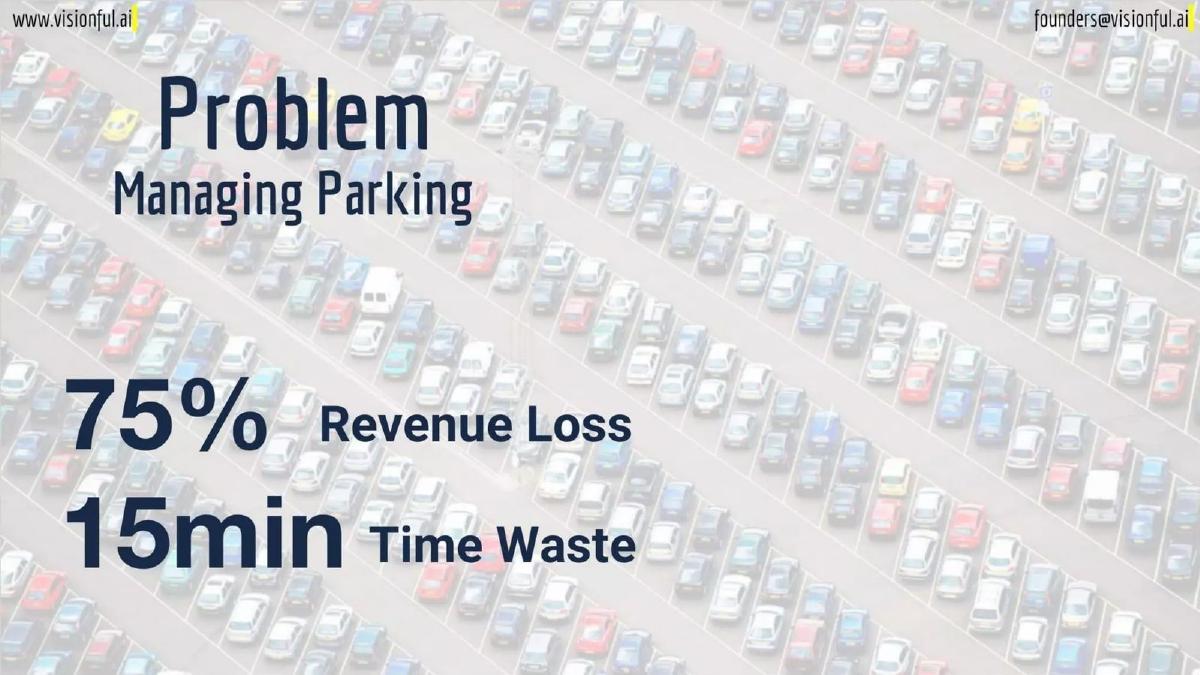
- The startup quantifies the problem effectively, noting 75% revenue loss and 15 minutes of time wasted in parking management (Slide 4).
- The founding team is highly technical, featuring three PhDs across the CEO, CTO, and Head AI Scientist roles (Slide 11).
- The business model is framed as B2B SaaS with a stated $10M ARR currently in the pipeline (Slide 8).
- The deck provides a clear ROI example: a mid-size university campus can generate $2M in additional revenue using the Visionful system (Slide 10).
- There is no explicit 'Ask' slide detailing how the $150,000 would be spent or what the specific funding terms were.
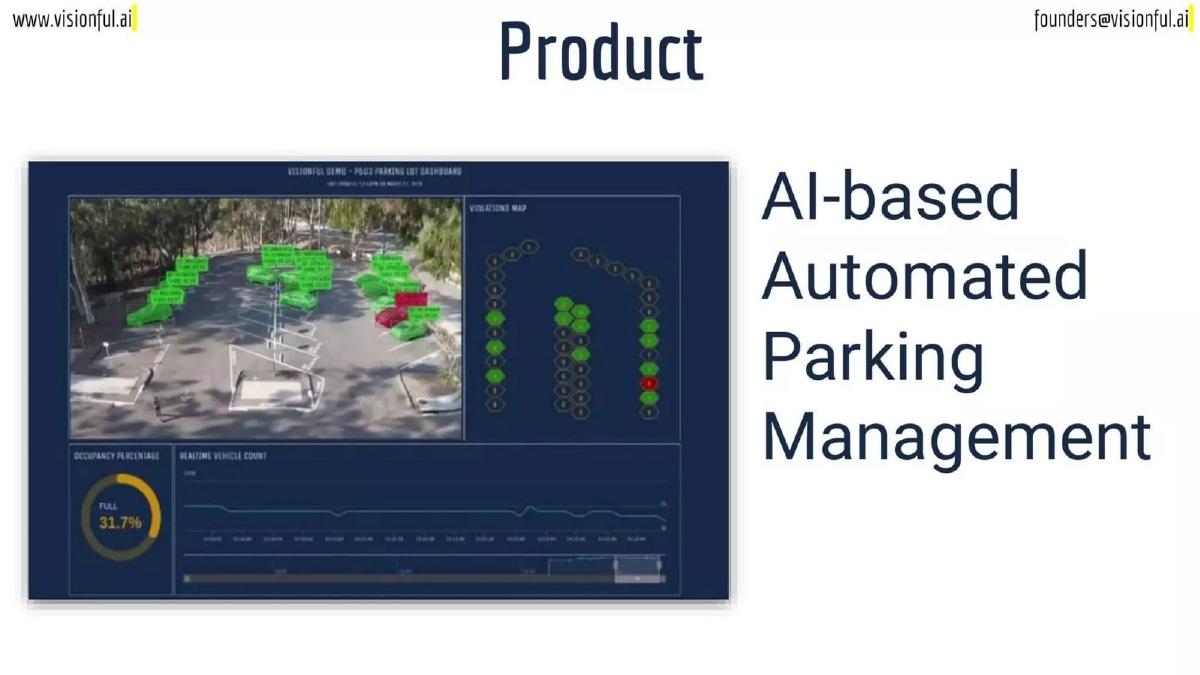
- The product is presented through a functional dashboard view showing real-time vehicle counts and occupancy percentages (Slide 5).
Introduction: The $150,000 Pre-Seed Signal
Visionful’s 2018 pitch deck is a study in how to leverage high-signal data to overcome the hurdles of a pre-seed round. While the amount raised ($150,000) was modest by today’s standards, the deck itself presents a company with much larger ambitions. By focusing on a specific, unsexy problem—parking management—and applying high-level technical expertise (three PhDs), Visionful created a narrative of inevitable efficiency. The deck is 13 slides long, minimalist in design, and extremely aggressive in its claims of traction and pipeline value.
Slides 1-4: The Problem of Scale
Slide 1: Title The deck opens with the tagline "The future of parking is automated." The visual shows a stylized city map with a car icon and a signal pulse, immediately establishing the intersection of physical infrastructure and digital connectivity.
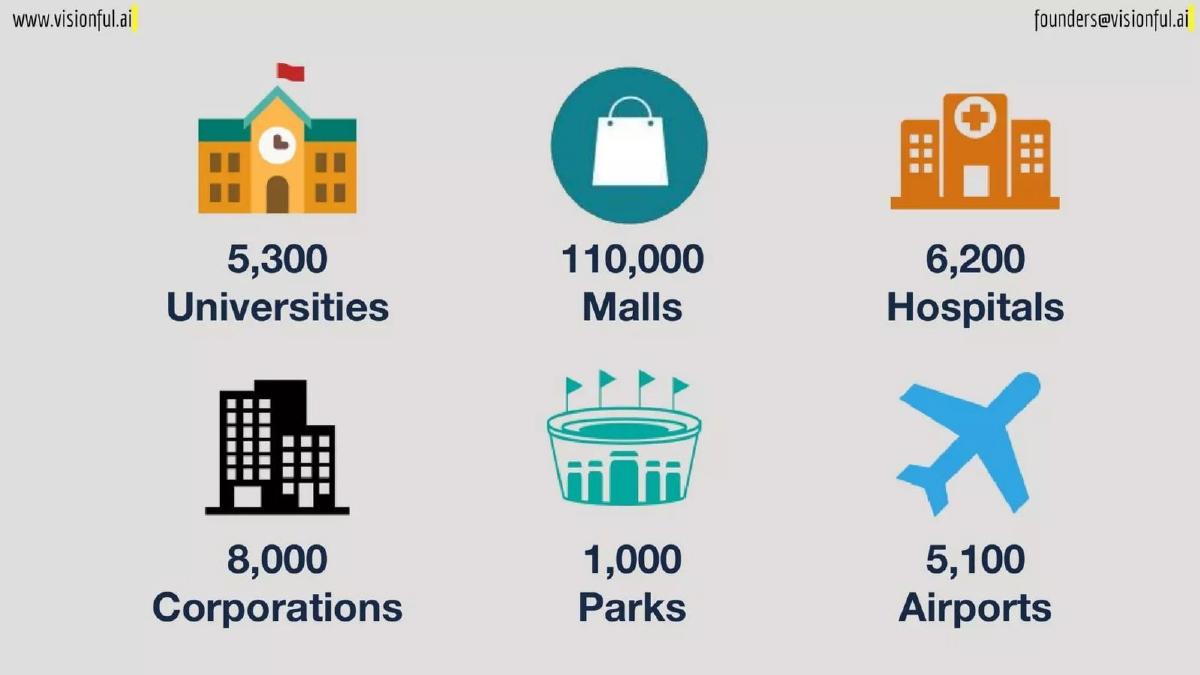
Slide 2: Target Verticals Visionful immediately establishes the scale of the opportunity by listing six key verticals. The slide cites 5,300 Universities, 110,000 Malls, 6,200 Hospitals, 8,000 Corporations, 1,000 Parks, and 5,100 Airports. This slide serves as a precursor to the TAM slide, showing the breadth of the potential customer base before discussing dollar amounts.
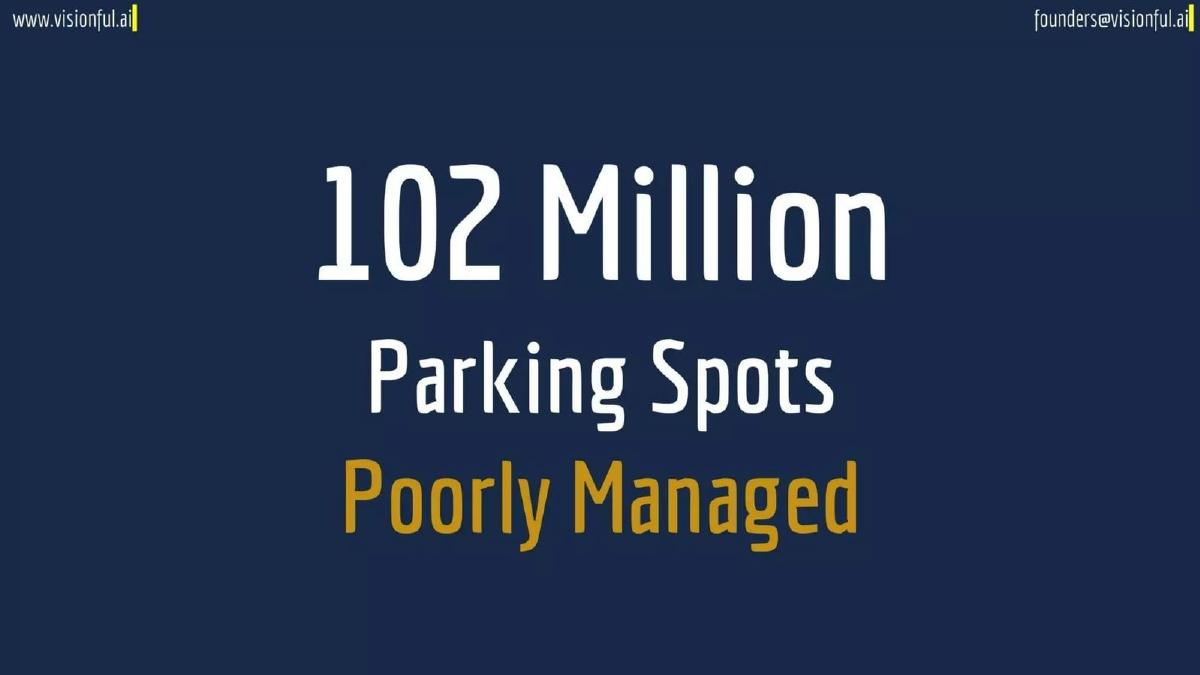
Slide 3: The Core Metric Slide 3 is a high-impact statement slide: "102 Million Parking Spots Poorly Managed." By using a large, bold font against a dark background, the founders force the investor to reckon with the inefficiency of the current status quo. It frames the problem as a management failure rather than a lack of physical space.
Slide 4: The Cost of Inefficiency This slide quantifies the pain for both the operator and the user. It cites a "75% Revenue Loss" for managers and "15min Time Waste" for drivers. This dual-sided problem sets up the solution as a win-win for the entire ecosystem. The background image of a crowded parking lot reinforces the visual chaos they intend to solve.
Slides 5-6: The Solution and Interface
Slide 5: Product Visionful introduces its "AI-based Automated Parking Management." The slide features a screenshot of the actual software interface. The dashboard shows a live camera feed with green and red bounding boxes around vehicles, demonstrating their computer vision capabilities in action. It also displays a "31.7% Full" occupancy metric, proving the system can translate visual data into actionable percentages.
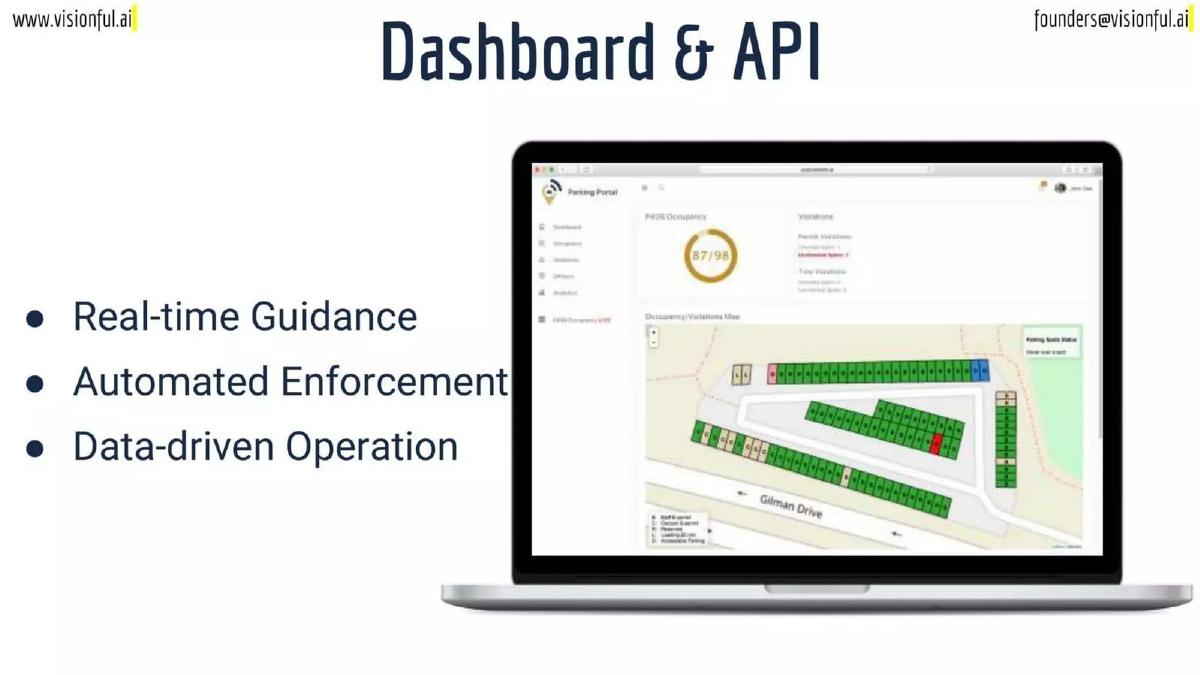
Slide 6: Dashboard & API This slide emphasizes the delivery mechanism. By highlighting "Real-time Guidance," "Automated Enforcement," and "Data-driven Operation," the company positions itself as a full-stack utility. The mention of an API suggests that their data can be integrated into larger smart city or corporate infrastructure systems, increasing the stickiness of the product.
Slides 7-10: Traction and Market Opportunity
Slide 7: Clients This is the most powerful slide in the deck. It claims "20X growth in 60 days" and displays the logos of Stanford University, Facebook, UC San Diego, and the University of San Diego. For a pre-seed company, having Facebook and Stanford as early clients or pilots is an extraordinary validator that likely did the heavy lifting for the entire fundraise.
Slide 8: Pipeline Visionful doubles down on traction by showing a "$10M ARR in pipeline." The slide lists major industry players like Ace Parking, ABM, and LAZ Parking. This demonstrates that they aren't just selling to individual campuses, but are successfully pitching the massive third-party operators that manage thousands of lots globally.
Slide 9: Market Size The deck follows the standard TAM/SAM format. It identifies a $118B Parking Industry as the TAM and a $12B Managed Parking market as the SAM. It also notes that the smart parking market is growing at 18% YoY, suggesting a tailwind for the business.
Slide 10: The ROI Case Study Slide 10 provides a concrete example of the value proposition. It states that a mid-size University Campus typically sees $4M in parking revenue, and the "Visionful System" can generate an "Additional $2M" in revenue. This 50% revenue increase is a compelling argument for any CFO or facility manager.
Slides 11-13: Team and Vision
Slide 11: Founders The team slide is a significant strength. It features Masoud Jalali, PhD (CEO), Kamran Alipour, PhD (CTO), Payam Vaezi, PhD (Head AI Scientist), and Farshad Yousefi (CMO). Having three PhDs on a four-person founding team at the pre-seed stage suggests a very high level of technical defensibility, particularly in the field of AI and computer vision.
Slide 12: The Ecosystem This slide connects Visionful to the broader trends of "Smart Cities" and "Autonomous Cars." It positions the company as the connective tissue between static infrastructure and the future of autonomous mobility. This expands the narrative from a simple parking app to a critical piece of future city infrastructure.
Slide 13: Closing The final slide repeats the contact information and the $10M ARR pipeline figure. Interestingly, it features a graphic that crosses out "Driving" and replaces it with "Parking" under the word "Autonomous," reinforcing their niche focus within the autonomous vehicle revolution.
What Works in the Visionful Deck
1. Extreme Social Proof: The inclusion of Facebook and Stanford logos on Slide 7 is the ultimate de-risking mechanism. Investors assume that if these organizations have vetted the technology, the technical hurdles are likely cleared.
2. Quantified Value Proposition: Slide 10’s breakdown of the $2M revenue increase for a university campus makes the sales process feel logical rather than aspirational. It answers the "Why now?" and "Why buy?" questions simultaneously.
3. Technical Pedigree: The concentration of PhDs on the team slide (Slide 11) provides confidence that the AI and computer vision claims are backed by legitimate expertise, which was particularly important in 2018 when "AI" was often used as a buzzword without substance.
4. Clear Vertical Focus: By listing specific numbers for malls, hospitals, and universities on Slide 2, the founders show they have done the homework on their Go-To-Market strategy. They aren't just selling to "everyone"; they are selling to specific high-density environments.
What is Missing from the Visionful Deck
1. The Ask: There is no slide detailing how much money they are raising, the valuation, or the milestones they intend to hit with the capital. While the catalogue facts state they raised $150,000, a founder using this deck today would need to be explicit about the round terms.
2. Competitive Landscape: The deck completely ignores competitors. In the smart parking space, there are numerous hardware-based solutions (sensors in the ground) and other vision-based startups. Failing to address why Visionful is superior to these alternatives is a notable omission.
3. Business Model Specifics: While it mentions "B2B SaaS," it doesn't explain the pricing structure. Is it per spot, per camera, or a flat monthly fee? Investors usually want to see how the $10M ARR pipeline is calculated.
4. Hardware vs. Software: The company description mentions they offer both software and hardware, but the deck focuses almost entirely on the software dashboard. The logistics of hardware installation, maintenance, and capital expenditure (CapEx) are not addressed.
What a Founder Should Copy
1. Use a 'Pipeline' Slide: If you are in the B2B space, don't just show who you have signed; show who is in the funnel. Slide 8’s use of logos for the pipeline is a great way to show momentum even if contracts aren't fully executed yet.
2. Lead with the Problem's Magnitude: Slide 3 ("102 Million Parking Spots") is a great example of using a single, massive number to anchor the investor's perspective on the problem's scale.
3. Simplify the Product View: Don't use complex architectural diagrams. Slide 5 shows exactly what the user sees. If your software looks good and works, show it clearly.
4. The ROI Slide: Every B2B deck should have a version of Slide 10. If you can tell an investor, "Our customer spends X and we give them X + Y," you have a business, not just a product.
Frequently asked questions
- What is the core technology behind Visionful?
- Visionful utilizes AI-based computer vision to automate parking management. According to the deck, the system provides real-time guidance, automated enforcement, and data-driven operations. Slide 5 shows a dashboard that tracks 'AI Vision Analytics' for cars, humans, autonomous vehicles, and fleets, allowing lot managers to see occupancy percentages and violation maps in real-time.
- How does Visionful justify its market opportunity?
- The deck uses a top-down market sizing approach on Slide 9, identifying a $118B Total Addressable Market (TAM) for the parking industry and a $12B Serviceable Addressable Market (SAM) for managed parking. It further supports this by listing the sheer volume of potential sites on Slide 2, including 110,000 malls, 8,000 corporations, and 5,300 universities.
- What kind of traction did Visionful have at the time of this deck?
- For a pre-seed company, the traction was substantial. Slide 7 claims '20X growth in 60 days' and displays logos for Stanford University, Facebook, UC San Diego, and the University of San Diego. Furthermore, Slide 8 claims a $10M ARR pipeline consisting of major parking operators like Ace Parking, ABM, and LAZ Parking.
- Who are the founders of Visionful?
- The team is led by four individuals, three of whom hold PhDs. As shown on Slide 11, the team includes Masoud Jalali, PhD (CEO), Kamran Alipour, PhD (CTO), Payam Vaezi, PhD (Head AI Scientist), and Farshad Yousefi (CMO). This high concentration of advanced degrees likely served as a strong signal of technical competency to investors.
- What is missing from the Visionful pitch deck?
- The deck is missing several standard components, most notably a specific 'Ask' slide defining the amount of capital sought and its allocation. It also lacks a detailed competitor analysis, a roadmap of future product features, and specific unit economics or pricing tiers for their B2B SaaS model beyond the general ROI example for universities.