Visomall presents a vision for a social e-commerce platform that combines the utility of Amazon with the social engagement of Facebook. The deck identifies a significant market gap, noting that 95% of retail sales in 2014 occurred offline, totaling $4,530B. The founder, Adiv Ohayon, positions Visomall as a solution for retailers like H&M and Macy’s who struggle to sell online. However, the deck is notably light on product specifics, with Slide 7—meant to showcase 'Fun Experiences'—appearing as a blank dark grey box. The venture is currently a solo operation, with the founder explicitly seekin…
Key takeaways
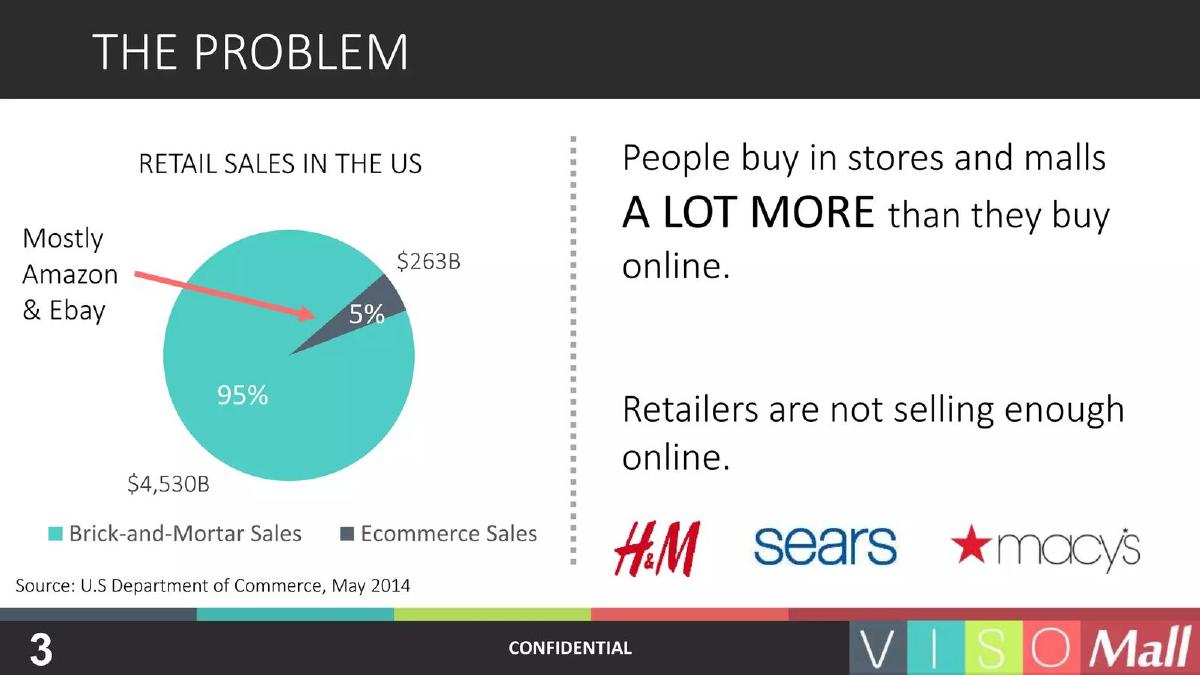
- The deck identifies a massive $4.5 trillion offline retail market as the primary opportunity (Slide 3).
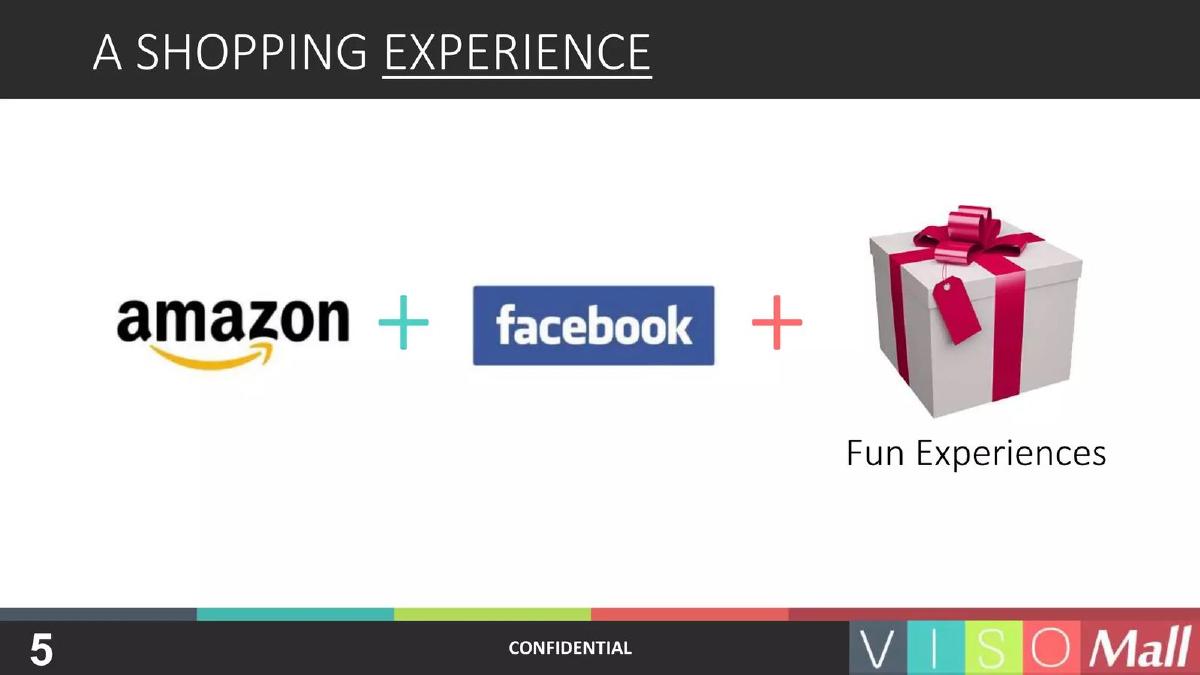
- Visomall defines its value proposition as a combination of Amazon, Facebook, and 'Fun Experiences' (Slide 5).
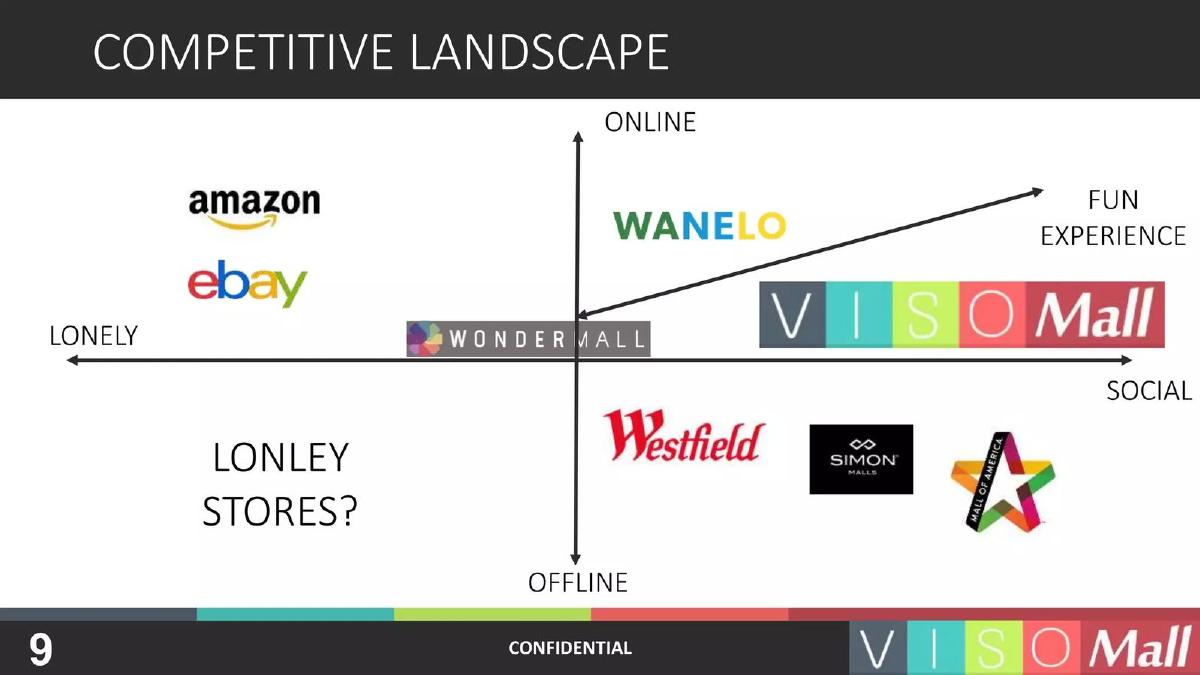
- The competitive landscape places Visomall in the high-social, high-fun quadrant, distinct from 'lonely' platforms like Amazon and eBay (Slide 9).
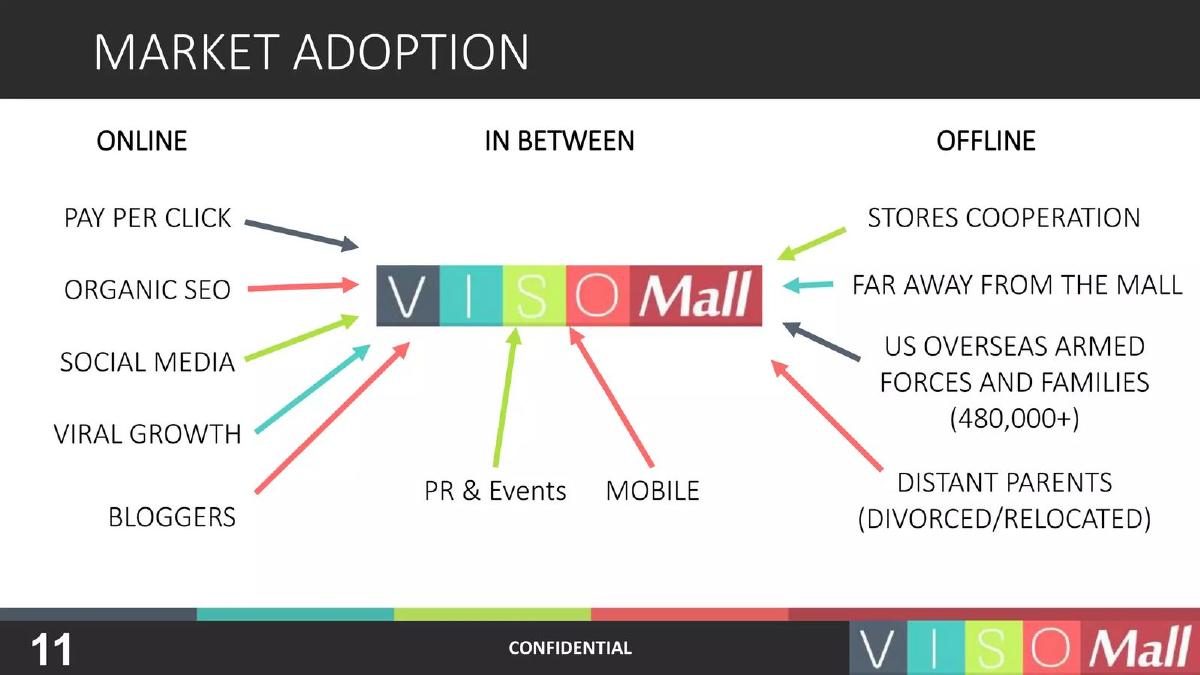
- Market adoption strategies include targeting specific demographics like the 480,000+ US overseas armed forces and families (Slide 11).
- The company is currently a solo-founder venture led by Adiv Ohayon, a former CTO at ViralShops (Slide 13).
- The founder lists technical proficiency in PHP, C#, Unity, and Node.js among other languages (Slide 13).
- A primary goal of the current phase is recruiting a CTO who is 'fun to work with' (Slide 15).
- The deck lacks a formal 'Ask' slide detailing the amount of capital being raised or the valuation sought.
Visomall Pitch Deck Analysis
The Visomall pitch deck is a 16-slide presentation that outlines a vision for a social e-commerce platform. The deck focuses heavily on the disparity between offline and online retail sales, positioning the 'social' element of shopping as the missing link in current e-commerce offerings. However, the deck is characterized by significant gaps in product demonstration and team structure, reflecting a very early-stage venture.
Slide 1: Title Slide
The deck opens with the title "Reinventing the Shopping Experience" and the Visomall logo. The logo uses a multi-colored block design, and the background features a simple cloud illustration. The branding suggests a consumer-facing, friendly, and perhaps playful platform, though the slide provides no specific industry context beyond the word 'Shopping.'
Slide 3: The Problem
This slide establishes the market opportunity using data from the U.S. Department of Commerce (May 2014). It notes that 95% of retail sales ($4,530B) occur in brick-and-mortar stores, while only 5% ($263B) occur online. The slide explicitly states that "Retailers are not selling enough online," highlighting brands like H&M, Sears, and Macy’s. The core thesis is that people buy in malls because they prefer the experience over the 'lonely' nature of Amazon and eBay.
Slide 5: A Shopping Experience
Visomall defines its product through a simple equation: Amazon + Facebook + Fun Experiences . This slide attempts to communicate the value proposition by leveraging the utility of a marketplace, the connectivity of a social network, and an undefined element of 'fun.' It uses a gift box icon to represent these fun experiences, but remains conceptual rather than functional.
Slide 7: Fun Experiences
This slide is titled "FUN EXPERIENCES" but contains only a large, blank dark grey rectangle. There is no text, no imagery, and no explanation of the product features. In a pitch deck, this is a critical failure, as it fails to demonstrate the very thing the founder claims will differentiate the company from multi-billion dollar competitors.
Slide 9: Competitive Landscape
The founder uses a standard four-quadrant graph to map the competition. The axes are Online vs. Offline and Lonely vs. Social/Fun Experience . Amazon and eBay are placed in the Online/Lonely quadrant. Physical malls like Westfield, Simon Malls, and Mall of America are in the Offline/Social quadrant. Visomall places itself in the top-right quadrant (Online/Social/Fun), with Wanelo and WonderMall as the nearest competitors.
Slide 11: Market Adoption
This slide outlines the go-to-market strategy. It divides tactics into Online (Pay Per Click, SEO, Social Media, Viral Growth, Bloggers), In Between (PR & Events, Mobile), and Offline . Notably, it identifies specific niche targets for offline-to-online conversion: "US Overseas Armed Forces and Families (480,000+)" and "Distant Parents (Divorced/Relocated)." This indicates a strategy of targeting users who are physically separated from their social shopping circles.
Slide 13: The Team
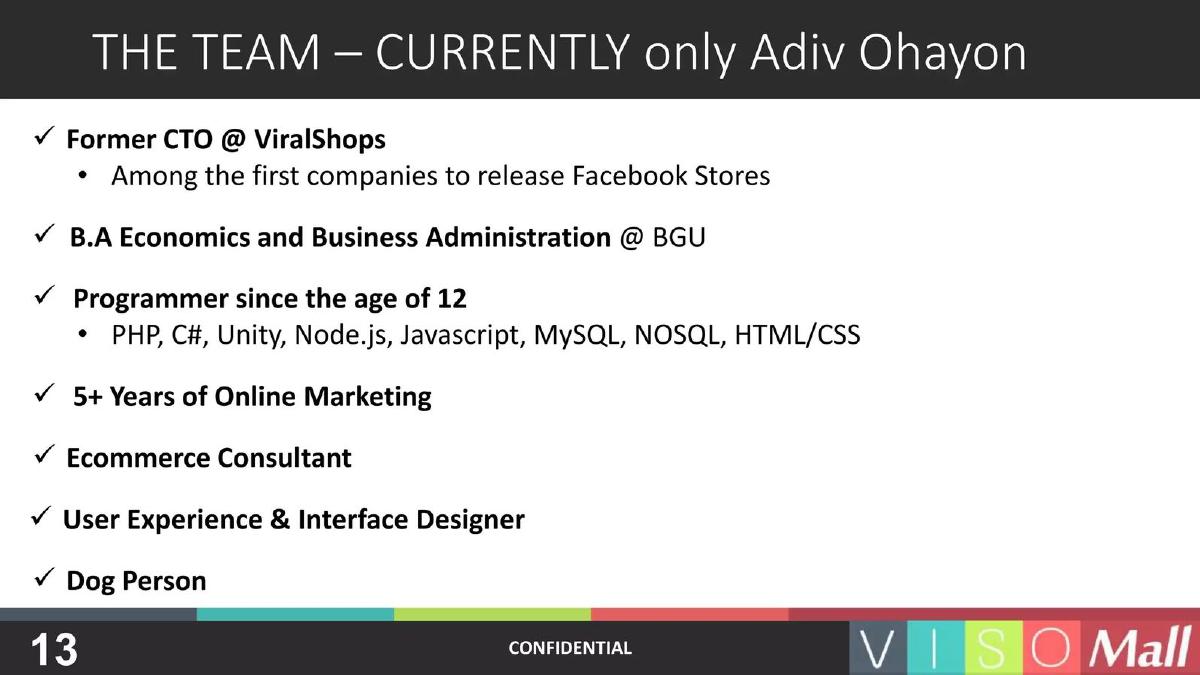
The slide title explicitly states: "THE TEAM – CURRENTLY only Adiv Ohayon." It lists Ohayon’s credentials, including his role as former CTO at ViralShops, where he was among the first to release Facebook Stores. His technical stack includes PHP, C#, Unity, Node.js, Javascript, MySQL, NOSQL, and HTML/CSS . He also lists himself as an Ecommerce Consultant, UX/UI Designer, and "Dog Person." While he appears technically capable, the slide confirms the lack of organizational depth.
Slide 15: What’s Next
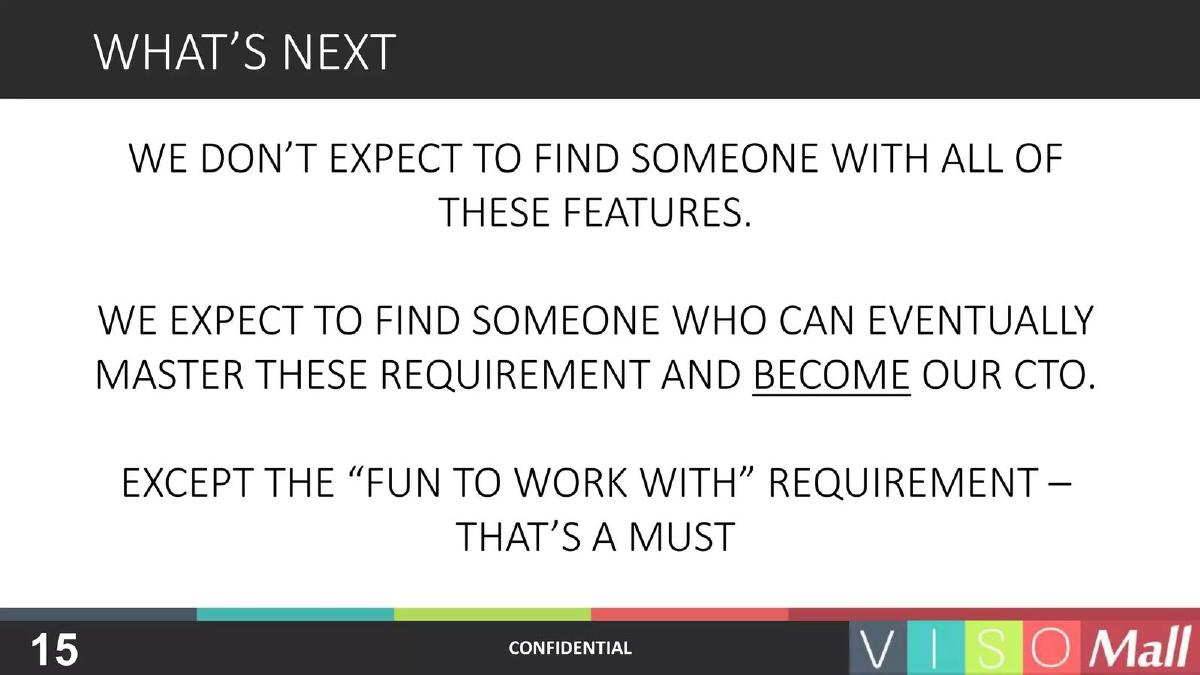
This slide serves as a recruitment call rather than a traditional business milestone slide. It states that the company is looking for a CTO . The founder notes, "We don’t expect to find someone with all of these features," but emphasizes that being "fun to work with" is a mandatory requirement. This reinforces the solo-founder status and the early stage of the project.
What Visomall Does Well
Market Sizing: The deck uses clear, cited data (Slide 3) to show the massive gap between offline and online retail. By focusing on the $4.5 trillion offline market, it makes the potential upside feel significant. · Niche Targeting: Identifying the overseas military and divorced parents (Slide 11) shows a level of strategic thinking regarding who would actually benefit from a 'social' online shopping experience. · Founder Transparency: The founder is honest about being a solo operator and clearly defines his technical skills (Slide 13), which helps set realistic expectations for the current state of the build.
What is Missing from the Deck
Product Demonstration: Slide 7 is a missed opportunity. Without showing what a 'Fun Experience' looks like, the pitch remains entirely theoretical. · Business Model: There is no mention of how Visomall intends to make money. Will it take a commission on sales, charge a subscription fee to retailers, or sell advertising? · Traction: Even for a solo founder, investors look for some form of validation—user signups, a beta waitlist, or retail partnerships. None are present here. · The Ask: The deck does not state how much money is being raised or what the specific use of funds would be, other than the general need for a CTO.
What Founders Should Copy
The 'Equation' Value Prop: Using a formula like 'Amazon + Facebook' (Slide 5) is a very effective way to quickly communicate a complex product idea to an audience that already understands the constituent parts. · Specific Competitive Axes: Instead of just 'Price' and 'Quality,' using 'Social' vs. 'Lonely' (Slide 9) helps define a unique brand personality and highlights a specific emotional pain point in the market. · Clear Source Attribution: Citing the U.S. Department of Commerce (Slide 3) adds immediate credibility to the market size claims, preventing the numbers from looking like 'founder math.'
Frequently asked questions
- What is the core problem Visomall is trying to solve?
- According to Slide 3, the problem is that 95% of retail sales still happen in physical stores and malls, totaling $4,530B, while e-commerce accounts for only 5% ($263B). The deck argues that major retailers like H&M, Sears, and Macy’s are failing to capture enough online sales because the current online shopping experience is 'lonely' compared to the social nature of physical malls.
- How does Visomall differentiate itself from Amazon and eBay?
- Slide 9 shows a competitive landscape where Amazon and eBay are categorized as 'Online' but 'Lonely.' Visomall positions itself in the 'Online,' 'Social,' and 'Fun Experience' quadrant. It claims to offer a more engaging, social-driven shopping environment that mimics the 'fun' of a physical mall, which traditional e-commerce platforms supposedly lack.
- Who is behind Visomall?
- As stated on Slide 13, the team currently consists only of Adiv Ohayon. Ohayon is a former CTO at ViralShops and has a background in economics and business administration from BGU. He is a programmer with experience in multiple languages and five years of online marketing experience. The deck emphasizes his role as a solo operator looking to expand.
- What is the 'Fun Experiences' feature mentioned in the deck?
- While Slide 5 lists 'Fun Experiences' as a core pillar of the business alongside Amazon and Facebook, Slide 7, which is titled 'Fun Experiences,' is entirely blank (a solid dark grey rectangle). The deck does not provide specific details, screenshots, or descriptions of what these experiences actually entail, leaving the core product hook undefined.
- What is the current stage of the company based on the deck?
- Visomall appears to be at the pre-seed or idea stage. Slide 13 confirms it is a one-person operation, and Slide 15 indicates that the founder is still searching for a CTO. The absence of traction data, revenue figures, or a specific funding 'Ask' suggests the deck is intended for early-stage networking or co-founder recruitment rather than a late-stage investment round.