The Vivagogy pitch deck, dated October 2016, is a brief 7-slide presentation that outlines a vision for 'Making Education to Employment One Process.' The company identifies a significant global skills gap costing over $19 trillion and proposes an online system to track informal learning and match it to job competencies. While the deck provides a clear problem statement and a high-level commercial model—offering free learning to users while selling access to a candidate database to employers—it is critically lacking in execution details. There is no mention of a founding team, current product…
Key takeaways
- Global EdTech investment reached $6.54 billion in 2015, yet the skills gap continues to cost over $19 trillion globally (Slide 2).
- The recruitment industry is identified as the only current beneficiary of the education-employment gap, capturing a $400 billion market (Slide 3 and 4).
- Vivagogy proposes an online system that tracks both formal and informal learning to match users to job competencies in real-time (Slide 4 and 5).
- The commercial model relies on providing free tools to learners and teachers to build a global database, then selling access to employers (Slide 6).
- The solution aims to disintermediate the recruitment industry and reinvest savings into 'third world economies' (Slide 6).
- The deck lacks all standard operational slides, including team bios, financial projections, competitive analysis, and a funding ask (Omission).
- A McKinsey quote is used to validate the disconnect between employers, education providers, and youth (Slide 5).
The Vision: Bridging the Gap
The Vivagogy deck, titled 'Making Education to Employment One Process,' is a high-level conceptual pitch. It focuses on the systemic failure of the current education and recruitment sectors. While the deck is dated October 2016, the problems it identifies—specifically the disconnect between what is taught and what is required by the workforce—remain relevant. However, as a fundraising tool, the deck is extremely sparse, relying on macro-economic statistics rather than company-specific achievements.
Slide 1: Title and Mission
The opening slide sets a broad, social-impact tone: 'Creating new learning paradigms to improve social conditions.' It establishes the company's core thesis that education and employment should not be treated as separate silos but as a single, unified process. There is no company logo or branding beyond the text and a simple geometric background.
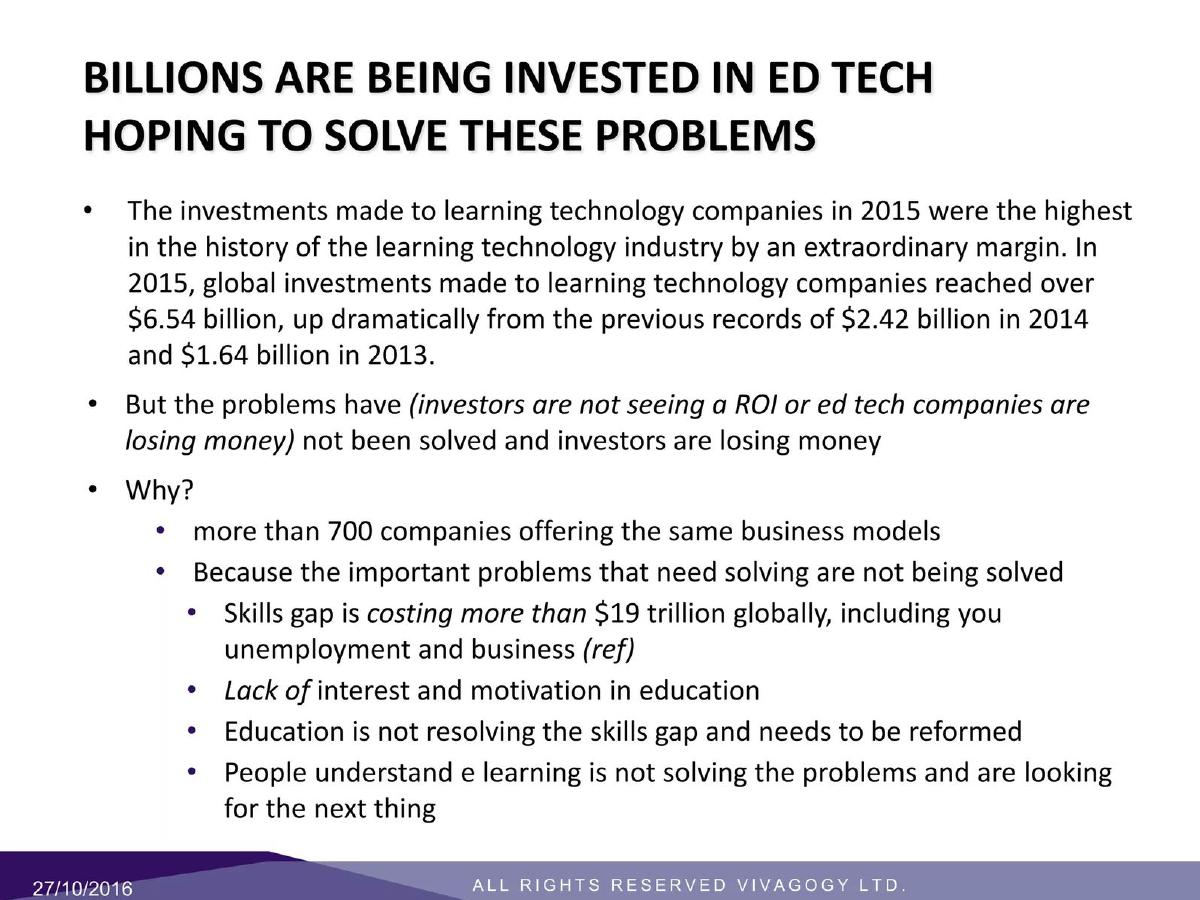
Slide 2: The EdTech Market Context
Vivagogy uses this slide to establish the market opportunity and the failure of existing solutions. They note that global investments in learning technology reached $6.54 billion in 2015 , a significant jump from $2.42 billion in 2014 and $1.64 billion in 2013 . Despite this capital influx, the slide claims investors are not seeing a ROI because the 'important problems' aren't being solved. Specifically, they cite a global skills gap costing more than $19 trillion . This slide serves to tell investors that while the sector is hot, the current players are failing, creating an opening for a new approach.
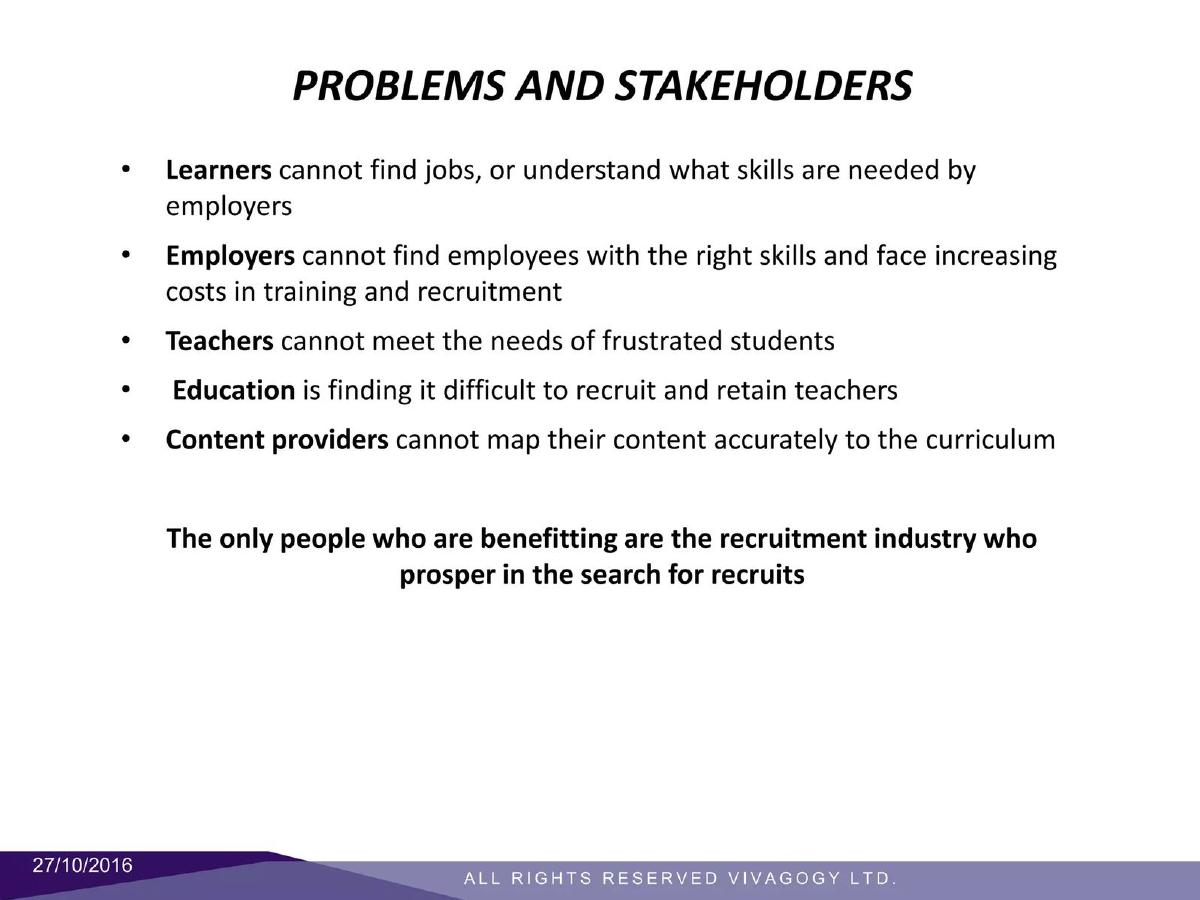
Slide 3: Problems and Stakeholders
This slide breaks down the pain points for five specific groups:
Learners: Cannot find jobs or understand required skills. · Employers: Cannot find skilled employees and face high recruitment costs. · Teachers: Cannot meet student needs and face high burnout/low retention. · Education: Struggles to recruit and retain staff. · Content Providers: Cannot map content to curricula.
The slide concludes with a provocative statement: 'The only people who are benefitting are the recruitment industry who prosper in the search for recruits.'
Slide 4: Solving the Problems for Stakeholders
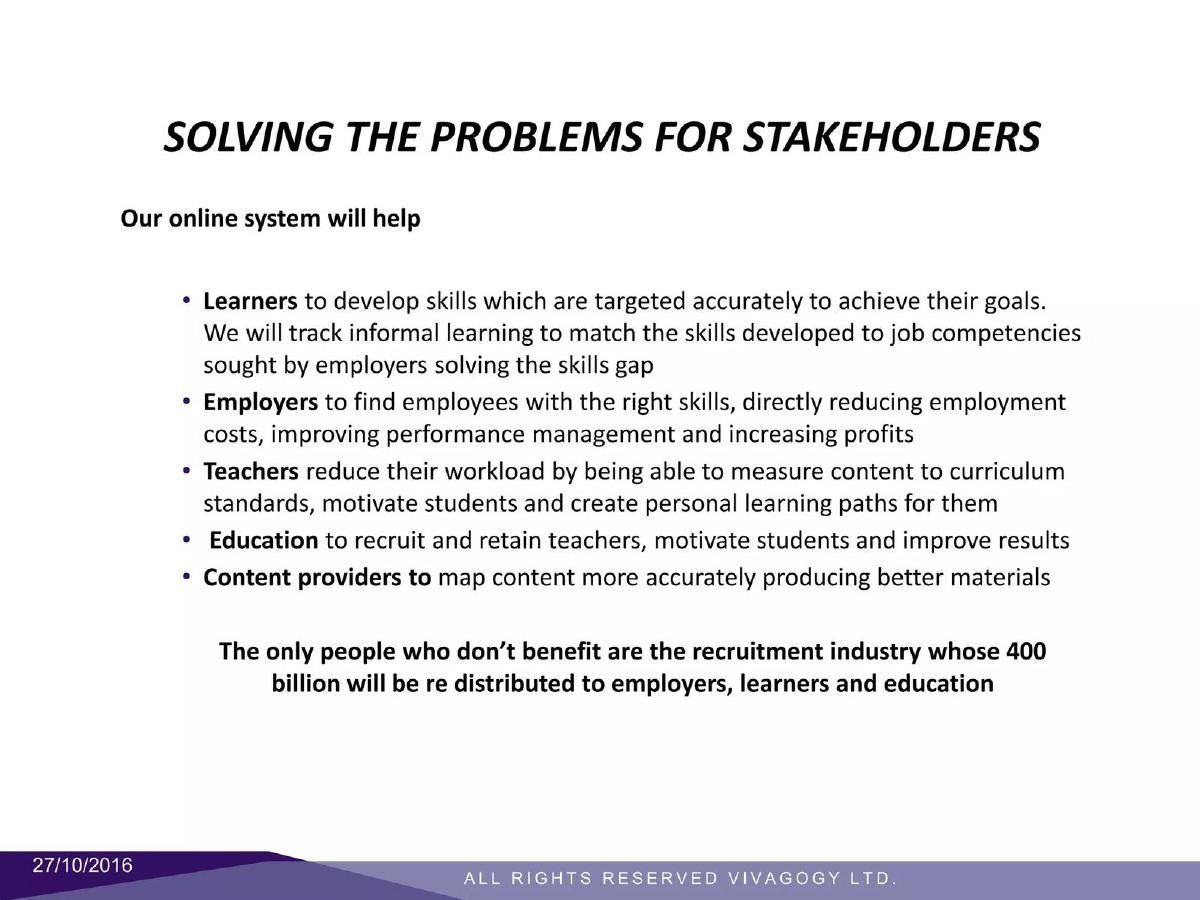
Vivagogy proposes an 'online system' to address these issues. The solution involves tracking 'informal learning' to match skills to 'job competencies sought by employers.' The most notable claim here is the financial target: the recruitment industry's $400 billion will be 're distributed to employers, learners and education.' This is a bold claim of total industry disruption, though the mechanism for this redistribution is not explained in technical detail.
Slide 5: The Vivagogy Solution and McKinsey Validation
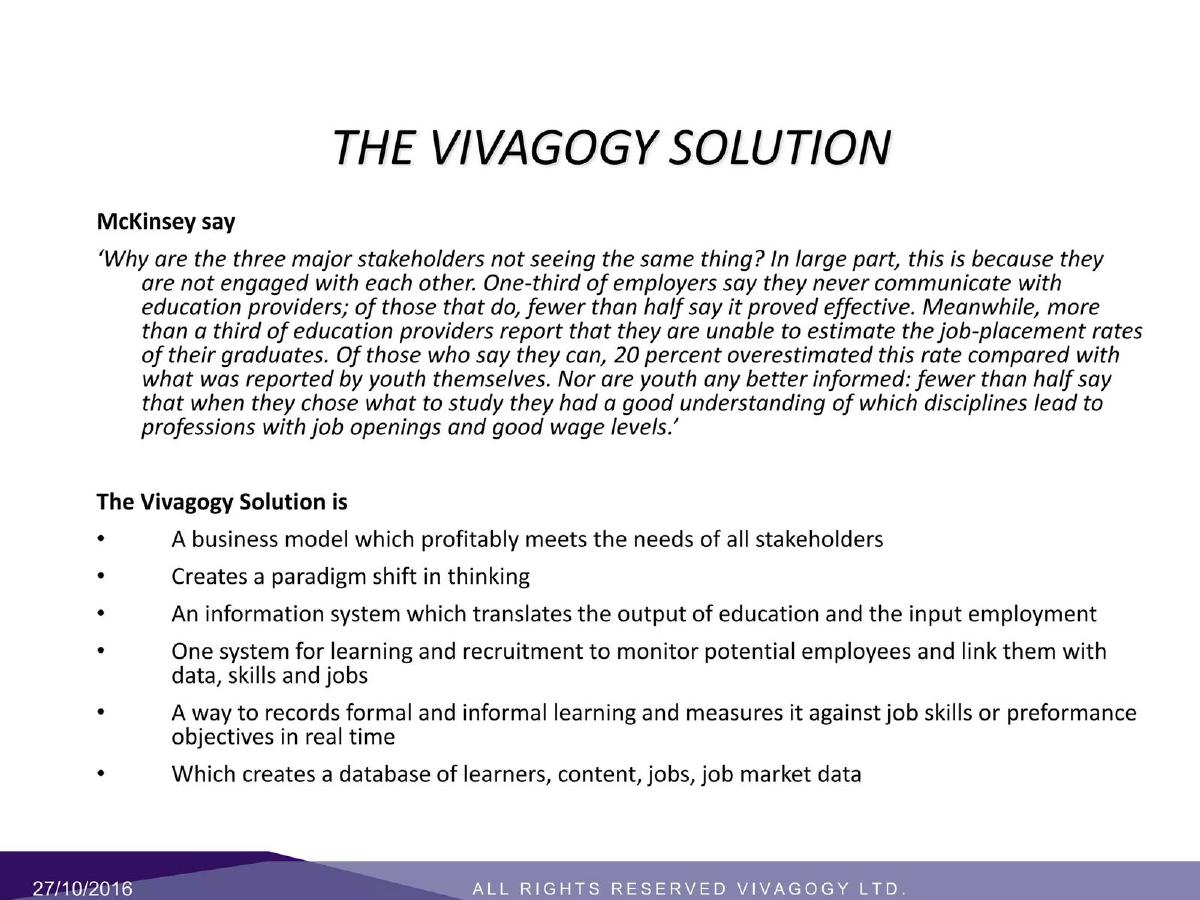
To add authority, the deck quotes McKinsey regarding the lack of engagement between stakeholders. The quote notes that one-third of employers never communicate with education providers. Vivagogy defines its solution as an 'information system' and a 'database of learners, content, jobs, [and] job market data.' It emphasizes the ability to record formal and informal learning in real-time against performance objectives.
Slide 6: The Commercial Model
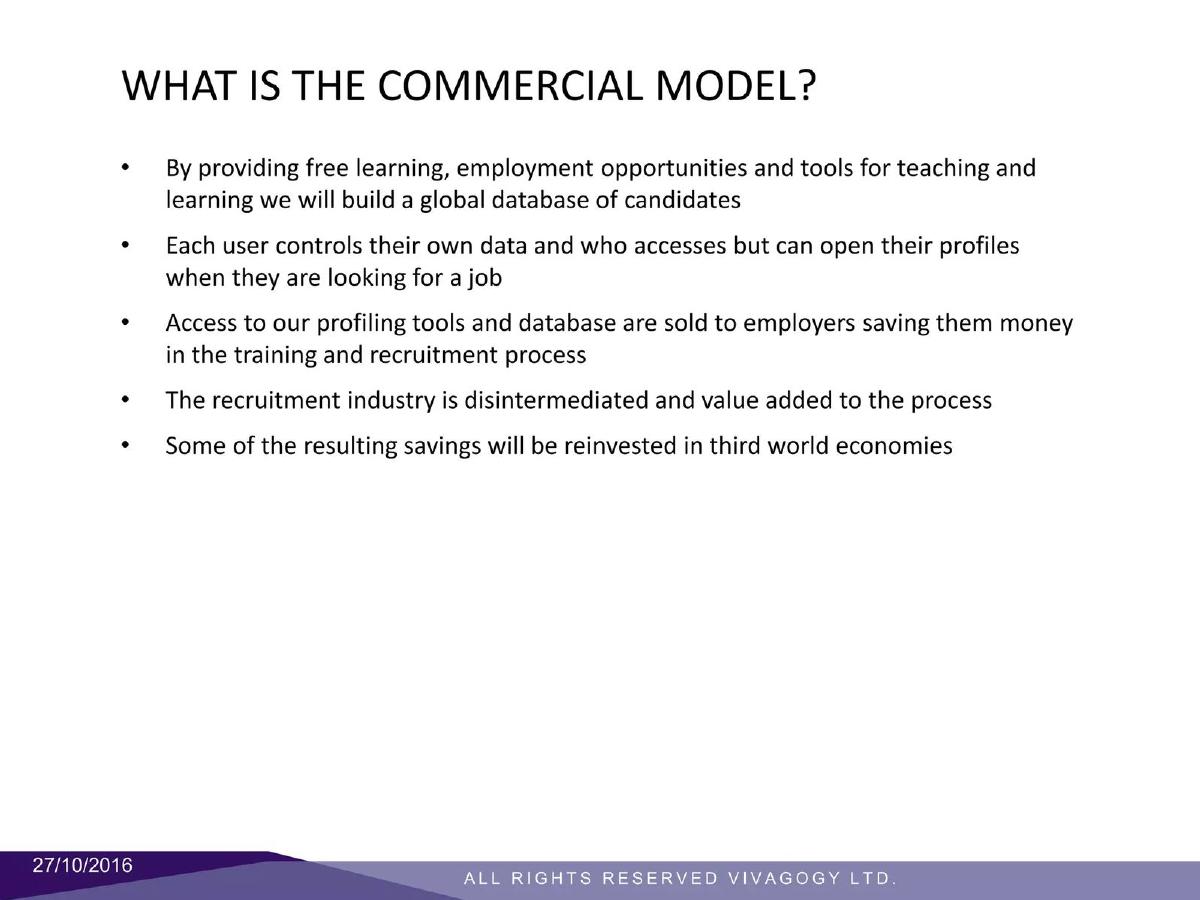
This is the most critical slide for an investor, as it outlines the revenue logic. The model is a classic 'data play':
Provide free tools to learners and teachers to build a global database. · Users control their own data but can open profiles for job searches. · Sell access to profiling tools and the database to employers. · Disintermediate the recruitment industry. · Reinvest savings into 'third world economies.'
The deck does not provide pricing tiers, projected user acquisition costs, or a timeline for reaching the scale necessary for a database to be valuable to employers.
Slide 7: The Conclusion
The final slide simply states 'The next big thing Vivagogy.' It lacks contact information, a summary of the funding requirements, or a call to action.
What Works in This Deck
Clear Problem Identification: The deck does an excellent job of articulating the 'why.' By breaking down the problem by stakeholder, it shows a holistic understanding of the education-to-employment ecosystem. The use of the $19 trillion skills gap figure provides a sense of massive scale.
Disruption Narrative: The focus on the $400 billion recruitment industry as the 'villain' of the story is a compelling narrative hook. It positions Vivagogy not just as another EdTech tool, but as a platform that could fundamentally shift how value is captured in the labor market.
What Is Critically Missing
The Team: This is the most significant omission. In early-stage fundraising, the team is often more important than the idea. There is no information on who is building this, their background in education, or their technical capability to build a global database.
Product and Traction: The deck mentions an 'online system' but provides no screenshots, user numbers, or pilot study results. Without evidence of a working prototype or early user engagement, the pitch remains entirely theoretical.
The Ask: A pitch deck is a request for capital. This deck never specifies how much money is being raised, what the valuation is, or how the funds will be used (e.g., hiring, marketing, R&D).
Competitive Analysis: The deck claims there are 'more than 700 companies offering the same business models' (Slide 2) but never explains how Vivagogy is different from LinkedIn, Coursera, or existing Applicant Tracking Systems (ATS).
Founder's Takeaway
If you are a founder, do not use this deck as a template for a seed or Series A round. It is a 'vision deck' that might work for a very early conversation with a social impact mentor, but it lacks the rigor required for professional investors. To improve this, a founder should: 1. Add a team slide immediately. 2. Show the product—even if it is just wireframes. 3. Define the 'Ask' and the milestones that money will buy. 4. Provide a concrete go-to-market strategy beyond 'providing free learning' to build a database, which is a notoriously difficult and expensive way to scale.
Frequently asked questions
- What is the core problem Vivagogy aims to solve?
- Vivagogy targets the 'skills gap,' which they value at $19 trillion globally. According to Slide 3, learners cannot find jobs or understand needed skills, while employers struggle to find qualified recruits. The deck argues that current EdTech solutions are failing because they don't address the fundamental lack of communication between education providers and the labor market.
- How does Vivagogy plan to make money?
- The commercial model, detailed on Slide 6, involves building a massive database of candidates by offering free learning and teaching tools. Vivagogy plans to sell access to these profiling tools and the resulting database to employers. The goal is to save employers money on recruitment and training by providing pre-verified, skill-matched candidates.
- Who are the primary stakeholders in the Vivagogy ecosystem?
- Slide 3 and 4 identify five key stakeholders: Learners, Employers, Teachers, Education Institutions, and Content Providers. The platform aims to reduce workload for teachers, help content providers map materials to curricula, and allow learners to track informal learning against real-world job competencies.
- What is missing from this pitch deck?
- The deck is missing almost all components required for a professional investment round. There is no team slide, no product screenshots, no traction or user growth data, no competitive landscape, and no financial ask. It lacks a roadmap and any evidence that the 'online system' mentioned on Slide 4 actually exists or has been tested.
- What is the 'paradigm shift' mentioned in the deck?
- The paradigm shift refers to moving away from the recruitment industry's current $400 billion dominance. Vivagogy intends to 'disintermediate' recruiters by creating a direct, data-driven link between the output of education and the input of employment, effectively making them a single continuous process (Slide 1 and 6).