The Vocera February 2017 Investor Review deck presents a mature company focused on solving critical communication breakdowns in healthcare, which it claims cause 69% of accidental deaths and serious injuries in hospitals (Slide 4). The company positions itself as a dominant player with a >70% win rate in competitive sales (Slide 16). Financially, Vocera demonstrates a clear path to profitability, showing Adjusted EBITDA improving from (13%) in 2014 to 3% in 2016, with a long-term target of 20% (Slide 22). The deck emphasizes a diversified revenue model where 60% of total revenue is recurring,…
Key takeaways
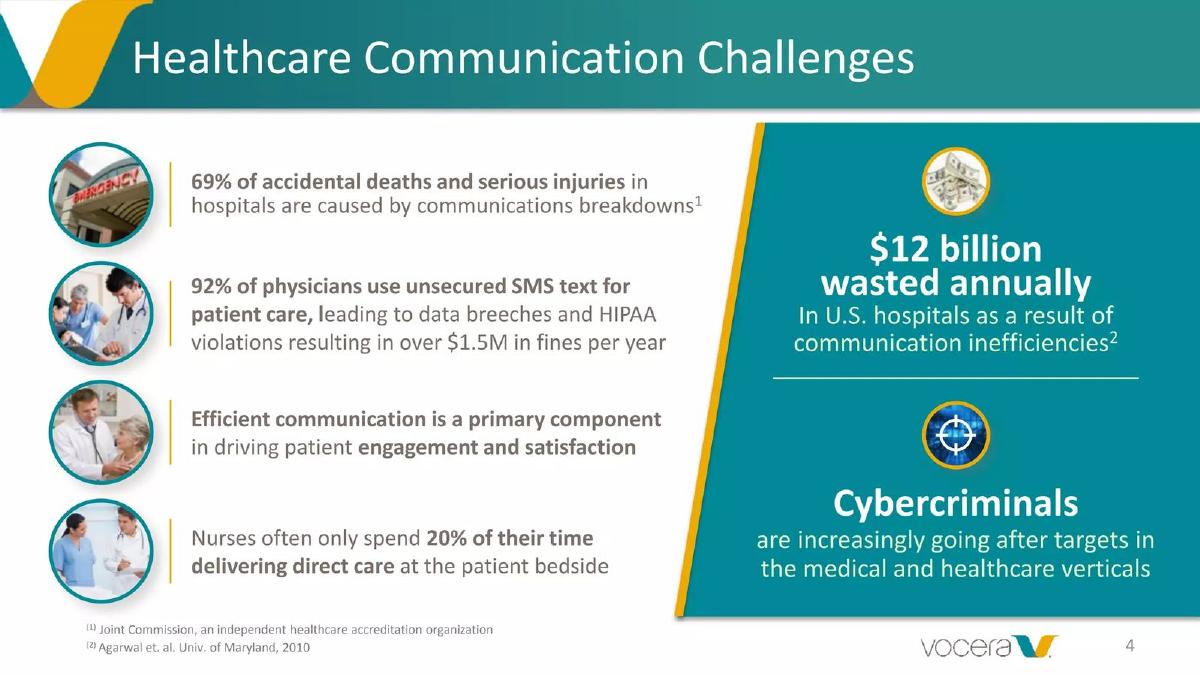
- Communication breakdowns are cited as the cause for 69% of accidental deaths and serious injuries in hospitals (Slide 4).
- The company estimates that $12 billion is wasted annually in U.S. hospitals due to communication inefficiencies (Slide 4).
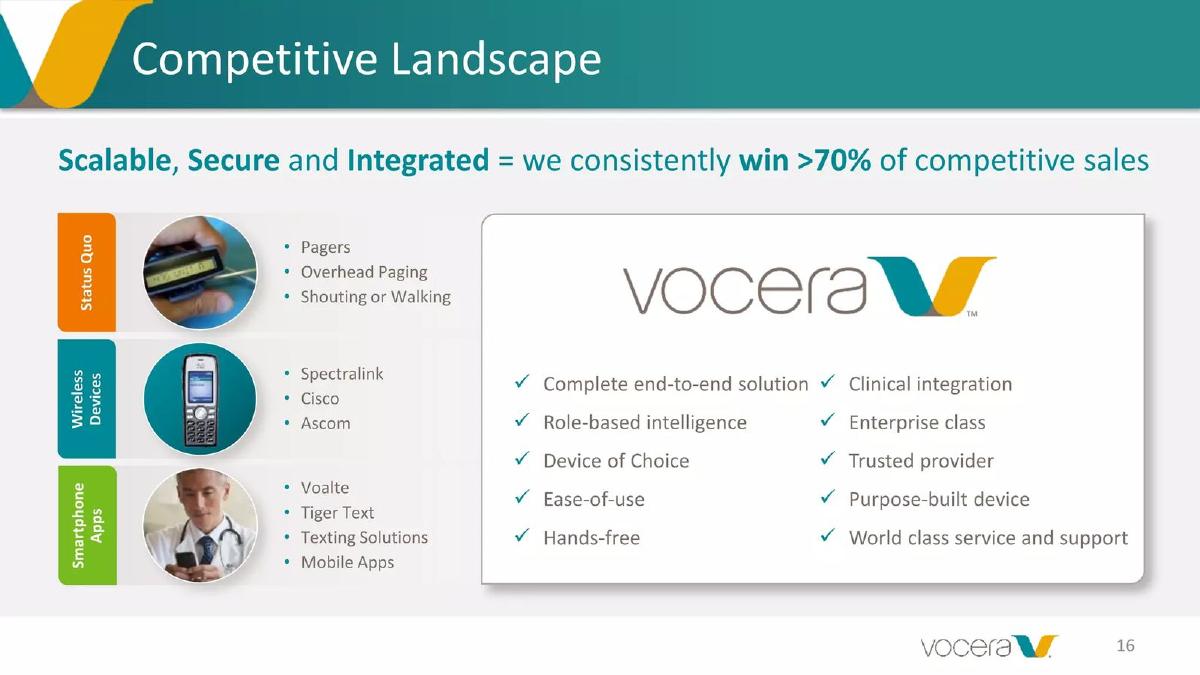
- Vocera claims a competitive win rate of over 70% against status quo methods and other wireless devices (Slide 16).
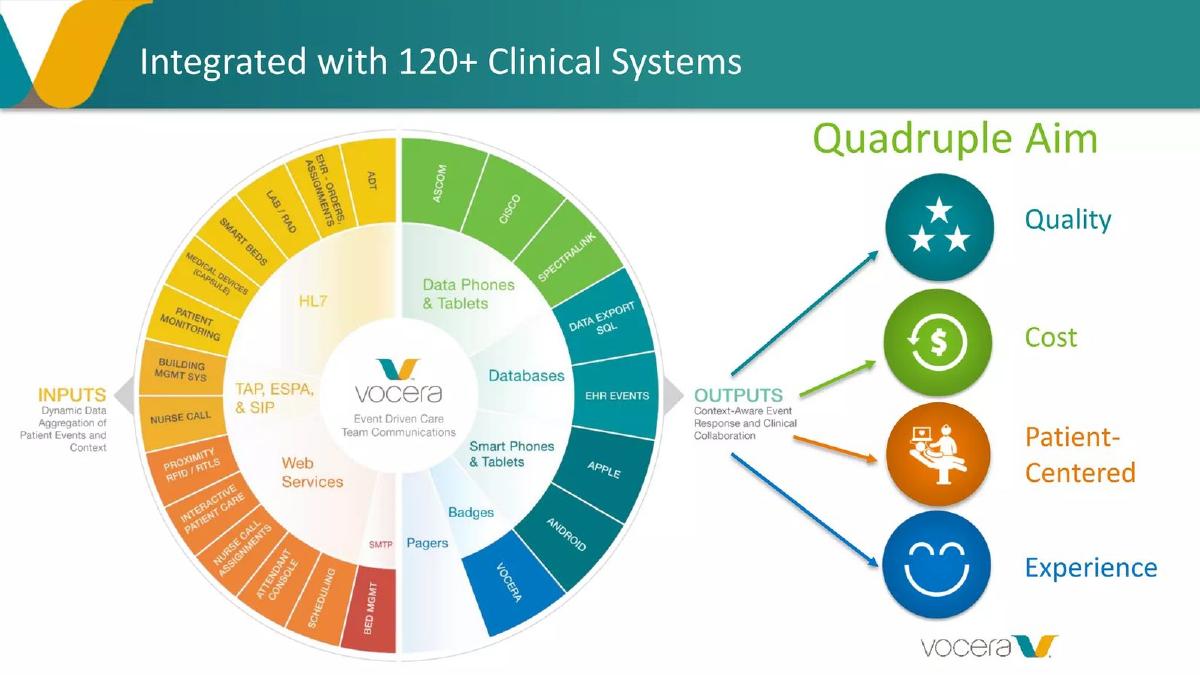
- The platform integrates with more than 120 clinical systems, including EHR, nurse call, and patient monitoring (Slide 13).
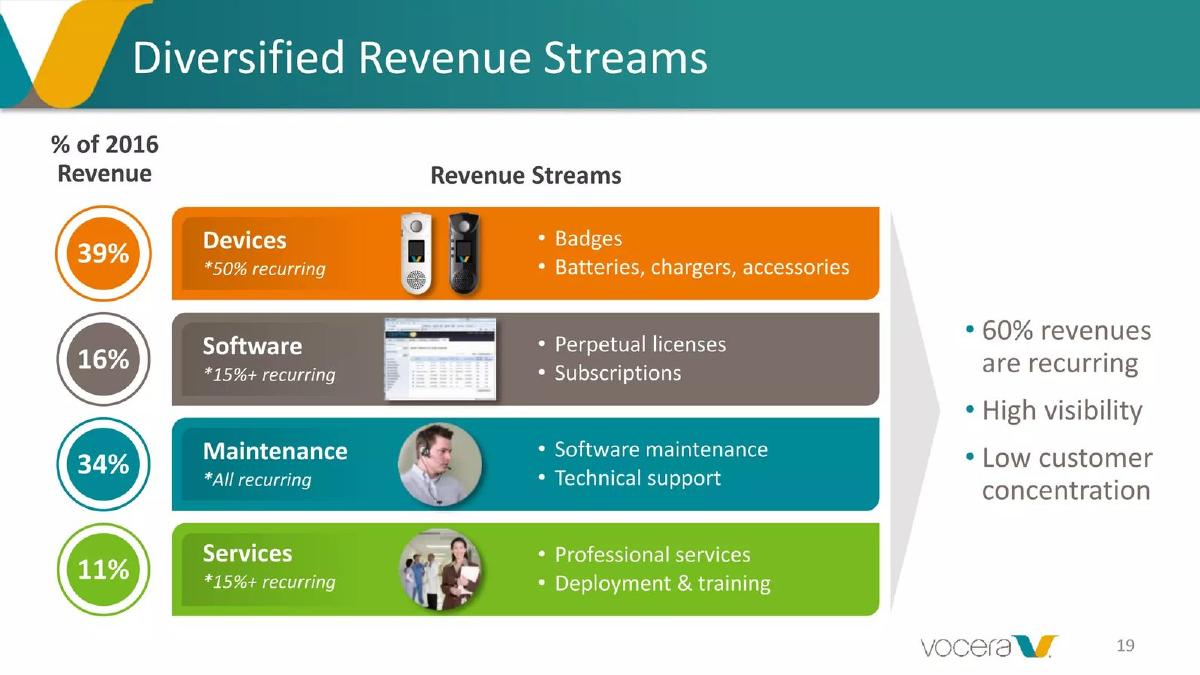
- Recurring revenue accounts for 60% of total revenue as of the 2016 reporting period (Slide 19).
- Hardware (Devices) remains the largest revenue segment at 39%, though 50% of this segment is considered recurring (Slide 19).
- Sales and Marketing (S&M) expenses as a percentage of revenue decreased from 47% in 2014 to 37% in 2016 (Slide 22).
- The company targets a long-term Adjusted EBITDA margin of 20%, up from 3% in 2016 (Slide 22).
Vocera Investor Review: A Deep Dive into Clinical Collaboration
The February 2017 investor deck for Vocera represents a company in a transition phase, moving from a hardware-centric communication tool to a comprehensive clinical software platform. The deck is structured to convince institutional investors that the company has reached an inflection point in profitability and market dominance.
Slide 1: Title Slide
The deck opens with a clean, branded title slide labeled "Investor Review" dated February 2017. The branding is consistent with a mature, publicly-traded or late-stage private entity, focusing on professional aesthetics rather than the high-concept imagery often seen in early-stage seed decks.
Slide 4: Healthcare Communication Challenges
Vocera establishes the "Problem" with high-stakes statistics. They cite the Joint Commission to state that 69% of accidental deaths and serious injuries in hospitals are caused by communication breakdowns. Furthermore, they quantify the economic impact at $12 billion wasted annually in U.S. hospitals due to inefficiencies. The slide also highlights a security gap, noting that 92% of physicians use unsecured SMS, leading to potential HIPAA violations and fines exceeding $1.5M per year. This slide effectively moves the product from a "nice-to-have" gadget to a critical safety and compliance requirement.
Slide 7: Multiple Avenues for Growth
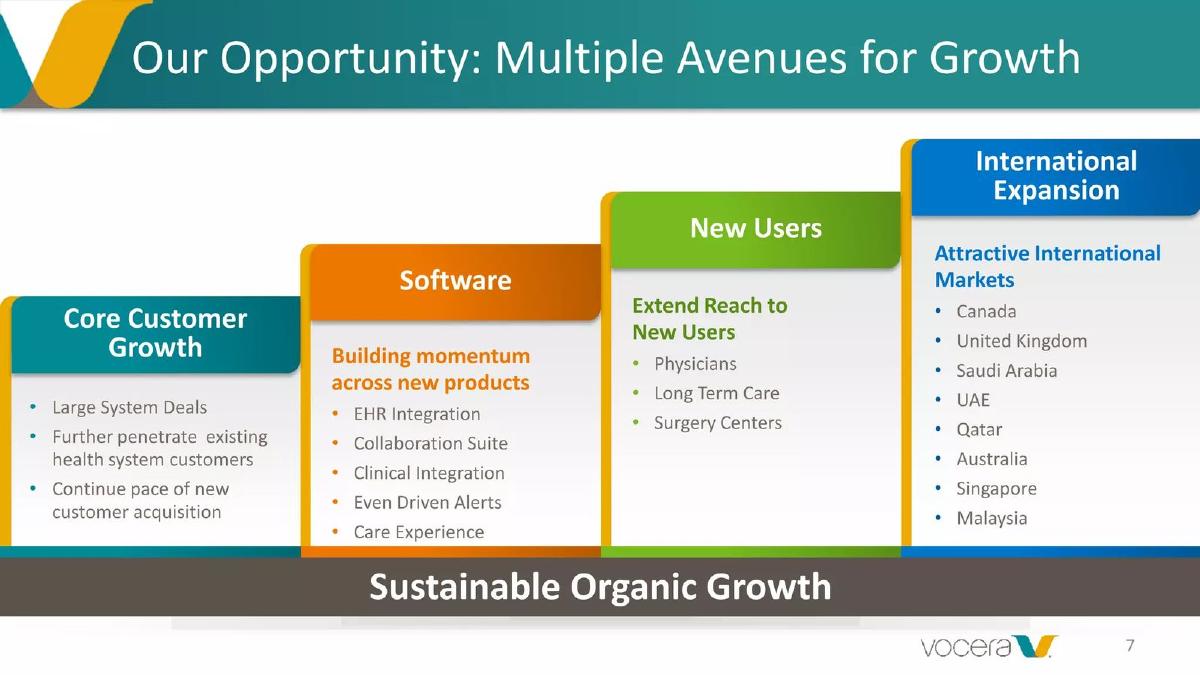
This slide outlines the company's roadmap for "Sustainable Organic Growth." It is divided into four pillars: Core Customer Growth (penetrating existing health systems), Software (EHR and clinical integrations), New Users (expanding to physicians and surgery centers), and International Expansion . The international section specifically targets Canada, the UK, Saudi Arabia, UAE, Qatar, Australia, Singapore, and Malaysia. This provides a clear geographic and sectoral expansion plan for investors looking for long-term scale.
Slide 10: Clinical Communication and Collaboration
Slide 10 defines the product's functional utility through three lenses: Communicate (Secure text, voice, and image), Experience (improving response times and patient safety), and Engage . The mention of "Over 120 clinical integrations" is a key competitive moat, suggesting that the platform is deeply embedded in the hospital's technical infrastructure rather than being a standalone app.
Slide 13: Integrated with 120+ Clinical Systems
This slide provides a technical visualization of the Vocera ecosystem. It shows "Inputs" (Nurse call, patient monitoring, EHR orders) flowing into the Vocera engine, which then outputs to various devices (Badges, Smart Phones, Tablets). The right side of the slide maps these outputs to the Quadruple Aim : Quality, Cost, Patient-Centered care, and Experience. This is a sophisticated way of showing how technical features translate directly into the KPIs that hospital administrators care about most.
Slide 16: Competitive Landscape
Vocera uses this slide to position itself as the superior alternative to three categories of competitors. They dismiss the "Status Quo" (pagers and shouting) and frame "Wireless Devices" (Cisco, Ascom) and "Smartphone Apps" (Voalte, TigerConnect) as incomplete solutions. The headline claim is bold: "we consistently win >70% of competitive sales." They list 12 checkmarks for their solution, including "Hands-free" and "Purpose-built device," which are unique to their proprietary hardware badge.
Slide 19: Diversified Revenue Streams
This is one of the most critical slides for a financial analyst. It breaks down the 2016 revenue mix: 39% Devices, 34% Maintenance, 16% Software, and 11% Services. The deck highlights that 60% of total revenues are recurring . Even in the hardware (Devices) category, they claim 50% is recurring due to the constant need for batteries, chargers, and accessories. This helps mitigate the investor fear of lumpy hardware sales cycles.
Slide 22: Operating Leverage Drives Significant Value
The final slide in this set demonstrates the company's path to increased margins. It compares actuals from 2014, 2015, and 2016 against a "~$200M Target Model." Key metrics show a trend of efficiency: Sales & Marketing (S&M) dropped from 47% to 37% of revenue in three years, and Adjusted EBITDA moved from (13%) to 3% . The target model suggests a future where Opex is only 49% of revenue, leading to a 20% Adjusted EBITDA margin. This slide is designed to show that the company's fixed costs are being covered by growing revenue, leading to rapid profit expansion.
What Vocera Does Well
The deck is exceptionally strong at quantifying the cost of the problem. By using the $12 billion waste figure and the 69% death/injury statistic, they create a sense of urgency that transcends simple workflow improvement. They also do an excellent job of explaining their revenue model; many companies hide their hardware/software split, but Vocera leans into it to show how hardware actually drives recurring maintenance and accessory revenue.
What is Missing from the Deck
Based on the provided slides, there is no Team Slide , which is unusual for a comprehensive review, though this may be because the company was already well-established or public at the time. There is also a lack of specific Case Studies or named customer logos on these slides, which would have grounded the "70% win rate" claim in reality. Finally, while they mention international expansion, they do not provide a breakdown of current vs. projected international revenue.
Founder Takeaways
Founders should study Slide 22 as a masterclass in showing operating leverage. Instead of just showing revenue growth, Vocera shows how each expense line item is shrinking as a percentage of that revenue. This proves to investors that the business model is scalable. Additionally, Slide 13 is a great example of how to visualize a complex "middle-ware" product. If your software sits between many different data sources and many different end-users, a circular "Input/Output" diagram is often the clearest way to explain your value proposition.
Frequently asked questions
- What is Vocera's primary value proposition to hospitals?
- Vocera focuses on reducing the 'Quadruple Aim' of healthcare: improving quality, reducing cost, enhancing the patient-centered approach, and bettering the clinician experience. According to Slide 13, they achieve this by aggregating dynamic data from 120+ clinical systems and delivering context-aware event responses to care teams via badges, smartphones, and tablets.
- How does Vocera generate revenue?
- The company uses a diversified model shown on Slide 19. In 2016, revenue was split between Devices (39%), Maintenance (34%), Software (16%), and Services (11%). Notably, 60% of total revenue is recurring, including 100% of maintenance and 50% of device-related costs like batteries and chargers.
- Who are Vocera's main competitors according to the deck?
- Slide 16 categorizes the competitive landscape into three tiers: the 'Status Quo' (pagers, overhead paging), 'Wireless Devices' (Spectralink, Cisco, Ascom), and 'Smartphone Apps' (Voalte, TigerConnect). Vocera claims to win over 70% of competitive sales by offering a 'complete end-to-end solution' that includes hands-free, purpose-built hardware.
- What are the key financial trends for Vocera between 2014 and 2016?
- Slide 22 shows significant operational improvement. Operating expenses (Opex) dropped from 77% of revenue in 2014 to 61% in 2016. This shift allowed the company to move from a (13%) Adjusted EBITDA loss to a 3% profit over the same period, driven by higher sales productivity and economies of scale.
- What is the company's strategy for future growth?
- As detailed on Slide 7, Vocera pursues 'Sustainable Organic Growth' through four avenues: core customer growth (large system deals), software momentum (EHR and clinical integration), extending reach to new users (physicians and long-term care), and international expansion into eight specific global markets.