ThermoCube presents a hardware-centric solution to the high costs of thermal energy storage, proposing a modular tank system built from pressure-less cells. The deck highlights a significant cost advantage, claiming material costs of approximately 1.8 Euro per kWh compared to competitor sales prices exceeding 14 Euro per kWh. Seeking 2.5 million Euro for a 20% equity stake, the company targets two primary markets: heat-driven applications like grid buffers and a 'ThermoBattery' model that leverages electricity price fluctuations. While the deck provides detailed financial projections and a cl…
Key takeaways
- The company claims a massive cost advantage with material costs at 1.8 Euro per kWh versus competitor prices of over 14 Euro per kWh (Slide 3).
- ThermoCube is seeking a 2.5 million Euro investment in exchange for 20% of the company's shares (Slide 3).
- The product is designed as a modular system of pressure-less cells, scalable from 26 to 144 cubic meters (Slide 7).
- A European Patent was reportedly granted in 2023, providing a defensive moat for the technology (Slide 3).
- Financial projections target break-even in 2027, with revenue expected to reach 13.788 million Euro by 2028 (Slide 13).
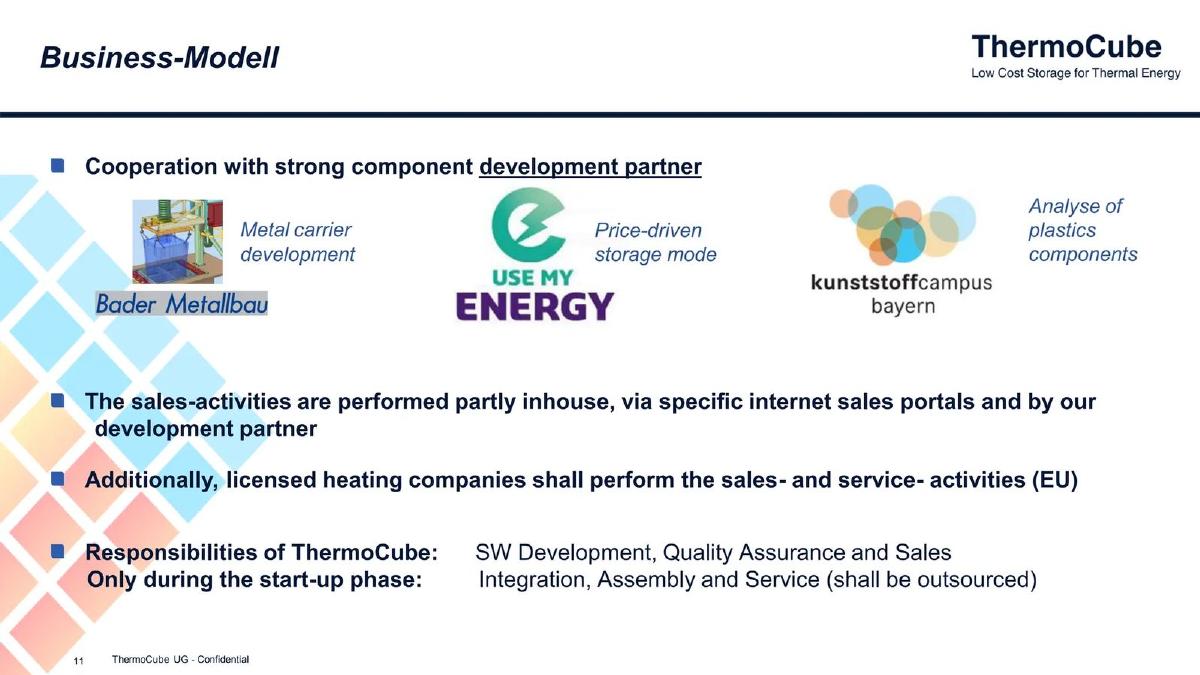
- The business model relies on external partners like Bader Metallbau and kunststoffcampus bayern for development and components (Slide 11).
- The deck identifies a market for 'ThermoBatteries' where heat pumps are activated only when electricity prices are low to maximize profit (Slide 9).
- There is no team slide included in the provided 8 slides, leaving founder expertise unverified.
Executive Summary and Value Proposition
Slide 1: Title Slide
The deck opens with a clean, dark blue title slide featuring the ThermoCube logo and the tagline "Smart Solutions for the Heat Transition." The date 13.02.2024 is noted in the bottom right corner. The visual branding uses a diamond grid of blue and red squares, likely representing the thermal gradient or modular nature of the product.
Slide 3: Summary
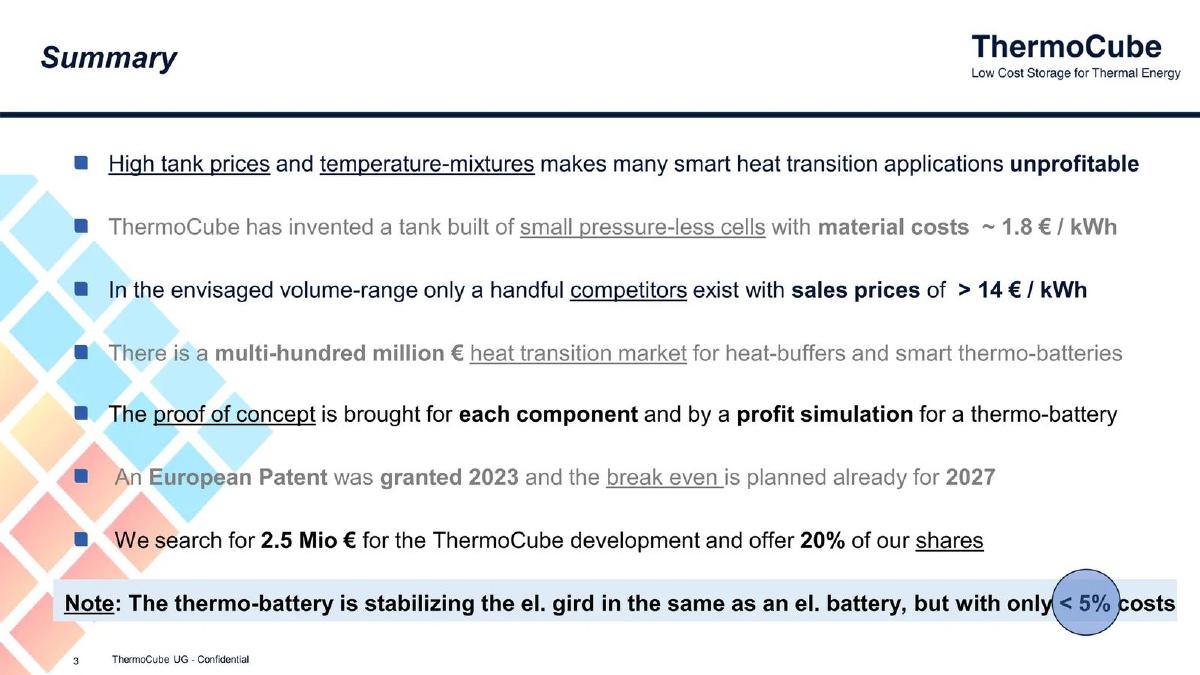
This slide serves as the executive summary, laying out the core investment thesis. It identifies the problem: high tank prices and temperature-mixture issues make heat transition applications unprofitable. The solution is a tank built of "small pressure-less cells" with material costs of approximately 1.8 Euro / kWh . This is contrasted against competitors who reportedly have sales prices of > 14 Euro / kWh . Key milestones mentioned include a European Patent granted in 2023 and a planned break-even in 2027. Most importantly, the ask is clearly stated: 2.5 Mio Euro for 20% of shares . A footer note claims the thermo-battery can stabilize the electrical grid at of an electrical battery.
Problem and Product Definition
Slide 5: Problems of Conventional Heat Tanks
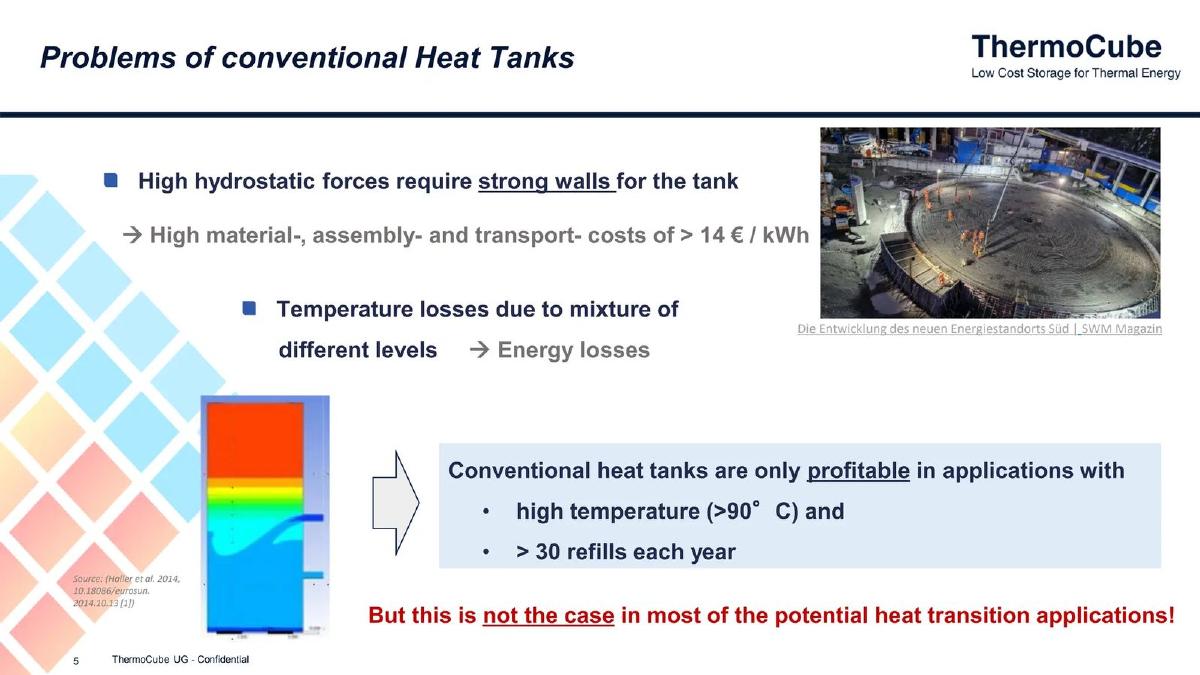
ThermoCube details the technical limitations of current market solutions. High hydrostatic forces require "strong walls," leading to high material, assembly, and transport costs exceeding 14 Euro / kWh. The slide also notes energy losses due to the mixture of different temperature levels within a single tank. The conclusion presented is that conventional tanks are only profitable at high temperatures (>90 degrees Celsius) and with more than 30 refills per year, which does not apply to most heat transition use cases.
Slide 7: Product Specifications
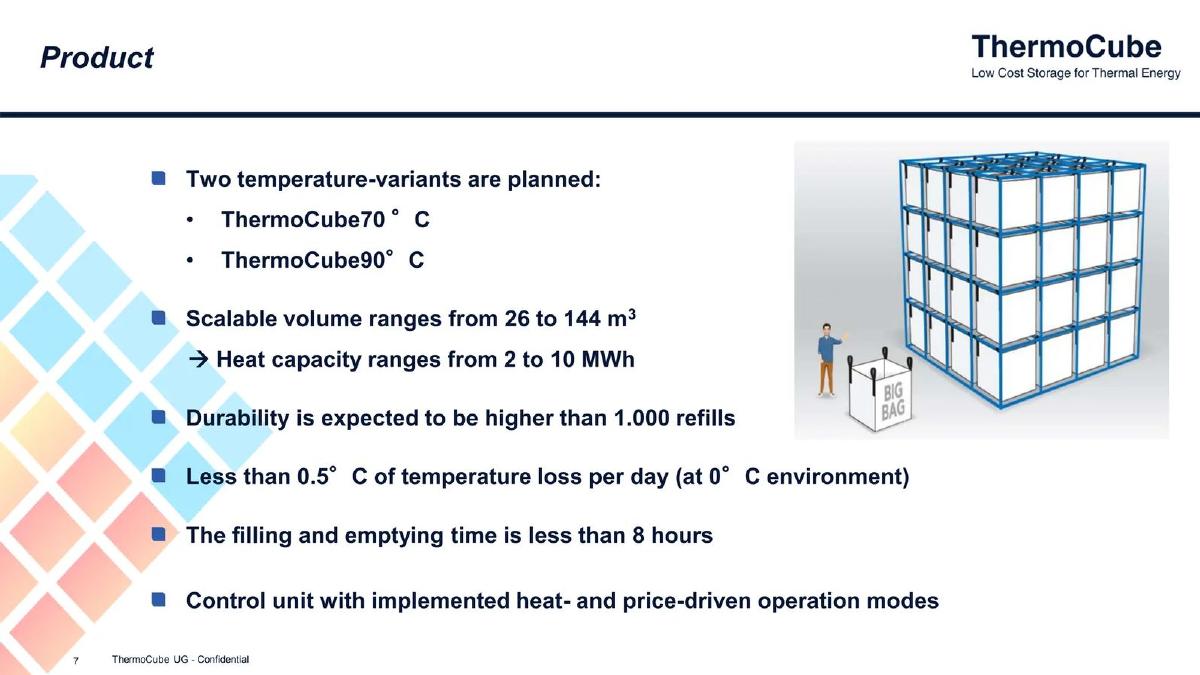
The product slide introduces two planned variants: ThermoCube 70 and ThermoCube 90 (referring to Celsius). The system is modular and scalable from 26 to 144 cubic meters , providing a heat capacity between 2 to 10 MWh . Technical claims include a durability of over 1,000 refills, temperature loss of less than 0.5 degrees Celsius per day in a 0-degree environment, and a charge/discharge time of less than 8 hours. A control unit is mentioned that implements heat- and price-driven operation modes.
Market Strategy and Business Model
Slide 9: Market Segments and Entry
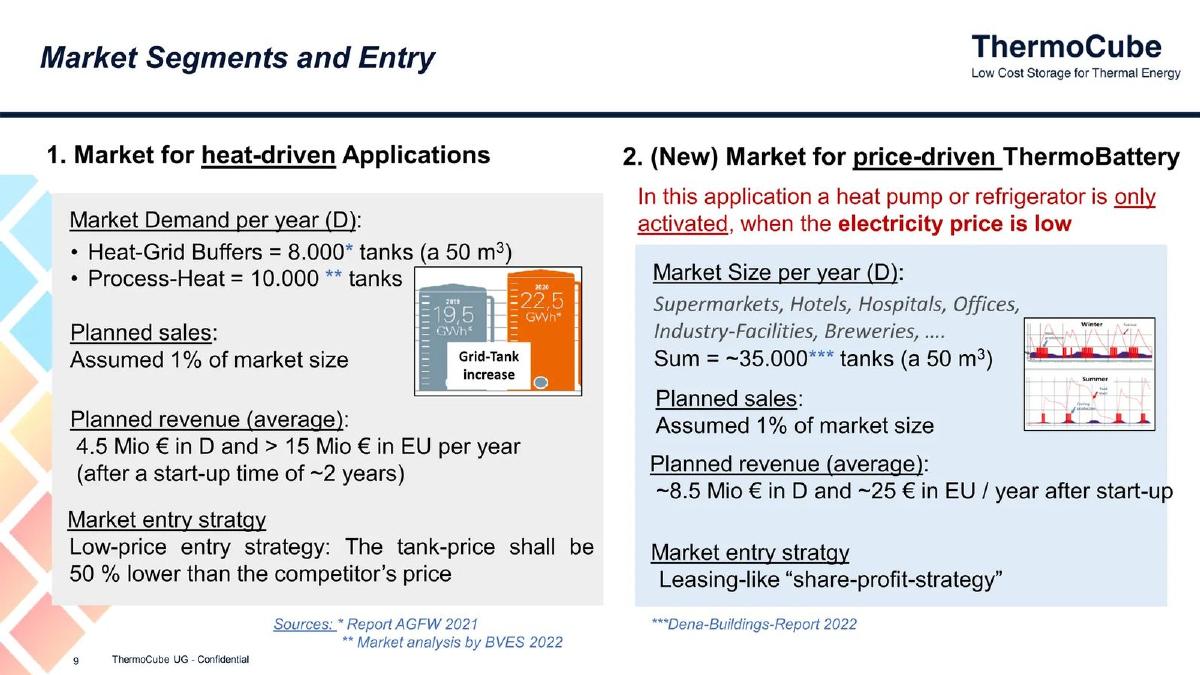
The market is split into two categories. The first is "heat-driven applications" like grid buffers and process heat, with a total demand estimated at 18,000 tanks per year. ThermoCube assumes a 1% market share, projecting 4.5 million Euro in German revenue and over 15 million Euro in EU revenue after a 2-year startup phase. The second is the "price-driven ThermoBattery" for supermarkets, hotels, and hospitals, where the system activates during low electricity prices. This segment has a larger estimated demand of 35,000 tanks per year, with projected EU revenues of ~25 million Euro using a "share-profit-strategy" leasing model.
Slide 11: Business-Modell
This slide outlines the operational structure. ThermoCube intends to cooperate with development partners: Bader Metallbau for metal carriers, Use My Energy for storage software, and kunststoffcampus bayern for plastics analysis. Sales will be handled through internal portals, development partners, and licensed heating companies across the EU. ThermoCube defines its core responsibilities as software development, quality assurance, and sales, while planning to outsource integration, assembly, and service after the initial startup phase.
Financials and Projections
Slide 13: Milestones and Finance Plan
A detailed Profit & Loss (P&L) table and Gantt chart are provided. The development roadmap spans from Q3 2024 to mid-2026. The financial plan shows a net loss of 441k Euro in 2024, increasing to 1.165 million Euro in 2025 as R&D and staff costs peak. Revenue is expected to begin in 2025 (68k Euro) and scale significantly to 13.788 million Euro by 2028 . The plan identifies 2027 as the break-even year with a projected profit of 1.072 million Euro. The cash position is tracked, showing the 2.5 million Euro investment sustaining the company through the R&D phase.
Slide 15: Attachment - Profit Simulation
The final slide provides a case study for a 2,500 square meter supermarket. Using 2023 data for heat demand, cooling demand, and electricity prices, the simulation shows how a price-driven tank generates profit. For a 60-cubic-meter tank, the simulation yields a sum profit of 2,932 Euro, or 40 Euro per cubic meter. This slide is intended to validate the "share-profit" business model mentioned on Slide 9.
What Works and What is Missing
What Works
Clear Cost Advantage: The deck repeatedly hammers home the 1.8 Euro vs. 14 Euro per kWh cost comparison, which is a compelling hook for hardware investors. · Specific Market Sizing: Rather than using vague billions-of-dollars figures, the deck estimates the market in number of tanks (e.g., 35,000 tanks for the ThermoBattery segment), which feels more grounded. · Detailed Financial Roadmap: The P&L on Slide 13 is unusually detailed for an early-stage deck, showing quarterly burn and specific cost categories like External R&D and Staff.
What is Missing
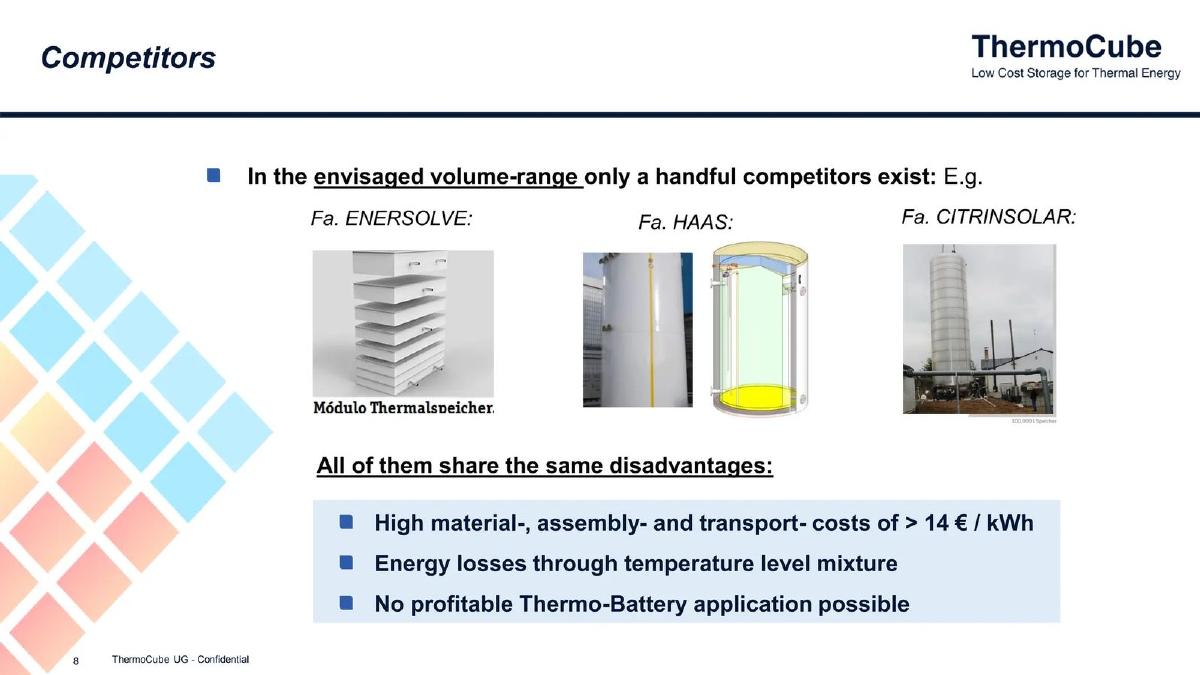
Team Slide: The provided slides contain no information about the founders, their technical backgrounds, or their previous successes. In hardware, the ability to execute on manufacturing is critical. · Technical Deep-Dive: While "pressure-less cells" are mentioned, there is no explanation of the materials or the physical mechanism that prevents temperature mixing. · Competitive Landscape: While Slide 3 mentions a "handful of competitors," they are not named, and there is no feature-by-feature comparison matrix. · Manufacturing Strategy: The deck mentions outsourcing assembly after the startup phase but does not detail where or how these modular units will be produced at scale to maintain the 1.8 Euro/kWh material cost.
Founder Takeaways
Quantify the hardware advantage: ThermoCube does an excellent job of translating technical specs (pressure-less cells) into economic benefits (lower wall strength requirements = lower cost). Founders should always link their engineering choices directly to the bottom line.
Use simulations for new business models: If you are proposing a profit-sharing or leasing model, a slide like Slide 15 is essential. It shows the investor that you have run the numbers against real-world historical data (2023 electricity prices) rather than just guessing.
Be explicit with the ask: Many founders bury the investment ask at the end. ThermoCube puts the 2.5 million Euro for 20% equity on Slide 3, ensuring every investor knows exactly what the deal is from the start.
Frequently asked questions
- What is the core technology behind ThermoCube?
- According to Slide 3 and Slide 7, ThermoCube has developed a thermal storage tank composed of small, pressure-less cells. This design avoids the high hydrostatic forces that require expensive, strong walls in conventional tanks. The modular approach allows for scalable heat capacities ranging from 2 to 10 MWh.
- How does ThermoCube plan to make money?
- The company employs two strategies outlined on Slide 9 and Slide 11. First, a low-price entry strategy for heat-driven applications (like grid buffers) where they aim to price 50% lower than competitors. Second, a 'share-profit-strategy' for their price-driven ThermoBattery, which uses software to optimize energy use based on market prices.
- What are the specific financial requirements and valuation?
- Slide 3 explicitly states the company is searching for 2.5 million Euro in development capital. In return, they are offering 20% of their shares, which implies a post-money valuation of 12.5 million Euro.
- Who are the partners involved in the project?
- Slide 11 lists several key development partners: Bader Metallbau for metal carrier development, 'Use My Energy' for the price-driven storage mode software, and kunststoffcampus bayern for the analysis of plastics components.
- What is the projected timeline for product development?
- Slide 13 provides a Gantt chart showing development activities starting in mid-2024. The ThermoCube 70 degree Celsius project is slated for pilot tank testing by late 2025, followed by the 90 degree Celsius variant concluding its pilot phase in mid-2026.