Jus Mundi raised $10M in 2021 for its Series A by positioning itself as the specialized search engine for international law and arbitration. The deck focuses heavily on the inefficiency of legacy legal publishers who rely on 'digitalized books' rather than modern search infrastructure. The most striking data points are the company's efficiency metrics: 0% churn among renewed clients and a massive 191% Net Revenue Retention (NRR) driven by upselling to existing 2019 clients. Despite redactng specific CAC and CLV figures in the public version, the deck clearly illustrates a path from €500k ARR…
Key takeaways
- The company achieved 400%+ Year-over-Year growth, reaching €500,000 ARR by January 2021 (Slide 11).
- Jus Mundi reports a 0% churn rate for its renewed clients, indicating high product stickiness (Slide 09).
- Net Revenue Retention stands at 191%, showcasing significant expansion revenue from the 2019 cohort (Slide 09).
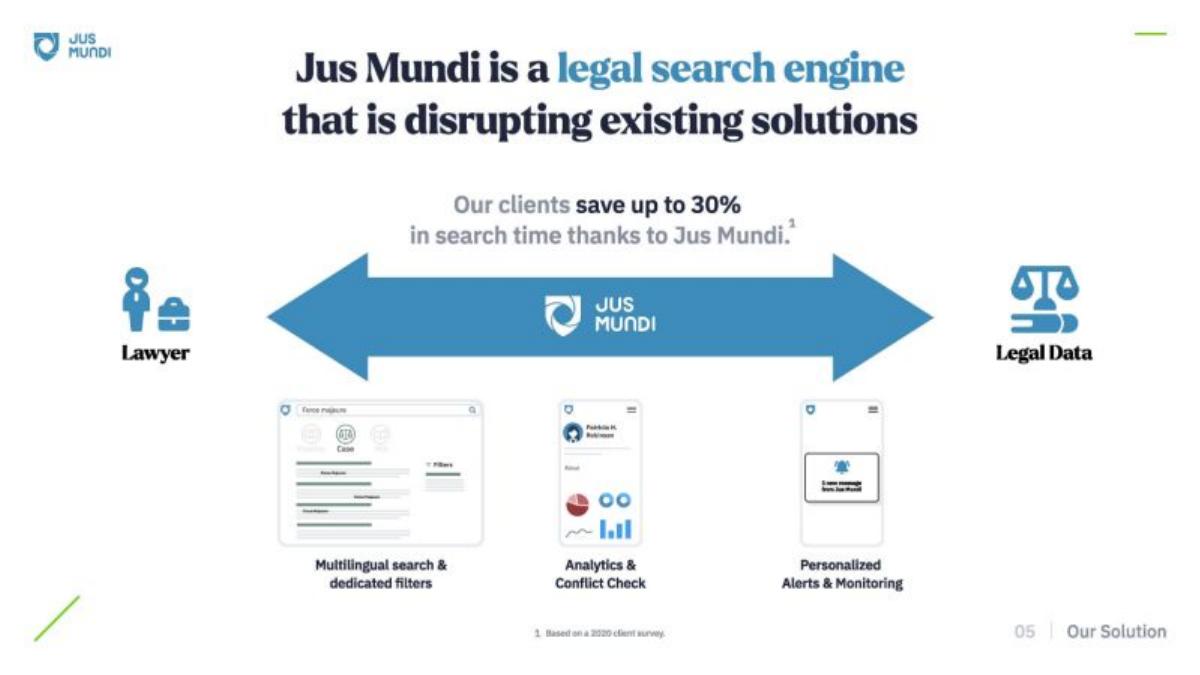
- The platform claims to save lawyers up to 30% in search time compared to traditional methods (Slide 05).
- The Total Addressable Market (TAM) is valued at €21B, with the international research segment (SAM) at €7B (Slide 07).
- Client distribution is global, with 40% in the US, 30% in Europe, and 80% of total clients located outside the E.U. (Slides 02, 12).
- The business model utilizes 1 to 5-year subscriptions with an 8-month payback period (Slide 10).
- The roadmap targets a jump to €80M ARR in five years by expanding into trade, sports, and corporate sectors (Slide 15).
Executive Summary and Value Proposition
Slides 1-2: The Hook
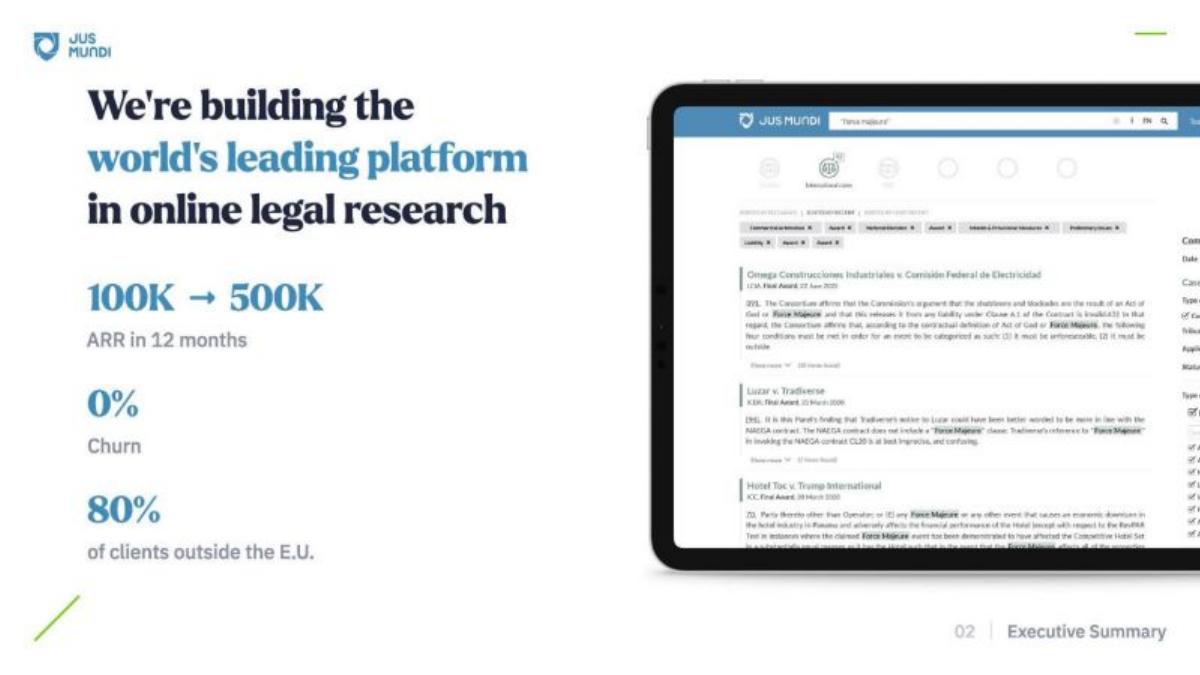
Jus Mundi opens with a clear, descriptive title: "The Search Engine for International Law and Arbitration" (Slide 01). This immediately tells the investor that this is a vertical search play, not a general AI or broad legal-tech tool. The executive summary on Slide 02 is data-heavy, which is effective for a Series A pitch. It highlights a jump from 100K to 500K ARR in 12 months , a 0% churn rate , and the fact that 80% of clients are outside the E.U. , proving the product has global legs despite being a French company.
The Problem and Existing Solutions
Slides 3-4: The Inefficiency of 'Digitalized Books'
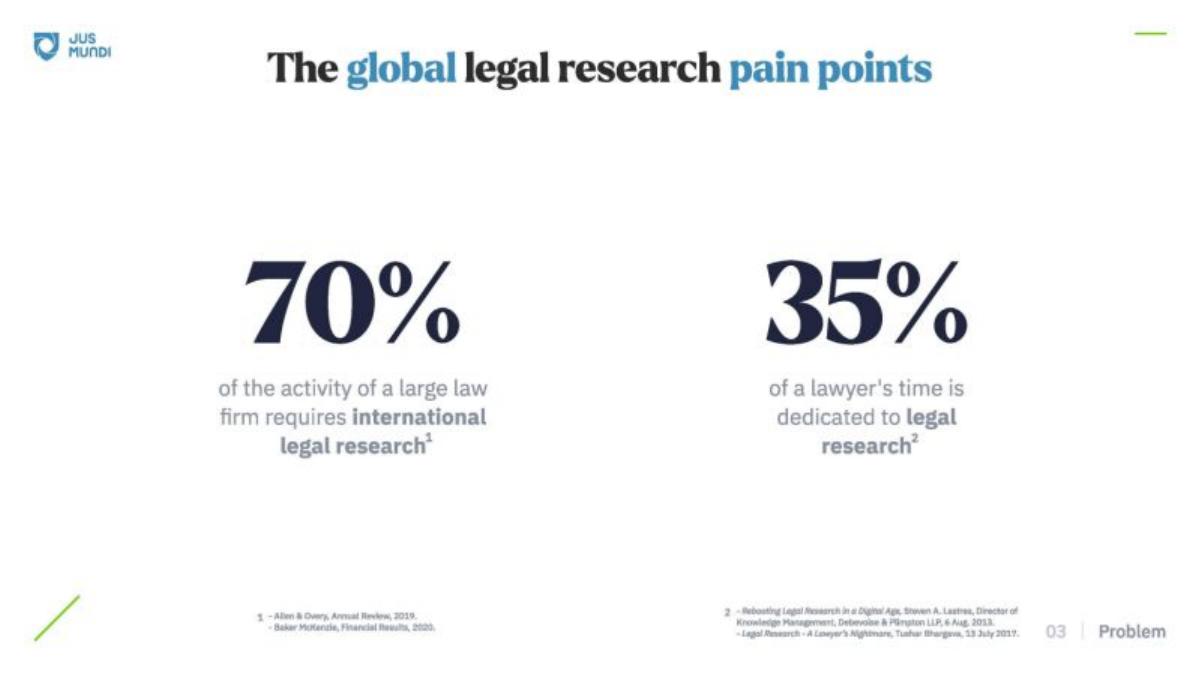
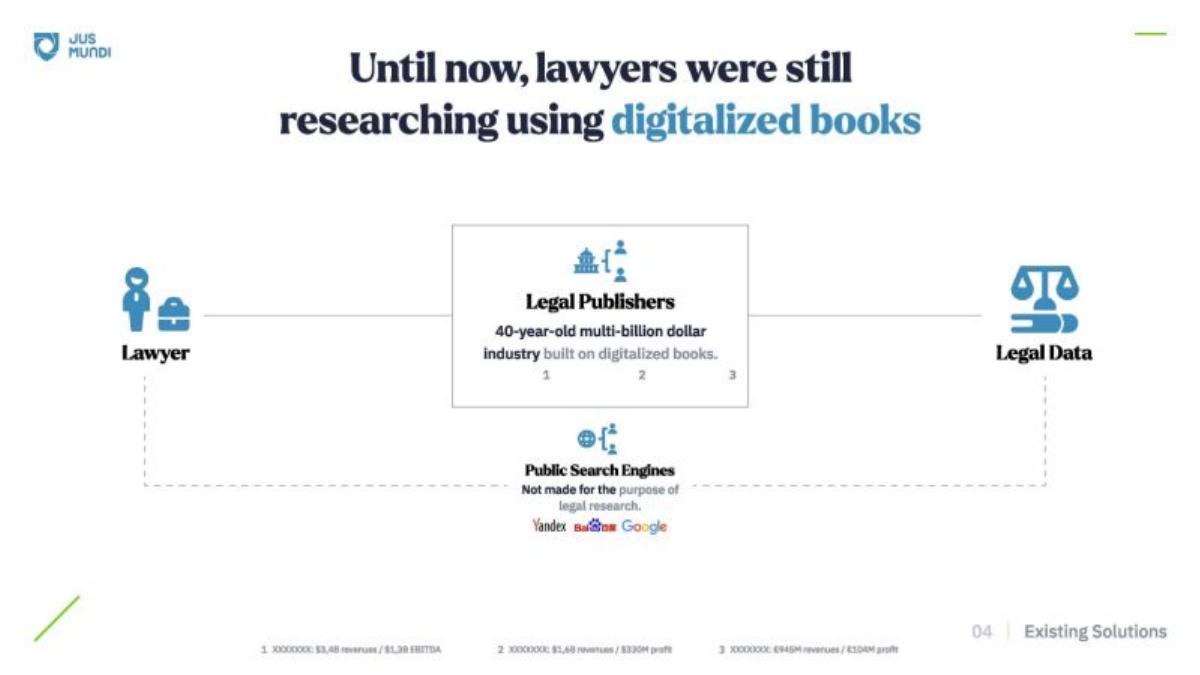
Slide 03 quantifies the pain: 70% of large law firm activity requires international research, and 35% of a lawyer's time is spent doing it. The deck uses these figures to establish a high-value problem. Slide 04 is a clever competitive analysis. Instead of a standard feature grid, it categorizes incumbents as "Legal Publishers"—a 40-year-old multi-billion dollar industry built on digitalized books . By framing competitors like LexisNexis or Westlaw (implied by the revenue figures in the footer: $3.4B and $1.6B) as antiquated, Jus Mundi creates a narrative of technological disruption rather than just incremental improvement.
The Jus Mundi Solution
Slides 5-6: Product and 'Secret Sauce'
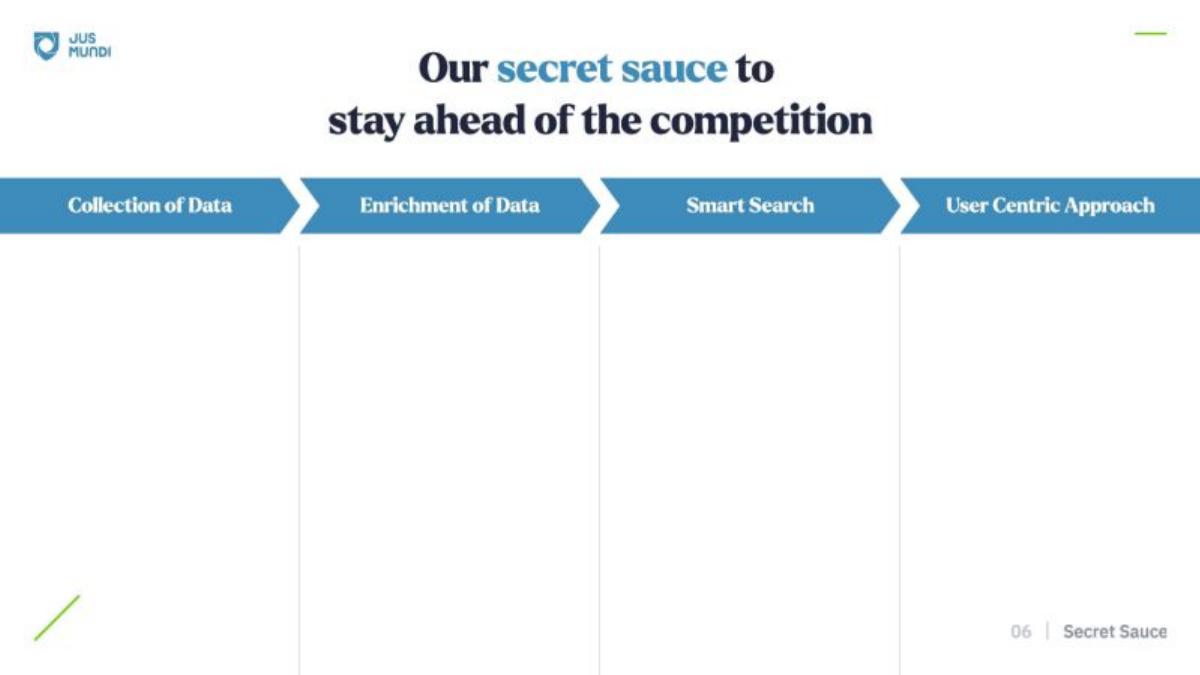
Slide 05 introduces the platform as the bridge between the lawyer and legal data. It claims a 30% time saving and highlights three key features: multilingual search, analytics/conflict checks, and personalized alerts. Slide 06, titled "Our secret sauce," is unfortunately largely blank in this version of the deck, though the headers suggest a four-step process: Collection of Data, Enrichment of Data, Smart Search, and User Centric Approach . This indicates a proprietary data pipeline, which is a common requirement for defensibility in legal tech.
Market Opportunity
Slides 7-8: TAM and SAM Breakdown
The market sizing on Slide 07 is logical. It takes a €21B TAM and divides it into thirds, focusing on the €7B international research segment. They note this segment is growing at 10% per year , double the rate of the overall market. Slide 08 provides a granular look at the SAM, breaking it down by legal verticals. Arbitration is the largest at €600M , followed by IP and Competition at €450M each. This level of detail shows investors that the founders have a deep understanding of where the actual budget sits within law firms.
Traction and Unit Economics
Slides 9-11: The Power of Retention
Slide 09 is arguably the strongest in the deck. 0% Churn and 191% Net Revenue Retention are world-class SaaS metrics. The NRR figure is particularly important as it proves that the "land and expand" strategy is working. Slide 10 discusses profitability, claiming an 8-month payback period . While the specific CAC and CLV figures are redacted as "€XXX," the visual representation of a very long blue bar for CLV versus a tiny grey bar for CAC communicates the desired ratio. Slide 11 shows the 400%+ YoY growth curve, ending at €500,000 ARR in January 2021. The growth is steep and consistent, which is exactly what Series A investors look for.
Global Footprint and Team
Slides 12-14: Validation and Expertise
Slide 12 proves global adoption with a map showing 40% of clients in the US and 30% in Europe . They name-drop prestigious clients like Freshfields, DLA Piper, and Harvard University . Slide 13 is a placeholder for "Customer Acquisition," marked as confidential. Slide 14 introduces the team, which is well-balanced. The CEO, Jean-Rémi de Maistre , is an ex-lawyer at the ICJ, providing domain authority. The "experienced key hires" section is equally impressive, featuring a Head of Sales from LexisNexis and a Head of Legal from Dentons . This suggests the company can successfully poach talent from the incumbents they are disrupting.
The Ask and Roadmap
Slides 15-17: The Path to €80M
The deck concludes with a roadmap to €80M ARR in 5 years (Slide 15). The strategy is to expand from the initial arbitration niche into trade, sports, and eventually the broader corporate market. The final slides (16-17) provide contact information and a promotional link for the deck source. Notably, the specific dollar amount of the "Ask" is not on the slide, though the catalogue facts state the round was $10M .
What Jus Mundi Does Well
The deck excels at category positioning . By calling themselves a "search engine" and their competitors "digitalized book publishers," they move the conversation away from content and toward technology and efficiency. The use of Net Revenue Retention (191%) is a brilliant move; it is a much more powerful metric for Series A than simple user growth because it proves the product is indispensable to high-paying enterprise clients.
What is Missing
The most significant omission is the unit economics detail . While the bars on Slide 10 show a healthy ratio, the redaction of actual CAC and CLV figures makes it impossible to verify the "8-month payback" claim. Additionally, the "Secret Sauce" slide (06) is empty, leaving a gap in the technical explanation of how their search engine actually outperforms Google or LexisNexis. Finally, there is no use of proceeds slide, which usually details how the $10M will be spent (e.g., % to engineering vs. % to sales).
Founder Takeaways
Lead with your strongest metric: If you have 191% NRR, put it in the first three slides. It validates everything else you say. · Define the incumbent's weakness: Don't just say you are better; explain why the old way of doing things (e.g., "digitalized books") is fundamentally flawed for the modern era. · Verticalize your TAM: Investors often fear that niche markets are too small. By breaking the €7B SAM into specific verticals like IP, Mining, and Construction, Jus Mundi shows a clear path to expansion. · Strategic Hires: Showing that you can hire top talent from your biggest competitors is a massive signal of company health and future success.
Frequently asked questions
- What is Jus Mundi's core value proposition?
- Jus Mundi positions itself as a specialized search engine for international law and arbitration. Unlike legacy legal publishers who provide 'digitalized books,' Jus Mundi uses a modern search interface with multilingual capabilities and dedicated filters. According to slide 05, this results in a 30% reduction in search time for lawyers, addressing the fact that 35% of a lawyer's time is typically spent on legal research.
- How does the company justify its market size?
- The deck breaks down a €21B Total Addressable Market (TAM) into three equal parts: US national research, other national research, and international research. Jus Mundi focuses on the €7B international research segment (SAM), which it claims is growing at 10% per year. Slide 08 further segments this into verticals like Arbitration (€600M), IP (€450M), and Construction (€360M).
- What are the most impressive traction metrics in the deck?
- The standout metrics are found on slide 09: 0% churn and 191% Net Revenue Retention. This suggests that once a law firm or government agency adopts the tool, they not only stay but significantly increase their spend. This is paired with 400% YoY growth, taking the company from a low base in 2019 to €500k ARR by early 2021 (Slide 11).
- Who are the primary customers for Jus Mundi?
- The platform has a diverse, global customer base. Slide 12 highlights 50 law firms (including Freshfields and DLA Piper), 5 governments (including Japan's MOFA), and 13 universities (including Harvard and Sorbonne). Geographically, 40% of clients are in the US and 30% are in Europe, showing strong international appeal beyond their headquarters.
- What is the long-term growth strategy?
- Jus Mundi plans to reach €80M ARR by 2026. The strategy involves moving from their initial focus on Arbitration into Trade and Sports law in 2021, followed by a broader expansion into corporate legal departments. Slide 15 indicates they will continue to accelerate growth within their existing law firm and government client bases while adding new legal verticals.