Justbeth International is a Nigerian social enterprise addressing the critical lack of potable water in regions like Ebonyi State, where residents often rely on contaminated sources like lead mining pits. The business model centers on the production of 60cl water sachets, sold in bags of 20 for approximately $0.36. A key differentiator is their 'business inclusion' strategy, which leverages 220 distributors across 110 villages to empower women and youth. With historical revenue growing from $28,422 in 2018 to $60,540 in 2020, the company is seeking $100,000 to scale operations through factory…
Key takeaways
- The company operates as a social enterprise focused on clean water production and youth/women empowerment in Nigeria (Slide 1).
- A primary problem identified is the reliance on lead mining pits for water in Abakaliki, Ebonyi State (Slide 3).
- The solution involves a full-stack approach: water exploration, borehole drilling, and sachet packaging (Slide 4).
- Justbeth targets a market of 11 million people in Eastern Nigeria, aiming for a 5% sales penetration (Slide 7).
- Unit economics are based on 60cl sachets sold in bags of 20 for 150 Naira ($0.3636), yielding a gross profit of 65 Naira ($0.158) per bag (Slide 12).
- Revenue grew significantly over three years, reaching $60,540 in 2020 (Slide 12).
- The funding ask is $100,000, intended for factory expansion, trucks, and packaging machines (Slide 12).
- The leadership team brings a combined 15 years of industry experience, led by a CEO with a background in geology (Slide 11).
Executive Summary and Social Mission
Slides 1-2: Vision and Mission
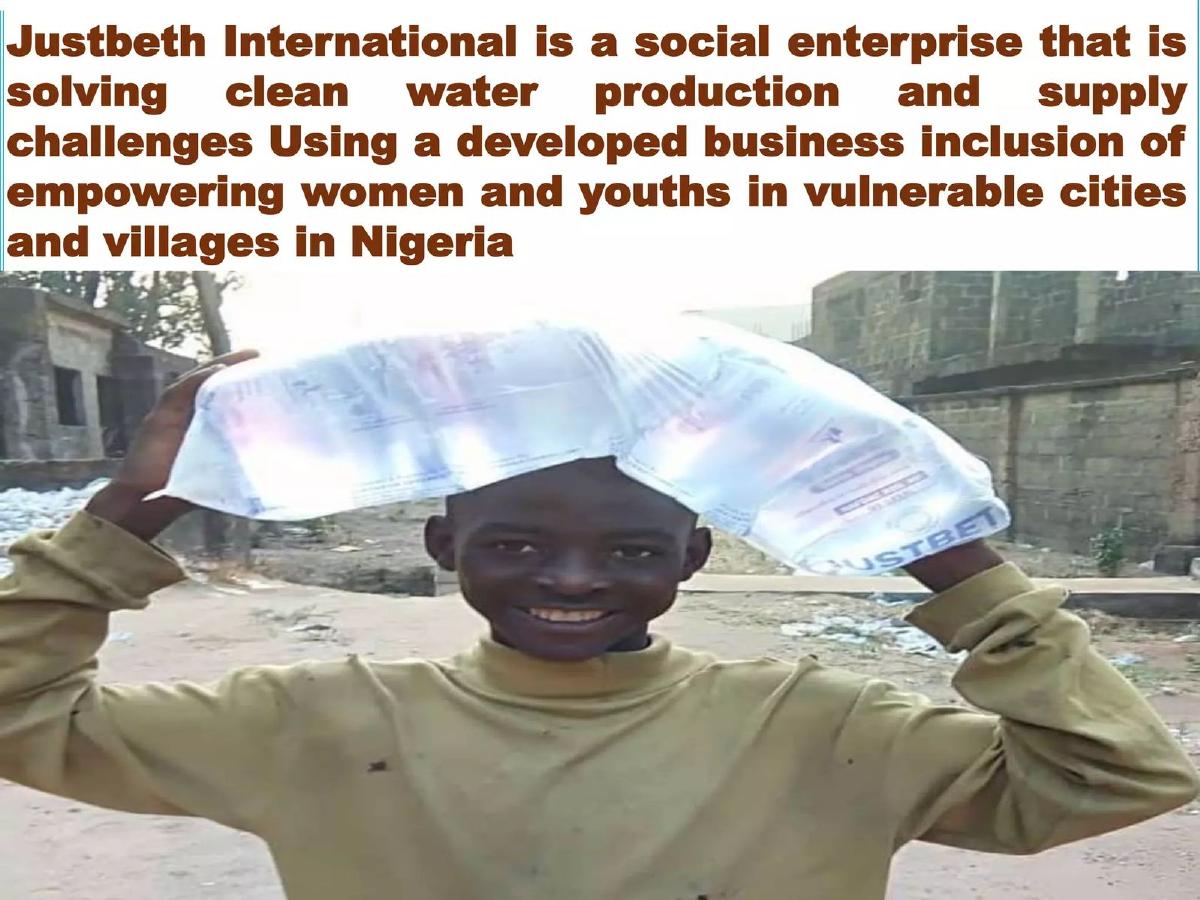
Justbeth International introduces itself on Slide 1 as a social enterprise operating in Nigeria. The core value proposition is the intersection of clean water production and social inclusion, specifically targeting women and youth in vulnerable cities and villages. The imagery used features a young person carrying a large bag of water sachets, which immediately establishes the local context and the product format. Slide 2 formalizes the vision to be an 'African Leader' in the sector and a mission focused on brand recognition through technology and 'developed business inclusion.'
The Problem and Local Context
Slide 3: The Water Crisis in Ebonyi State
This slide provides the 'why' behind the venture. It highlights that many Nigerian villages lack portable drinking water. Specifically, it names Abakaliki in Ebonyi State, where residents depend on a 'lead mining pit' as a water source. The slide also notes that existing bottled water options are too expensive for the general population. The visual evidence of people collecting water from murky, open sources serves as a powerful justification for the business's existence.
The Multi-Stage Solution
Slide 4: Infrastructure and Distribution
Justbeth presents a four-part solution on Slide 4 . First is 'Water exploration & Borehole Drilling,' indicating they handle their own sourcing. Second is 'Table Water Production & Packaging,' showing industrial sachet-filling machinery. Third is 'Women / Distributors Empowerment,' linking back to their social mission. Finally, they mention a 'Website/App that Enable for easy ordering or booking,' though they clarify this is 'on the way,' suggesting the current business is largely offline.
Slide 5: Product Specifications
Slide 5 displays the actual product packaging. The 'Justbeth Table Water' brand is NAFDAC registered (Reg. No: D1-1419L), which is a critical regulatory milestone for food and beverage companies in Nigeria. The product is sold in 60cl units. The slide also shows the physical sachet bags, which are the standard format for affordable drinking water in the region.
Slide 6: Operational Proof
This slide is a placeholder for a video clip titled 'JUSTBETH WATER VIDEO CLIP (1).mp4.' While the video cannot be played in a static deck, the thumbnail shows workers operating pumping equipment at a water source, intended to provide proof of active operations.
Market Opportunity and Financials
Slide 7: Market Size and Growth
The company breaks down its market into three tiers on Slide 7 . Their 'Current Area of Operation' has a population of 500,000, where they claim 10% penetration (50,000 sales). They aim to expand across Ebonyi State (3.2 million people) and eventually the broader Eastern Nigeria region (11 million people). The slide claims a 'GROWTH 135%,' though it does not specify the timeframe for this metric.
Slide 8: Business Model and Revenue Streams
Slide 8 outlines the revenue mechanics. Revenue is generated from the sale of table water. A single truck is estimated to generate 60,000 Naira ($144 approx.) daily. The slide calculates a monthly revenue of $4,737 per truck (1,954,201 Naira). It also mentions 'different bottle sizes' and 'different brands,' with an annual figure of $2,675 (1,103,544 Naira) listed next to a row of water bottles, though the relationship between these figures is not explicitly defined.
Slide 9: Competitive Landscape
The competitive analysis on Slide 9 pits Justbeth against four local rivals: Aqua Rapha, Royal Water, Enesto Water, and Omec Water. The 'Underlying Magic' or competitive advantage for Justbeth is listed as being pure/clean, 'makes money' (likely for distributors), 'easy to buy,' 'saves money' (for consumers), and offering a 'Delivery Service.'
Execution Strategy and Team
Slide 10: Go-To-Market Strategy
The GTM strategy relies heavily on a B2B2C model. They currently utilize 220 distributors across 110 villages. Marketing efforts include 'Referral Marketing,' 'Road Shows' using branded trucks, and TV/Radio advertisements. Interestingly, they commit that '1% of our sales will be used to acquire new customers.' Target institutional markets include hospitals, schools, churches, and military camps.
Slide 11: The Leadership Team
The team consists of three key members. Justice Omaka (Co-founder/CEO) is a geologist with an MBA and 7 years of experience. Cythia Mamah (CFO/ICT Technologist) has 3 years of experience in HR and tech. Kenneth Eze (COO) brings 5 years of experience in operations management. The slide claims the team has a collective 15 years of industry experience.
Slide 12: Financial Model, Traction, and The Ask
The final slide provides the most granular data. The unit economics for a 'bag' (20 sachets of 60cl) are: 150 Naira ($0.3636) sale price, 85 Naira ($0.206) production cost, and 65 Naira ($0.158) gross profit. The traction chart shows revenue growth from $28,422 in 2018 to $56,844 in 2019, and $60,540 in 2020. The 'Financial Need' is stated as $100,000 for expansion and equipment.
What Works / What is Missing
What Works: The deck does an excellent job of grounding the business in a specific, urgent problem (lead-contaminated water) and providing a clear, culturally relevant solution (sachet water). The unit economics are transparently laid out on Slide 12 , allowing investors to see the margin per bag. The inclusion of the NAFDAC registration number on Slide 5 adds significant credibility regarding regulatory compliance.
What is Missing: The most significant omission is a forward-looking financial projection. While 2018-2020 data is provided, there are no estimates for how the $100,000 investment will impact revenue in 2021 and beyond. Additionally, the 'App' mentioned on Slide 4 and Slide 10 is described as 'on the way' and 'ongoing development,' but there is no information on the technical team or the budget allocated to this digital transition. The deck also lacks a clear 'Exit Strategy' or long-term ROI plan for investors.
Founder Takeaways
Quantify the Social Impact: Justbeth successfully links its business metrics to social outcomes. Founders of social enterprises should follow this lead by showing how every dollar of revenue correlates to a unit of impact (e.g., liters of clean water provided). · Use Local Context: The mention of the 'lead mining pit' on Slide 3 is a powerful hook. It transforms a generic 'clean water' pitch into a specific, urgent intervention. · Clear Unit Economics: Slide 12 is a model of simplicity. By breaking down the cost and profit of a single 'bag,' the founders make the scalability of the business easy to understand. · Regulatory Proof: In industries like food, beverage, or healthcare, showing your license or registration (like the NAFDAC number on Slide 5 ) is a non-negotiable requirement for building investor trust.
Frequently asked questions
- What is the specific product Justbeth sells?
- Justbeth produces 'Table Water' packaged in 60cl sachets. These are sold in bags containing 20 sachets each. According to Slide 12, the selling price is 150 Naira ($0.3636) per bag, with a production cost of 85 Naira ($0.206). The deck also mentions different bottle sizes and brands on Slide 8, though the primary financial model focuses on the sachet bags.
- How does the company plan to use the $100,000 investment?
- The capital is earmarked for five specific areas: factory expansion, purchase of production materials, acquisition of distribution trucks, purchase of water packaging machines, and general working capital. This is detailed on Slide 12 under the 'Financial Need' section, indicating a focus on scaling physical infrastructure to meet demand.
- What is the social impact component of the business?
- Justbeth defines itself as a social enterprise. Its impact is two-fold: providing clean water to villages that currently lack access or rely on contaminated lead mining pits, and empowering women and youth through a distribution network. Slide 10 notes they have 220 distributors across 110 villages, integrating these vulnerable groups into the supply chain.
- Who are the main competitors and how does Justbeth differentiate?
- Slide 9 lists Aqua Rapha, Royal Water, Enesto Water, and Omec Water as competitors. Justbeth claims differentiation through lower pricing (noting competitors are 'very expensive'), wider coverage (competitors are 'urban concentration only'), and their unique 'empowerment integration' which competitors reportedly lack.
- What is the current scale of the business?
- As of the 2020 data on Slide 12, the company generated $60,540 in annual sales revenue, up from $28,422 in 2018. They currently operate in Ebonyi State with a network of 220 distributors. Slide 7 indicates they have reached approximately 10% of their current area of operation, equating to 50,000 sales.