Juno’s 10-slide Series A deck is a lean, vision-heavy presentation that successfully secured $4M in 2022. The narrative centers on the fragmentation of employee benefits and the rise of remote, global work. Rather than overwhelming investors with complex spreadsheets, Juno focuses on the 'all-in-one' nature of its platform, highlighting a marketplace of 725 global services. The deck excels at demonstrating social proof through high-profile client logos like Oyster and Paddle, and a compelling case study with Stuart. However, it is notably silent on unit economics, churn, and a specific financ…
Key takeaways
- The deck defines a clear vision to become the global synonym for 'employee experience' on slide 2.
- Juno identifies a three-pronged product strategy: a wellbeing marketplace, an expense platform, and a virtual card (slide 3).
- The platform leverages a massive supply side with 725 global services listed on slide 5.
- Market size is framed through McKinsey 2021 data, targeting a combined $514bn across L&D, Wellbeing, and Insurance (slide 7).
- A single case study for 'Stuart' demonstrates the consolidation of 12 different vendors into Juno's single platform (slide 10).
- The deck reports 300% employee growth and 5x revenue growth for a specific client, though company-wide ARR is omitted (slide 10).
- Over 30% of revenue is stated to be fueled by existing client growth, indicating strong expansion potential (slide 5).
- The deck completely omits a 'Team' slide and a formal 'Ask' or use of funds slide.
The Visionary Approach to Employee Experience
Juno’s pitch deck is a study in minimalist, high-impact storytelling. In an era where HR tech can often feel clinical and administrative, Juno uses a warm color palette and a vision-first narrative to position itself as a lifestyle brand for the workplace. Raising $4M in a Series A round in 2022, the company focused on the 'why' and the 'what' rather than the 'how much' in this specific presentation. This teardown examines how they used a 10-slide structure to sell a massive market opportunity without revealing sensitive financial internals.
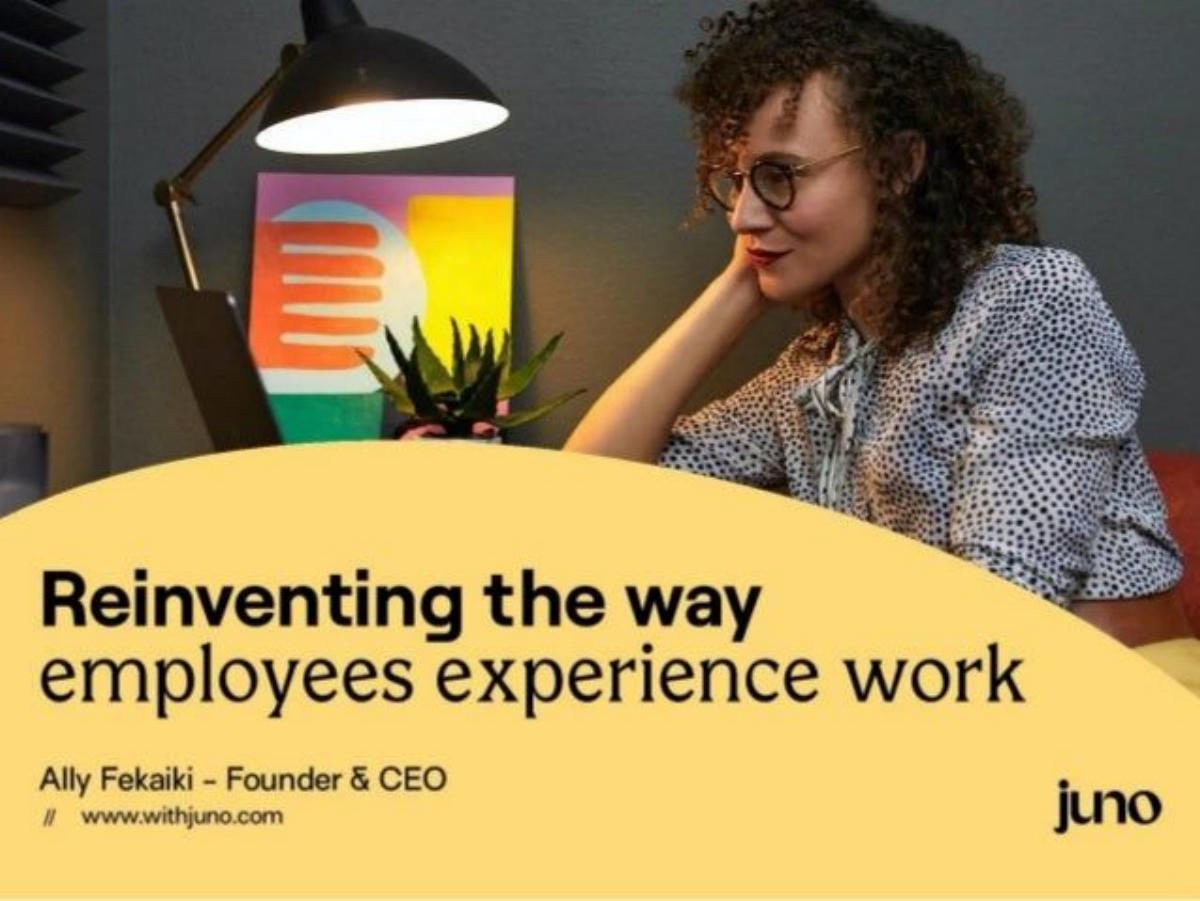
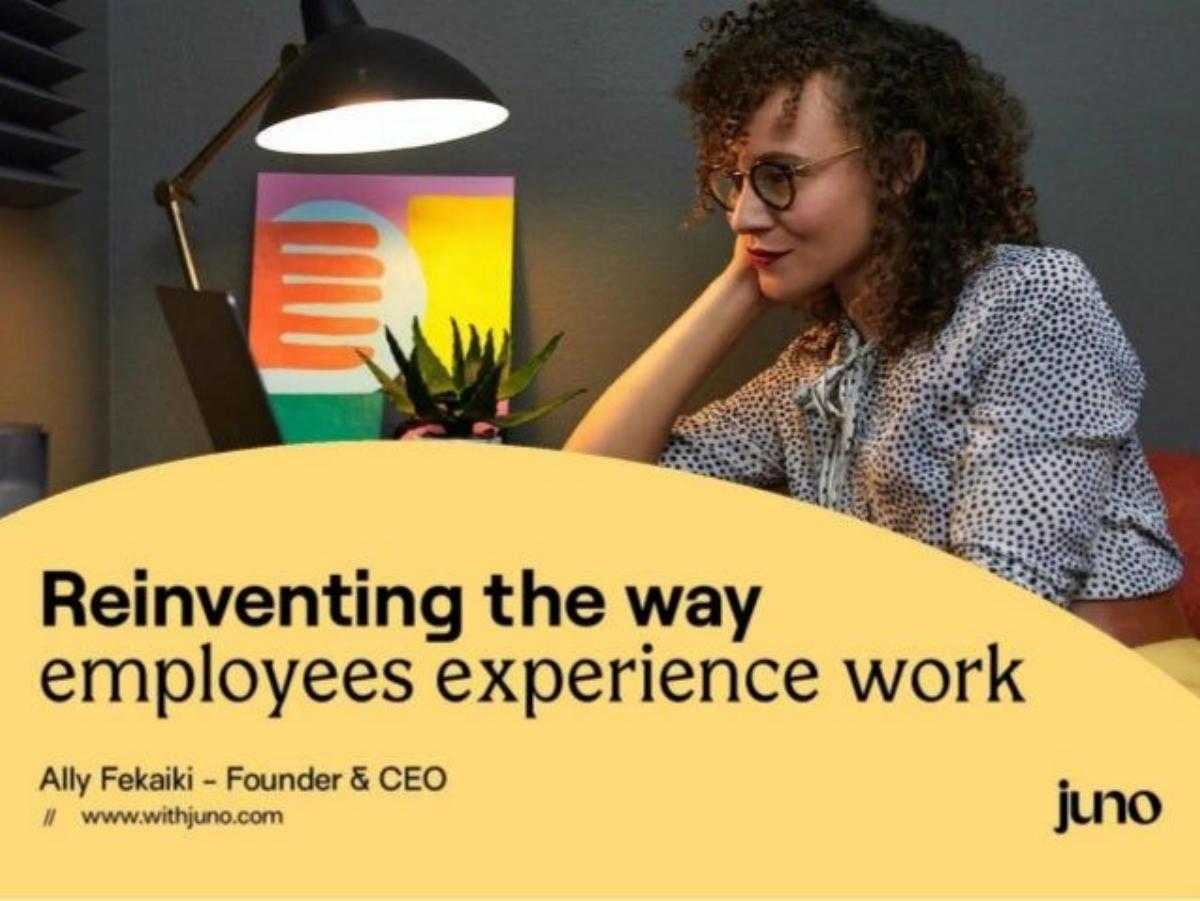
Slide 1: Cover and Tagline
The deck opens with a high-quality lifestyle image and the tagline: "Reinventing the way employees experience work." This is a classic 'Vision' slide. It doesn't mention software, SaaS, or benefits. Instead, it focuses on the outcome. Ally Fekaiki is listed as the Founder & CEO, establishing the primary point of contact immediately. The branding is clean, using a soft yellow and purple palette that deviates from the standard 'corporate blue' seen in most HR tech decks.
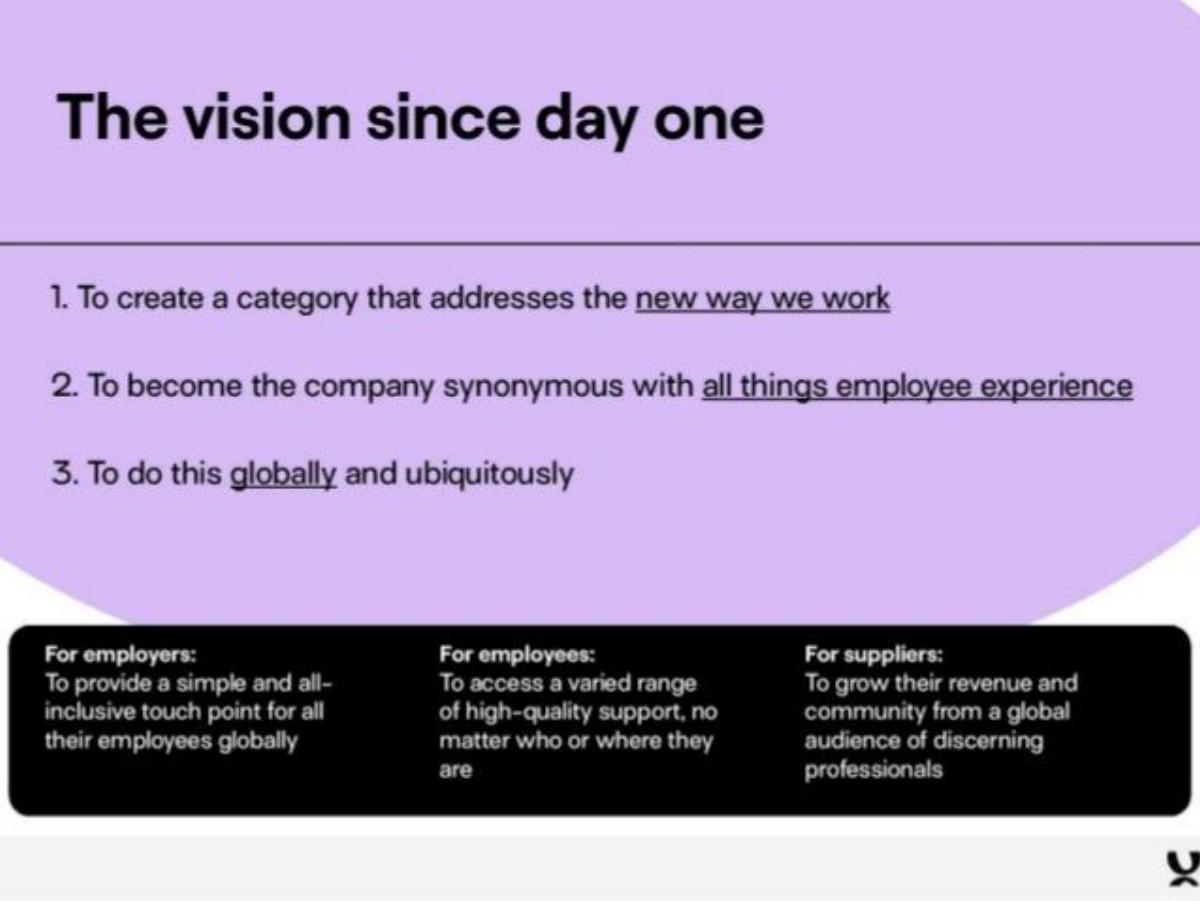
Slide 2: The Vision Since Day One
Slide 2 doubles down on the company's long-term ambitions. They outline three core goals: creating a new category for the 'new way we work,' becoming synonymous with 'employee experience,' and achieving global ubiquity. At the bottom, they break down the value proposition for three distinct stakeholders: Employers (simple touchpoint), Employees (high-quality support), and Suppliers (revenue growth). This slide is critical because it establishes Juno as a marketplace, not just a tool.
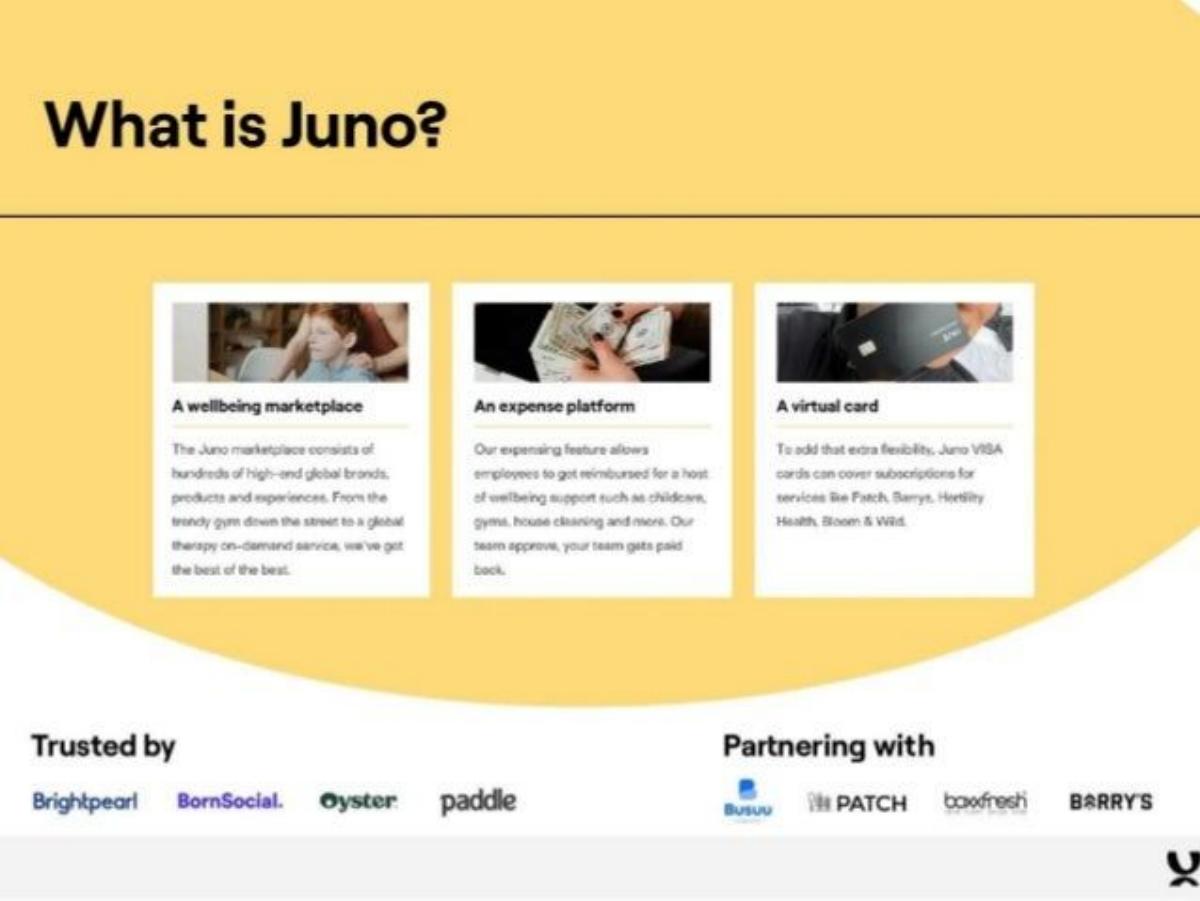
Slide 3: What is Juno?
This is the 'Product' slide. It breaks the platform into three digestible components: A wellbeing marketplace , An expense platform , and A virtual card . By including a 'virtual card' (specifically a Juno VISA card), they signal a fintech layer to their business, which often commands higher valuation multiples than pure-play marketplaces. The slide also includes 'Social Proof' via a 'Trusted by' section featuring Oyster and Paddle, and a 'Partnering with' section featuring brands like Barry’s and Patch.
Slide 4: The Problem Statement
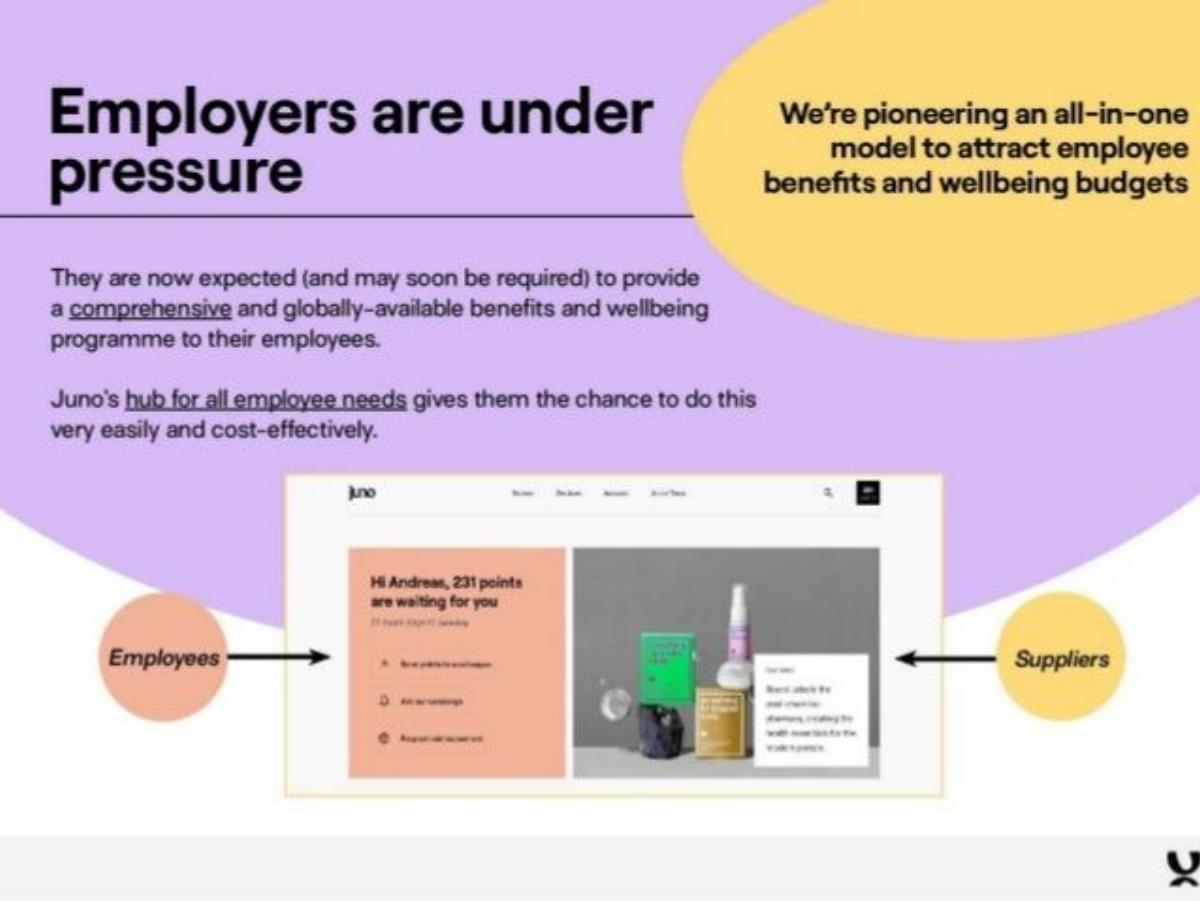
Titled "Employers are under pressure," this slide addresses the market pain point. It notes that employers are now expected (and may soon be required) to provide comprehensive, global benefits. It positions Juno as the 'hub for all employee needs' that makes this transition 'easy and cost-effectively.' The inclusion of a small UI screenshot provides a glimpse of the product, showing an employee named Andreas with '231 points' waiting for him, hinting at a gamified or points-based reward system.
Slide 5: The Marketplace Density
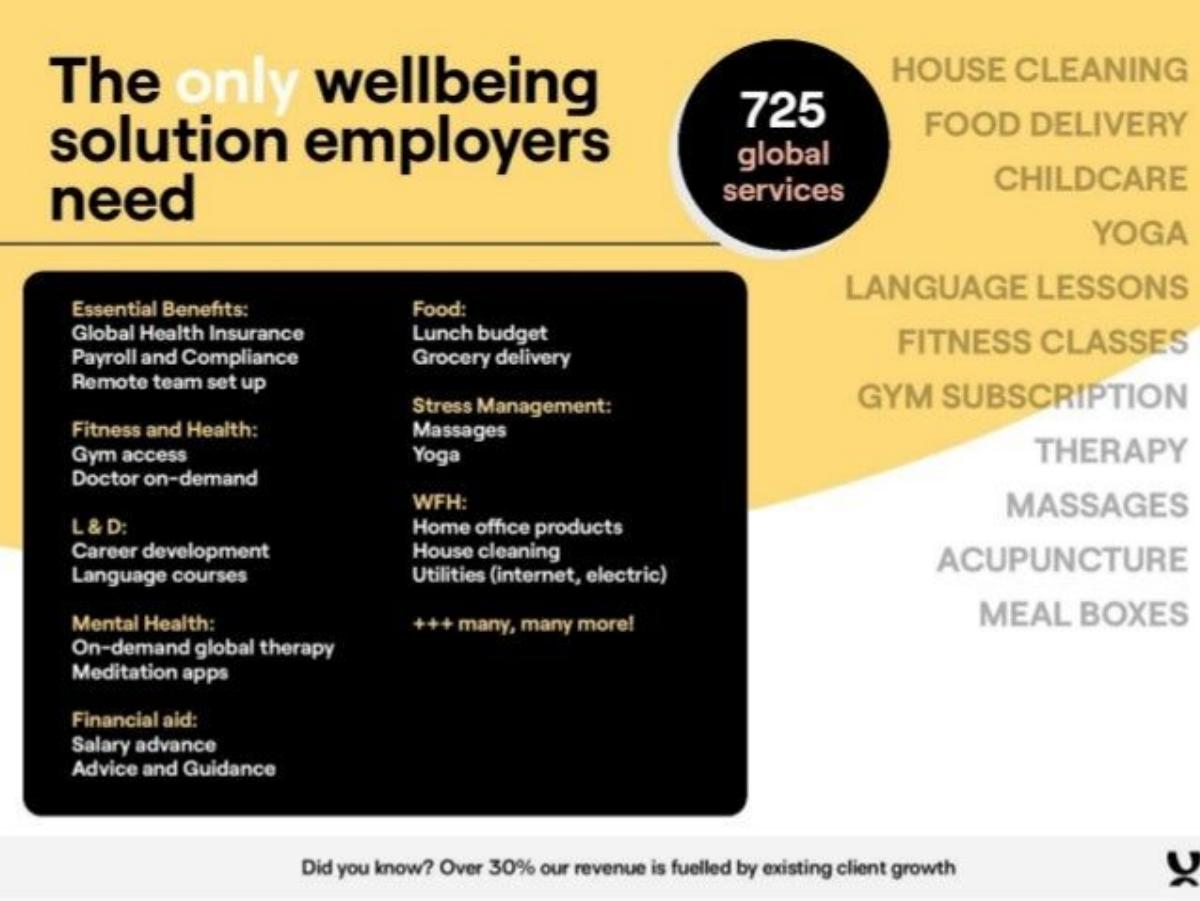
This is arguably the most important slide for a marketplace business. It claims Juno is "The only wellbeing solution employers need" and boasts "725 global services." The list of services is exhaustive, covering everything from Global Health Insurance and Payroll to Yoga and House Cleaning. A small but vital footer note states: "Over 30% our revenue is fueled by existing client growth," which is a strong indicator of Net Revenue Retention (NRR) without showing a full cohort table.
Slide 6: The Macro Trend
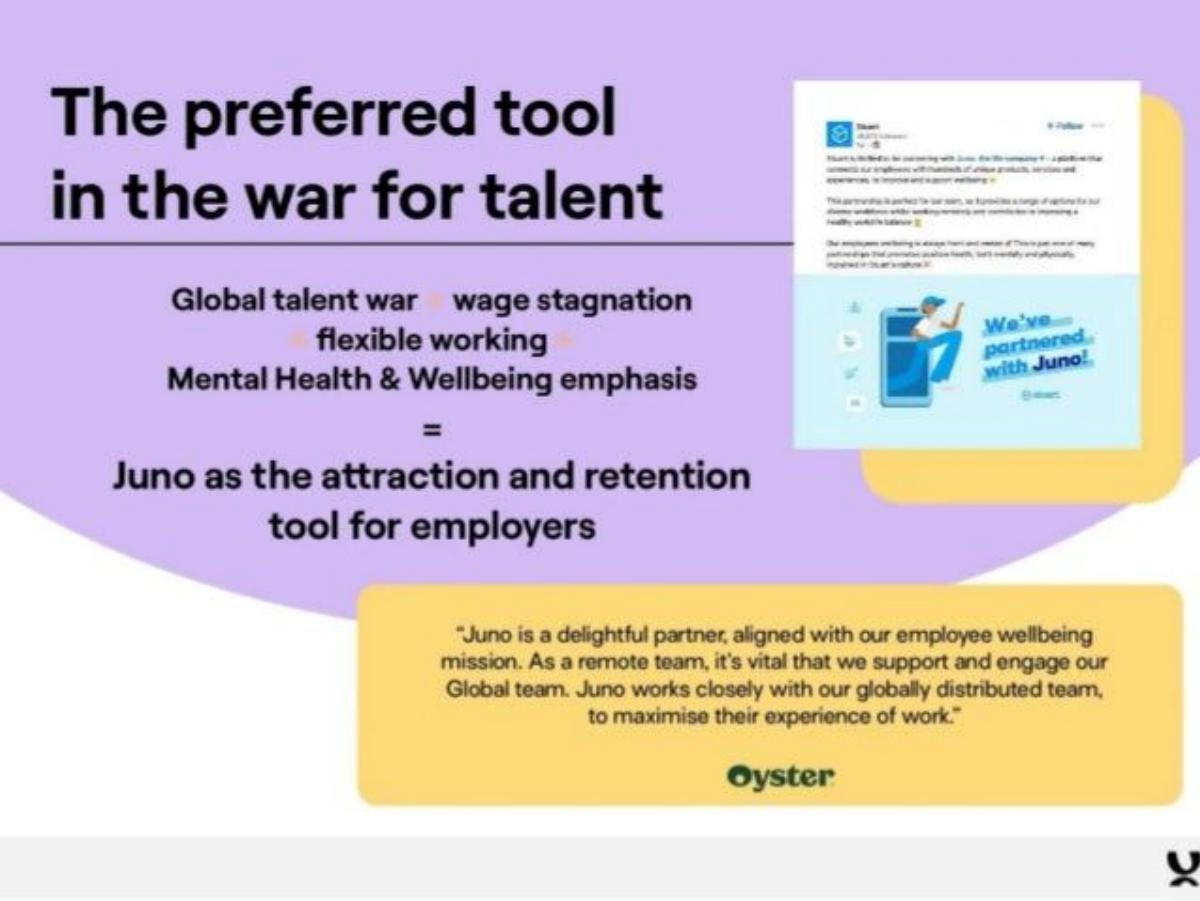
Slide 6 connects Juno to the 'war for talent.' It lists macro factors like 'wage stagnation,' 'flexible working,' and 'Mental Health emphasis.' The slide uses a testimonial from Oyster, a high-profile remote work platform, which serves as a powerful endorsement. The quote emphasizes that Juno helps 'maximise their experience of work' for a 'globally distributed team,' reinforcing Juno's suitability for the remote-first era.
Slide 7: Market Size (TAM)
Juno uses McKinsey 2021 data to justify its 'gigantic opportunity.' They aggregate three massive markets: L&D ($388bn) , Wellbeing ($56bn) , and Insurance ($70bn) . By stating "Juno plays in all categories," they argue that their TAM isn't just one of these buckets, but the intersection of all of them. A footer note adds more traction data: "Over 50% of Juno's clients increase in size and spend within 6 months."
Slide 8: Differentiation
Titled "Better than 'Benefits'," this slide contrasts Juno with legacy providers. For employers, the key differentiators are 'global workforce support out of the box' and 'tax savings.' For employees, the focus is on 'choice' and a 'beautifully designed end-user experience.' This slide addresses the 'Engagement' problem—most corporate benefits go unused because the UX is poor; Juno claims to solve this through design.
Slide 9: Product Scalability
This slide focuses on the technology. It shows a Juno VISA card and a backend dashboard. The headline "Game-changing product" is supported by the claim that the team has built 'scalable technology for all sides of the marketplace.' While light on technical details, the visuals suggest a mature, ready-to-scale platform rather than a prototype.
Slide 10: The Case Study
The deck concludes with a deep dive into a single client: Stuart . This is a highly effective way to end. It shows how Stuart consolidated "over 12 different vendors" into Juno. The metrics are impressive: 300% employee growth and 5x revenue growth (referring to the client's growth while using Juno). It also lists the global footprint of the rollout: UK, France, Spain, Italy, Portugal, and Poland. This proves the 'global' claim made earlier in the deck.
What Works in the Juno Deck
1. The 'Consolidator' Narrative: The strongest part of this deck is the argument for consolidation. By showing that a client like Stuart replaced 12 vendors with one, Juno presents itself as a cost-saver and a complexity-reducer. In a crowded SaaS market, being the 'one tool to rule them all' is a winning pitch.
2. Marketplace Breadth: Citing 725 global services (Slide 5) is a massive moat. It suggests that Juno has already done the hard work of business development and integration, making it difficult for a new competitor to catch up quickly.
3. Social Proof: The deck is littered with high-quality logos. Using Oyster and Paddle—companies that are themselves icons of the 'modern work' movement—creates an association of 'cool' and 'forward-thinking' that is rare in HR tech.
What is Missing from the Juno Deck
1. The Team: There is no team slide. Investors at the Series A level typically want to see the pedigree of the leadership team, especially in a complex marketplace/fintech hybrid. While the CEO is named on the cover, the rest of the 'scalable technology' builders are anonymous.
2. The Financials: There are no ARR figures, no CAC/LTV ratios, and no churn metrics. While they hint at growth (30% from existing clients), the lack of a dedicated traction slide with a growth chart is a notable omission for a Series A deck.
3. The Ask: The deck ends abruptly with a case study. There is no slide detailing how much they are raising, what the valuation expectations are, or how the funds will be allocated (e.g., 50% engineering, 30% sales). This suggests this version of the deck might have been a 'teaser' or a 'leave-behind' rather than the full presentation used in the room.
What Founders Should Copy
1. Stakeholder Segmentation: Copy the way Juno breaks down the value proposition for Employers, Employees, and Suppliers on Slide 2. It shows you understand the incentives of everyone in your ecosystem.
2. The 'Did You Know?' Footers: Juno uses the bottom of their slides to drop 'micro-traction' facts (e.g., "Over 50% of Juno's clients increase in size..."). This is a great way to include data without cluttering the main visual narrative of the slide.
3. Visual Consistency: The deck feels like a single, cohesive brand experience. The use of custom photography and a consistent color palette makes the company feel larger and more established than a typical startup. If you are selling 'Employee Experience,' your deck must reflect a high-quality experience.
Frequently asked questions
- What is Juno's core business model according to the deck?
- Juno operates as a B2B SaaS marketplace. It provides employers with a platform to manage employee benefits globally. The model is three-sided: employers pay for the platform to manage budgets, employees use it to select personalized benefits, and suppliers (725+ services) gain access to a professional audience. Revenue is driven by platform fees and, as noted on slide 5, significant expansion from existing clients.
- How does Juno differentiate itself from traditional benefits providers?
- Juno differentiates by moving away from 'fixed' benefits to a 'flexible' marketplace. On slide 8, they contrast themselves with traditional 'Benefits' by highlighting a 'beautifully designed end-user experience' and the ability for employees to 'choose what is most meaningful.' They also emphasize their 'out of the box' global support, which traditional localized providers often struggle to match.
- What are the most significant omissions in the Juno pitch deck?
- The most glaring omissions are the Team slide and the Ask slide. There is no information regarding the founders' backgrounds (other than the CEO's name on the cover) or the specific amount of capital being raised. Additionally, the deck lacks a competition slide and detailed financial projections, relying instead on high-level market data and a single-client case study.
- Who are Juno's primary customers and partners?
- According to slide 3, Juno is 'Trusted by' companies like Brightpearl, BornSocial, Oyster, and Paddle. Their partner network includes consumer brands and service providers such as Busuu, Patch, Boxxfresh, and Barry’s. This mix of high-growth tech companies as clients and trendy wellness brands as partners reinforces their 'modern work' branding.
- What market trends is Juno capitalizing on?
- Juno explicitly targets the 'war for talent' and the shift toward 'flexible working' (slide 6). They position their platform as a solution for 'wage stagnation' and the increased emphasis on 'Mental Health & Wellbeing.' By citing McKinsey data on slide 7, they align themselves with the massive global spend on Learning & Development ($388bn) and Wellbeing ($56bn).