Juro’s 2022 Series B deck is a highly professional, metrics-driven presentation that secured $23M in funding. The narrative centers on a paradigm shift from 'file-based' contract management (MS Word) to a 'browser-native' workflow. The deck excels by providing granular transparency into its Go-To-Market (GTM) engine, showing a 3x year-over-year net ARR growth and a 1xx% net dollar retention rate. It effectively uses cohort analysis and capital efficiency ratios (1:1 ARR added to net cash burn) to prove the scalability of the business model. While it uses redacted figures for specific ARR tota…
Key takeaways
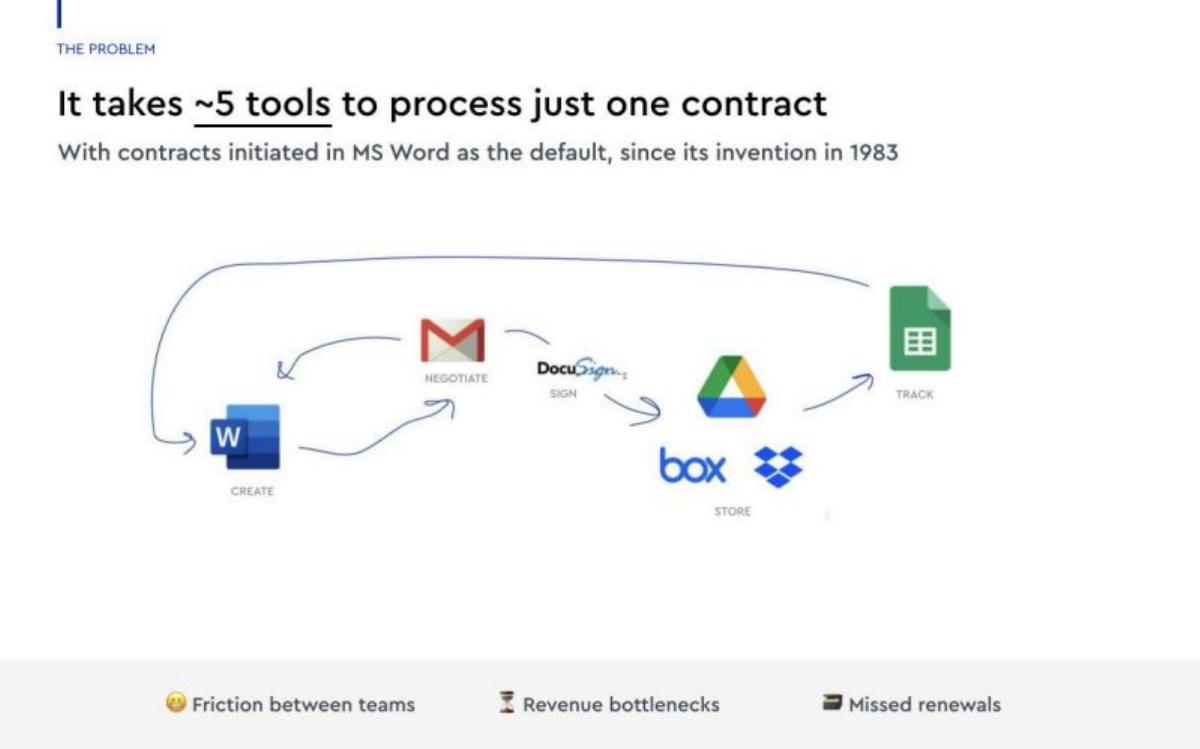
- The problem is framed as a tool-fragmentation issue, stating it takes approximately five tools to process a single contract (Slide 2).
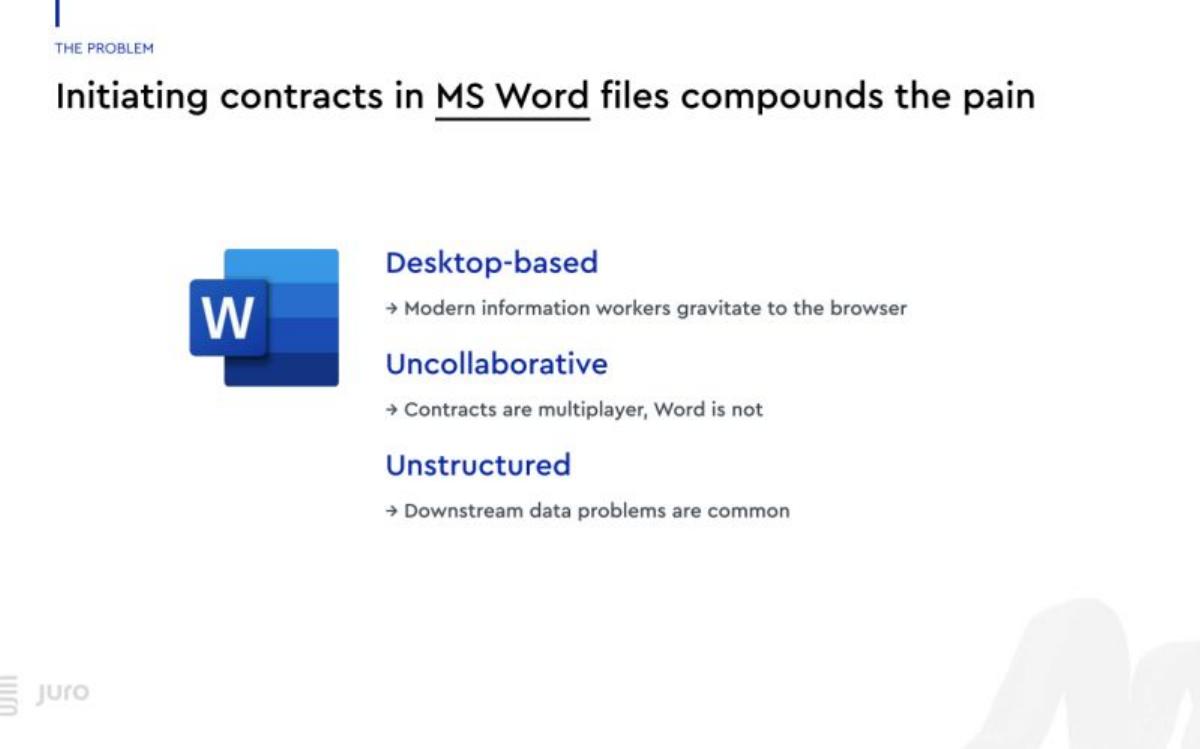
- Juro positions itself as 'browser-native' to contrast with the 'uncollaborative' and 'unstructured' nature of MS Word (Slide 3).
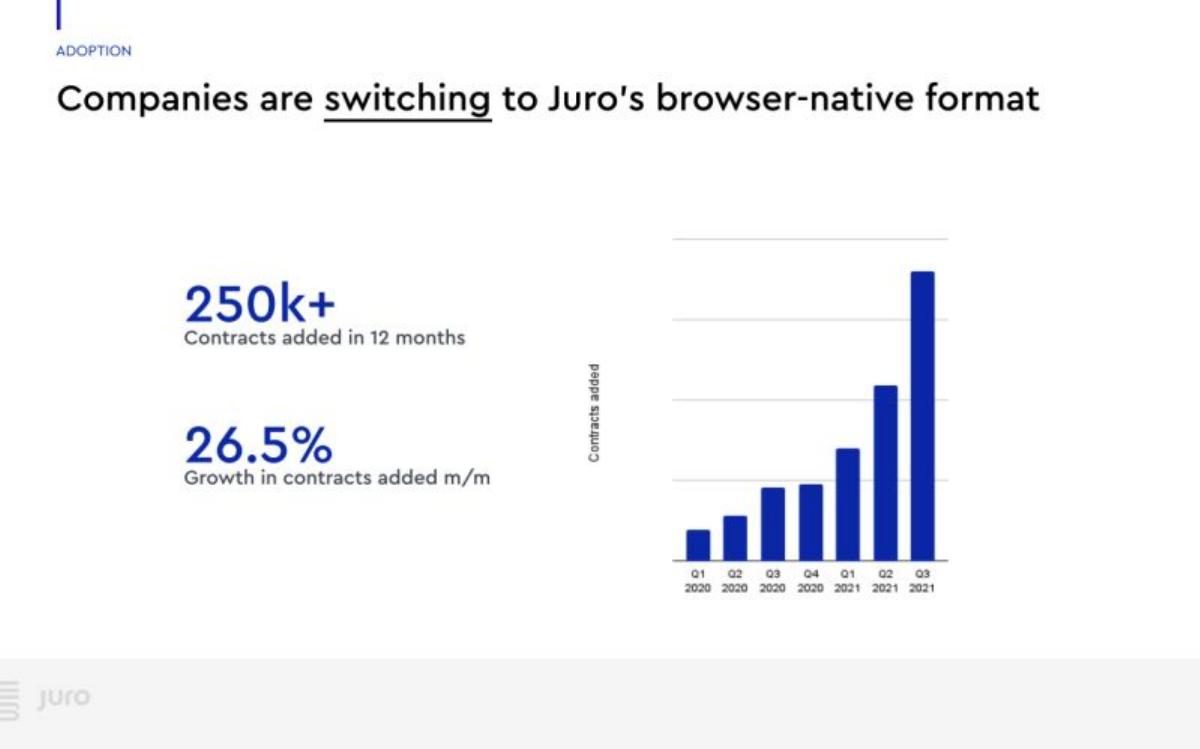
- Adoption metrics show significant momentum with 250k+ contracts added in 12 months and 26.5% month-over-month growth in contract volume (Slide 5).
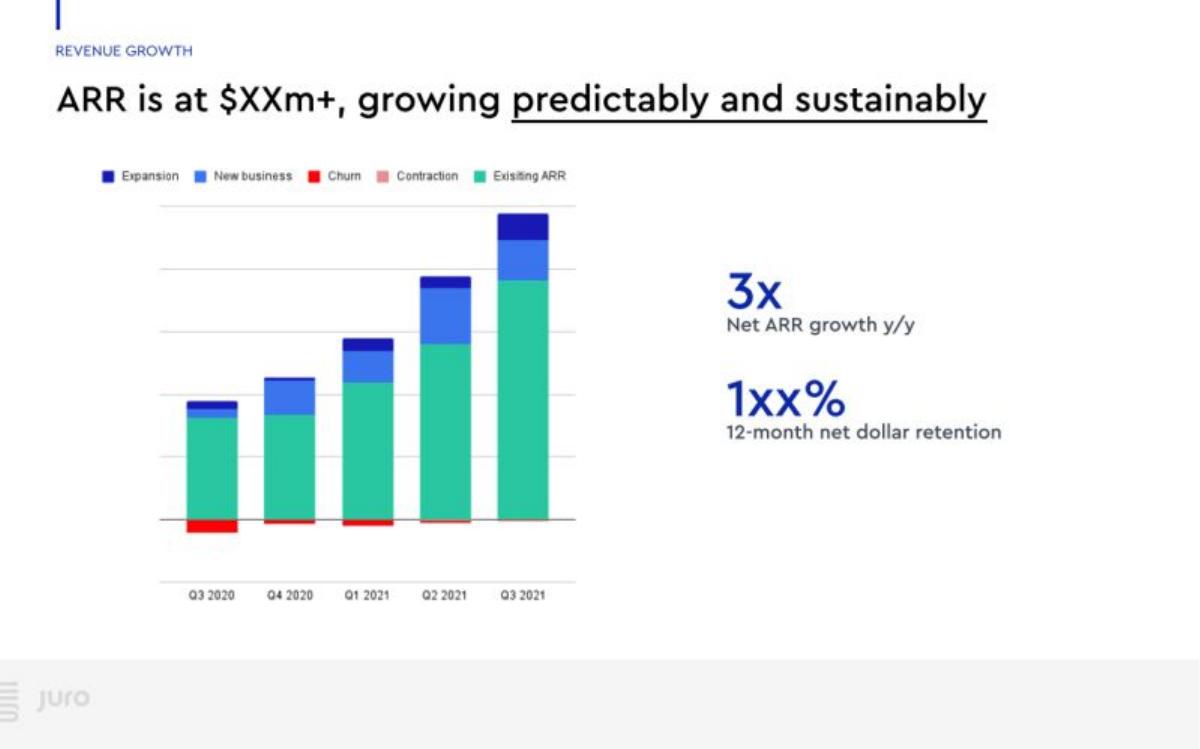
- The company demonstrates high-quality growth with a 3x net ARR increase year-over-year and net dollar retention exceeding 100% (Slide 6).
- GTM efficiency is highlighted through a breakdown of SQLs, with 45% coming from organic inbound channels (Slide 8).
- The deck includes a rare 'Leadership' slide that tracks employee headcount growth against departures, boasting a 94 Employee NPS (Slide 12).
- Capital efficiency is a core pillar, citing a 1:1 ratio of ARR added to net cash burn and a 0.9 gross sales efficiency (Slide 13).
- The vision slide sets a trajectory from a 'System of automation' in 2021 to a 'System of record' in 2022 (Slide 14).
The Narrative: Moving from Files to Data
Juro’s Series B pitch deck is built on a single, powerful thesis: the world of legal contracts is stuck in 1983. By attacking Microsoft Word as the primary 'villain' of the story, Juro creates a clear category distinction. They aren't just another e-signature tool; they are a browser-native platform that treats contracts as structured data rather than static files. This distinction is critical for a Series B raise, where the goal is to prove that the company is not just a feature, but a fundamental shift in how an enterprise operates.
Slide 1: Title Slide
The deck opens with a minimalist blue slide featuring the Juro logo and the tagline: "All-in-one contract automation." It includes the website URL at the bottom. It is clean, professional, and immediately establishes the company's focus on the 'all-in-one' value proposition.
Slide 2-3: The Problem Definition
Slide 2 identifies a specific friction point: "It takes ~5 tools to process just one contract." The slide illustrates a messy workflow involving MS Word (Create), Gmail (Negotiate), DocuSign (Sign), Box/Dropbox (Store), and Google Sheets (Track). It explicitly mentions that MS Word has been the default since 1983, framing it as an antiquated solution. The bottom of the slide lists the business consequences: friction between teams, revenue bottlenecks, and missed renewals.
Slide 3 doubles down on the MS Word critique, labeling it "Desktop-based," "Uncollaborative," and "Unstructured." This sets the stage for Juro's 'browser-native' solution by highlighting that modern workers gravitate to the browser and that contracts are inherently 'multiplayer'—a term borrowed from the gaming and collaborative software world (like Figma or Notion).
Slide 4: The Solution Today
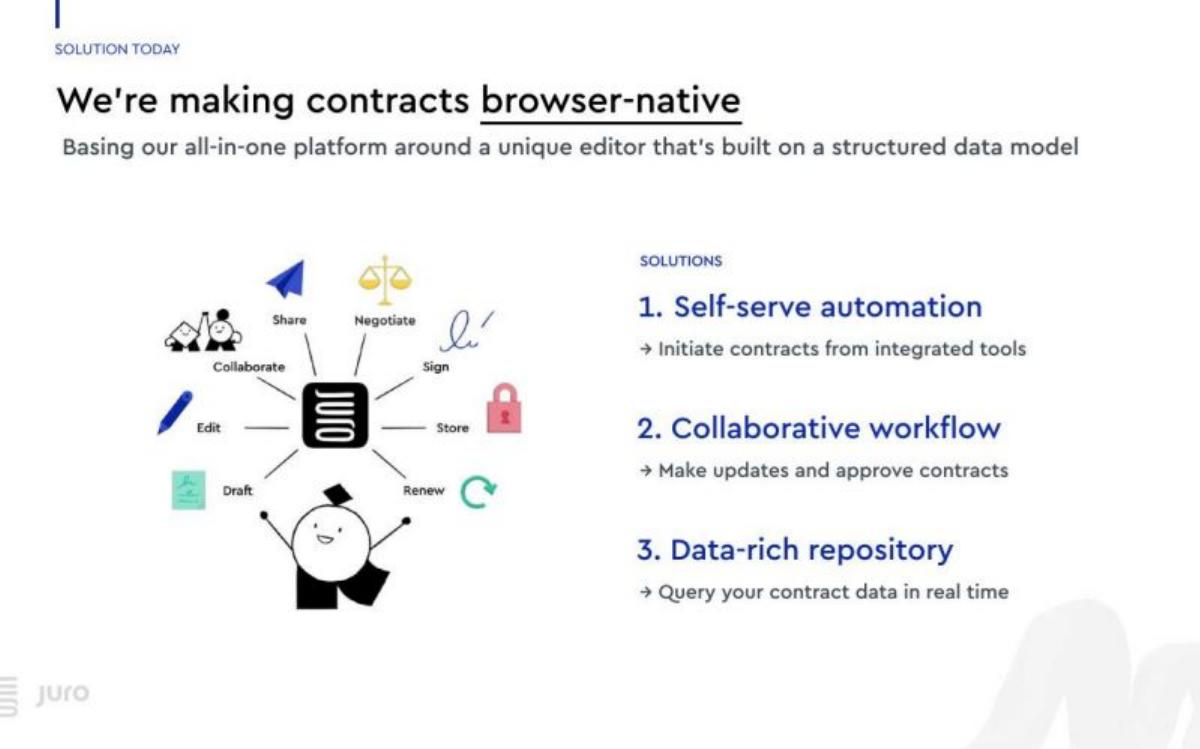
Juro introduces its platform as "browser-native" and built on a "unique editor that's built on a structured data model." The slide lists three core pillars: 1. Self-serve automation, 2. Collaborative workflow, and 3. Data-rich repository. The visual uses a hub-and-spoke diagram showing Juro at the center of drafting, editing, collaborating, sharing, negotiating, signing, storing, and renewing.
Slide 5: Adoption and Momentum
This is where the deck transitions from 'why' to 'how well.' Slide 5 shows a bar chart of "Contracts added" from Q1 2020 to Q3 2021. The growth is exponential, particularly in 2021. Key figures cited include "250k+ Contracts added in 12 months" and "26.5% Growth in contracts added m/m." This proves that the platform is being used at scale, not just purchased.
Slide 6: Revenue Growth
Slide 6 addresses the financial health of the business. While the specific ARR figure is redacted as "$XXm+," the slide claims the growth is "predictable and sustainable." It highlights "3x Net ARR growth y/y" and "1xx% 12-month net dollar retention." The stacked bar chart shows a healthy mix of existing ARR, new business, and expansion, with very minimal churn (red) and contraction (pink) visible at the bottom of the bars.
Slide 7: Competitive Landscape
Juro uses a standard 2x2 matrix to position itself. The axes are "Files-based vs. All-in-one" and "Not optimized for legal vs. Suitable for legal." Juro occupies the top-right quadrant alone. Competitors (blurred in this version) are relegated to the 'Files-based' or 'Not optimized for legal' categories, reinforcing the 'browser-native' and 'legal-first' messaging.
Slide 8: Go-To-Market Engine
This slide provides deep transparency into Juro's sales funnel. A bar chart shows "# Customers by Industry," with SaaS and FinTech leading the pack. A pie chart breaks down "2021 SQLs by Channel," revealing that 45.0% of leads are organic inbound, 19.6% are paid inbound, and 35.4% are outbound. This is a very healthy mix for a Series B company, suggesting a strong brand and content engine. Typical customers listed include Luno, Cazoo, Deliveroo, Personio, and Trustpilot.
Slide 9: Retention and Churn
Slide 9 focuses on the downward trend of churn. It shows a line graph where "Gross $ARR quarterly churn" is decreasing (ending at 0.6% in the final period shown) and "Net $ARR quarterly churn" is significantly negative (shown as -10.6%), indicating that expansion from existing customers far outweighs losses. This is the 'holy grail' of SaaS metrics.
Slide 10: Community and Advocacy
Juro highlights its "community of champions" with a 72 NPS and 550+ Community group members. It includes G2 reviews and a specific testimonial from Michael Haynes, Head of Legal at Cazoo, who states that "Up to 30 per cent of the legal function's time is won back" using Juro. This provides social proof and a tangible ROI metric.
Slide 11: Land and Expand Motion
This slide uses a cohort analysis chart to show how revenue from specific quarterly groups (Q2 2020 through Q3 2021) grows over time. The 'layer cake' effect is clear, showing that once a customer is 'landed,' they 'expand' their usage significantly. Expansion case studies are mentioned with "XXX% growth" figures, though the specific dollar amounts are redacted.
Slide 12: Leadership and Culture
The team slide features CEO Richard Mabey (ex-Freshfields, LegalZoom) and CPO Pavel Kovalevich (ex-Accenture, IdeaPort). Uniquely, it also includes a "94 Employee NPS" and a chart showing headcount growth vs. departures. This is a strong signal to investors that the company is a stable place to work and can retain talent during a scale-up phase.
Slide 13: Capital Efficiency
For a Series B, investors want to know how much 'gas' is required to move the 'car.' Juro reports a "1:1 ARR added / net cash burn" ratio and a "0.9 Gross sales efficiency." These are top-tier metrics. The slide also lists their funding history: $750k in 2016 (Seedcamp), $2m in 2018 (Point Nine Capital), and $5.25m in 2020 (Union Square Ventures).
Slide 14: Ultimate Vision
The final content slide outlines the roadmap. In 2021, Juro was a "Single Player System of automation." In 2022, it aims to be a "Multiplayer System of record." The 'Future' (Step 3) is blurred but suggests a broader play in the contract collaboration space. It explicitly mentions a goal to "change the paradigm for contract collaboration" while acknowledging that DocuSign currently "owns eSignature for files."
What Works in This Deck
Metric Transparency: Juro doesn't just say they are growing; they show the mechanics of that growth through SQL channel breakdowns, cohort analysis, and capital efficiency ratios. · Clear Villain: By positioning against MS Word rather than just other startups, Juro makes the problem feel universal and the solution feel like an inevitable evolution. · Culture as a Metric: Including Employee NPS and retention data is a sophisticated move that addresses the 'people risk' inherent in Series B companies. · Visual Consistency: The deck uses a clean, modern aesthetic that mirrors the 'browser-native' product they are selling.
What Is Missing
Detailed Product Walkthrough: While the 'hub-and-spoke' diagram is good, the deck lacks actual screenshots of the 'unique editor' they claim is their differentiator. · TAM/SAM/SOM: There is no explicit slide defining the Total Addressable Market. While investors likely know the legal tech market is large, a Series B deck usually quantifies the specific slice the company is attacking. · The 'Ask': The deck does not explicitly state the amount they are looking to raise or the specific use of proceeds (e.g., hiring 50 engineers, expanding to the US). This may have been handled in a separate document or during the live pitch.
What a Founder Should Copy
The GTM Slide (Slide 8): Every founder should be able to show exactly where their leads come from (Organic vs. Paid vs. Outbound). It proves you have a repeatable engine, not just a few lucky breaks. · The Cohort Chart (Slide 11): This is the most effective way to prove 'Land and Expand.' If your older customers are paying more today than they were a year ago, you have a high-value product. · The Efficiency Ratios (Slide 13): In a tighter funding environment, showing your 'Burn Multiple' (ARR added vs. Cash Burn) is essential. Juro’s 1:1 ratio is a gold standard for SaaS.
Frequently asked questions
- How much did Juro raise with this deck?
- According to the catalogue facts, Juro raised $23M in a Series B round in 2022. The deck itself focuses on the performance metrics that justified this valuation, such as 3x year-over-year ARR growth and strong capital efficiency ratios.
- What is Juro's primary competitive advantage according to the slides?
- Juro positions itself as the only 'all-in-one' system that is 'suitable for legal' and 'browser-native.' On Slide 7, they use a 2x2 matrix to contrast their structured data model against legacy 'files-based' competitors and general-purpose tools not optimized for legal teams.
- What does Juro's customer base look like?
- Slide 8 shows that Juro's largest customer segment is SaaS, followed by FinTech and Retail. They list high-profile customers including Deliveroo, Cazoo, Personio, and Trustpilot, indicating a strong product-market fit among modern, high-growth technology companies.
- How does Juro prove its 'land and expand' strategy?
- Slide 11 uses a quarterly ARR cohort chart to visualize how older customer groups increase their spending over time. They supplement this with expansion case studies showing specific accounts growing by 'XXX%' as more contracts are added to the platform.
- What is unique about Juro's team slide?
- Unlike most decks that only show founder bios, Juro's Slide 12 includes internal culture metrics. It features a Glassdoor rating of 5.0, a 100% CEO approval rating, a 94 Employee NPS, and a chart showing very low employee departures relative to headcount growth.