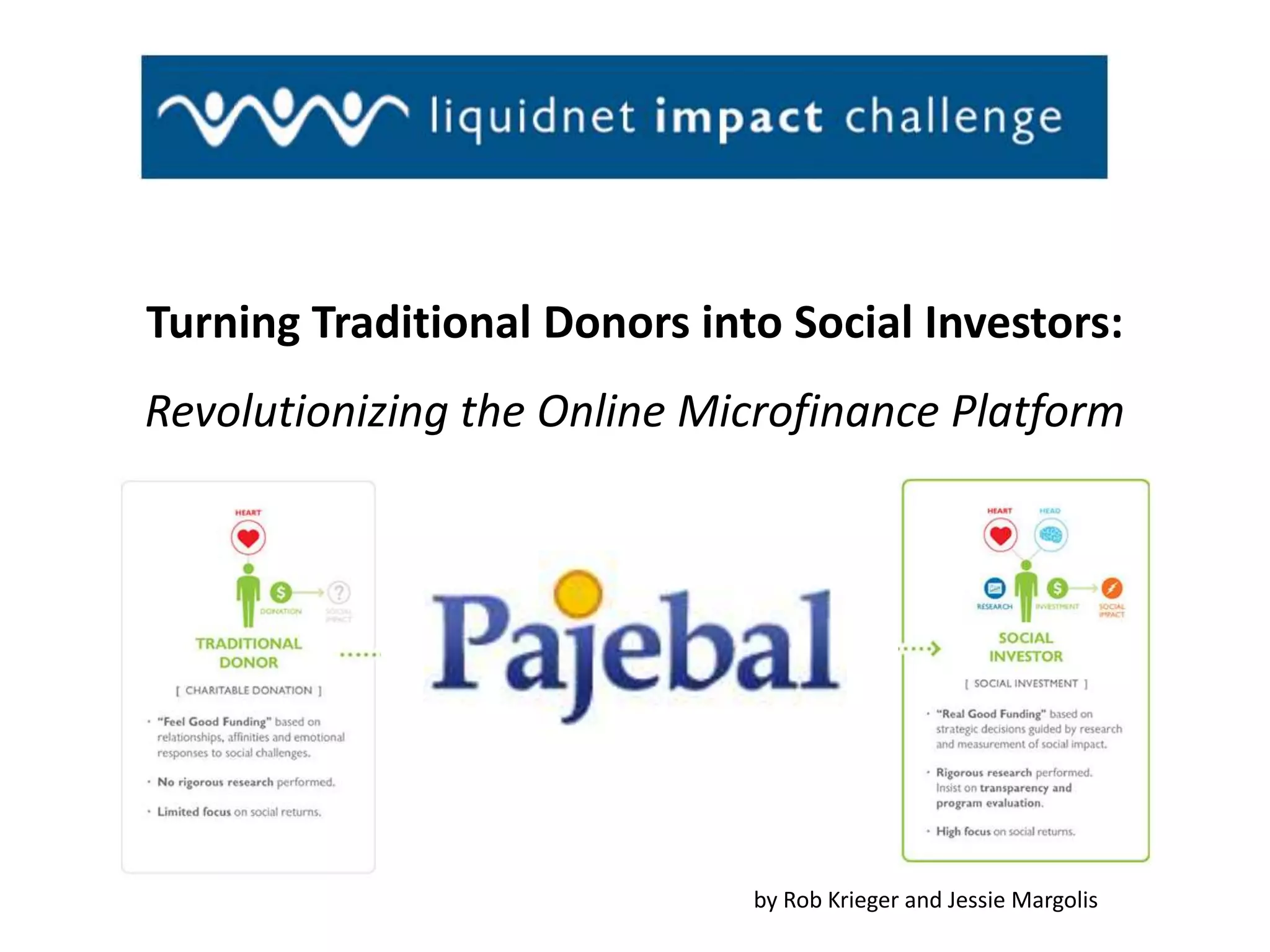
Pajebal’s pitch deck, submitted for the Liquidnet Impact Challenge, identifies five core failures in the current microfinance landscape, specifically targeting the lack of financial accountability and the 'disconnect' created by pooling small donations. The company proposes a shift from 'Traditional Donors' to 'Social Investors' by facilitating direct B2B relationships where U.S. corporations lend to specific developing-world businesses. Key features include a video-based pitch system to increase transparency and a game-like 'stock market' for small businesses to track performance via points.…
Key takeaways
- The deck identifies five specific issues with current microfinance, including a lack of financial accountability and the failure to leverage lender business knowledge (Slide 3).
- Pajebal proposes a video-based 'pitch' system to provide lenders with a 'true inside look' into the dynamism of developing world entrepreneurs (Slide 4).
- Idea #2 introduces a gamified 'stock market' where participants trade non-legal shares of small businesses using a points system to identify top-performing investments (Slide 5).
- The core solution, Idea #3, focuses on a one-lender-to-one-borrower B2B relationship, specifically targeting U.S. Corporate Social Responsibility (CSR) programs (Slide 6).
- Pajebal is a registered North Carolina nonprofit corporation with an existing office in Quetzaltenango, Guatemala (Slide 9).
- The implementation plan relies heavily on Skype-based communication for weekly or quarterly feedback sessions between lenders and borrowers (Slide 9).
- The deck omits a traditional team slide, revenue model, market size analysis, and a specific dollar amount for the 'ask' (Slides 1-10).
- The name 'Pajebal' is derived from the Kiche Maya village that inspired the work, meaning 'at the snake’s tail' or 'at the end of the line' (Slide 10).
Executive Summary: A Pivot from Charity to Social Investment
The Pajebal pitch deck, created for the Liquidnet Impact Challenge, represents a fundamental critique of the first generation of online microfinance. While acknowledging that platforms like Kiva have successfully reached millions, the authors, Rob Krieger and Jessie Margolis, argue that the current model is flawed because it treats lenders as 'Traditional Donors' rather than 'Social Investors.' The deck is structured as a series of three 'Ideas' or innovations intended to transform Pajebal, Inc. from a standard microfinance intermediary into a B2B connection platform. It is a process-heavy deck that prioritizes the 'how' of the relationship over the 'how much' of the market.
Slide 1: Title and Vision
The cover slide introduces the 'liquidnet impact challenge' branding and the core thesis: 'Turning Traditional Donors into Social Investors: Revolutionizing the Online Microfinance Platform.' It features a side-by-side comparison of a 'Traditional Donor' (motivated by heart/emotion, no research, limited focus on returns) versus a 'Social Investor' (motivated by heart and head, rigorous research, high focus on social returns). This sets the stage for a deck focused on professionalizing the micro-lending experience.
Slide 2: The Current Landscape
Slide 2 provides context by illustrating the existing microfinance model, citing Kiva, MicroPlace, and MYC4. It uses a flow chart from Kiva.org to show how capital moves from lenders to field partners and finally to entrepreneurs. The slide acknowledges that these platforms have 'significantly enhanced the ability for capital to reach millions,' but serves as a baseline for the critique that follows.
Slide 3: Identifying the Five Core Issues
This is the 'Problem' slide, though it is framed as 'Issues.' Pajebal identifies five specific shortcomings of current platforms: Issue #1: Lack of financial accountability. Issue #2: Inability to gauge 'communicative dynamism' or passion. Issue #3: The 'feel good effect' replaces strategic decision-making. Issue #4: Failure to leverage the business knowledge of developed-world lenders. Issue #5: An over-concentration on micro-loans rather than small businesses that can create significant employment.
Slide 4: Idea #1 - The Video Pitch System
To solve the transparency and dynamism issues, Pajebal proposes a video-based system. The slide shows mockups of a YouTube-style interface where borrowers create video pitches. The rationale is that current platforms do not allow for 'sufficient direct screening.' The solution requires all borrowers to post a video to give lenders a 'true inside look' into the business attractiveness.
Slide 5: Idea #2 - The Gamified Stock Market
This slide introduces a more radical concept: an online 'stock market' for small businesses. Crucially, the slide notes that 'investment does not equate to actual legal ownership.' Instead, it is a game-like setting where participants trade shares based on financial statements and video pitches. Motivation comes from 'gain in points' and the pride of being the 'best investor in the competition.' This is presented as a way to efficiently allocate capital by identifying the most promising projects through crowd-sourced due diligence.
Slide 6: Idea #3 - The B2B 'Deep Dive'
Idea #3 is the core of the 'New Pajebal.' It moves away from individual micro-lenders to a 'one business lender-to-one business borrower relationship.' Using Stonyfield Farm as an example, the slide explains how a U.S. company can use its CSR funds to lend to a specific entrepreneur (e.g., Francisco, an organic coffee farmer). This 'one-lender-one-borrower dynamic' allows the investor business to take on a consultative role.
Slide 7: Synthesizing the Solutions
This slide maps the three ideas back to the five issues identified on Slide 3. It serves as a summary of the value proposition. For example, it notes that Idea #3 solves Issue #4 by allowing U.S. businesses to take a consultative role via an 'online portal and Skype.' It also addresses Issue #5 by focusing on 'small to medium businesses' rather than just micro-enterprises.
Slide 8: The User Journey Comparison
Slide 8 provides a detailed, step-by-step comparison between how 'John Doe' uses current platforms (pooling $50 with no direct connection) and how 'Stonyfield Farm' would use the New Pajebal (investing $3,200, reviewing financial info and video pitches, and maintaining a direct connection). This slide is effective at illustrating the shift in scale and engagement the founders are proposing.
Slide 9: Implementation and Organization Status
The deck moves into execution with a 6-step process for establishing the lender-borrower relationship, emphasizing 'Skype video meetings' and 'regularly practiced feedback.' The bottom of the slide contains critical organizational data: Pajebal, Inc. is a 'registered North Carolina nonprofit corporation' with an office in 'Quetzaltenango, Guatemala.' It states the intent to scale across Latin America and notes that competition funds would be donated to the nonprofit.
Slide 10: The Origin Story
The final slide explains the name 'Pajebal,' which is Kiche Maya for 'at the snake’s tail.' It provides an emotional hook, stating that the people at the 'end of the line' have been there too long. It concludes with a call to action to view the project at their website.
What Works in This Deck
Clear Problem Identification: The deck does an excellent job of articulating exactly why the current microfinance model is insufficient for 'social investors.' By breaking the problem into five distinct issues, the founders create a logical framework that their solutions directly address.
Differentiated Model: The shift from individual micro-donations to B2B corporate lending is a clear, defensible pivot. It targets a different pool of capital (CSR budgets) and offers a different value proposition (mentorship and high-touch due diligence).
Process Mapping: The 6-step implementation plan on Slide 9 and the step-by-step comparison on Slide 8 make the theoretical ideas feel tangible. Investors (or competition judges) can easily visualize how the platform would actually function.
What Is Missing from This Deck
Business Model and Sustainability: As a nonprofit, the deck explains how it will use 'won funds,' but it does not explain how Pajebal sustains itself long-term. Is there a fee on the loans? A subscription for the U.S. corporations? The financial mechanics of the organization itself are absent.
Team Slide: While the names Rob Krieger and Jessie Margolis appear on the cover, there are no bios, photos, or descriptions of their expertise. In fundraising, the 'who' is often as important as the 'what,' especially for a project requiring boots-on-the-ground operations in Guatemala.
Market Size and Traction: The deck mentions an existing office in Guatemala but provides zero data on current operations. How many loans have they facilitated? What is the repayment rate? How many U.S. companies are interested? Without these metrics, the deck remains purely conceptual.
The 'Ask': Because this was for a competition, there is no specific funding goal or breakdown of how capital will be deployed. A standard pitch deck needs a clear financial request and a roadmap for those funds.
Lessons for Founders
Use a 'Problem/Solution' Matrix: Pajebal’s use of Slide 7 to map specific solutions to previously identified problems is a masterclass in logical consistency. Founders should ensure that every 'feature' they pitch is a direct answer to a 'pain point' they’ve established.
Leverage Comparative User Stories: Slide 8’s comparison between 'John Doe' and 'Stonyfield Farm' is much more effective than a bulleted list of features. It tells a story of how the user experience changes, which is easier for an audience to remember.
Define Your 'Social' Metrics: Pajebal successfully argues that 'feel good' isn't a metric. By emphasizing 'financial accountability' and 'communicative dynamism,' they suggest that social impact can be measured with the same rigor as financial returns. Founders in the ESG or impact space should adopt this 'Head and Heart' approach to appeal to sophisticated investors.
Frequently asked questions
- What is the primary problem Pajebal is trying to solve?
- Pajebal argues that current microfinance platforms like Kiva focus too much on 'feel-good' donations rather than strategic social investment. According to slide 3, these platforms fail to encourage financial accountability, do not allow lenders to assess an entrepreneur's 'communicative dynamism,' and disconnect the donor from the project by pooling funds. Pajebal aims to fix this by creating direct, high-transparency B2B connections.
- How does the 'stock market' idea work if the shares aren't legal?
- As detailed on slide 5, the 'stock market' is a game-like competitive setting. While the initial capital extension involves real funds, the subsequent trading of 'shares' does not equate to legal ownership. Instead, participants use a points system to 'buy' and 'sell' based on financial statements and video pitches. This is designed to motivate lenders through pride and competition rather than direct financial gain.
- What is the role of U.S. corporations in this model?
- Pajebal targets U.S. companies through their Corporate Social Responsibility (CSR) programs. Slide 6 explains that a single U.S. business lends to a single business in the developing world. This allows the U.S. company employees to take on a consultative role, providing mentorship and due diligence, which Pajebal believes leads to more prudent investment and better business growth for the borrower.
- Is Pajebal a for-profit startup or a nonprofit?
- Pajebal is explicitly identified as a 'registered North Carolina nonprofit corporation' on slide 9. The deck was created for the 'liquidnet impact challenge,' and the text notes that any funds won in the competition would be donated to the organization to help it scale from western Guatemala to other areas of Latin America.
- What technology does Pajebal use to facilitate these relationships?
- The deck emphasizes two main technology components: a video-based pitch website and Skype. Slide 9 outlines a 6-step implementation process where Skype video meetings are used for the initial 'get-to-know-the-business' conversation and subsequent weekly or quarterly feedback sessions between the lender and the borrower.