Yalo’s 23-slide Series A deck is a data-driven narrative centered on the shift from traditional commerce to conversational AI. The company positions itself at the intersection of 'Enterprise Ready' and 'Fast Start,' a competitive quadrant that avoids the slow implementation cycles of legacy players like Salesforce while maintaining higher sophistication than consumer-grade bots like ManyChat. The deck highlights impressive unit economics, including an ACV range of 84K to 1MM USD and a reported 36M USD pipeline. By focusing on high-impact metrics—such as a 90% reduction in calls and doubling s…
Key takeaways
- Yalo defines its market opportunity by citing that people spend 84% of their time on messaging apps like WhatsApp and Messenger (Slide 2).
- The platform promises an aggressive implementation timeline, claiming only 3 weeks to get started for enterprise clients (Slide 3).
- The deck claims a 2X increase in sales compared to other digital channels, providing a clear ROI for prospective buyers (Slide 6).
- Traction is evidenced by a massive 36M USD pipeline, signaling strong market demand at the time of the raise (Slide 12).
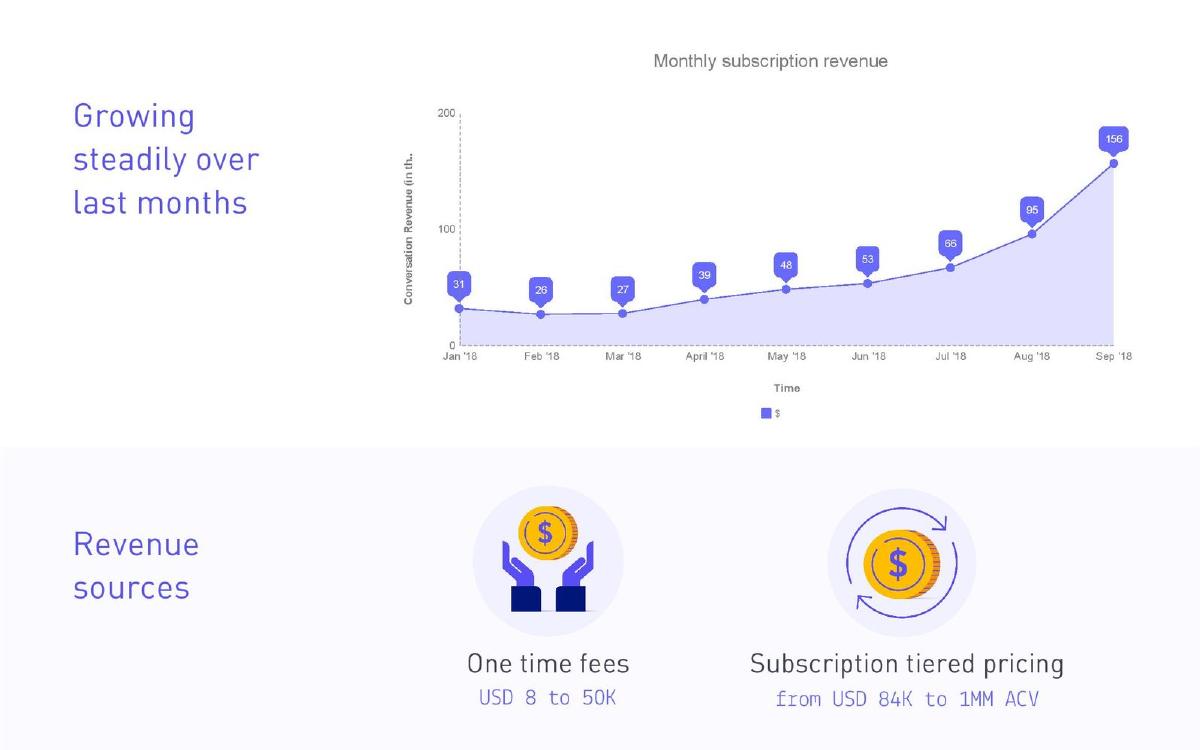
- Revenue growth is shown through a monthly subscription chart, rising from 31 in January 2018 to 156 in September 2018 (Slide 16).
- The business model is dual-pronged, featuring one-time fees (8K to 50K USD) and high-value tiered subscriptions (84K to 1MM ACV) (Slide 16).
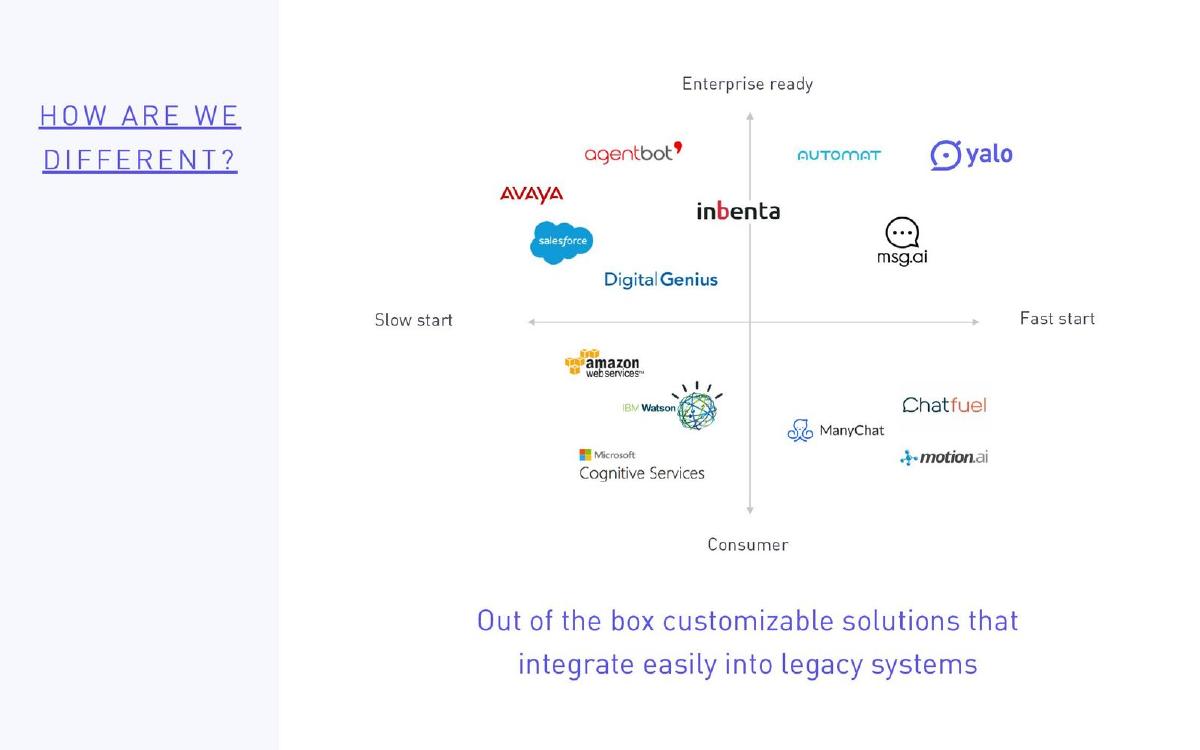
- Yalo positions itself against 14 competitors, placing itself uniquely in the 'Enterprise Ready' and 'Fast Start' quadrant (Slide 19).
- Product efficacy is highlighted by a 90% call reduction metric achieved through automated WhatsApp notifications (Slide 20).
Executive Summary: The Rise of Conversational Commerce
Yalo’s Series A pitch deck is a focused, high-signal document that addresses the friction inherent in enterprise digital transformation. By targeting messaging apps—specifically WhatsApp—Yalo taps into a pre-existing user habit. The deck is structured to move quickly from the macro trend (messaging dominance) to micro-wins (90% call reduction), ultimately landing on a robust financial story characterized by high ACVs and a significant pipeline.
Slide 1: The Vision Statement
The cover slide introduces Javier Mata as founder and CEO and sets a clear, functional tone. The tagline, "AI that improves relationships with your customers over chat," avoids technical jargon in favor of a business outcome. The inclusion of the yalochat.com URL and a simple graphic of a hand holding a smartphone immediately establishes the mobile-first nature of the product.
Slide 2: The Macro Trend
Slide 2 provides the 'Why Now' for the investment. Citing a Nielsen survey, it states that "People spend 84% time on Messaging Apps." By featuring the WhatsApp and Messenger logos, Yalo identifies the specific ecosystems where they operate. This slide justifies the company's existence by showing that they are building where the attention already is, rather than trying to force users into a new proprietary app.
Slide 3: The Speed Advantage
Enterprise software is notorious for long implementation cycles. Yalo attacks this pain point directly on Slide 3, claiming it takes "ONLY 3 weeks to get STARTED." The use of a genie illustration suggests a 'magic' or frictionless experience, but the core message is purely operational: Yalo is a 'Fast Start' solution that provides immediate time-to-value.
Slide 6: The ROI Proof Point
Slide 6 moves from implementation to results. It claims a "2X INCREASE SALES vs. other channels." This is a critical slide for a Series A deck because it moves the product from a 'nice-to-have' support tool to a 'must-have' revenue generator. By framing the product as a sales accelerator, Yalo justifies the high ACVs mentioned later in the deck.
Slide 12: The Pipeline
Traction is often the most scrutinized part of a Series A. Slide 12 presents a single, massive figure: "36M USD in pipeline." While pipeline is not the same as closed revenue, for a company targeting million-dollar contracts, a large pipeline indicates that the sales team has successfully identified a market need and is in active negotiations with major players. This figure suggests significant future scale.
Slide 16: Business Model and Revenue Growth
This is the 'meat' of the deck. Slide 16 shows a bar chart of "Monthly subscription revenue" from January 2018 to September 2018. The revenue grows from 31 (presumably in thousands, though the axis is partially cut off) to 156. This represents a 5x increase in less than a year. Below the chart, the business model is detailed: "One time fees USD 8 to 50K" and "Subscription tiered pricing from USD 84K to 1MM ACV." This confirms Yalo is playing in the high-end enterprise space, where individual accounts can be worth seven figures annually.
Slide 19: Competitive Positioning
The competitive matrix on Slide 19 is one of the most effective slides in the deck. It uses two axes: "Consumer vs. Enterprise ready" and "Slow start vs. Fast start." Yalo places itself in the top-right quadrant (Enterprise ready + Fast start). It positions itself as more sophisticated than consumer bots like ManyChat and Chatfuel , but faster and more modern than legacy giants like Salesforce , Avaya , and IBM Watson . This positioning is a classic 'Goldilocks' strategy—offering the power of the big players with the agility of a startup.
Slide 20: Product and Efficacy
Slide 20, titled "HOW WE DO IT," shows a screenshot of the WhatsApp notification interface. The key metric here is "90% Call reduction." This provides a secondary ROI case: if Slide 6 was about making money (sales), Slide 20 is about saving money (support costs). For an enterprise, reducing call center volume by 90% is a transformative cost-saving measure.
What Works in Yalo's Deck
The deck excels at quantifying value . Instead of talking about 'better AI' or 'natural language processing,' Yalo talks about 2X sales increases and 90% call reductions. These are metrics that a CFO or a Head of Sales can understand and get excited about. The clarity of the business model is also a strength; by stating the ACV range up to 1MM USD, they signal that they are building a high-margin, scalable enterprise software business, not a low-cost self-service tool.
The competitive positioning is also handled masterfully. By identifying 'Speed of Implementation' as a primary axis, they turn their biggest competitors' (Salesforce, IBM) greatest weakness into Yalo's greatest strength. This allows them to compete for the same budget while offering a different value proposition.
What is Missing
Despite the strong metrics, there are notable omissions in the provided slides. There is no detailed team slide included in the selection, which is usually a requirement for a Series A to prove the founders have the technical and sales pedigree to close million-dollar deals. Additionally, while the pipeline is mentioned, there is no breakdown of the current customer base or logos of the companies contributing to that 36M USD figure. Seeing a few Fortune 500 logos would have validated the 'Enterprise Ready' claim.
Finally, the deck lacks unit economics beyond the ACV. Investors at the Series A stage typically want to see Customer Acquisition Cost (CAC) and LTV/CAC ratios to understand how efficiently the company can deploy the new capital to grow that 36M USD pipeline.
Founder Takeaways: Lessons from Yalo
Focus on Business Outcomes: Don't sell the technology; sell the result. Yalo focuses on sales increases and cost reductions, which are the two things every enterprise buyer cares about. · Own a Quadrant: When building a competitive matrix, don't just put yourself in the top right. Define the axes so that the top right represents a unique combination of traits that your competitors lack (in this case, Enterprise scale + Startup speed). · Show the Trajectory: The revenue chart on Slide 16 is powerful because it shows consistent, month-over-month growth. Even if the absolute numbers are early, the slope of the line tells the story of product-market fit. · Leverage Existing Ecosystems: By building on WhatsApp, Yalo doesn't have to solve the 'user adoption' problem. They only have to solve the 'business integration' problem. Founders should look for platforms where their target users are already active.
Frequently asked questions
- What is Yalo's core value proposition for enterprises?
- Yalo focuses on improving customer relationships through AI-driven chat on platforms where users already spend their time, specifically WhatsApp and Messenger. Their core value lies in the combination of 'Enterprise Ready' features with a 'Fast Start' implementation, promising a 90% reduction in call volume and a 2X increase in sales compared to other channels.
- How does Yalo generate revenue?
- According to Slide 16, Yalo utilizes a hybrid revenue model. They charge one-time implementation fees ranging from 8K to 50K USD. The primary driver of long-term value is their tiered subscription pricing, which targets large-scale enterprise contracts with Annual Contract Values (ACV) between 84K and 1MM USD.
- Who are Yalo's main competitors according to their deck?
- Slide 19 identifies a broad competitive landscape. Legacy enterprise players include Salesforce, Avaya, and IBM Watson. Consumer-focused bots include ManyChat and Chatfuel. Specialized AI competitors include Digital Genius, Inbenta, and msg.ai. Yalo differentiates itself by being faster to deploy than legacy systems while remaining more enterprise-capable than consumer tools.
- What specific metrics does Yalo use to prove traction?
- The deck uses three primary traction signals: a 36M USD sales pipeline (Slide 12), a monthly subscription revenue chart showing 5x growth over nine months (Slide 16), and specific performance KPIs like 90% call reduction and 2X sales increases for their existing clients.
- What is the implementation timeline for Yalo's solution?
- Yalo emphasizes speed as a competitive advantage. Slide 3 explicitly states that it takes 'ONLY 3 weeks to get STARTED.' This is a direct challenge to traditional enterprise software deployments, which often take months or years to integrate with legacy systems.