yboo is a mobile application targeting the UK's £5.4BN wasted mobile spend by providing automated, usage-based deal recommendations. The deck outlines a transition from a simple recommendation engine to a 'Switchbot' for automatic network switching. Beyond the consumer app, yboo proposes a B2B revenue stream by selling 'big data' insights to mobile operators to help them optimize products. The company sought £250k at a £1.25M pre-money valuation, with £150k already committed at the time of the deck's publication. While the deck provides clear screenshots of the Android app and specific financ…
Key takeaways
- The company identifies a £5.4BN total wasted spend in the UK, with 60m consumers overpaying by an average of £156 per year (Slide 2).
- The product roadmap includes a 'Switchbot' for automatic switching to eliminate consumer hassle (Slide 5).
- yboo employs a dual revenue model: consumer connection bonuses and B2B 'big data' sales to mobile operators (Slide 10).
- Capturing 1% of the UK switching market is projected to generate £3.75m in yearly revenue based on £12.50 connection bonuses (Slide 11).
- The fundraising ask is £250k for 16.66% equity at a £1.25M pre-money valuation (Slide 12).
- At the time of the deck, £150k of the £250k round was already agreed upon (Slide 12).
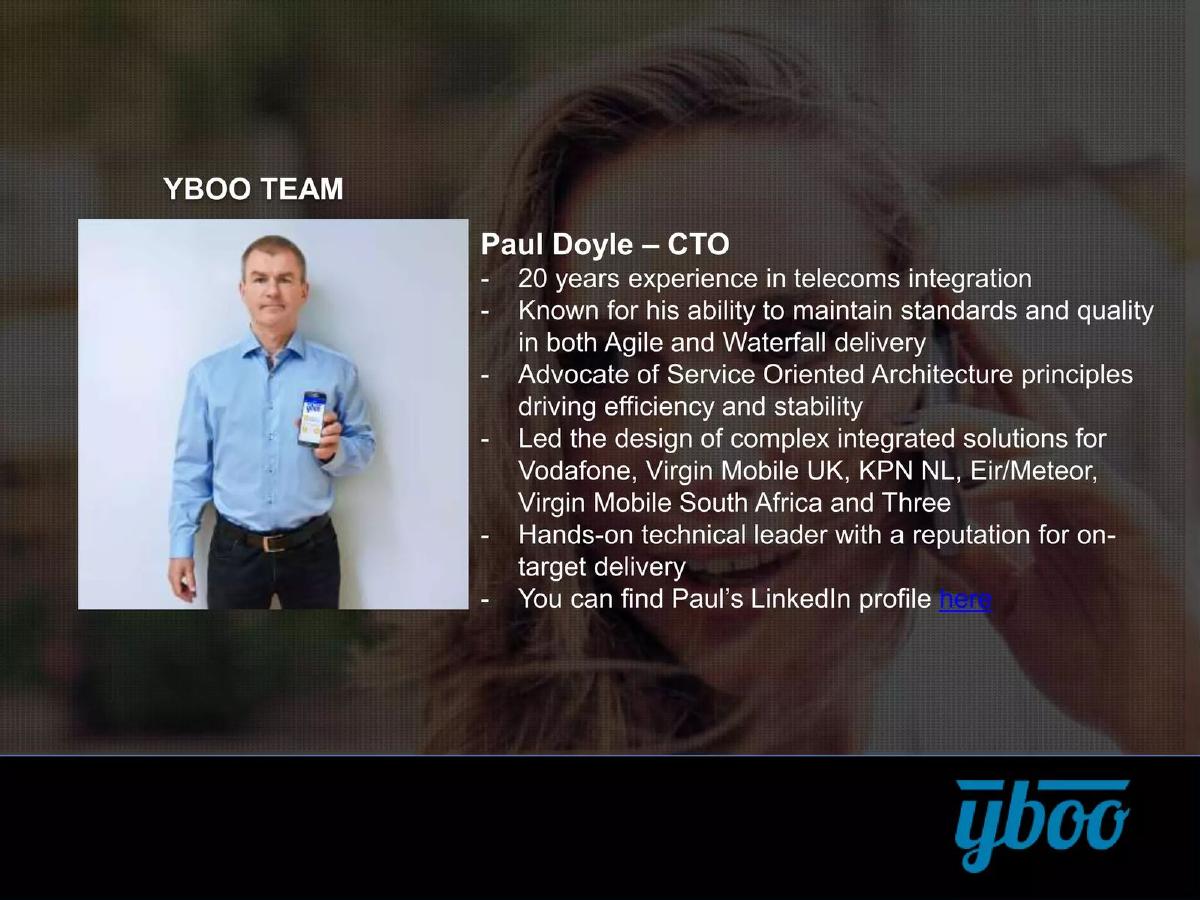
- The team slide only features Paul Doyle, the CTO, highlighting his 20 years of telecoms experience with brands like Vodafone and Virgin Mobile (Slide 4).
- The app was live on Google Play at the time of the pitch, with an iOS version listed as 'coming soon' (Slide 8).
Company Overview and Problem Definition
Slide 1: Title Slide
The deck opens with a clear value proposition: yboo is a mobile app that solves the problem of knowing which mobile network and deal is best for the user. The slide includes the company logo, website, and social media handles for the company and Martyn Gould.
Slide 2: The Impact
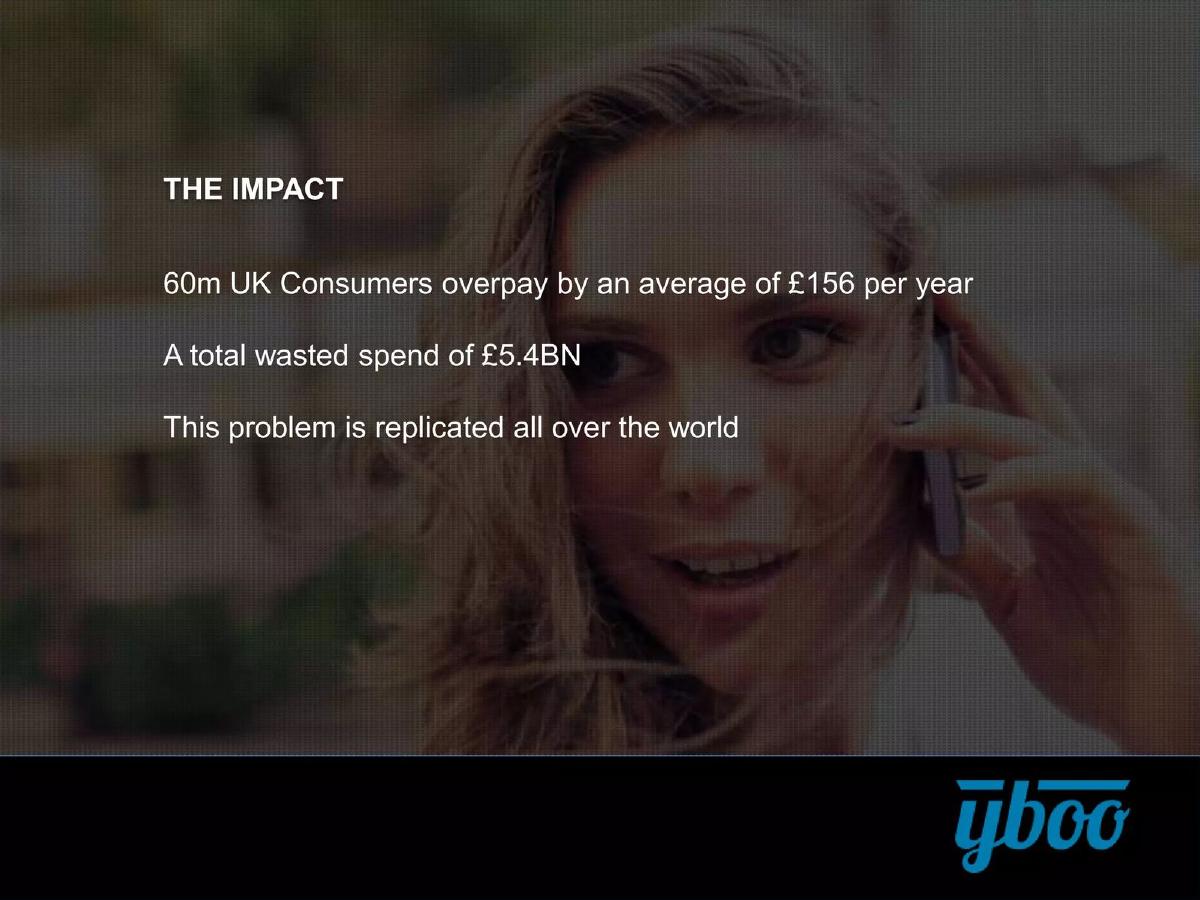
This slide quantifies the market pain point. It states that 60 million UK consumers overpay by an average of £156 per year, totaling £5.4 billion in wasted spend. It frames the problem as a global issue, suggesting scalability beyond the UK market.
Slide 3: Old World vs. New World
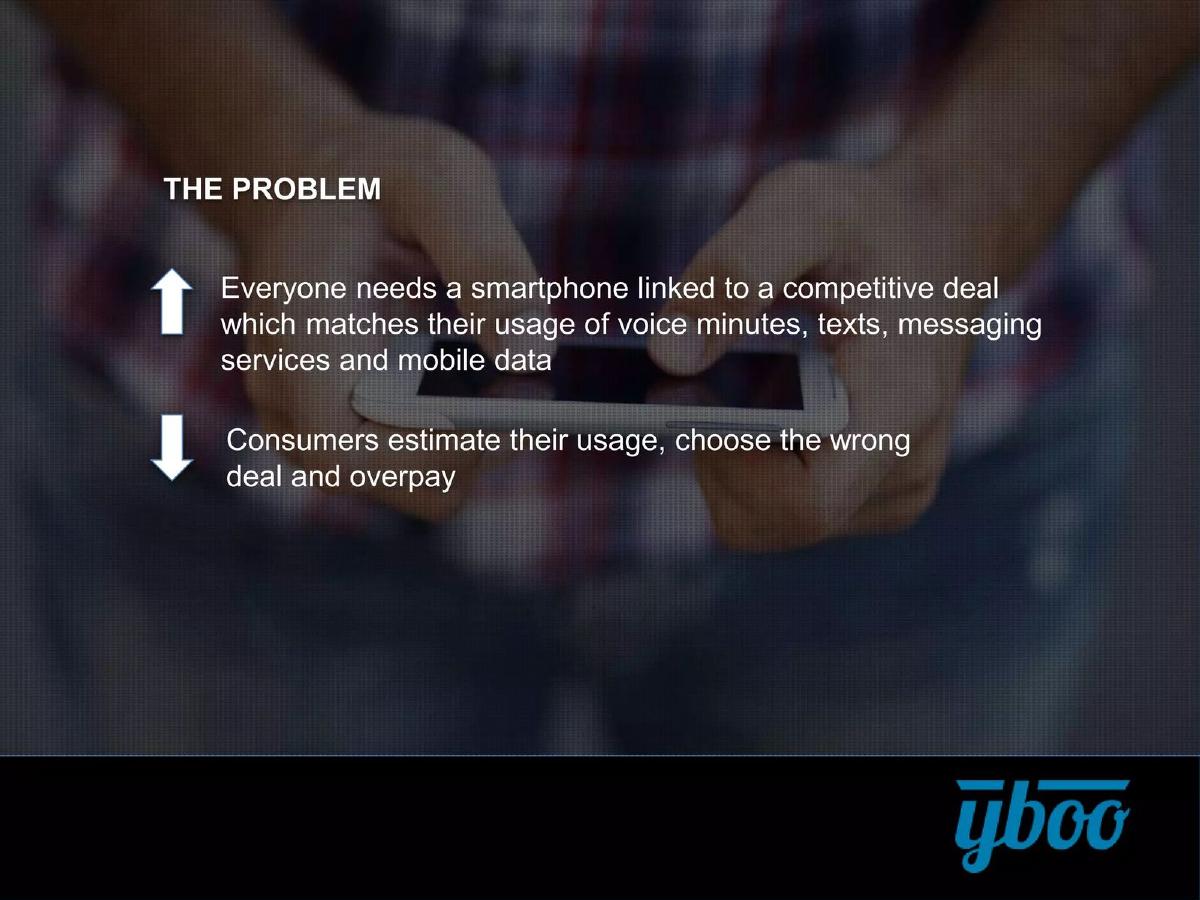
yboo uses a comparison framework to define its utility. In the 'Old World,' consumers estimate usage, buy the wrong deals, and overpay. In the 'New World,' users employ yboo to receive recommendations and secure the 'right deal,' implying a shift from guesswork to data-driven decision-making.
Team and Roadmap
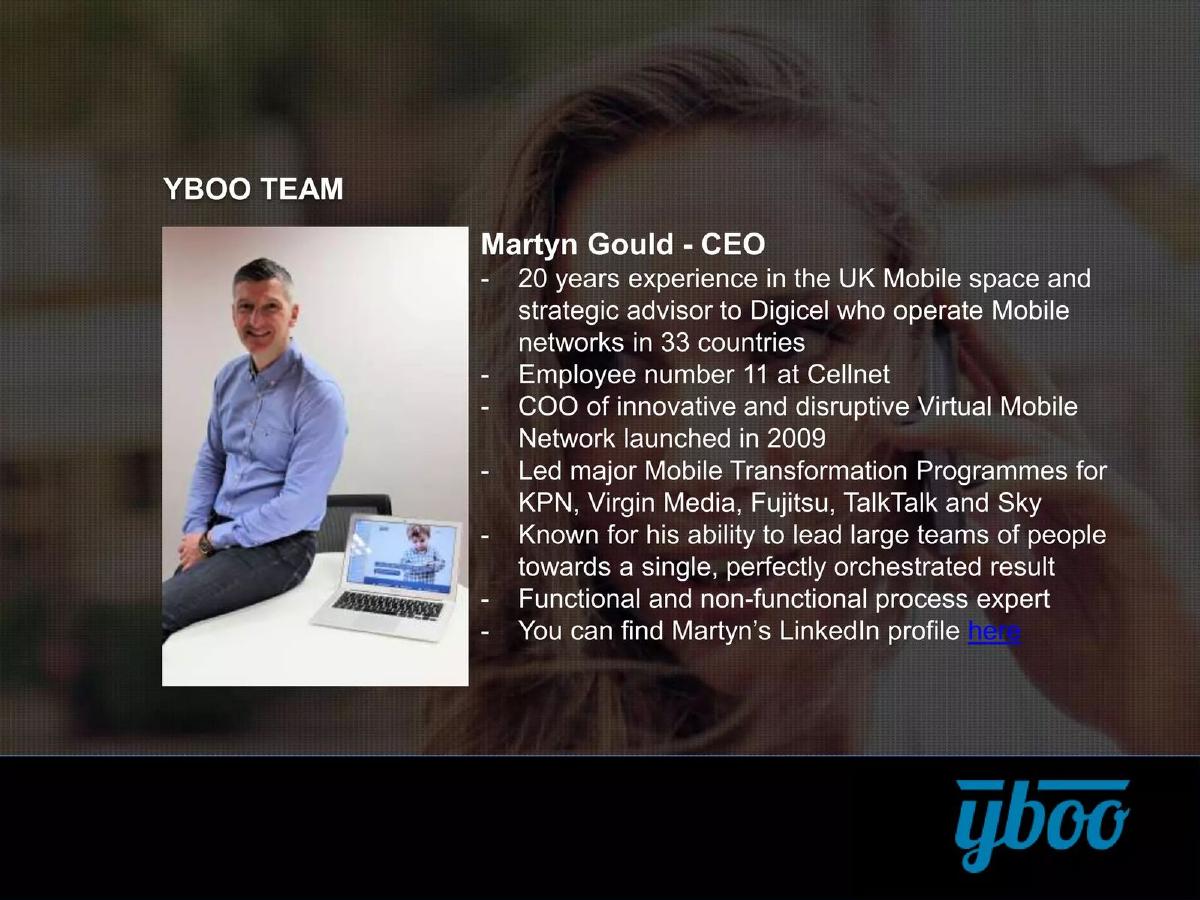
Slide 4: YBOO Team
This slide is dedicated entirely to Paul Doyle, the CTO. It lists 20 years of experience in telecoms integration and mentions work for major brands including Vodafone, Virgin Mobile UK, KPN NL, Eir/Meteor, Virgin Mobile South Africa, and Three. Notably, no other team members, such as a CEO or marketing lead, are featured on this specific slide, which is a significant omission for a seed-stage deck.
Slide 5: The Plan
The roadmap is presented as a linear timeline. It marks 'Today' between the 'Growth Raise' and 'iOS + Devices' milestones. Future goals include 'Switchbot' (automatic switching), a Series A round, international expansion, and an eventual exit. The 'Switchbot' is highlighted as a key feature to provide 'Zero hassle' and 'Zero work' for the consumer.
Product and Traction
Slide 6: Operator Product
This slide introduces the B2B side of the business. It describes manipulating 'big data' and metamodels to provide mobile operators with advanced insights. It includes screenshots of LinkedIn interactions or internal communications suggesting interest from industry professionals regarding WiFi offload analytics.
Slide 7: Achievement to Date
yboo lists four key achievements: recommending deals from the 'whole of the UK Mobile Market,' having a 'Fully functional Android App,' receiving 'Quality feedback from early adopters,' and having a 'Clear growth/marketing strategy.' A Google Play badge is prominently displayed.
Slide 8: Download YBOO
This slide serves as a call to action for the app. It reiterates that the app is available for Android and that an iOS version is 'coming soon.' It uses the marketing tagline: 'yboo understands your usage better than you do.'
Slide 9: Wait for Your Results
This slide provides a detailed look at the app's user interface. It shows a 'Recommendations' screen with specific deals (e.g., giffgaff goodybags) and a 'Recommendation Details' screen. The details break down costs by minutes, MBs, and SMS, showing how yboo calculates the cost of all activity, including out-of-bundle charges.
Business Model and Investment
Slide 10: Why Our Model Works
The company identifies three pillars for its success: a strong consumer value proposition, simplicity of use, and dual revenue streams. The revenue streams are defined as 'Connection bonuses' (B2C) and 'Big Data (product optimisation) sales' (B2B).
Slide 11: The Future
yboo provides revenue projections based on market share. Capturing 1% of the UK 'switching' market is estimated to yield £3.75m in yearly revenue, based on a £12.50 connection bonus. Capturing 1% of the UK 'big data' market (telecommunication providers only) is estimated to yield £2.75m in yearly revenue.
Slide 12: Equity Investment Model
The financial ask is explicit. The company is raising £250k at a £1.25M pre-money valuation, representing 16.66% of share capital. It notes that £150k is already agreed, with £100k remaining.
Slide 13: YBOO in the News
The final slide in this set shows a press feature from 'Tech North' titled 'Yboo is a clever new way to find a better mobile deal,' dated April 11, 2017. This provides external validation and social proof for the concept.
What Works / What is Missing
What Works: The deck is highly effective at quantifying the problem. By citing a specific £5.4BN figure and a per-consumer loss of £156, the founders make the 'why now' very compelling. The inclusion of actual app screenshots (Slide 9) demonstrates that the product is not just a concept but a functional tool. Furthermore, the clarity of the investment terms on Slide 12—specifically noting that 60% of the round is already committed—creates a sense of momentum and 'FOMO' (fear of missing out) for potential investors.
What is Missing: The most glaring omission is the lack of a full team. While Paul Doyle has impressive credentials, a startup requires more than a CTO to scale. There is no mention of the CEO, founders, or their background in business development or marketing, which is critical for a consumer-facing app. Additionally, while the deck mentions 'quality feedback from early adopters,' it lacks hard traction metrics such as Monthly Active Users (MAU), churn rates, or the current Cost Per Acquisition (CPA) versus the Lifetime Value (LTV) of a user. The revenue projections on Slide 11 are also 'top-down' (e.g., 'if we get 1% of the market'), which is generally viewed less favorably by investors than 'bottom-up' projections based on current growth rates.
Founder Takeaways
Be explicit with your ask: Slide 12 is a model for how to present a funding round. It lists the amount, the valuation, the equity percentage, and the current status of the round. This transparency saves time for both the founder and the investor.
Show the product in action: Instead of just describing the app, yboo provides high-resolution screenshots that show exactly how the data is parsed and presented to the user. This proves technical capability and UX design standards.
Diversify your revenue narrative: By presenting both a B2C (commissions) and B2B (data) model, yboo shows it has multiple paths to profitability. This de-risks the investment if one side of the market proves harder to monetize than expected.
Frequently asked questions
- What is the core problem yboo is trying to solve?
- According to Slide 2, yboo addresses the issue of 60 million UK consumers overpaying for mobile service by an average of £156 annually. This results in a total wasted spend of £5.4 billion. The deck suggests that consumers struggle to estimate their own usage, leading them to purchase the wrong deals.
- How does yboo plan to make money?
- Slide 10 outlines a dual revenue stream. First, the company earns connection bonuses when users switch to a recommended mobile deal. Second, it sells 'Big Data' insights to mobile operators, helping them manipulate metamodels to gain advanced insights into consumer behavior and product optimization.
- What is the current status of the product in this deck?
- Slide 7 and Slide 8 confirm that yboo had a fully functional Android app available on the Google Play store at the time of the pitch. The deck notes that the iOS version was still in development. The app already recommended deals from the entire UK mobile market.
- What are the specific terms of the investment round?
- Slide 12 states that yboo was raising £250k at a pre-money valuation of £1.25 million. This investment represents 16.66% of the company's share capital. The slide also notes that £150k had already been secured, leaving a remaining £100k to be filled by new investors.
- Who is behind the company according to the slides?
- The deck is unusual in that the 'Team' section (Slide 4) only lists one individual: Paul Doyle, the CTO. It highlights his 20 years of experience in telecoms integration and his history of leading solutions for major carriers like Vodafone, Virgin Mobile, and Three. No CEO or other founders are mentioned in the provided slides.