Florence’s Series B deck is a masterclass in marketplace defensibility. By positioning their core staffing product, FlorenceFlex, at the center of a SaaS ecosystem (FlorenceRota and FlorenceAcademy), the company demonstrates how to move beyond a simple transactional platform into a comprehensive infrastructure provider. The deck highlights a massive UK market opportunity growing from £6bn in 2020 to £9bn by 2030. While the version analyzed contains several redacted financial slides, the strategic narrative is clear: use high-margin SaaS products to drive worker acquisition and retention, ulti…
Key takeaways
- The UK temporary nurse and care staffing market is projected to grow from £6bn in 2020 to £9bn by 2030 (Slide 6).
- Florence utilizes a 'flywheel' model where FlorenceRota and FlorenceAcademy act as acquisition and retention funnels for the core FlorenceFlex marketplace (Slide 16).
- The company identifies as 'staffing infrastructure for healthcare' rather than just a staffing agency (Slide 13).
- Florence is targeting a 7x increase in market share, moving from 1% to 7% by 2025 (Slide 19).
- The product suite includes a B2B SaaS platform (FlorenceAcademy) that generates revenue while serving as a worker acquisition channel (Slide 16).
- The capital ask is specifically £25m, despite publisher reports of a $35M total round (Slide 19).
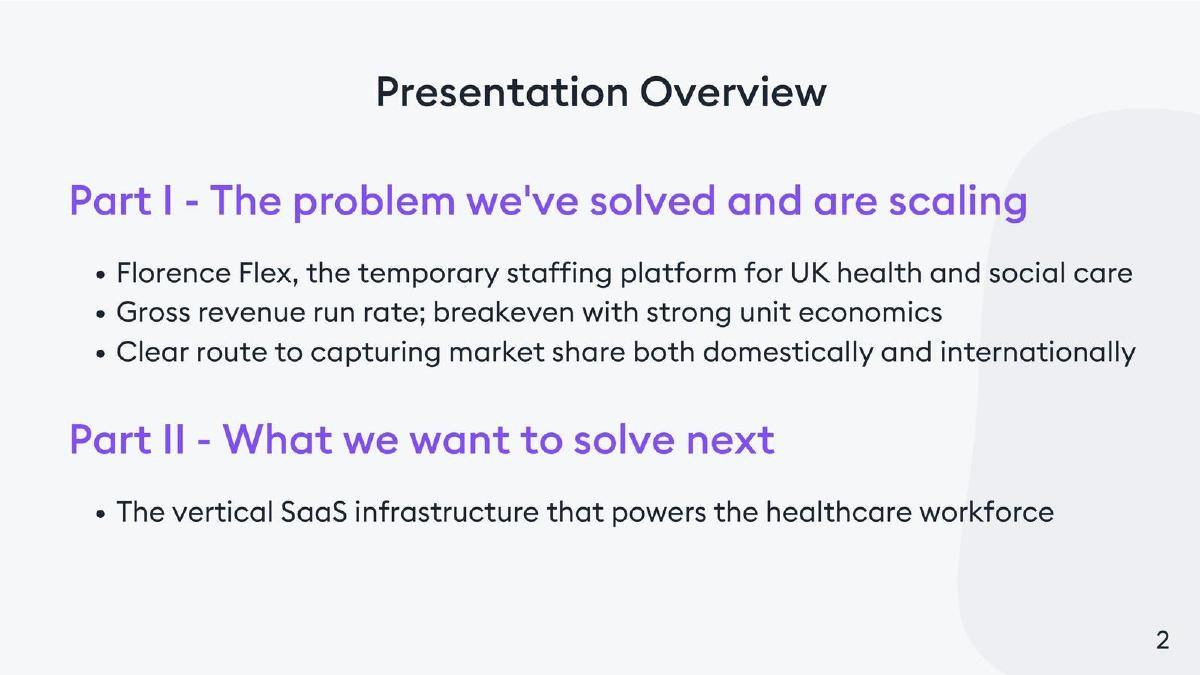
- The deck structure is divided into distinct parts, separating the marketplace business (Part I) from the infrastructure/SaaS vision (Part II).
- A significant portion of the mid-deck (Slides 9-12) is dedicated to EBITDA and contribution margins, though the specific figures are redacted in this version.
The Florence Series B Teardown
Florence is a UK-based healthcare technology company that has successfully transitioned from a simple marketplace for temporary nurses into a comprehensive staffing infrastructure provider. This 21-slide deck was used to secure a significant Series B round, reported by Business Insider as $35M in 2024, though the deck itself specifies a £25m ask. The presentation is structured to show both the immediate market capture and the long-term platform play.
Slide 1-5: Branding and Visual Identity
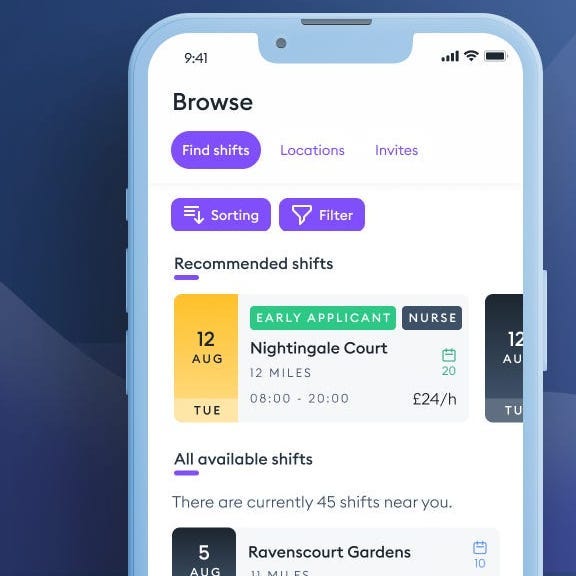
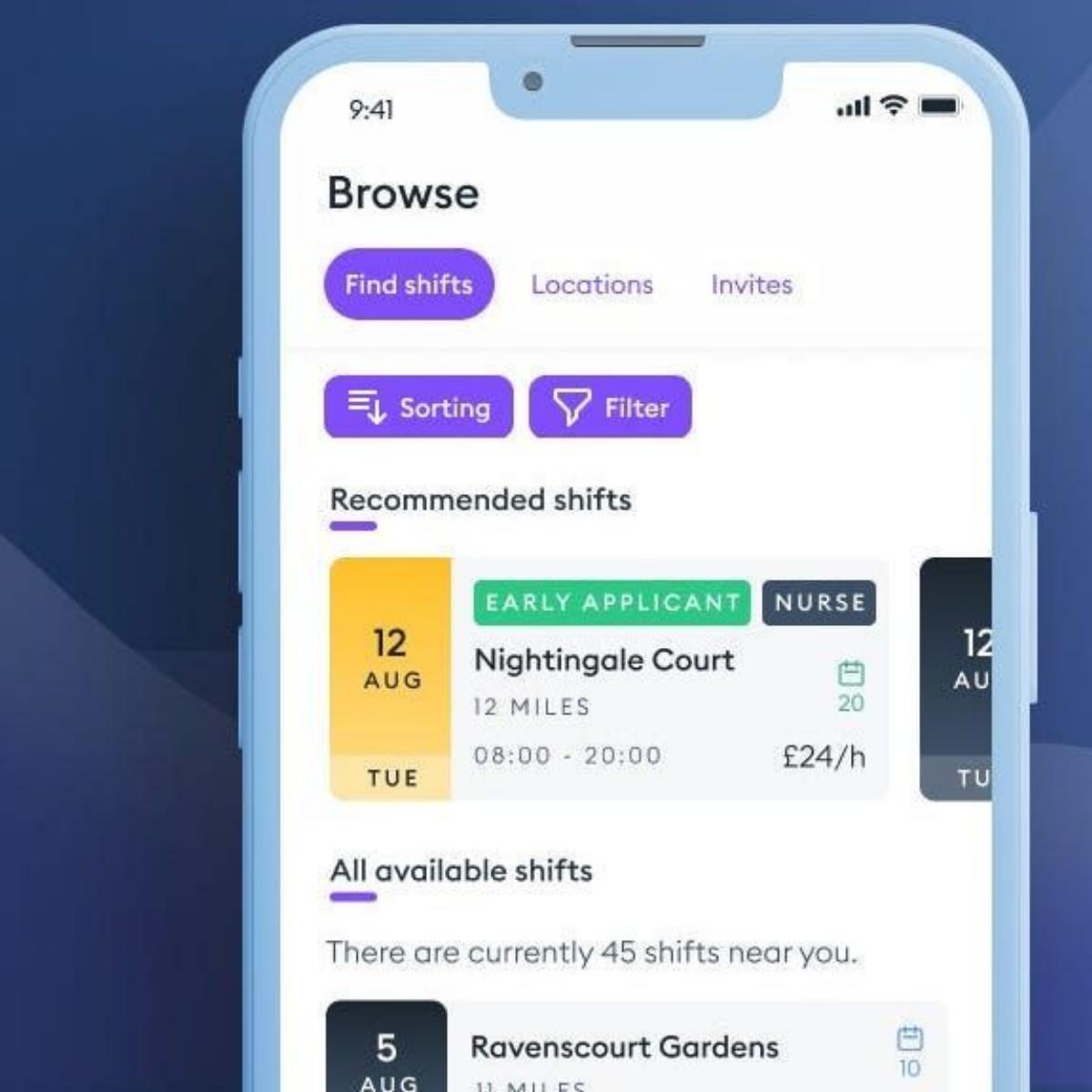
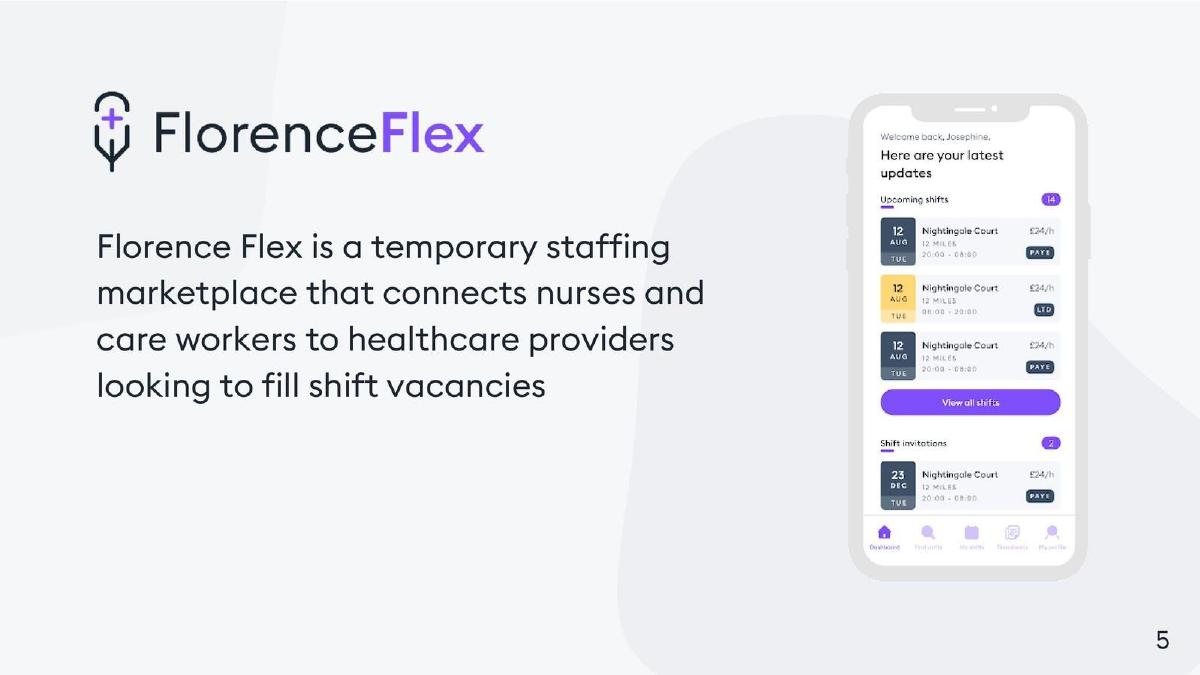
The deck opens with a clean, mobile-first visual on Slide 1 , showing the Florence app interface. The UI highlights 'Recommended shifts' at locations like 'Nightingale Court' with clear pricing (£24/h) and distance metrics. This immediately grounds the investor in the product's utility. Slides 2 through 5 are minimalist, focusing on the brand's 'F' logo and title, establishing a professional and modern aesthetic that carries through the presentation.
Slide 6: The Macro Opportunity
Slide 6 presents the core market thesis. It states that the annual spend on UK temporary nurse and care staffing is 'large and growing.' The slide uses two organic shapes to represent the market size: £6bn in 2020 growing to £9bn by 2030. This 50% projected increase in market size provides a strong tailwind for the investment case, suggesting that even without gaining market share, the company would see growth—though their ambitions are much higher.
Slides 7-12: The Marketplace Engine (Part I)
Slide 7 introduces 'Part I: FlorenceFlex.' This section focuses on the core marketplace. While Slide 8 is a transition, Slide 9 is a critical financial marker titled 'EBITDA & CONTRIBUTION MARGIN.' Although the specific data points are redacted in this public version, the presence of this slide early in the deck indicates that Florence is a metrics-driven organization. For a Series B round, showing a clear path to (or achievement of) positive contribution margins is essential. Slides 10, 11, and 12 likely contained the supporting data for these margins, cohort analyses, or geographic expansion metrics that proved the model's scalability.
Slides 13-16: Staffing Infrastructure and the Flywheel (Part II)
Slide 13 marks a strategic pivot in the deck: 'Part II: Owning the staffing infrastructure for healthcare.' This is where Florence moves from being a 'staffing agency alternative' to a 'SaaS-enabled marketplace.' Slide 16 is arguably the most important slide in the deck. It illustrates the 'SaaS product suite' driving the 'Flex' business. It shows a circular flywheel:
FlorenceRota: Described as a 'Sticky experience that generates recurring revenue streams' and provides platform insights to drive worker acquisition. · FlorenceAcademy: Described as a 'Strong worker acquisition channel' and a 'Revenue generating B2B SaaS platform.'
By surrounding the core marketplace (FlorenceFlex) with these two SaaS products, Florence demonstrates how they lower CAC (Customer Acquisition Cost) and increase LTV (Lifetime Value) through retention and cross-selling. This is a sophisticated narrative that justifies a higher valuation multiple than a pure-play staffing business.
Slides 17-18: Expansion and Execution
These slides transition from the product strategy to the execution roadmap. They likely detailed the specific milestones achieved to date and the operational plan for the next 24 months. In a Series B deck, these slides serve to prove that the management team has the 'right to win' in the categories they are entering.
Slide 19: The Ask and Future Milestones
Slide 19 explicitly states the fundraising goal: 'We are raising £25m to:' followed by three clear objectives:
1. Increase market share: Moving from 1% to 7% in UK healthcare temp staffing by 2025. This is a bold 7x growth target. · 2. Product & GTM Investment: Building out the SaaS offering specifically across UK social care. · 3. International Expansion: Launching and growing in international markets.
This slide is effective because it ties the capital directly to measurable outcomes (market share %) and strategic shifts (internationalization).
Slides 20-21: Conclusion
The deck concludes with a return to the brand identity. By the end of the 21 slides, the investor has seen a massive market, a proven marketplace model, a defensible SaaS flywheel, and a clear plan for the next £25m.
What Florence Does Well
The Flywheel Visualization: Slide 16 is a perfect example of how to explain a complex multi-product strategy. It clearly shows how the SaaS tools aren't just 'add-ons' but are fundamental drivers of the core marketplace's efficiency. This reduces investor fear regarding the high costs of acquiring healthcare professionals.
Market Share Specificity: Many decks use vague terms like 'disrupting the market.' Florence uses a specific number: 1% to 7%. This allows investors to do their own math on the revenue potential based on the £6bn-£9bn market size mentioned on Slide 6.
What is Missing
The Team Slide: In the provided sequence, there is no slide introducing the founders or the leadership team. For a Series B, investors want to see a 'bench' of experienced executives across clinical, tech, and sales. While likely present in the full version, its absence here leaves a gap in the 'why us' narrative.
Competitive Landscape: The deck focuses heavily on Florence's internal ecosystem but does not explicitly address competitors like Lantum or traditional agencies. A slide showing why Florence wins against incumbents would strengthen the 'Owning the infrastructure' claim.
What Founders Should Copy
Segment the Narrative: Use 'Part I' and 'Part II' to separate your current core business from your future platform vision. This prevents the deck from feeling cluttered and helps investors follow the logic of your expansion.
Focus on Infrastructure: If you are building a marketplace, look for ways to frame it as 'infrastructure.' Marketplaces are often seen as transactional and volatile; infrastructure is seen as essential and recurring. Florence’s move to include Rota and Academy tools is a textbook example of this positioning.
Frequently asked questions
- What is the core problem Florence is solving?
- Florence addresses the inefficiencies and rising costs in the UK healthcare staffing market. By providing a digital platform (FlorenceFlex) that connects organizations directly with nurses and care workers, they bypass traditional, expensive staffing agencies. The deck highlights a growing £9bn market by 2030, suggesting that current manual processes cannot scale to meet the increasing demand for temporary care staffing.
- How does Florence differentiate itself from a standard staffing agency?
- Florence differentiates through its 'SaaS product suite' (Slide 16). Unlike a traditional agency, Florence provides FlorenceRota (a scheduling tool) and FlorenceAcademy (a training platform). These tools create a 'sticky' experience for healthcare providers and a steady stream of qualified workers for the marketplace, effectively owning the entire staffing infrastructure rather than just the transaction.
- What are the primary growth levers mentioned in the deck?
- The deck outlines three primary levers on Slide 19: increasing UK market share from 1% to 7%, investing in product and Go-To-Market (GTM) for their SaaS offerings in the social care sector, and expanding into international markets. This indicates a shift from a UK-centric marketplace to a global healthcare technology provider.
- Why is the FlorenceAcademy product strategically important?
- As shown on Slide 16, FlorenceAcademy serves two purposes: it is a revenue-generating B2B SaaS platform and a 'strong worker acquisition channel.' By training the workforce, Florence ensures a higher quality of care on its platform while simultaneously lowering the cost of acquiring new nurses and carers compared to traditional marketing.
- What financial metrics does Florence emphasize to investors?
- The deck places heavy emphasis on profitability and unit economics, with Slide 9 specifically titled 'EBITDA & Contribution Margin.' By highlighting these metrics early, Florence signals to Series B investors that the business is not just growing top-line revenue but is doing so with sustainable margins and a clear path to profitability.