Flower One positions itself as a dominant infrastructure player in the Nevada cannabis industry, leveraging a 400,000 square foot flagship greenhouse and a 55,000 square foot production facility. The deck, dated July 2020, emphasizes a 'turnkey solution' for brand partners, covering everything from cultivation and extraction to sales and marketing. While the presentation showcases impressive physical scale and a growing list of 16+ brand partners, it reflects a specific moment in time—the height of the COVID-19 pandemic—with a dedicated operational response slide. The financial data shows rap…
Key takeaways
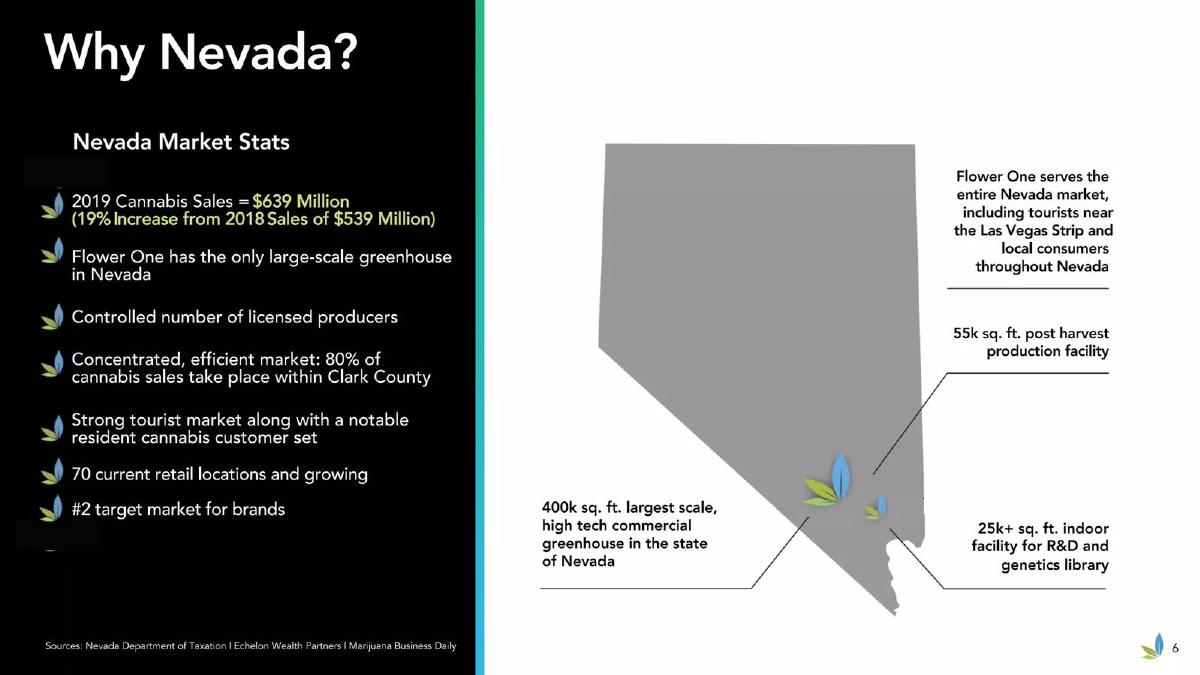
- The company operates the largest commercial cultivation and production facility in Nevada, featuring a 400,000 square foot greenhouse (Slide 7).
- Flower One reported 2019 full-year revenues of $9.5M, which grew to $8.8M in Q1 2020 alone (Slide 19).
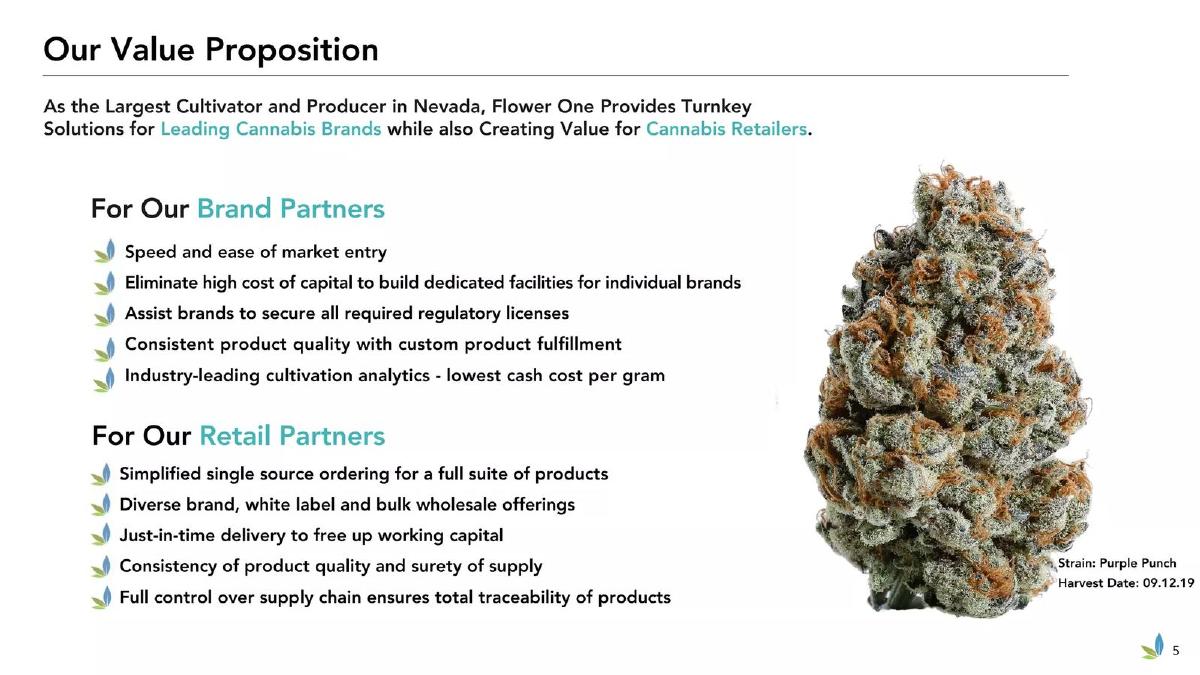
- The business model is built on a turnkey solution for over 16 brand partners, providing cultivation, extraction, and distribution (Slide 7, 10).
- Production capacity is stated at 100,000 to 110,000 pounds of flower annually from the flagship greenhouse (Slide 7).
- The manufacturing facility includes an exclusive partnership with Dennis Group, a top U.S. food and beverage design-build firm (Slide 13).
- The deck includes a specific COVID-19 Operational Response Plan, detailing shift-based distancing and enhanced disinfection protocols (Slide 25).
- The Board of Directors features individuals with significant experience in corporate affairs, greenhouse operations, and cross-border finance (Slide 22).
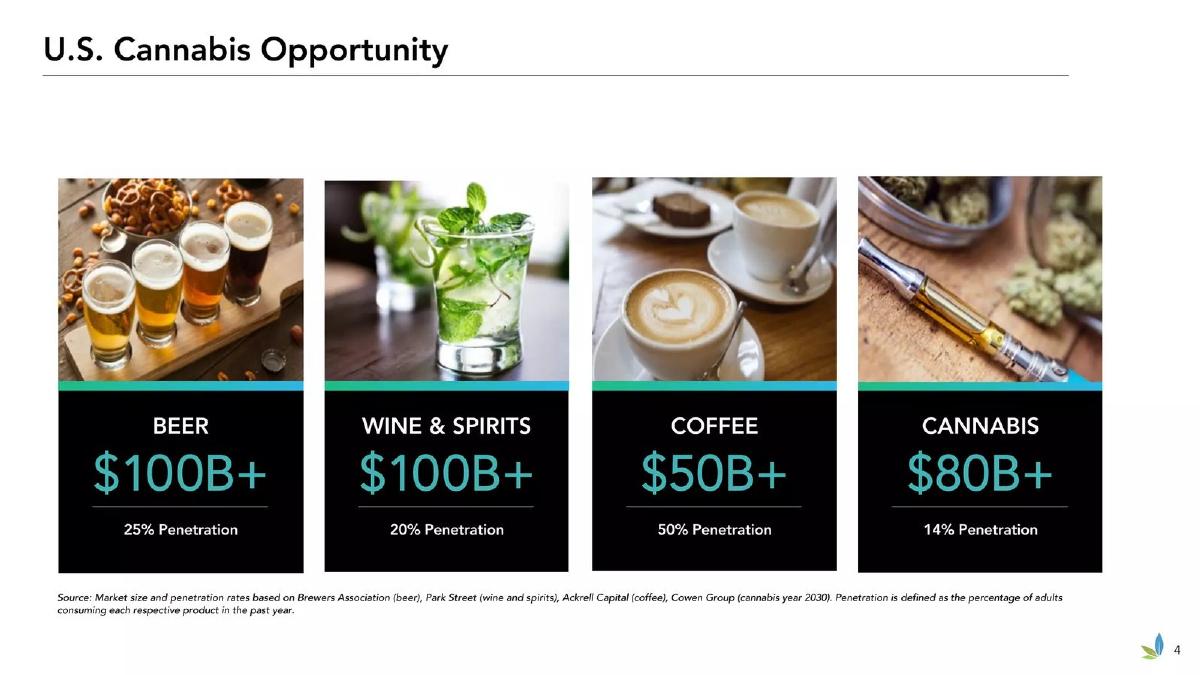
- Market opportunity is framed by comparing cannabis ($80B+) to established industries like beer ($100B+) and coffee ($50B+) (Slide 4).
Introduction and Market Context
Slide 1: Title Slide
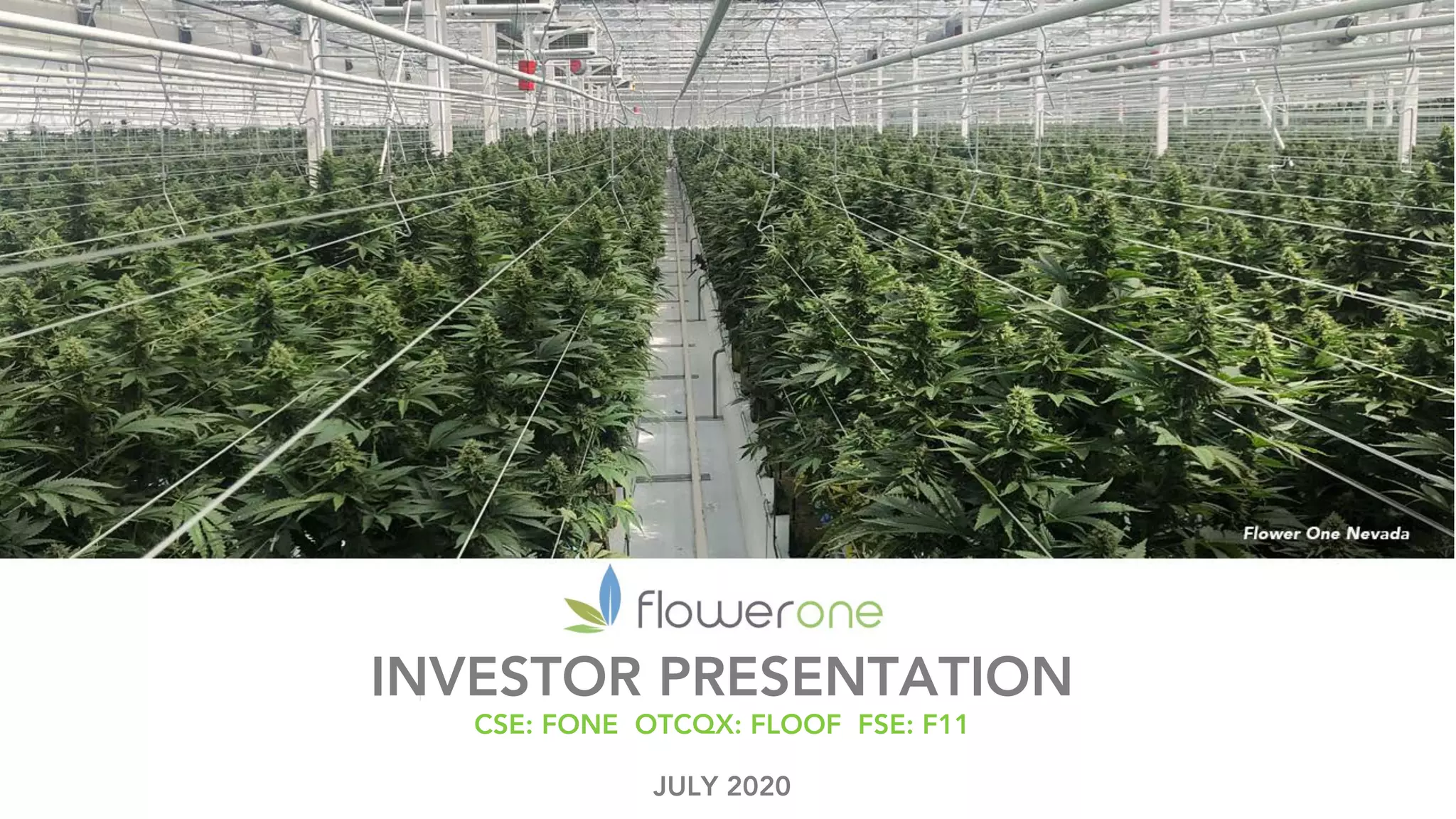
The presentation opens with a high-angle photograph of a massive, industrial-scale cannabis greenhouse. The branding is clean, featuring the Flower One logo and ticker symbols for the CSE (FONE), OTCQX (FLOOF), and FSE (F11). The date is explicitly stated as July 2020. The image immediately establishes the company's core value proposition: industrial-scale agricultural production.
Slide 4: U.S. Cannabis Opportunity
This slide frames the cannabis market by comparing it to other major consumer categories. It lists Beer at $100B+ (25% penetration), Wine & Spirits at $100B+ (20% penetration), and Coffee at $50B+ (50% penetration). It positions Cannabis as an $80B+ opportunity with only 14% penetration. The data is sourced from the Brewers Association, Cowen Group, and others, projecting the cannabis market size for the year 2030. The goal here is to show the massive headroom for growth as penetration increases toward levels seen in other vice or ritual-consumption industries.
Infrastructure and Operations
Slide 7: Nevada Footprint
This is the 'moat' slide. It features an aerial view of the company's facilities in Nevada. Four key metrics are highlighted: 400K Square Feet for the flagship greenhouse (capable of 100K-110K pounds annually), 55K Square Feet for the production facility (processing 1,000 lbs of flower and 3,000-5,000 lbs of biomass), 25K Square Feet for indoor cultivation and testing, and 16+ Brand Partners . The slide explicitly labels this as the 'Largest commercial cultivation & production facility in Nevada.'
Slide 10: Turnkey Solution for Brand & Retail Partners
Flower One defines its business model as a comprehensive service provider. The slide lists five pillars: Cultivation, Extraction, Manufacturing & Production, Distribution, Sales, Marketing, and Brand/Market Penetration Strategy. By positioning themselves as a 'turnkey solution,' they signal to investors that they are not just growing plants, but providing the entire supply chain infrastructure for brands that don't want to build their own facilities. A photo of the 'Sour Sunset' strain is included, dated May 21, 2020.
Slide 13: Manufacturing & Production
This slide focuses on the technical capabilities of the 55,000 square foot production facility. It highlights an exclusive partnership with Dennis Group , described as the #1 design-build firm in the U.S. for food and beverage. Key stats include 100+ SKUs emerging from the facility and a mention of 'Product Capabilities' including contract manufacturing and white-label solutions. The background image shows a highly sterile, stainless-steel industrial extraction environment, reinforcing the 'food-grade' standards mentioned later in the deck.
Strategy and Financials
Slide 16: Strategic Plan & Recent Financial Performance
This acts as a transition slide, listing the upcoming topics: Operational Enhancements, Strategic Expansion, Recent Financial Performance, and 2019-2020 YTD Revenue Performance. It features a photo of the 'Wedding Cake' strain, also harvested in May 2020. This slide confirms the deck's focus on operational execution and financial results rather than early-stage ideation.
Slide 19: Recent Financial Performance
The financial data provided shows a company in a state of rapid, albeit volatile, growth. For 2019, the company reported $9.5M in full-year revenues , with Q4 alone contributing $5.8M (a 128% increase over Q3). For 2020, Q1 revenues reached $8.8M , nearly equaling the entire previous year. However, the slide also includes Q2 preliminary unaudited revenues of $3.8M . While the slide notes this was 'ahead of company guidance of $3.25M-$3.75M,' it represents a significant drop from the Q1 peak, likely reflecting the initial impact of the pandemic or market shifts in Nevada.
Governance and Safety
Slide 22: Board of Directors
The board consists of four individuals with detailed biographies. Ken Villazor has 20 years of experience in corporate affairs and pharma. Molly Hemmeter brings 20 years of experience in public health and wellness, including a CEO role at Landec Corporation. David Wesley provides the technical expertise in large-scale greenhouse operations. Amit Varma handles the financial side, with a background in corporate banking and debt/equity financing. The bios are dense and emphasize institutional experience, which is a common strategy for cannabis companies seeking to distance themselves from 'legacy' market perceptions.
Slide 25: COVID-19 Operational Response Plan
Given the July 2020 date, this slide was essential for investor confidence. It outlines specific actions taken since mid-March, including hiring additional cleaning staff, implementing shift-based distancing, and reconfiguring workflows. Notably, it mentions that onsite dispensary activations were temporarily suspended to assist retail partners. This slide serves to demonstrate management's agility and commitment to maintaining the 'cannabis supply chain in Nevada' during a global crisis.
What Works and What is Missing
What Works
Scale Visualization: The use of aerial photography and specific square footage metrics (Slide 7) effectively communicates the company's physical dominance in the Nevada market. · B2B Positioning: By focusing on 'Brand Partners' and 'Turnkey Solutions' (Slide 10), the company differentiates itself from simple cultivators. They are an infrastructure play. · Institutional Board: The biographies on Slide 22 are professional and highlight experience in regulated industries (pharma, public companies, F&B), which builds credibility. · Transparency on Revenue: Providing both 2019 and early 2020 figures (Slide 19) gives a clear view of the growth trajectory, even if the Q2 numbers showed a dip.
What is Missing
Unit Economics: While the deck mentions total revenue and production capacity, it omits the cost per gram to produce or the margins on their contract manufacturing services. · The 'Ask': There is no slide detailing how much capital is being raised, the valuation, or the specific use of funds. This suggests the deck is a general corporate update for public market investors rather than a specific private placement pitch. · Competitive Landscape: Slide 4 looks at the macro opportunity, but there is no analysis of other large-scale cultivators in Nevada or how Flower One's pricing compares to competitors. · Path to Profitability: The revenue growth is clear, but there is no mention of EBITDA or net income, which is a critical omission for a company operating at this scale.
What a Founder Should Copy
The 'Turnkey' Narrative: If you are building an infrastructure-heavy business, don't just sell your capacity; sell the 'solution' that allows your customers to avoid building their own infrastructure. · Contextualizing Market Size: Comparing a new industry (cannabis) to established ones (coffee, beer) with penetration percentages is a highly effective way to make a large TAM (Total Addressable Market) feel grounded and achievable. · Operational Rigor: Including a slide like the COVID-19 response (Slide 25) shows that management is proactive and focused on business continuity, which is vital during periods of macro uncertainty.
Frequently asked questions
- What is Flower One's primary competitive advantage in Nevada?
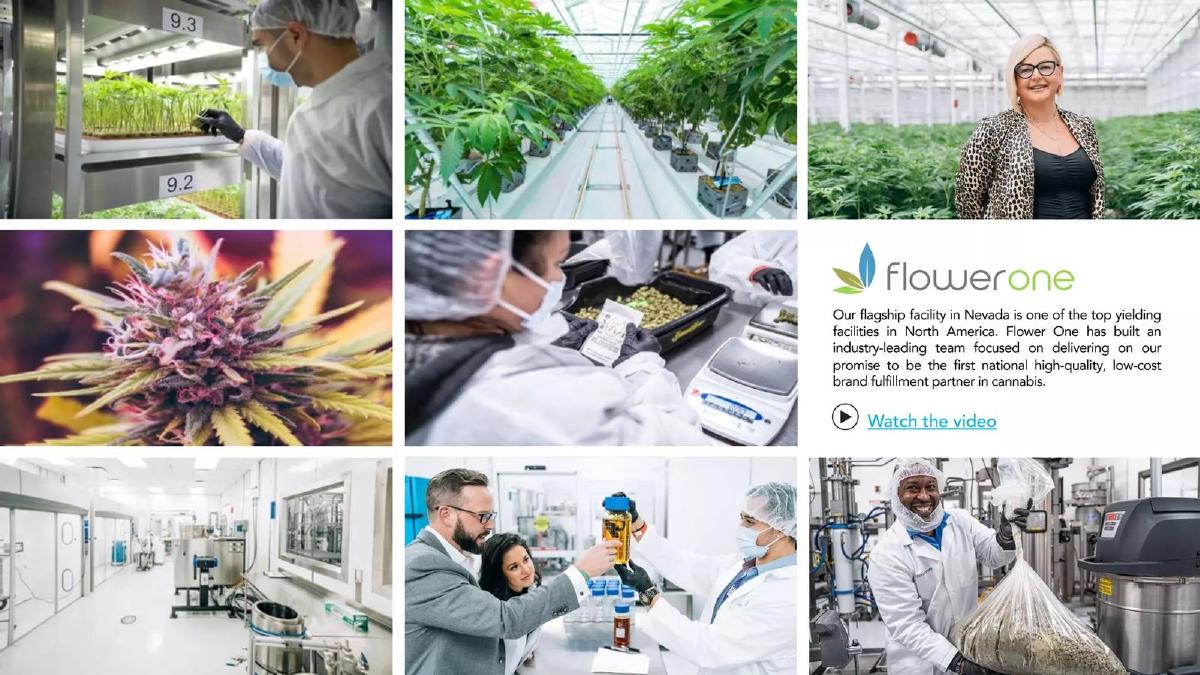
- According to slide 7, their primary advantage is sheer physical scale. They operate a 400,000 square foot flagship greenhouse, which they claim is Nevada’s largest and among North America’s top yielding facilities. This is supported by a 55,000 square foot production facility capable of processing over 1,000 pounds of bulk flower and 3,000 to 5,000 pounds of biomass into various products.
- How does Flower One generate revenue?
- The deck describes a 'Turnkey Solution for Brand & Retail Partners' on slide 10. They act as a vertically integrated service provider for third-party brands, handling cultivation, extraction, manufacturing, distribution, and marketing. Slide 13 notes they offer contract manufacturing and white-label solutions, allowing them to monetize their infrastructure by producing goods for 16+ different brand partners.
- What were the company's financial trends leading up to July 2020?
- Slide 19 shows a business in a high-growth phase. 2019 revenues were $9.5M. Q1 2020 saw a massive spike to $8.8M, nearly matching the previous full year. However, the Q2 2020 preliminary unaudited revenues were reported at $3.8M. While this was 'ahead of company guidance,' it represented a significant sequential decline from Q1.
- Who is behind the company's governance?
- Slide 22 details a Board of Directors with diverse professional backgrounds. Ken Villazor brings 20 years of corporate affairs experience; Molly Hemmeter has a background in leading public health and wellness companies; David Wesley has a decade of experience in large-scale greenhouse operations; and Amit Varma focuses on cross-border corporate banking and finance.
- How did the company address the COVID-19 pandemic?
- Slide 25 outlines a specific 'COVID-19 Operational Response Plan.' Measures included hiring additional cleaning staff, implementing disinfection between shifts, enforcing social distancing between teams, and reconfiguring production workflows. They also temporarily suspended onsite dispensary activations to help retail partners manage customer flow.