Flowtab's pitch deck, likely dating from early 2013, targets the nightlife industry with a mobile ordering and payment solution. The company positions itself as a way to eliminate 'forgotten bar tabs' and 'point-of-sale headaches' for bartenders. With a lean 10-slide presentation, the team emphasizes their early traction—7 venues and $12,450 in total sales—alongside a significant distribution partnership with Dex One, which provides access to a 2,000-person national sales force. While the deck successfully identifies a high-friction market, it relies heavily on future advertising revenue proj…
Key takeaways
- The platform combines mobile ordering, payments, and loyalty specifically for the nightlife sector (Slide 2).
- The team includes a founder who previously built a POS company, Zing Checkout, providing relevant domain expertise (Slide 3).
- Problem identification focuses on three stakeholders: customers (waiting), bartenders (POS headaches), and owners (fees) (Slide 4).
- Traction as of February 1, 2013, included 7 venues, 2,200 users, and $12,450 in total sales (Slide 7).
- Acquisition costs are clearly stated: $1,500 - $2,500 to acquire a bar and $4 - $19 to acquire a user (Slide 7).
- A pilot distribution deal with Dex One grants the startup access to a 2,000-person national sales force (Slide 7).
- The competitive matrix claims Flowtab is the only player offering 0% credit card processing and table ordering simultaneously (Slide 8).
- The financial roadmap sought a $500,000 Angel Round in February 2012, followed by a $3M Series A target for Q4 2013 (Slide 9).
Slide-by-Slide Teardown
Slide 1: Title and Branding
The deck opens with a minimalist title slide featuring the Flowtab logo and a dictionary-style definition of 'flow.' It includes the company's San Francisco address and a contact phone number at the bottom. The branding is clean, though the definition of 'flow' is a common trope in early 2010s tech decks that adds little to the actual business case.
Slide 2: The One-Sentence Pitch
Slide 2 provides a clear, concise mission statement: 'Flowtab is a mobile ordering, payments and loyalty platform for bars and nightclubs.' This is a textbook example of a 'what we do' slide. It defines the product category (ordering, payments, loyalty) and the specific target market (bars and nightclubs) immediately.
Slide 3: Team
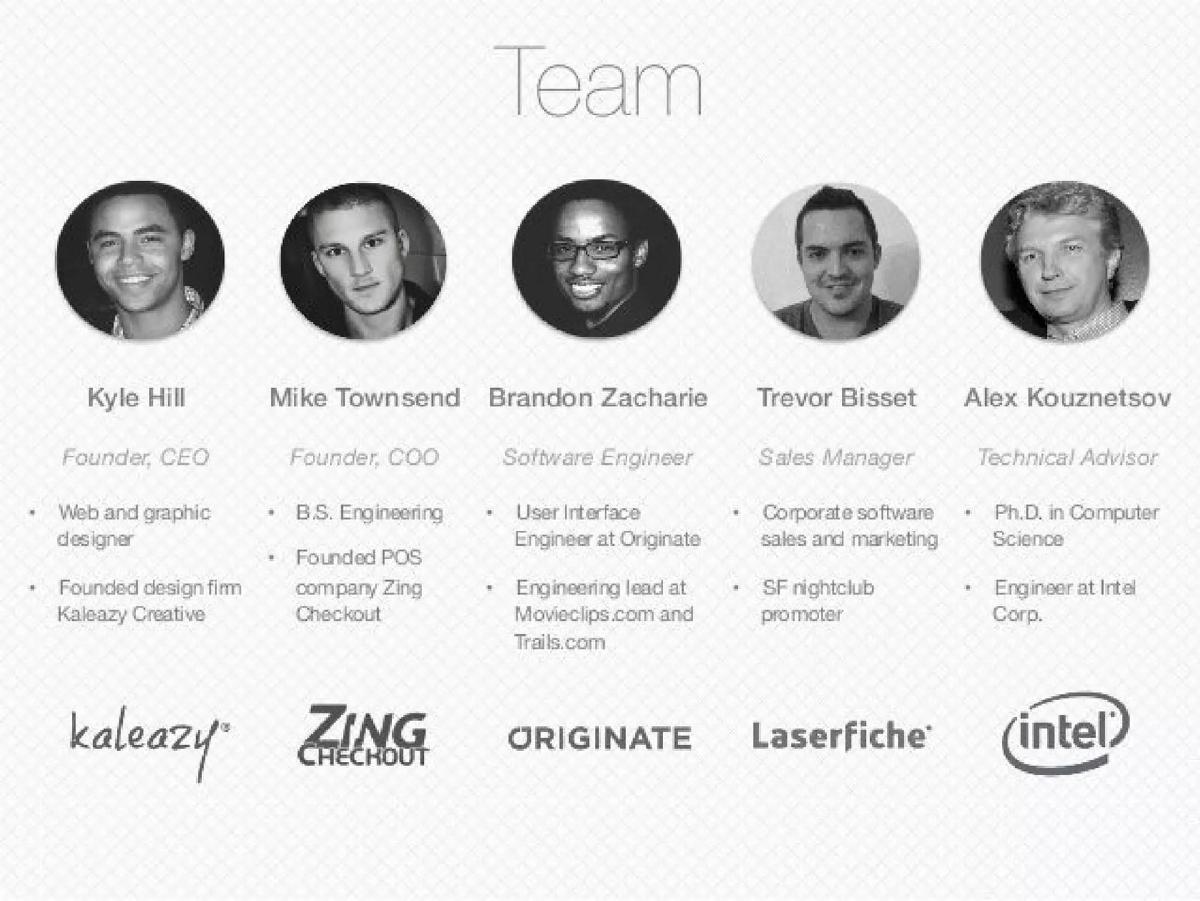
The team slide features five individuals. Kyle Hill (CEO) and Mike Townsend (COO) are the founders. Townsend’s background is particularly relevant as the founder of Zing Checkout, a POS company. The inclusion of Trevor Bisset as Sales Manager is strategic, noting his experience as an 'SF nightclub promoter,' which suggests local market access. Brandon Zacharie provides the engineering backbone, and Alex Kouznetsov serves as a technical advisor. The logos for Intel, Originate, and Laserfiche are used to establish professional credibility.
Slide 4: Problem Statement
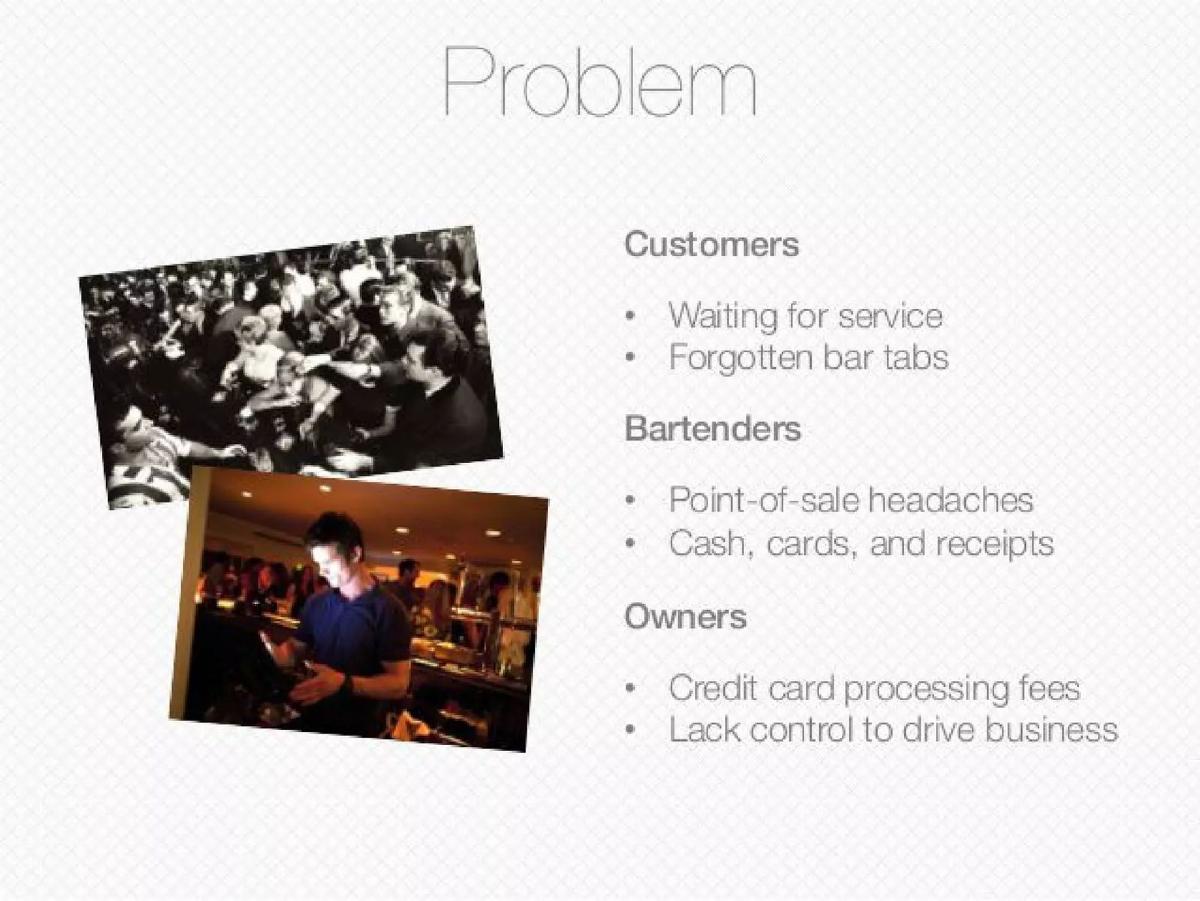
Flowtab breaks down the problem by stakeholder. For customers, the pain points are 'Waiting for service' and 'Forgotten bar tabs.' For bartenders, it is 'Point-of-sale headaches' and the friction of 'Cash, cards, and receipts.' For owners, the focus is on 'Credit card processing fees' and a 'Lack control to drive business.' This slide effectively demonstrates that the founders understand the multi-sided nature of the hospitality market.
Slide 5: Product Interface
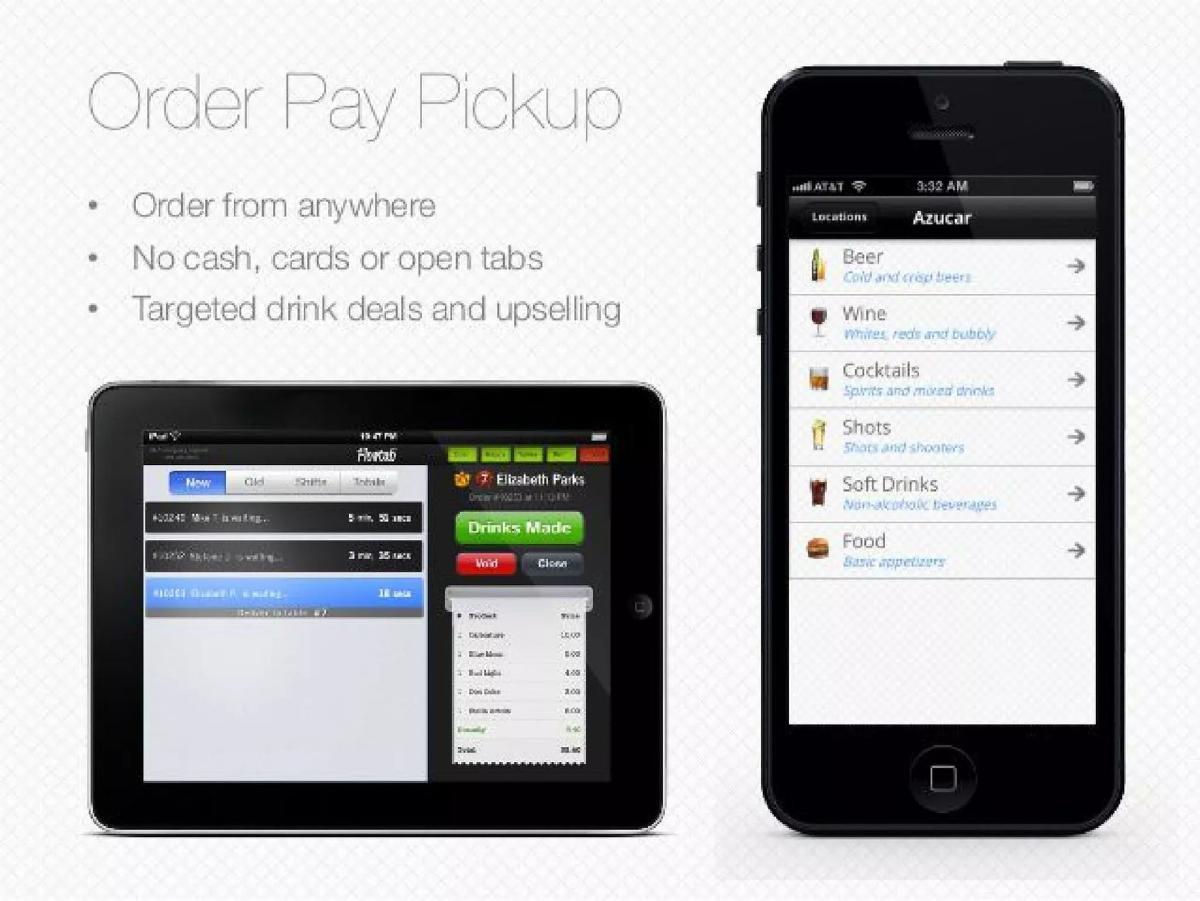
This slide showcases the user and merchant interfaces. A smartphone mockup shows a menu for a venue called 'Azucar,' categorized by Beer, Wine, Cocktails, etc. An iPad mockup shows the bartender's view, featuring a queue of orders (e.g., 'Elizabeth Parks') with timers indicating how long they have been waiting. The text highlights 'Order from anywhere,' 'No cash, cards or open tabs,' and 'Targeted drink deals and upselling.'
Slide 6: Business Model
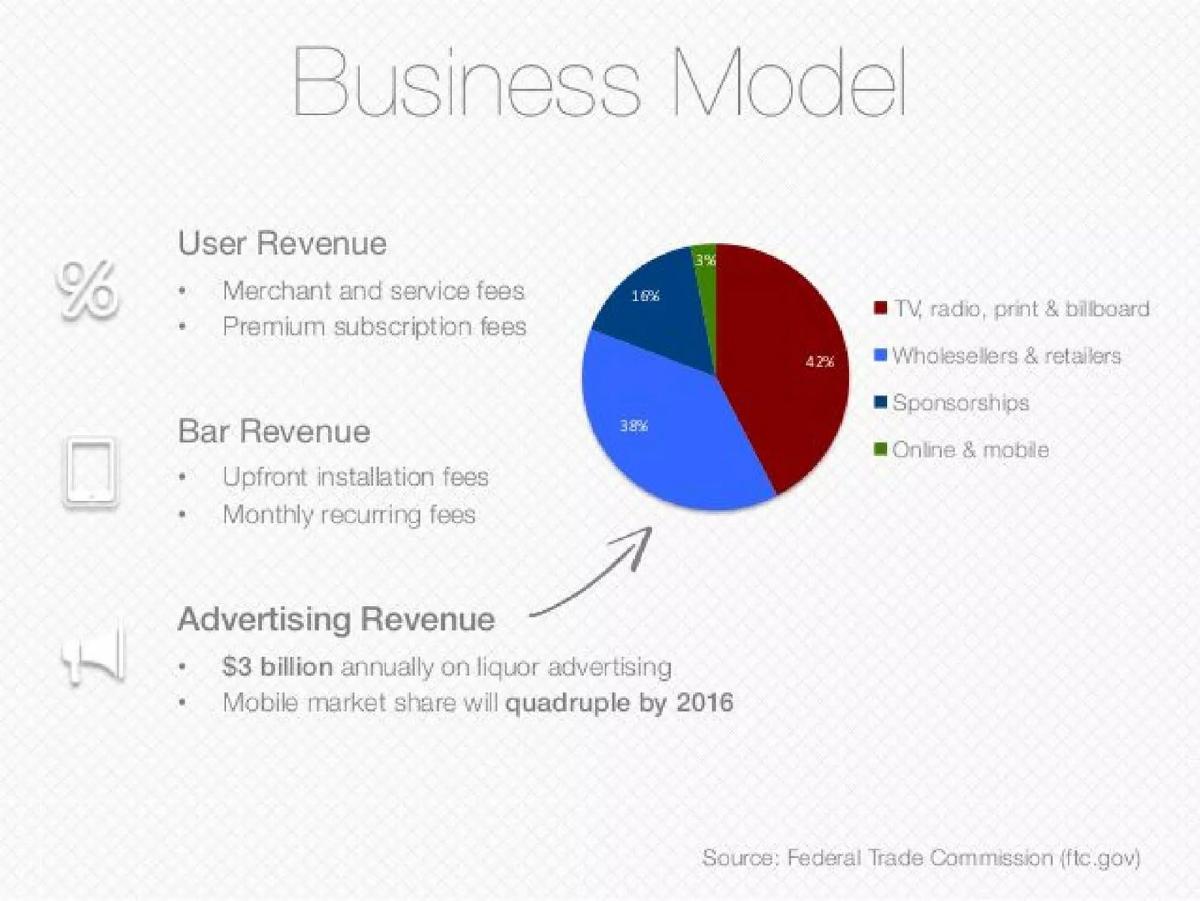
The business model is divided into User Revenue (fees and subscriptions), Bar Revenue (install and recurring fees), and Advertising Revenue. A pie chart shows the breakdown of the advertising market, with 'TV, radio, print & billboard' taking 42%. Flowtab cites a Federal Trade Commission source stating that $3 billion is spent annually on liquor advertising, positioning their app as a way to capture a portion of that spend as it shifts to mobile.
Slide 7: Traction and Distribution
This is the most data-dense slide in the deck. It lists 7 venues, 2,200 users, 120 orders per week, and $12,450 in total sales. Crucially, it includes unit economics: a $1,500 - $2,500 cost to acquire a bar and a $4 - $19 cost to acquire a user. The slide also highlights a 'Pilot distribution deal' with Dex One, giving them a 2,000-person sales force, and an affiliate program that signed 10% of Lyft drivers.
Slide 8: Competition
The competition slide uses a standard checkmark matrix. Flowtab compares itself to GoPago, Coaster, Tabbbedout, and Bartab. Flowtab claims to be the only solution offering '0% CC Processing,' 'Distribution Partner,' and 'Table Ordering' all at once. Interestingly, it concedes that 'Tabbedout' has POS integration, which Flowtab lacks at this stage. The slide also mentions that $90M was raised in the SMB loyalty space in 2011-2012 by companies like LevelUp and BellyCard, arguing the nightlife niche is 'wide open.'
Slide 9: Financials and Exit Strategy
The financials table shows an 'Initial Seed' of $50,000 in August 2012, an 'Angel Round' target of $500,000 in February 2012 (likely a typo for 2013 given the traction dates), and a 'Series A' target of $3M in Q4 2013. The bottom half of the slide lists four exit targets: Google Wallet, mFoundry, Intuit, and Micros, explaining the strategic rationale for each (e.g., Intuit for 'increased market share for merchant services').
Slide 10: Closing Slide
The final slide is a placeholder added by the source (chagency), providing links to other pitch decks and design services. It does not contain Flowtab-specific information or a call to action from the original founders.
What Works
Specific Unit Economics: Including the cost to acquire a bar ($1,500 - $2,500) and a user ($4 - $19) on Slide 7 shows a level of operational maturity often missing in seed decks. · Distribution Strategy: The Dex One partnership is a major highlight. Small business sales are notoriously difficult; having a 2,000-person sales force via a partner is a significant 'unfair advantage.' · Multi-Stakeholder Problem Solving: By addressing the bartender's 'POS headaches' and the owner's 'processing fees' alongside the customer's wait time, the deck shows it isn't just a consumer app, but a B2B2C utility. · Relevant Team Experience: Having a founder who previously built a POS company (Zing Checkout) directly addresses the technical and industry hurdles of the space.
What is Missing
POS Integration Detail: Slide 8 admits that a competitor has POS integration while Flowtab does not. In the bar industry, asking a bartender to manage a separate iPad (as shown on Slide 5) alongside their existing POS is a massive friction point that isn't fully addressed. · The '0% CC Processing' Explanation: This is a bold claim on Slide 8. The deck does not explain how they achieve this—whether through surcharging, a specific partnership, or by shifting the cost to the user via 'service fees' mentioned on Slide 6. · Market Size (TAM): While they mention the $3B liquor advertising market, they don't provide a Total Addressable Market for the actual transaction fees or subscription revenue from the bars themselves. · Use of Funds: While Slide 9 asks for $500,000, it doesn't specify how that money will be spent (e.g., hiring more engineers, marketing, or expanding to new cities).
Founder's Playbook: What to Copy
The Traction Footnotes: Use footnotes to define exactly what your metrics mean and the timeframe they cover, as seen on Slide 7. It builds trust with investors. · The Exit Strategy Slide: While some investors find it premature, naming specific acquirers and the reason they would buy you (e.g., 'Increase Wallet user base') shows you understand the broader corporate landscape. · Comparative Honesty: On the competition slide (Slide 8), Flowtab admits a competitor has a feature they don't (POS integration). This makes the other checkmarks feel more authentic rather than just a 'we are better at everything' marketing graphic. · Stakeholder Segmentation: When your product affects multiple groups, break the 'Problem' slide down by persona (Customer vs. Bartender vs. Owner) to show you've mapped the entire ecosystem.
Frequently asked questions
- What is Flowtab's primary value proposition?
- Flowtab positions itself as a mobile ordering, payments, and loyalty platform specifically for bars and nightclubs. According to Slide 4, it aims to solve the problem of customers waiting for service and forgetting bar tabs, while reducing point-of-sale headaches for bartenders and lowering processing fees for owners. The interface shown on Slide 5 allows users to order from their phones and pick up at the bar.
- How does Flowtab plan to generate revenue?
- The business model on Slide 6 outlines a three-pronged revenue strategy. User revenue comes from merchant/service fees and premium subscriptions. Bar revenue is generated through upfront installation fees and monthly recurring fees. Finally, they target advertising revenue, citing a $3 billion annual liquor advertising market and projecting that mobile market share would quadruple by 2016.
- What is the most significant competitive advantage claimed in the deck?
- Beyond the product features, Flowtab's strongest strategic advantage is its distribution partnership. Slide 7 highlights a pilot deal with Dex One, which provides a '2,000 national sales force.' This addresses the primary hurdle for hospitality tech: the high cost and slow pace of door-to-door merchant acquisition.
- Who are the key members of the Flowtab team?
- The team on Slide 3 consists of CEO Kyle Hill (design background), COO Mike Townsend (founder of POS company Zing Checkout), Software Engineer Brandon Zacharie (formerly of Originate and Movieclips.com), Sales Manager Trevor Bisset (SF nightclub promoter), and Technical Advisor Alex Kouznetsov (Ph.D. in Computer Science and Intel veteran).
- What are the specific traction metrics shared in the deck?
- Slide 7 reports that as of February 1, 2013, Flowtab had 7 venues, 2,200 users, and was processing 120 orders per week. Total sales reached $12,450. The slide also notes a targeted affiliate program that signed 10% of Lyft drivers and a sponsorship partner in JLP (The President's Tequila) to prove their ad revenue model.