Flow Water’s July 2021 investor presentation is a high-gloss, 27-slide deck (9 analyzed here) designed to support its Reverse Takeover (RTO) and subsequent listing on the Toronto Stock Exchange (TSX). The company positions itself at the intersection of 'enhanced' and 'flavored' water, categories growing at 14-16% CAGR. With a management team led by the former CEO of Nestle Waters and a board featuring retail titans, the deck emphasizes operational maturity. The marketing strategy is equally aggressive, boasting 4.8 billion impressions and partnerships with A-list celebrities like Halle Berry…
Key takeaways
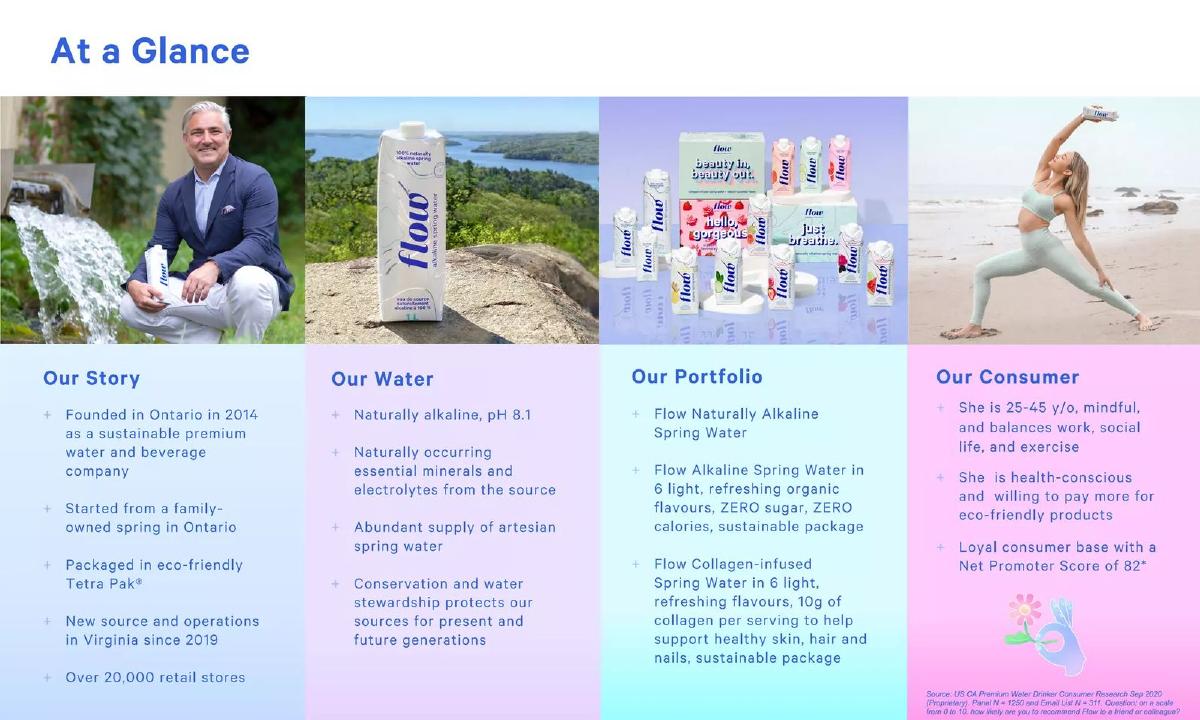
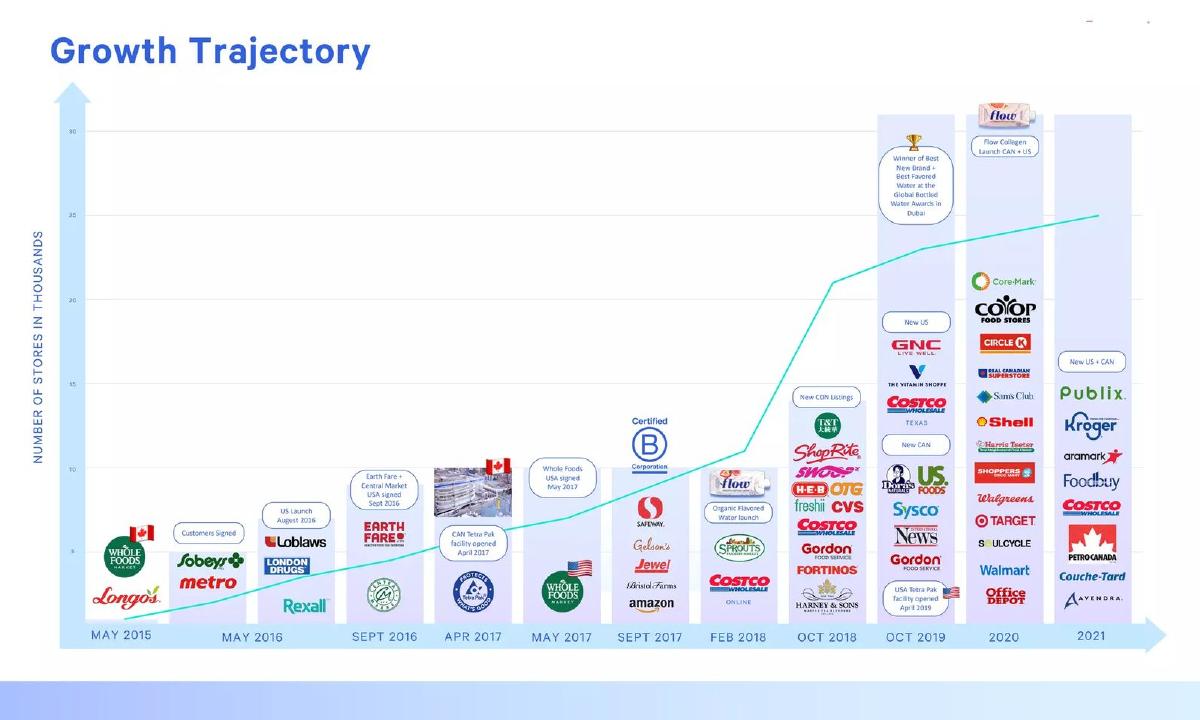
- The company achieved a presence in over 20,000 retail stores by July 2021, according to slide 2.
- Flow targets the 'enhanced water' and 'flavored water' markets, which were forecasted to grow by 16% in 2021-2022 (slide 3).
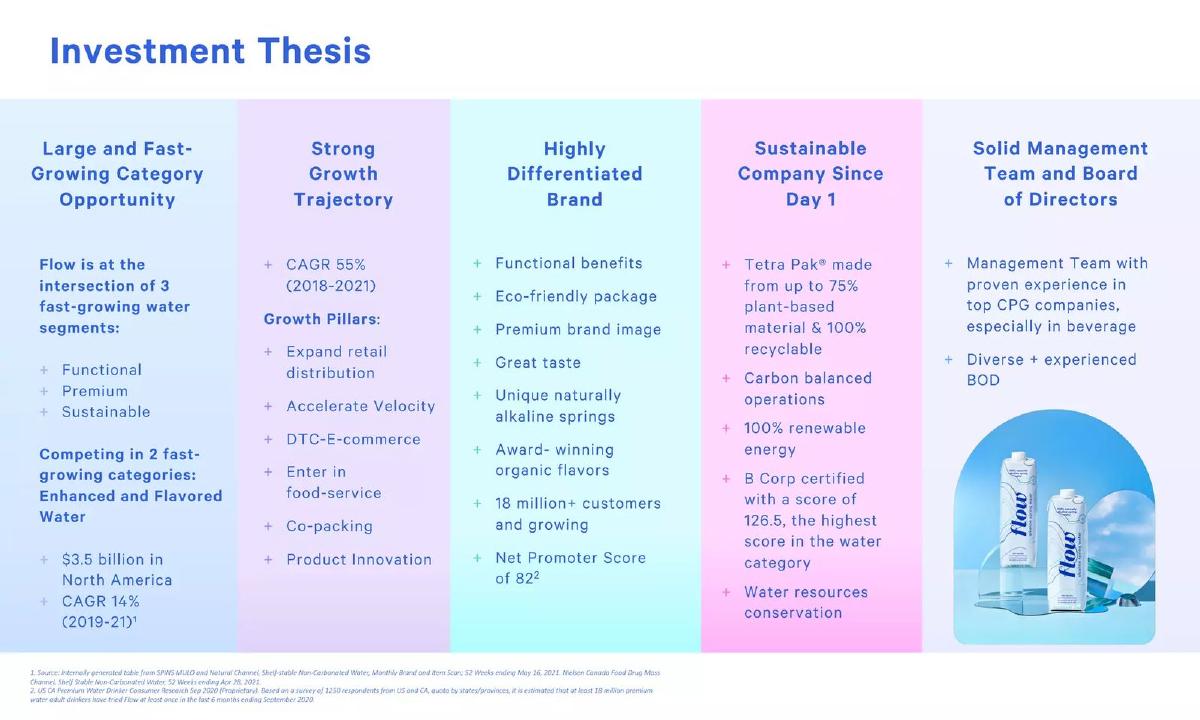
- The brand identifies its primary consumer as a 'health and wellness woman' aged 25-45, citing a Net Promoter Score of 82 (slide 4).
- Growth pillars include a move into co-packing for adjacent premium beverage partners and a focus on 4 key 'hydro zones' in the US (slide 5).
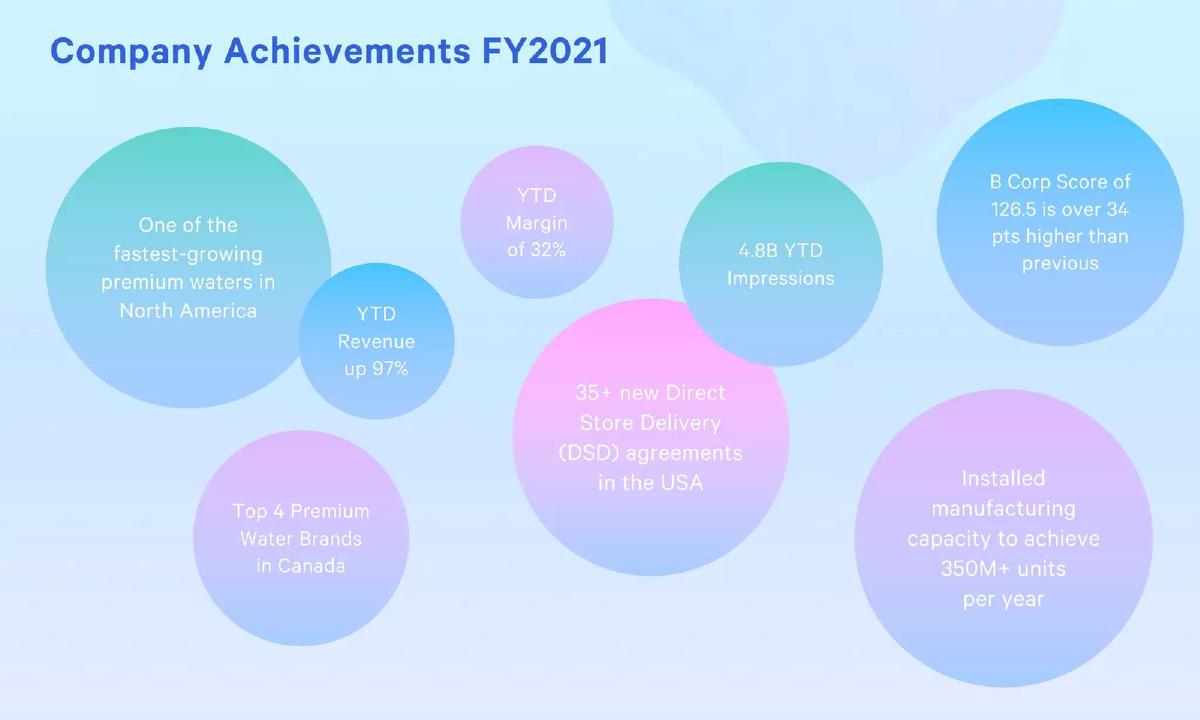
- Marketing efforts generated 4.8 billion impressions through celebrity-led campaigns featuring figures like Halle Berry and Russell Westbrook (slide 6).
- The management team is led by CEO Maurizio Patarnello, who previously oversaw an $8 billion revenue business at Nestle Waters (slide 7).
- The deck confirms a successful RTO with $98.9 million total funds raised and a TSX listing under the ticker FLOW (slide 8).
- The Board of Directors includes high-level executives from Tim Hortons, Nestle S.A., and Loblaws, signaling deep retail and governance expertise (slide 9).
Introduction: The Transition from Startup to Public Entity
The Flow Water Investor Presentation from July 2021 represents a pivotal moment in the company's lifecycle. Unlike early-stage seed decks that focus on a 'problem/solution' framework, this deck is a sophisticated capital markets document. It was designed to finalize investor sentiment during a Reverse Takeover (RTO) process on the Toronto Stock Exchange (TSX). The visual language is high-fashion, the metrics are focused on distribution and market share, and the leadership team is built for institutional scale.
Slide 1: Title and Brand Identity
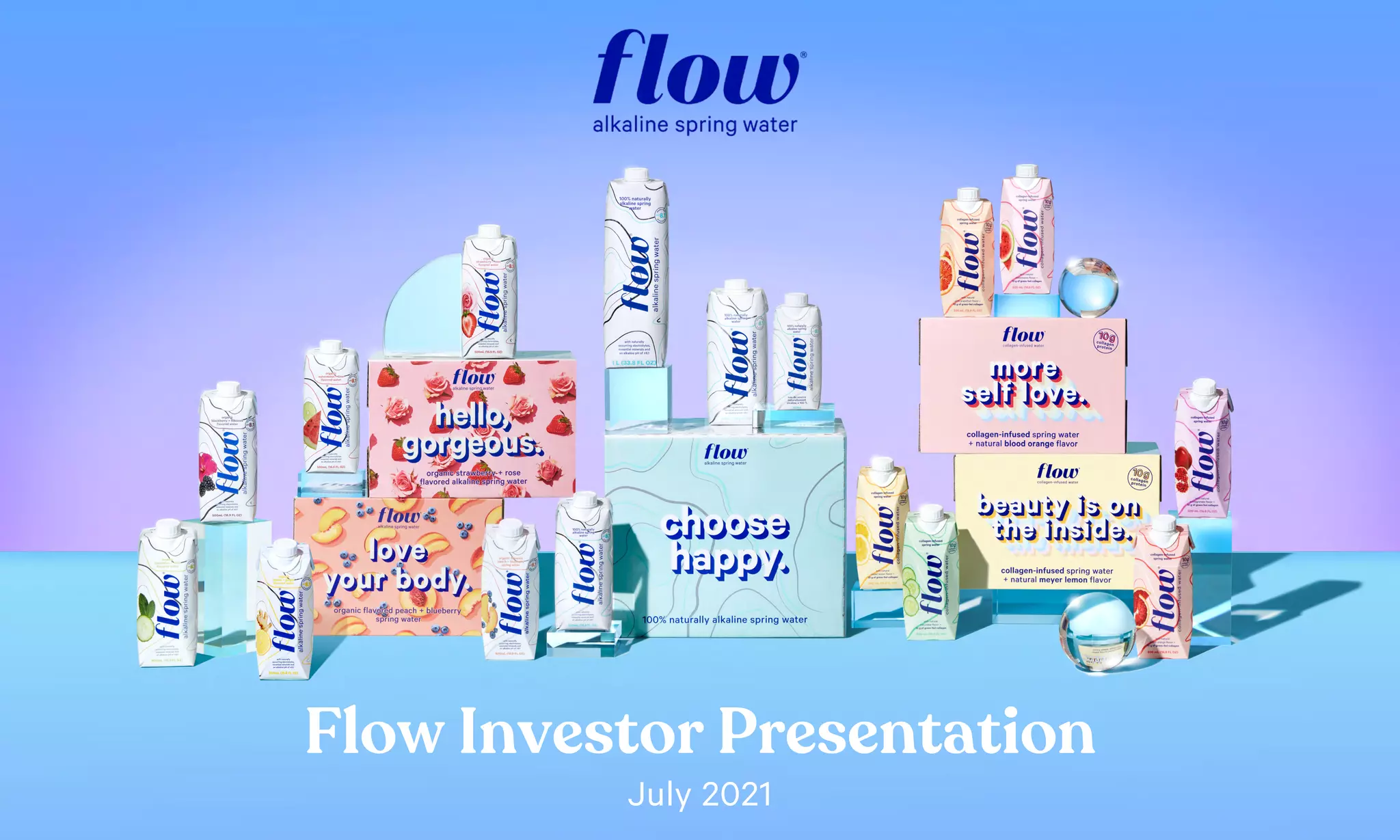
The cover slide sets a clear aesthetic tone. It features a wide array of Flow products, including their flagship alkaline water and their collagen-infused line. The photography is bright and minimalist, utilizing a pastel blue background that reinforces the 'water' theme while feeling premium. The title 'Flow Investor Presentation July 2021' is straightforward, positioning the brand as a serious contender in the beverage space.
Slide 2: At a Glance
This slide acts as an executive summary, breaking the business down into four quadrants: Our Story, Our Water, Our Portfolio, and Our Consumer. Key facts presented here include the company's founding in Ontario in 2014 and its expansion to a second source in Virginia in 2019. Crucially, it mentions a retail footprint of over 20,000 stores. The 'Our Water' section emphasizes the product's natural alkalinity (pH 8.1), while the 'Our Consumer' section introduces the Net Promoter Score (NPS) of 82, a very high figure for a CPG brand, suggesting strong brand advocacy.
Slide 3: Market Opportunity in Shelf-Stable Water
Flow uses this slide to justify its existence within the broader $13.6B shelf-stable water market. The data, sourced from SPINS and Nielsen, shows that while 'Bulk Water' and 'Other Shelf-stable Water' are growing slowly (2-3%), the 'Enhanced' and 'Flavored' segments are growing at 14-16% CAGR. By positioning Flow at the intersection of these two high-growth categories, the company makes a data-driven case for its future valuation and revenue potential. The forecasted growth for 2021-2022 remains steady at 16% for their specific sub-sectors.
Slide 4: The Primary Consumer Target
Slide 4 is a deep dive into the 'health and wellness woman' persona. It defines the target as 25-45 years old, active, and willing to pay more for eco-friendly products. This slide is less about product features and more about brand alignment. The mention that Flow 'over-indexes as being a brand that aligns with my values' is a qualitative metric intended to show investors that Flow has captured a specific, loyal niche that is difficult for legacy brands like Dasani or Aquafina to penetrate.
Slide 5: Key Growth Pillars
This slide outlines the roadmap for scaling the business. It is divided into three sections: Increased Distribution, Expanded E-commerce, and New Revenue Streams. The distribution strategy focuses on '4 key hydro zones' in the US using a Direct Sales Delivery (DSD) model with 35+ new distributors. The e-commerce section highlights a Shopify-powered DTC model with recurring subscriptions. Perhaps most interesting is the 'New Revenue Streams' column, which mentions co-packing for other premium beverage partners, suggesting the company is leveraging its manufacturing infrastructure to generate high-margin B2B revenue.
Slide 6: Brand Presence and Celebrity Influence
Flow demonstrates its marketing muscle here, claiming 4.8 billion impressions. The slide features a 'who's who' of influencers and celebrities, including Shawn Mendes, Halle Berry, Russell Westbrook, and Paloma Elsesser. The strategy is a '360 marketing activation' that includes digital Out-of-Home (OOH), social media, and a Venmo-based cashback promotion ($5 back when you buy $10 of Flow). This level of spend and celebrity alignment is typical of a company preparing for a public listing, where brand recognition is a key driver of stock liquidity.
Slide 7: Management Team
This is arguably the most important slide for institutional investors. The CEO, Maurizio Patarnello, brings 27+ years of experience from Nestle, specifically as the former Chairman and CEO of Nestle Waters (an $8 billion business). The rest of the team is equally pedigreed: Tim Dwyer (CRO) comes from Red Bull and Pepsi; Devan Pennell (CFO) has public company M&A experience; Dave Mock (COO) has 30+ years in CPG including Loblaws; and Krissie Milan (CMO) has experience at McKinsey and Tiffany & Co. This team signals to the market that Flow is not a 'scrappy startup' but a professionally managed corporation.
Slide 8: Path to Public Update
Slide 8 provides the mechanical details of the RTO. It notes the TSX conditional approval on June 23, 2021, and the release of $68.9 million from escrow. The total funds raised through the RTO process are stated as $98.9 million. The slide concludes with the ticker symbol (FLOW) and the trading commencement date of July 14, 2021. This slide serves as a final confirmation of the company's transition to the public markets, providing certainty to the investors viewing the deck.
Slide 9: Board of Directors
The final slide analyzed reinforces the governance and strategic oversight of the company. The board includes the founder, Nicholas Reichenbach, alongside heavyweights like Marc Caira (former CEO of Tim Hortons and Global CEO of Nestle Professional) and Patrick Bousquet-Chavanne (CEO of eShopWorld). The presence of Lori O'Neill, a former partner at Deloitte, as the Audit Committee Chair, provides the financial oversight necessary for a TSX-listed company. This board composition is designed to instill confidence in the company's long-term strategic planning and regulatory compliance.
What Works in This Deck
1. Professionalism and Brand Consistency: The deck is visually stunning. It uses high-quality photography and a consistent color palette that mirrors the product packaging. For a CPG brand, the 'vibe' of the deck is a proxy for the 'vibe' of the product, and Flow succeeds in looking like a premium, modern brand.
2. The 'Nestle' Signal: Hiring the former CEO of the world's largest water company is a massive win. It immediately de-risks the operational side of the business in the eyes of investors. The deck leans into this heavily on the team slide.
3. Clear Market Segmentation: By using Nielsen and SPINS data to separate 'enhanced water' from 'bulk water,' Flow avoids being compared to low-margin commodity products. They successfully frame themselves as part of a high-growth, high-margin category.
What Is Missing or Could Be Improved
1. Unit Economics: While the deck mentions 'velocity' and 'distribution,' it lacks specific data on gross margins, Contribution Margin (CM), or Customer Acquisition Cost (CAC) for their DTC channel. For a company going public, these figures are usually expected in a full prospectus, but their absence in the summary deck makes it hard to judge the underlying profitability of the 20,000 retail doors.
2. Competitive Landscape: The deck mentions categories but does not name specific competitors like Liquid Death, Essentia, or Fiji. A competitive matrix showing how Flow's sustainability (Tetra Pak) and alkalinity compare to these specific rivals would have strengthened the 'moat' argument.
3. Sustainability Proof Points: While they mention 'eco-friendly Tetra Pak,' the deck doesn't provide specific metrics on carbon footprint reduction compared to plastic bottles. In a market increasingly focused on ESG (Environmental, Social, and Governance) criteria, more rigorous data here would have been beneficial.
Founder Takeaways: What to Copy
1. The 'At a Glance' Slide: Every founder should have a slide like Slide 2. It forces you to summarize your story, product, market, and consumer in one view. It is the perfect 'hook' for a busy investor.
2. Leveraging NPS: If you have a high Net Promoter Score, use it. CPG is a game of loyalty and repeat purchases. Citing an NPS of 82 is a powerful way to prove product-market fit without showing a complex cohort analysis.
3. Strategic Use of Influencers: Flow doesn't just list celebrities; they show how these celebrities are integrated into '360 marketing activations' and international campaigns. If you use influencers, show the scale and reach (e.g., the 4.8 billion impressions) rather than just a gallery of headshots.
4. Governance as a Growth Tool: Flow’s board isn't just a list of friends; it’s a list of people who have run the companies Flow wants to become (Nestle, Tim Hortons). Founders should aim to recruit board members who fill their specific operational gaps, as Flow did with their retail and audit experts.
Frequently asked questions
- What is the primary business model for Flow Water?
- Flow Water operates as a premium beverage company focused on naturally alkaline spring water packaged in eco-friendly Tetra Pak containers. According to slide 5, their model is multi-channel, encompassing over 20,000 retail doors, a Direct-to-Consumer (DTC) Shopify-powered website with subscriptions, and a B2B co-packing arm for other premium beverage brands.
- How does Flow Water differentiate its product in a crowded market?
- Flow differentiates through three main pillars: source, packaging, and additives. Slide 2 highlights that the water is naturally alkaline (pH 8.1) from artesian springs, packaged in sustainable Tetra Pak, and includes a portfolio of collagen-infused and organic flavored options with zero sugar or calories.
- What were the details of Flow Water's public listing?
- As detailed on slide 8, Flow Water pursued a Reverse Takeover (RTO) path. They received TSX conditional approval on June 23, 2021, and completed an amalgamation with RG One on June 29, 2021. The process raised a total of $98.9 million, with trading commencing on July 14, 2021, under the ticker FLOW.
- Who is the target audience for Flow Water?
- The deck explicitly defines its target on slide 4 as 'the health and wellness woman.' This demographic is aged 25-45, mindful, active, and willing to pay a premium for eco-friendly products. The company uses this profile to justify its high-gloss, celebrity-centric marketing campaigns.
- What is the significance of the management team in this deck?
- The management team (slide 7) is a critical 'trust signal' for institutional investors. By hiring Maurizio Patarnello, the former CEO of Nestle Waters, Flow demonstrates it has the leadership required to scale a global beverage brand. The team also includes veterans from Red Bull, Pepsi, and McKinsey, covering all functional bases from DSD (Direct Store Delivery) to digital marketing.